
Best Times to Post Podcast Clips on Each Platform


Post podcast clips to land in the slots your specific audience checks their phone: TikTok and Reels reward evening and late-night windows (roughly 6–10 p.m. and again after 9 p.m.), YouTube Shorts leans morning and after-work, and LinkedIn wants weekday mornings, 8–10 a.m. local. Those are starting points, not laws, the right time is whichever hour your own analytics show your audience is awake and scrolling, posted just before that peak.
Most timing guides hand you a clock time and stop there. The more useful unit is the rhythm behind the clock: talk-content audiences scroll in three borrowed-attention pockets, the commute, the lunch break, the late-evening wind-down, and a clip works when it lands as a pocket opens. Pair that with one platform fact most lists ignore: the first hour of engagement decides far more on TikTok and Reels than it does on Shorts or LinkedIn, so timing is doing different amounts of work on each feed. The windows below are built from those two ideas, and they come with a routine to replace them with your own data inside a few weeks.
This matters because clipping is now the front door to a show. Social video clips have become the top driver of podcast discovery, with 57% of listeners relying on social media for podcast recommendations (InsideRadio, citing new survey data), the first time that surpassed friends and family. A clip posted into a dead hour gets a fraction of the reach of the same clip posted into a live one.
What is the best time to post podcast clips on each platform?
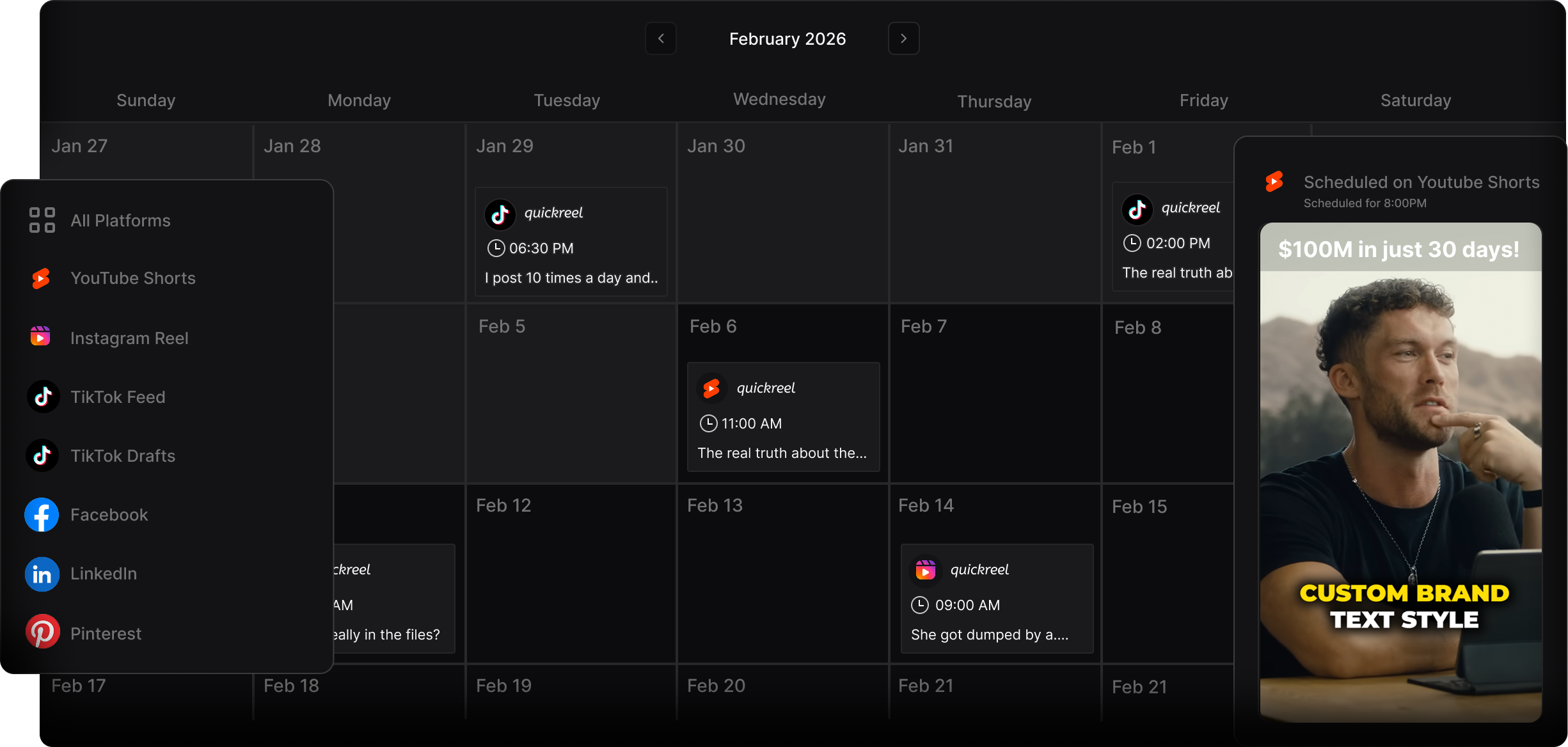
Aim for these starting windows in your audience's local time: TikTok 6–10 p.m. and again 9 p.m.–midnight on weekdays; Instagram Reels 11 a.m.–1 p.m. and 7–9 p.m.; YouTube Shorts 7–9 a.m. and 5–7 p.m.; LinkedIn 8–10 a.m. Tuesday through Thursday. Post 15–30 minutes before each peak so the clip is live when attention arrives.
Treat that table as a hypothesis to test, not a guarantee. There is no single industry-wide "best time" that holds across every show, and any source claiming a precise universal minute is overselling, posting times are audience-specific and they drift as a feed's user base changes. What does hold is the logic: post into the windows when people with a free screen are scrolling, and give the feed something to push during its first-hour judgment period. The rest of this guide is that logic, made concrete.
Why audience rhythm beats a generic best-time chart
Talk content is consumed in pockets of borrowed attention, the gaps where someone has a screen but not a task. For podcast audiences, those gaps cluster in three places: the commute, the lunch break, and the late-evening wind-down. A clip from your show competes for one of those pockets, so you want it surfacing just as the pocket opens, not three hours earlier when it has already scrolled past.
This is also why the watching habit changed the math. 53% of new US weekly listeners now prefer to watch a podcast, up from 30% in April 2022 (Backlinko). A watchable clip slots into the same idle moments people used to fill with audio, but it lives on a feed, where timing controls whether it is even seen.
The honest caveat: every "best time" study is built on aggregate data from accounts that look nothing like yours. A B2B interview show and a true-crime show share almost no audience overlap, and their listeners are free at different hours. Use the aggregate window to start, then earn your own number from your own people.
Why first-hour velocity matters more on some feeds than others
How fast a clip gathers likes, watch-time, and shares in its first 30–60 minutes is a signal these systems use to decide whether to keep pushing it. That early velocity matters most where the feed is interest-based and recommendation-driven, and least where it is chronological or network-based. So the cost of bad timing is not the same on every platform.
- TikTok and Reels are the most velocity-sensitive. Both feeds decide early whether to widen a clip's distribution based on how the first wave of viewers responds. Post into a dead hour and the small early sample under-performs, so the system reads the clip as weak and stops pushing, even if it would have done well at 8 p.m. Timing here is doing real work.
- YouTube Shorts weighs first-hour signals but is more forgiving over a longer tail; Shorts can resurface days later on search and the Shorts shelf, so a mistimed post is recoverable. Timing still helps the launch, but it is not make-or-break, turning episodes into YouTube Shorts covers how that search-driven tail changes the calculus.
- LinkedIn is the least velocity-driven of the four. Its feed leans on your network and the post's dwell time over hours, not minutes, so the "post at exactly 9:04" advice matters far less. Posting on a weekday morning when professionals are at their desks is enough, see posting podcast clips on LinkedIn for what that audience rewards.
The practical takeaway: spend your timing effort where it pays. Get TikTok and Reels into the live evening windows; relax about the exact minute on Shorts and LinkedIn.

How to find your own slot from analytics (the part that actually works)
The generic table gets you started. Your analytics get you accurate. Every platform tells you when your followers are online and when your past clips earned the most watch-time, that data, not a blog post, is your real posting schedule. Here is the exact routine.
1. Pull your "audience active" hours from each app
Each platform exposes this under its creator or professional tools: TikTok's analytics show follower active times by day and hour; Instagram's professional dashboard shows "Most active times" for your followers; YouTube Studio shows "When your viewers are on YouTube." Note the top two or three hours per platform, then label each peak with the rhythm it sits in, commute, lunch, after-work, or late-night. That label is what you carry across platforms, because the pocket travels even when the exact hour does not: a lunch-scrolling audience is a lunch-scrolling audience on Reels and on Shorts, just at different clock times.
2. Cross-check against your best past clips
Active-followers data tells you who is awake; your top-performing clips tell you when posting actually converted to watch-time. Open your last 10–15 clips, sort by reach or average view duration, and note the post time of the top three on each platform. Where "audience active" and "my best clips" overlap, that is your slot.
3. Post one clip a week into a test window for a month
Pick the overlap hour, post there consistently for three to four weeks, and hold everything else steady, same clip quality, same caption approach. You are isolating one variable. On TikTok and Reels, read the result at the one-hour mark, not three days later: on those velocity-sensitive feeds the first-hour sample is what decided distribution, so a clip's day-three total has already been shaped by the timing you are trying to measure. On Shorts and LinkedIn, the slower tail means a multi-day read is fine. If your clips are uneven in quality, picking the best AI-suggested clips keeps the test fair by removing weak clips from the sample.
4. Re-read the data every quarter
Feeds change and so do audiences, a back-to-school shift, a new follower base from one viral clip, a daylight-saving jump. Re-pull your active hours each quarter and adjust. The schedule that worked in spring may be 90 minutes off by autumn.
Common mistakes when timing podcast clips
- Posting in your own time zone, not your audience's. If your listeners cluster on the US East Coast and you publish at 8 p.m. Pacific, you are landing at 11 p.m. their time. Schedule against your audience's local peak, which your analytics will tell you.
- Chasing one "magic minute" across every platform. TikTok evening and LinkedIn morning are different worlds. A single posting time copied across four feeds guarantees three of them are wrong. Time each platform to its own window, the TikTok clip format guide and the Reels specs guide cover the native rhythms each one rewards.
- Treating a generic chart as a finish line. Aggregate best-time data is a starting hypothesis. If you never replace it with your own analytics, you are timing for the average account, which is not yours.
- Ignoring first-hour velocity on TikTok and Reels. Posting a strong clip into a dead hour can get it throttled before it is ever judged fairly. On these two feeds especially, the window is not cosmetic.
- Posting a great clip you never reviewed. Timing only helps a clip that earns its first hour. Every AI clipper still needs a 20–40% human pass, trim the hook, fix the exit, check the caption, before it ships. To understand what the suggestion engine is scoring before you trust the cut, how AI clip detection works covers the mechanics.
Does posting time matter more than the clip itself?
No. A perfectly timed weak clip still fails; a strong clip posted an hour off its peak usually still travels. Timing is a multiplier on quality, not a substitute for it, the order of priority is hook, then clip, then caption, then timing. Get the first three right, and timing adds the last 10–20% of reach.
That order is worth holding onto. It is easy to obsess over the schedule because it feels controllable, while the clip itself does the real work. For many creators a short clip routinely out-reaches the full episode it came from, because that is where casual scrollers first meet the show. The feed is that crowded, and a forgettable clip at the perfect minute still gets scrolled. Build a clip people finish first, then place it well.