
How AI Clip Detection Actually Works

An AI clipper does not "watch" your episode for funny bits. It reads the transcript and listens to the audio, then scores every stretch of talk on a handful of measurable signals, where the topic changes, where emotion spikes, where a question gets a sharp answer, where the speaker's energy jumps, and where the pauses fall. The moments that score high on several signals at once become your suggested clips.
That is the whole trick. Once you know the five signals, you stop treating AI suggestions as a black box and start reading them the way the model does, which is exactly how you catch the good ones it ranked low and skip the dead ones it ranked high.
Why this matters before you trust a single suggestion
Clips are not a side dish for a video show. By one practitioner estimate, they drive 20–40% of new audience and can raise reach 2–5× for video podcasts (Podcast Studio Glasgow), treat those as a directional range, not a guarantee, since they come from a single studio's client data rather than a platform-wide audit. When the clip is your main discovery channel, knowing why the AI picked a moment is the difference between posting a 12-second hook and posting 40 seconds of warm-up the model mislabeled as a payoff.
There is a second reason. A widely cited figure puts around 85% of social video views with the sound off (Digiday, from publisher-reported data), treat it as directional, since it traces back to 2016 publisher anecdotes rather than platform-audited numbers, and individual studies range from roughly 69% to 85%. Either way the takeaway holds: the model leans hard on the transcript, the same text your captions will show. Understanding that lets you predict which clips read well as silent, captioned text, not just sound good in your ear.
The detection pipeline, step by step
Every modern clipper runs roughly the same five-stage pipeline. The order matters: each stage feeds the next, and the scoring stage is where the actual picking happens.
1. Transcribe and tag who's talking. Speech-to-text turns the episode into a timestamped transcript, and speaker diarization labels each line by voice. This is the foundation: a transcription error or a missed speaker change degrades everything downstream. If your audio is muddy, fix that before you blame the clipper.
2. Segment into candidate windows. The model breaks the transcript into overlapping chunks, usually 15 to 90 seconds, that could plausibly stand alone. It is looking for natural boundaries: a new question, a topic break, a beat of silence. Bad segmentation is why some suggestions start mid-sentence.
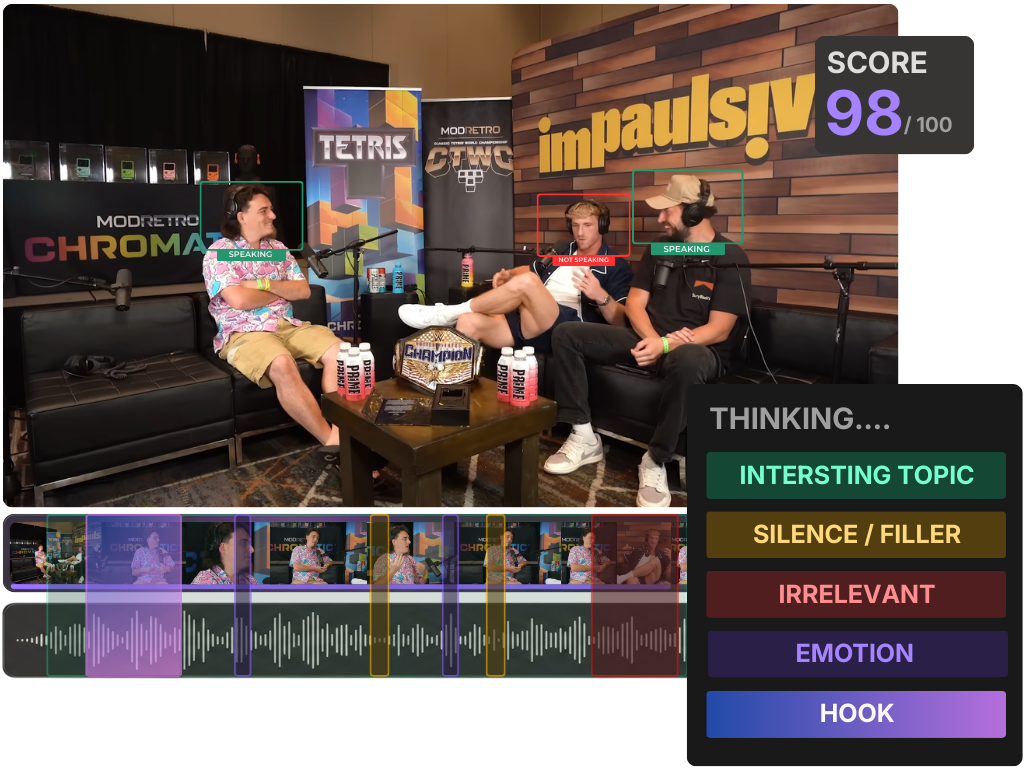
3. Score each window on five signals. This is the engine. Each candidate gets a number for each signal below, and the signals combine into a single rank. A moment that scores high on three or four signals beats one that spikes on a single signal.
4. Rank and attach a virality score. The combined scores produce an ordered list, and most tools slap a confidence or "virality" number on top. Treat that number as a sorting hint, not a prophecy, more on that in what an AI virality score really tells you.
5. Cut and caption. The top windows get trimmed to clean entry/exit points, reframed to vertical, and captioned from the transcript you already saw in stage 1.
The five signals an AI clipper scores on
Here is the part nobody explains in plain English. These are the measurable things the model looks for. None of them is "is this funny", the model approximates that through proxies.
Topic shifts are the model's favorite boundary. When the embedding of the conversation moves sharply, you stop talking about pricing and start talking about a near-bankruptcy, that break is a natural clip edge. Strong topic shifts on both sides of a window mean the clip will feel self-contained, which is the single biggest predictor of whether a stranger understands it.
Question-answer pairs are gold because they ship with structure built in. The question is the hook; the answer is the payoff. Interview shows produce more good clips than monologues partly because the format hands the model clean Q&A units. If your show is a solo monologue, you can fake this by asking your own question out loud before answering it.
Sentiment spikes are where the transcript's emotional charge jumps, strong language, a contrarian take, a vulnerable admission, a number that surprises. The model scores polarity and intensity, not "good vibes." A heated disagreement scores high; pleasant agreement scores low. This is why your most-shared clip is rarely your most comfortable moment.
Speaker energy comes from the audio: louder, faster, higher-pitched delivery, plus laughter and overlapping talk. It is a real signal, but it is secondary, energetic delivery of a boring point still loses to a calm delivery of a sharp one, because the muted viewer never hears the energy.
Pause patterns do quiet work. A beat of silence before a line often precedes something important, and silence after a punchline marks a clean exit. The model uses pauses mostly to find where to cut, not what to keep, which is why a well-paced clip starts on a breath and ends on one.

Common mistakes when reading AI suggestions
Trusting the virality score as a ranking of quality. The score reflects signal strength, not whether the clip lands with your audience. A moment can score high on energy and sentiment and still be incomprehensible without context. Use the score to sort, then judge each clip on its own. The virality score guide goes deeper on what that number can and can't tell you.
Posting the model's exact cut points. Detection finds the region; it rarely nails the frame. Almost every suggestion improves if you trim the first 1–2 seconds of lead-in and cut the moment the payoff lands. For narrative genres especially, where you end is everything, see where to end a true crime clip for max suspense.
Assuming a long clip is a complete one. The model sometimes pads a window to capture a full thought. Length is not comprehension. If the idea resolves at 22 seconds, do not ship 48.
Ignoring the transcript when you judge a clip. You know what was said, so the clip sounds complete to you. The muted stranger only reads the captions. Mute your own playback and read it cold before you post.
Skipping human review entirely. Detection narrows hundreds of windows to a usable shortlist. It does not replace your taste. Plan to keep, retrim, or discard, the human review step every AI clip needs is where good shows separate from auto-posted noise.
So which tool should you use?
For a working video podcast, the practical answer is whichever tool removes the most clicks between your episode and a posted clip. Detection quality across modern clippers is closer than the marketing implies, most surface roughly the same moments. The workflow around the suggestions is where they actually diverge. To score a whole back catalogue at once, batch-clip a whole episode in one pass covers the volume play, and the rubric in how to pick the best AI-suggested clips is what to run each suggestion through before it goes live.
QuickReel scores on the same signal family described above, then hands you an editable timeline, transcript-driven captions, and direct scheduling, so the review-and-fix step is fast instead of a re-export loop. It is an accelerant, not a replacement for your judgment, which is the honest framing for every AI clipper on the market.
FAQ
Does AI clip detection actually watch the video? Mostly no. The core signals come from the transcript and the audio, topic shifts, sentiment, question-answer structure, energy, and pauses. Some tools add light visual cues like face presence or scene changes for framing, but the moment selection is driven by text and sound, not by "watching" in any human sense.
Why did the AI miss my best moment? Usually because it scored low on the measurable signals even though it landed with you. A subtle, slow-burn insight with calm delivery and no clear topic break gives the model little to detect. You know it was great because you have the full context the model is trying to approximate from signals alone.
Why does it suggest clips that start mid-sentence? That is a segmentation artifact. The model found a high-scoring region but placed the boundary imperfectly. Nudge the start back to the nearest pause or sentence break, this single fix improves most suggestions.
Do interview podcasts get better AI clips than solo shows? Often, yes. Question-answer pairs hand the model clean hook-and-payoff units, which is one of the strongest signals. Solo hosts can close the gap by posing a question aloud before answering it, creating the same structure the model rewards.
Is a higher virality score always a better clip? No. The score measures how strongly a moment fires on the detection signals, not whether it works for your specific audience or reads clearly when muted. Treat it as a sorting tool, then judge each clip yourself.