
What an AI Virality Score Really Tells You

A virality score tells you one thing: how closely a moment matches the patterns that tend to travel, a sharp opening line, a sentiment spike, a clean quotable claim. It does not predict views, and it cannot see your niche, your timing, or your audience's taste. Read it as "this moment is worth a look," then make the call yourself. The number is a filter for your shortlist, not the order you post in.
Most clipping tools now stamp every suggested clip with a score, sometimes branded "virality," sometimes "clip score" or "highlight confidence." The label oversells what the math does. The model scores the transcript and the signal, not the outcome. Knowing exactly where that gap sits is what separates people who use the score well from people who post their top three in rank order and wonder why the 92 flopped and the 71 took off.
If you want the mechanics underneath the number first, how AI clip detection actually works breaks down the signals it scores on. This guide is about what to do with the score once you have it.
What does an AI virality score actually measure?
It measures pattern-match, not performance. The model reads the clip's transcript and audio and rates how strongly it resembles content that historically got engagement: a fast hook, emotional language, a self-contained claim, speaker energy, keyword density. High score means "looks like things that traveled", a correlation estimate on the inputs, never a forecast of the views you'll get.
That distinction is the whole article, so it's worth being concrete about which side of the line each factor falls on.
Look at the right column. Niche fit, timing, audience taste, and mute-legibility are four of the largest drivers of how a clip performs, and the score is blind to all of them. A model trained on what traveled across everyone has no idea that your true-crime audience rewards a slow, dread-building setup that a general engagement model would score low. That's not a flaw you can patch with a better model. It's structural: the score predicts the average internet, and you don't post to the average internet.

Are AI virality scores accurate?
They're accurate at the narrow thing they do, flagging interesting moments, and unreliable as a ranking of what will perform. Trust the score for separating "worth reviewing" from "skip." Distrust it for ordering your top five. The error is largest exactly where it matters most: among your best candidates, where small real-world factors decide the winner.
Here's the honest framing from inside the tooling. The next two figures are our own observation from running QuickReel's clip benchmarks, not a published study, read them as a vendor being candid, not as research. In our testing, most modern clippers surface a large majority of the same moments as each other, so the score is mostly agreeing with the field, not revealing a secret. Differentiation between good clips comes from workflow and judgment, not from the number. And every AI clipper we've measured, ours included, still needs a meaningful human pass, call it 20–40% of clips reworked or cut before posting, because the model finds candidates and you decide what ships. A score you obey without review is just automation of a guess.
One more honesty point. The reason scores lean so hard on a fast opening is that the whole field treats the first three seconds as decisive, Castmagic calls them "absolutely critical for social media success," the window where viewers "make split-second decisions about whether to continue watching" (Castmagic). That belief is baked into how these models are tuned, which is exactly why they over-reward fast hooks even when a slower build would serve your specific content better. Useful to know what the model optimizes for. Not a law of physics.
How to use a clip score: the trust-or-override rule
Use the score to build your review pile, then apply one rule. Trust its order only when the clip clears three checks the model can't run: it reads cold on mute, it fits a pattern your own audience has rewarded, and its hook isn't borrowed from a slow build the score penalized. Fail any one, and you override the rank with your own read.
This takes under a minute per clip once it's a habit.
The rule is deliberately asymmetric. A high score plus three yeses is a strong post, go with the model. But a single no flips you to manual, because each of those three is a known blind spot, not a tiebreaker. Most overrides happen on check two: the score loved a clean, general-interest explainer, and you know your audience clicks on the messy, specific, in-the-weeds stuff that a general model scores a flat 70. Your knowledge of your niche beats the model's knowledge of the average. Every time.
For a deeper scoring pass once you've decided which clips survive this rule, the five-criteria rubric for picking the best AI-suggested clips is the next layer down, it scores standalone legibility, hook, single idea, payload, and clean cuts at 0–2 each.
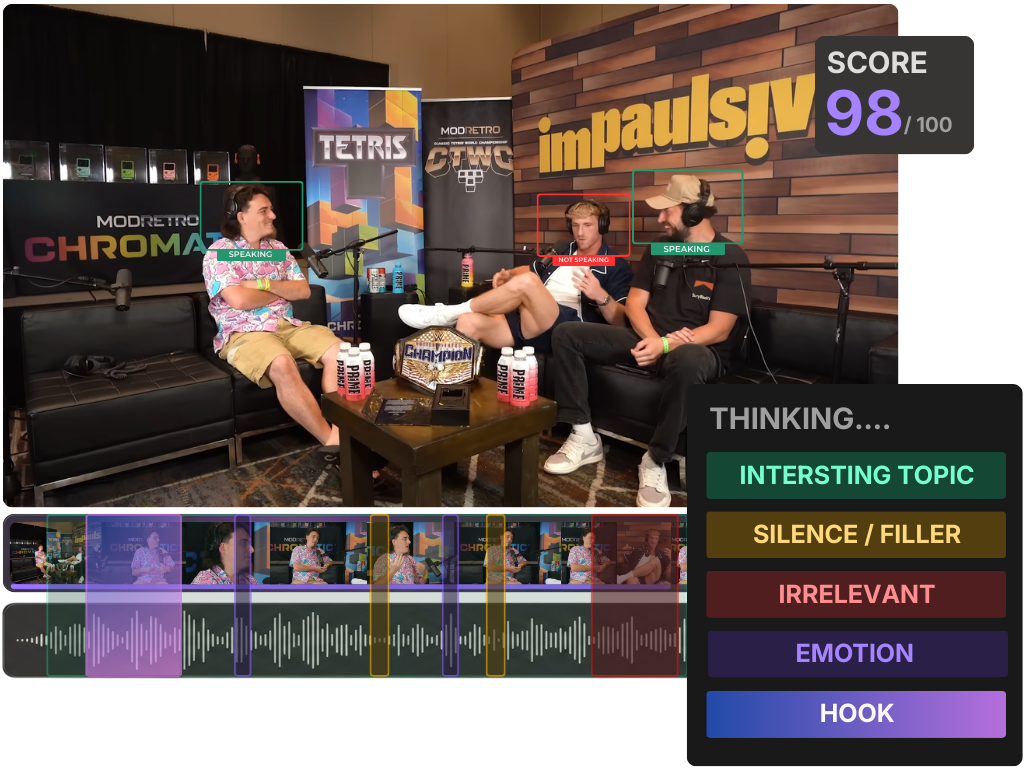

The trap: posting only your highest-score clips
Here's the mistake that quietly costs people their most loyal audience. If you only ever post the highest-scored clips, you train your feed toward the generic, because the score rewards what travels broadly, and the broadly-appealing clip is rarely the one that builds a specific, returning audience. Over a few months, a high-score-only feed flattens toward the same engagement-bait everyone else posts, and your niche-specific winners, the ones that scored a 68 but that your actual subscribers loved, never get made.
The numbers behind why this matters: clips drive an estimated 20–40% of new-audience acquisition for video shows and can raise reach 2–5× (Podcast Studio Glasgow; single-studio figures, treat as directional). That growth comes from two different jobs, reach and retention, and the score only optimizes the first. Broad clips bring strangers in. Niche clips turn strangers into subscribers. Optimize only for the score and you'll get a wide, shallow audience that never comes back.
The fix is a protected niche slot. For every three or four high-score clips you post, deliberately post one clip you believe in that the score doubted, a deep-in-the-weeds moment your real audience will recognize. Treat it as an experiment with your own retention data as the judge. If your in-the-know clips quietly hold better watch-time or pull more saves than the high-scorers, that's your audience telling you the model is wrong about them. This is exactly the dynamic in genres with a tight, devoted following, which true crime moments actually clip well is full of high-loyalty cuts a general score underrates.
Common mistakes when reading a virality score
- Posting the top scores in rank order. The score's gap is widest among your best clips. Use it to pick the pile, not the order, then apply the trust-or-override rule.
- Treating the number as a forecast. It's a similarity estimate on the transcript, not a views prediction. A 92 is "this looks like things that traveled," not "this will get 92k."
- Ignoring the mute read. The score reads the transcript; your viewers read the captions with the sound off. A clip can score high and still die silently if the on-screen hook doesn't land. A large share of social video plays on mute, the most-cited figure is ~85% of Facebook video watched without sound (Digiday, 2016; publisher-reported and now dated, so treat it as directional, not current).
- Skipping human review because the score is high. Every AI clipper needs a 20–40% human pass. A high score doesn't exempt a clip, the human review step every AI clip needs is where the score gets sanity-checked.
- Never posting a low-score clip. That's the niche-starvation trap. Reserve a slot. Let your retention data argue with the model.
- Comparing scores across tools. A 90 in one clipper and a 90 in another aren't the same scale, they're trained on different data and normalized differently. Compare a tool's scores only against its own.