
How to Pick the Best AI-Suggested Clips

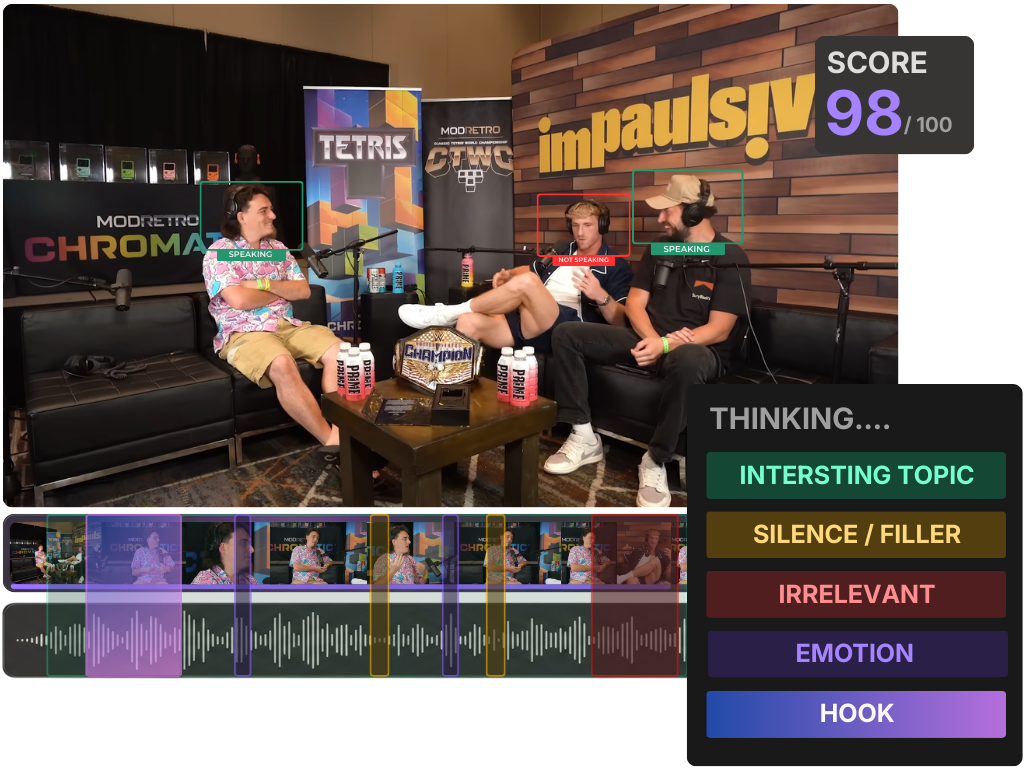
An AI clipper hands you 15–25 suggested clips per episode and ranks them for you. Don't trust the order. Score each suggestion yourself on five things, does it stand alone, does it hook in two seconds, is it one idea, does it carry an emotional or contrarian payload, are the cut points clean, then post the three that score highest. The AI's ranking is a draft of your shortlist, not the shortlist.
This matters because the tools agree with each other more than they agree with what actually performs. The suggestion engine is good at finding interesting seconds and mediocre at judging whether a 38-second cut works as a self-contained post. That gap is yours to close. And it pays to close it: one production studio estimates clips account for 20–40% of new-audience acquisition for video shows and can raise discovery reach 2–5× (Podcast Studio Glasgow; single-studio figures, treat as directional), but only for the clips you choose well.
If you want the why behind the AI's picks before you re-rank them, how AI clip detection actually works breaks down the signals it scores on. This guide is the next step: what to do with the list it gives you.
How do you choose which AI clips to post?
Re-rank the AI's suggestions against five criteria, scored 0–2 each for a 10-point total: standalone comprehension, a hook in the first two seconds, a single idea, an emotional or contrarian payload, and clean entry and exit. Post anything scoring 8 or higher, fix the 5–7s, discard the rest. The AI's order is your starting pile, not your decision.
Here's why each line earns its place, and how to score it in about a minute per clip.

The 5 criteria, and how to score each
1. It stands alone (0–2)
A clip is a stranger's first contact with your show. If understanding it requires a sentence that happened three minutes earlier, a name, a setup, an inside reference, it loses people in the scroll. Score 2 when the clip is fully legible cold. Score 1 when it needs one small assumption. Score 0 when the payoff lands on context that isn't in the cut.
This is the single most common reason an AI's top pick underperforms: the model found a genuinely strong moment but lifted it out of the scaffolding that made it land.
2. The hook lands in two seconds (0–2)
About 60% of social video is watched sound-off (Podcast Studio Glasgow), and the first three seconds decide whether someone stays. So the opening line, on screen, with no audio, has to create a question or a tension. Score 2 if the first visible caption makes you want the next one. Score 0 if the clip opens on "yeah, so, um" or a slow wind-up. AI clippers frequently start a clip 1–2 seconds too early; trimming that dead air is often the whole fix.
3. One idea, not three (0–2)
The strongest clips make a single point and stop. AI suggestions skew long because the model rewards a complete thought, and complete thoughts ramble. If you can name two distinct ideas in one clip, it's two clips, or one clip plus a cut. Score 2 for a single clean idea, 0 for a sprawling segment that changes subject halfway.
4. It carries an emotional or contrarian payload (0–2)
Information travels far less than feeling or friction. The clips that get shared say something surprising, take a side, admit something, or make you react. A correct-but-flat explanation scores 1 at best. A spicy take, a vulnerable admission, or a genuinely counterintuitive claim scores 2. This is the line where your taste matters most, and where the AI is weakest, because "interesting transcript" and "emotionally charged" are not the same signal.
5. Clean entry and exit (0–2)
Where a clip ends does as much work as where it starts. Cutting mid-word, mid-breath, or one beat past the punchline kills a good clip. Score 2 for a clip that begins on a full thought and ends on the line you'd want as the last frame. For suspense-driven content especially, the exit is the whole game, where to end a clip for maximum suspense is its own craft. Score 0 if the AI's boundaries clearly need dragging.
Add the five. Eight and up, post it. Five to seven, it's a fixer, usually a hook trim or a tighter exit away from an 8. Below five, let it go; you have enough good ones.
A worked example: two clips the AI scored the same
Here's the case the rubric was built for. On a recent business-interview episode, the clipper returned two suggestions with an identical virality estimate, call them Clip A and Clip B. The AI ranked them a tie. The rubric did not.
Clip A is a crisp 42-second explanation of a pricing framework. It's smart and well-spoken. But it opens with "so the way we thought about it was," it assumes you know what "it" refers to, and it ends on a qualifier. Clip B is 26 seconds: the guest says "we almost went bankrupt because I refused to raise prices" and then explains the moment it turned. It stands alone, hooks instantly, holds one idea, carries real stakes, and lands on a clean line.
Clip A scores a 5, a fixer, not a kill. Trim the wind-up, add a caption that supplies the missing "it," and end one line earlier, and it climbs toward an 8. Clip B is a 10; it posts as-is. The AI wasn't wrong that both moments were interesting. It just couldn't tell which one survives the scroll. The rubric can, in under two minutes.

Common mistakes when picking AI clips
- Posting the AI's top three in order. The rank reflects what the model can measure, keyword density, sentiment spikes, speaker energy, not standalone legibility or a clean exit. Re-rank every time. If your tool also shows a confidence number, read it skeptically; what an AI virality score really tells you is "this moment is interesting," not "this will perform."
- Keeping length the AI gave you. Suggestions run long. A 48-second clip that's an 8 is often a 24-second clip that's a 10 once you cut to the one idea.
- Ignoring the mute test. Watch your shortlist with the sound off and only the captions visible. If the hook doesn't survive, the clip won't either, about 60% of viewing happens sound-off (Podcast Studio Glasgow).
- Scoring nothing and shipping everything. Every AI clipper still needs a human pass before posting, the model finds candidates, you decide what ships. The rubric is that review step; skipping it is how mediocre clips get published at volume. The human review step every AI clip needs goes deeper on this.
- Over-trusting one strong line. A great quote inside a clip that needs context still fails cold. The whole cut has to stand alone, not just one sentence in it.
Tools: where the rubric runs fastest
The rubric works in any editor, you can score clips from any AI clipper on paper. It runs fastest when re-ranking and trimming live in the same place you generate, so a 5-scorer becomes an 8 without exporting and re-importing. QuickReel keeps suggestion, an editable timeline, captions, and scheduling in one pass, which is the difference between fixing a clip and abandoning it. If you're clipping a full back catalog rather than one episode, batch-clipping a whole episode in one pass covers doing this at scale. Opus Clip, Vizard, and Klap all surface a ranked list too; the criteria above apply to their output unchanged.