
How AI Picks Your Clip's First Three Seconds

An AI clipper does not choose your first three seconds to grab attention. It chooses them to mark a clean boundary, the spot where a topic starts and a pause falls. So the entry point it picks is the start of a thought, not the start of a hook. That is why your sharpest line so often lands at second nine instead of second one, and why the single most valuable edit you can make is moving that line to the front.
Detection gets you to the right two-minute neighborhood. You still set the first frame. Get the opening seconds right and a so-so clip travels; get them wrong and a genuinely great moment dies on the scroll because nobody waited for the part that mattered.
Why the first three seconds decide everything
The opening is not one of several things that matter on short-form. It is close to the only thing that matters before the viewer has decided to stay. Practitioners who clip podcasts for a living converge on the same line: the opening three seconds are "absolutely critical" for whether a social clip works at all (castmagic). The exact lift is hard to pin to an audited number, but the direction is not in dispute, the scroll decision happens fast and early, before most viewers have heard a full sentence.
There is a compounding reason the opening line carries even more weight than it seems. Most social video is watched on mute, a widely cited estimate puts it near 85% (Digiday, publisher-reported and directional; the same piece quotes silent-view rates anywhere from 50% to 90% depending on the publisher). So your first three seconds are not really audio. They are the first line of text on screen. The viewer reads your hook before they hear it, which means a buried payoff is doubly buried, out of earshot and off the first caption card.
When clips are your main discovery channel, and for a video show they often drive 20–40% of new audience (Podcast Studio Glasgow, a single studio's client data, so directional), the opening is where most of that audience is won or lost.

How AI actually sets the entry point
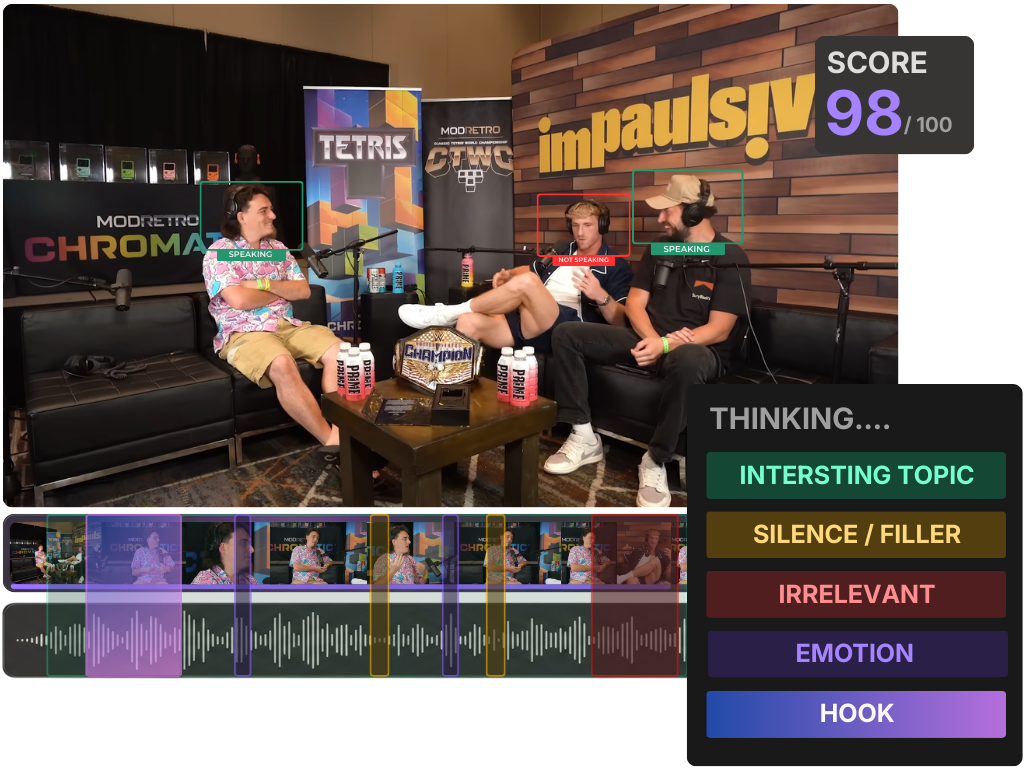
The model is not asking "what's the best opening line." It is asking "where does a self-contained chunk begin." Two of its detection signals do almost all the work at the front edge of a clip: the topic shift that opens a new idea, and the pause that gives it a clean cut point. (For the full five-signal breakdown, see how AI clip detection actually works.)
That logic produces a tidy, complete clip, and a slow one. A speaker almost never opens a thought with its conclusion. They warm up: they restate the question, set context, hedge, then land the point. The AI faithfully starts the clip at the warm-up because that is the true boundary of the thought. The payoff sits a sentence or two later, exactly where a human editor would have started.
So the bury is not a bug. It is the predictable result of optimizing for "clean thought boundary" instead of "strongest first line." Once you see that, you stop being surprised by it and start fixing it on every clip.
The four reasons AI buries the hook
It starts at the topic boundary. The clip opens where the new idea begins, which is the setup, not the conclusion. The strongest line is the destination of the thought, and the model puts the start at the departure point.
It starts at a pause. A beat of silence is the model's favorite entry, because it cuts cleanly. But people pause to gather a thought, not to deliver one. The cleanest cut point and the strongest opening line are rarely the same second.
It keeps your spoken order. Detection finds and trims; it does not re-sequence sentences. If you said the context first and the punchline second, that is the order you get. The model will not move your best sentence to the front for you, that is the manual move below.
It pads to a full thought. To make the clip self-contained, the model sometimes adds the lead-in that makes the payoff make sense. Good instinct for comprehension, bad for the first three seconds. Comprehension can come from the caption; the opening should not be spent on it.

The Three-Second Audit (run it on every clip)
Before you post any AI suggestion, run this four-question check on its opening. It takes about ten seconds per clip and catches almost every buried hook.
- Mute it and read only the first caption card. Does that text alone make a stranger curious? If it reads like setup, the hook is buried.
- Find the strongest line in the whole clip. Where does it actually fall, second one, or second nine?
- Check the gap. If the strongest line is more than ~2 seconds in, you have a re-order or a trim to make.
- Confirm the clip still resolves. After re-ordering, does the idea still land by the end? If moving the payoff up leaves the body pointless, the moment may not clip, cut it and move on.
Two passes is the rule: keep, re-order, or kill. Anything that fails the audit and can't be fixed in one move is not worth the slot. The broader keep/cut rubric lives in how to pick the best AI-suggested clips; this audit is the opening-specific layer on top of it.
The fix: lead with the payoff line
The move is simple and it is the same for all four causes. Take the strongest line the AI placed in the middle and put it first. Then let the context follow as the explanation. You are not rewriting anything, you are reordering two segments on the timeline so the destination becomes the departure.
A worked example. Say the AI clip opens like this:
"So a lot of people ask me how I got my first big client, and honestly for a long time I had no idea what I was doing, but the thing that actually worked was that I stopped pitching and started auditing their site for free first."
The hook is the last clause. As suggested, a muted viewer reads "So a lot of people ask me how I got my first big client" and keeps scrolling. Re-order it:
"The thing that actually worked? I stopped pitching and started auditing their site for free. For a long time before that I had no idea what I was doing, here's how I figured it out."
Now the first caption card states the payoff. The setup is still there, but it has a new job: it answers the curiosity the opening just created. Same words, same clip length, completely different first three seconds.
Two practical notes. Keep the re-order to whole sentences at clean pauses so the cut sounds natural, the same pause boundaries the model loves are your friend here. And after re-ordering, re-check the ending: a strong open with a limp close still underperforms. For genres where the ending carries the tension, the front-load can actually hurt, narrative shows like true crime often want the reveal held back, so see where to end a true crime clip for max suspense and which true crime moments actually clip well before you apply this move there.
Common mistakes on the opening
Trusting the virality score to mean the hook is in place. That number reflects how strongly the moment fired on detection signals, not whether the first three seconds work. A clip can score high and still open on its weakest line. Use the score to sort, then audit the opening yourself, more on reading that number in what an AI virality score really tells you.
Adding a title card to "fix" a weak open. A text overlay on top of a slow opening just delays the scroll. Fix the line underneath first; decorate second.
Front-loading the conclusion but keeping the dead air. Re-ordering helps only if you also trim the lead-in breath. Start on the first word of the payoff, not the inhale before it.
Applying the move to narrative clips. Story-driven moments often live or die on the reveal at the end. Front-loading the payoff spoils them. Save this technique for insight, opinion, and how-to clips; let suspense clips build.
Auditing one clip and trusting the rest. Buried hooks come in batches because they share a cause. If your first three suggestions opened on setup, the next ten probably do too, run the audit across the whole batch. When you're scoring a full episode at once, batch-clip a whole episode in one pass and audit openings as a group.
FAQ
Why does the AI start my clip before the good part? Because it sets the opening at the start of a thought, the topic boundary and the nearest clean pause, not at your strongest line. People warm up before they land a point, so the payoff usually sits a sentence or two after the entry point the model chose.
How long does my hook actually have? About three seconds, and on muted feeds that means your first caption card. Clipping practitioners call the opening three seconds "absolutely critical" for whether a clip lands (castmagic). There's no audited universal number, so plan as if the scroll decision happens before second four, because for most viewers it does.
Can I just regenerate the clip to get a better opening? Sometimes, but regeneration changes the region, not the model's habit of opening on the boundary. The re-order move is faster and more reliable than rolling the dice on a fresh batch, fix the opening you have first.
Does re-ordering the audio sound unnatural? Not if you cut at the pauses the speaker already left. Move whole sentences between natural breaths and the result sounds like a tighter edit, not a splice. Avoid cutting mid-sentence to force the order.
Should I do this on every clip? On insight, opinion, and how-to clips, almost always, leading with the payoff lifts the opening at no length cost. On narrative or suspense clips, no: those often need the reveal held to the end, so let them build instead.