
AI Clipping vs Hiring a Human Editor

Use AI clipping for volume and a human editor for your flagship cuts, most shows should do both, not pick one. AI clipping costs roughly a few cents to a couple of dollars per clip and turns one episode into ten clips in minutes; a competent freelance editor charges $25–$100 per short-form clip and takes days (Roster, 2026). The split is not about quality versus cheapness. It is about which job you are paying for.
That distinction is the whole article. AI is unbeatable at the mechanical work, finding moments, cutting to vertical, burning in captions, batching twenty clips at once. A human is worth their rate on the work AI cannot do: a narrative cut that tells a story, a sound-repair rescue, a brand-perfect flagship edit you will run as an ad. Below is the cost-and-quality model, then a decision tree that tells you which to use based on one number: how many clips you ship a month.
How much does each cost per clip?
AI clipping runs roughly $0.05–$2 per clip depending on your plan; a freelance short-form editor runs $5–$25 per clip at the budget tier, $25–$100 mid-tier, and $100–$300+ for premium work (Roster, 2026). The AI figure comes from dividing a subscription by the clips it produces. The human figure is what an editor charges per finished short.
Walk the AI math out. QuickReel's Pro+ plan is $29.40/mo for 500 credits, where roughly one credit covers a minute of source video (QuickReel pricing, verified 27 Jun 2026). A 45-minute episode costs ~45 credits and returns ten or more clips, so a month of that plan, eleven episodes' worth of input, lands well under a dollar per finished clip. Even QuickReel's $9 Starter clears several clips per episode. Opus Clip's $15 Starter and $29 Pro work out the same way: cheap per clip, because the machine does not bill by the hour (Opus Clip pricing).
The human side is a labour cost, and labour does not get cheaper at volume the way software does. krock.io puts the US freelance video-editor average at $30–$50/hour (krock.io, 2026). Take the top of that range and assume, generously, 30 minutes to find, cut, caption, and export one 60-second clip from a long episode: pulling 40 clips out of one episode is 20 hours of work, about $1,000 for a single episode (illustrative, at $50/hour). The same rates show up across platforms: GigRadar pegs short-form specialists at $15–$40/hour for basic clip work, climbing to $80–$150/hour for expert editors (GigRadar, 2026), and Upwork's hiring guide lists general video-editor rates in a comparable band (Upwork).
A caveat before you bank the cheap number. Per-clip AI cost assumes you actually use your credits, a $29 plan you touch twice a month is expensive per clip. And the "free editing" of AI is not free of your time: every AI clip needs a review pass, which we cost out below.
The side-by-side: cost, turnaround, revisions, judgement
Cost is one axis. The honest comparison runs across four: price per clip, turnaround, the revision loop, and editorial judgement. AI wins the first two outright. The revision loop is a draw with different shapes. Judgement is where a human still beats every model on the market.
Turnaround. AI returns clips in minutes; a freelance editor's standard turnaround runs days, Trevor O'Hare's base podcast package quotes a 3-day turnaround, and "rush jobs command premium rates" (Trevor O'Hare, 2026). If you publish on a fixed weekly cadence, that delay is the difference between posting Tuesday's clip on Tuesday and posting it Friday.
The revision loop. This one is genuinely a wash, but the shapes differ. With AI, a bad clip is your problem to fix, instantly, for free, by re-running or editing it yourself. With a human, revisions are a negotiation: most editors include one to three rounds, then bill for more, and each round costs a day. AI's loop is faster and cheaper; the human's loop ends with someone who is not you doing the work.
Judgement. A model detects moments by transcript signals and energy. It cannot tell that the quiet, unflashy answer at minute 31 is the best thing your guest said, or that two clips should be stitched into one arc. In our own clip-quality benchmarks, the leading tools land on most of the same obvious moments, the loud laugh, the hot take, the clean soundbite, which is why the AI category competes mostly on workflow and price rather than detection; even the vendors' own comparisons are fought on pricing models, not on who finds better clips (makeshorts pricing comparison, 2026). What they all miss is the non-obvious moment and the narrative through-line, exactly what you pay a human for.
Which tasks is each genuinely better at?
Split the work, not the loyalty. AI wins the high-volume mechanical jobs, finding obvious moments, vertical reframing, auto-captions, batching, because it does them in minutes for cents. A human wins the low-volume, high-stakes ones: the narrative cut, sound repair, color and B-roll, and the flagship clip you will run as an ad. The table below is the task-by-task verdict.
| Task | AI clipping | Human editor |
|---|---|---|
| Find clip-worthy moments at scale | Wins, surfaces the obvious ones in minutes | Loses on speed, wins on the non-obvious moment |
| Vertical reframe + auto-captions | Wins, instant, batched | Slow and expensive for this |
| Narrative cut / multi-moment story | Loses, literal cuts only | Wins, taste and structure |
| Sound repair, music, color, B-roll | Partial, basic only | Wins, real fixes |
| Flagship clip you will run as an ad | Loses, needs polish | Wins, worth the spend |
Sources: task-by-task verdicts from QuickReel's clip-quality benchmarks; per-clip cost from Roster 2026; AI-category pricing context from makeshorts pricing comparison 2026.
The pattern across that table: AI removes the busywork; a human supplies the taste. The smart move for most shows is to let the machine generate the weekly volume, the ten-plus clips that feed the algorithm, and reserve your editor budget for the two or three flagship cuts a month where craft actually moves the needle. A human editor freed from cutting captions is more valuable, not less; they spend their hours on the storytelling AI cannot do.
How much does each cost per month at real volume?
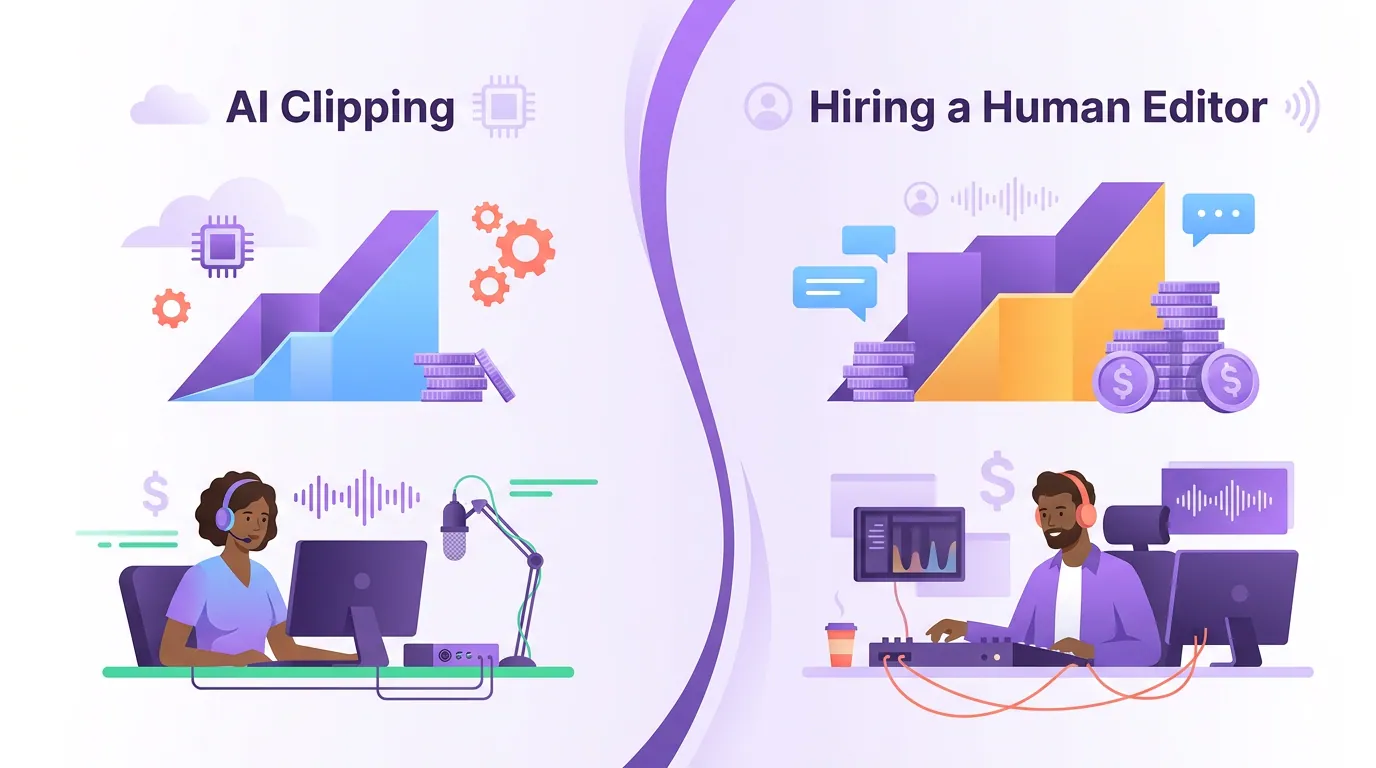
To ship ~20 clips a month, AI clipping costs $15–$30 total; a freelance clips retainer runs about $1,800/mo for 40 clips, and a full-service retainer covering long-form plus shorts runs $2,500–$5,000/mo (GigRadar, 2026). That is the number that decides it for most shows, because the per-clip gap compounds at volume.
The monthly view changes the calculus from the per-clip one. A single hand-edited flagship clip at $150 is a rounding error in your month; twenty hand-edited clips at $50 each is $1,000, every month, forever. AI's cost is flat regardless of how many clips you pull from your credits. So the more clips you need, the wider the gap, which is precisely why volume is the variable the decision tree turns on.
One honest note on the retainer numbers: the $2,500–$5,000 full-service tier bundles your long-form episode edits plus the shorts (GigRadar's example: 8 long-form videos plus 16 clips), not just clips (GigRadar, 2026). So you are not paying that purely for twenty shorts, you are paying for a managed pipeline. If all you need is the clips, the ~$1,800-a-month clips retainer is the fairer human comparison, and it is still roughly 60× the AI cost.
The decision tree: pick by clip volume
Here is the rule, keyed to how many clips you ship a month and what your budget is. It is the framework worth saving from this whole comparison.
Read the three branches out:
- Under ~10 clips a month on a tight budget, go AI. A weekly show pulling a few clips per episode does not have the volume to justify a retainer, and the per-clip human cost is brutal at low scale. Run AI, review the clips yourself, and put the hundreds you would have spent on a retainer toward a better microphone or ads instead.
- ~10–30 clips a month and you want a few standouts, go hybrid. This is where most growing video podcasts live. Let AI batch the weekly volume; commission one to three flagship clips a month from a freelancer at $50–$150 each. You get reach and craft without a four-figure retainer.
- Heavy narrative or ad-grade work with budget, go human-led. If your clips are documentary-style edits, branded ad units, or your whole brand rests on production polish, a retainer earns its keep. Even then, most teams still run AI for the routine cuts and save the editor for the work that matters.
The variable that flips the answer is volume, not quality preference. Quality preference makes you want a human everywhere; volume makes that unaffordable past a handful of clips. The honest answer for nearly everyone is the middle branch.

What this means for staying consistent
The reason the cheap-and-fast option matters is not the saved money, it is the saved show. About 47% of podcasts stop at three episodes or fewer (Amplifi Media analysis), and the strongest predictor of survival is publishing consistency. A pipeline that depends on a four-figure monthly editor invoice is fragile; one that depends on a $29 subscription you can run yourself is not. Clips drive real discovery, posting them consistently can raise a show's reach 2–5× (Podcast Studio Glasgow, citing ALM Corp), but only if you keep making them.
That is the case for AI carrying the volume and a human carrying the craft. The two are not rivals. One keeps you publishing; the other makes the flagship worth publishing.
FAQ
Is AI clipping good enough to replace a human editor? For high-volume social clips, increasingly yes, in our clip-quality benchmarks AI catches most of the obvious clip-worthy moments and handles reframe and captions in minutes. It does not replace a human for narrative edits, sound repair, or ad-grade flagship cuts. Use it for volume; keep a human for craft.
How much does it cost to hire a podcast clip editor? Expect $5–$25 per clip at the budget tier, $25–$100 mid-tier, and $100–$300+ for premium work, or $15–$40/hour for basic short-form (Roster, 2026; GigRadar, 2026). Monthly retainers run around $1,800 for a 40-clip package and $2,500–$5,000 for full-service (long-form plus shorts). Verified live 27 Jun 2026; rates move, so confirm before you commit.
Should I hire a podcast editor or use an AI tool? Decide by volume. Under ~10 clips a month on a budget, use AI. At ~10–30 clips with a few flagships you care about, go hybrid, AI for volume, a freelancer for one to three standout cuts. Only heavy narrative or ad-grade work with budget justifies a human-led pipeline.
Does AI clipping still need human review? Yes, plan to review every batch before it goes out, trimming the start, fixing a caption typo, or cutting a clip the model misjudged. "AI does the clipping" means it does the mechanical work, not that the output ships untouched. Budget a short review pass per batch; it is the one cost AI does not remove.
What is the cheapest way to clip a podcast? AI clipping, at roughly $0.05–$2 per finished clip versus $5+ for the cheapest human editor (Roster, 2026). QuickReel's free signup and Opus Clip's free tier let you test the workflow at $0 before paying, though free tiers add watermarks.
The bottom line
Run AI for the weekly volume; pay a human for the monthly flagship. The per-clip and per-month math both point the same way, AI is one to two orders of magnitude cheaper, and faster, for the mechanical work that makes up most of your clip calendar. A human editor is worth real money for the slice AI cannot do: the non-obvious moment, the narrative cut, the polished ad. The decision is not which to trust; it is what to assign to each.
For the use-case-specific version of this call, see the best clip tool setup for solo podcasters, choosing a podcast clip tool for an agency, what multi-seat teams should compare, and picking a clip tool for an in-house brand team. For the tool shortlist on the AI side, start with the best AI podcast clip generators and the best Opus Clip alternatives.