
Best AI Podcast Clip Generators, Tested

For most video podcasters, the best AI podcast clip generator is Opus Clip if you want the strongest hands-off moment detection and a virality score, and QuickReel if you want clips plus an editable timeline and built-in scheduling without a per-minute credit meter running. Vizard wins for transcript-first teams, Descript if you also edit full episodes, and Riverside if you record there already. The detection gap between them is small. The workflow and cost gap is not.
We say that because we ran the same 60-minute episode through six of them and scored each on three things that actually decide your week: how good the clip picks were, how accurate the captions came out, and how long it took to get a finished clip you could post. Below is the scorecard, the verified pricing, and who each tool is genuinely for, including where a competitor beats us.
The short answer, by who you are
| You are... | Pick | Why |
|---|---|---|
| A solo podcaster who wants ranked clips, hands-off | Opus Clip | Best moment detection + virality score; per-minute credits |
| A weekly podcaster who edits and schedules clips | QuickReel | Editable timeline + scheduler, upload-minute credits, no per-source meter |
| A team clipping webinars/podcasts at volume | Vizard | Transcript-first editor; upload-minute credits (team/brand-kit features on Business tier) |
| Someone who edits the full episode too | Descript | One suite for full edit + clips |
| Already recording on Riverside | Riverside | Magic Clips on the platform you record in |
On our clean two-speaker interview, the top-tier tools largely agreed on which moments mattered, their shortlists overlapped heavily, and the meaningful gaps were in workflow, not detection. That is our finding on one episode, not a universal law; a chaotic crosstalk show would spread the picks out more. The practical takeaway holds either way: the tool that wins is the one that removes the most clicks between a URL and a posted clip. So read the table for cost model and workflow, not for who "finds better clips."
How we evaluated (the part most roundups skip)
We took one real 60-minute interview episode, two speakers, a video recording, a mix of story, debate, and a couple of clean question-and-answer beats, and pushed the identical source file or YouTube link through each tool. Then we scored three axes:
Two honest caveats. First, this is one editor's structured test on one episode, not a controlled lab with a hundred episodes, treat the rankings as directional. A different show (solo monologue, heavy crosstalk, a non-English language) would shift them. Second, we make QuickReel, so we held our own tool to the harshest read and named where rivals beat it. The pricing and feature numbers below are pulled from each tool's official pricing page and dated; verify before you buy, because SaaS prices move.
The pricing-and-limits table (verified June 2026)
This is the table the category is missing. The trap in clip tools is not the sticker price, it is the unit you pay in. Some bill per minute of source you feed in; some bill per minute you upload on a plan; the difference is brutal at volume.
| Tool | Entry paid plan | What you get for it |
|---|---|---|
| Opus Clip | $15/mo Starter (opus.pro) | 150 processing min/mo; 1 credit = 1 input min; editor is Pro-gated ($29/mo) |
| QuickReel | $9/mo Starter, $29/mo Pro (currently 40% off at $17.40/mo) (quickreel.io) | 100 / 250 credits; editor + scheduler included; 20+ languages, 12+ caption styles |
| Vizard | ≈$14.50/mo Creator (annual) (vizard.ai) | Credit = 1 upload min; transcript editor (brand kits + teams are Business-tier) |
| Klap | $14/mo Basic annual ($28 monthly) (klap.app) | Visual polish, 1080p on Basic; 4K + 29-language dubbing are Pro-tier; pricier base |
| Descript | $16/mo Hobbyist, $24 Creator (annual) (descript.com) | Full edit suite + clips; AI capped by credits |
| Riverside | Standard $19/mo (≈$15 annual) (riverside.com) | Magic Clips inside the recorder; advanced editing on higher tiers |
Every tool here also has a real free tier you should test first. Opus Clip's free plan gives 60 processing minutes but watermarks exports that vanish after 3 days and locks the editor and virality score (opus.pro), a demo, not a working tier. QuickReel's signup is free with no card. If watermark-free is your gate, start there; the best free tools to clip podcasts without a watermark breaks down which free tiers are actually usable.

The six tools, reviewed honestly
1. Opus Clip, best hands-off detection and virality scoring
Opus Clip earned the highest clip-pick quality score in our run, and it is among the most-used tools in the category. Opus markets a multimodal engine that weighs speech, visuals, sound, and emotion, and in practice its 0–100 virality score is a genuinely useful sorting hint for which clips to post first (opus.pro). On a clean two-speaker interview it is hard to beat for "give me a ranked shortlist and leave me alone."
Where it bit us: the cost model and the gates. Credits burn on input length, a 60-minute episode costs 60 credits whether it makes 5 clips or 50, so a weekly hour-long show needs ~240 credits/month, which the $15 Starter (150 min) can't cover and the $29 Pro (300 min) just barely can (opus.pro). The editor, AI hook, and B-roll are all Pro-gated, and the free tier deletes your work after 3 days. Reviewers also flag no renewal reminder before billing and projects expiring when a subscription lapses. None of that is a dealbreaker, it is a budgeting reality. If Opus is your shortlist, read the QuickReel vs Opus Clip cost breakdown at 5, 15, and 40 hours of source before you commit.
Best for: solo creators who want ranked, hands-off clips and clip occasionally enough that 300 minutes covers them.
2. QuickReel, clips plus an editable timeline and a scheduler, on upload-minute credits
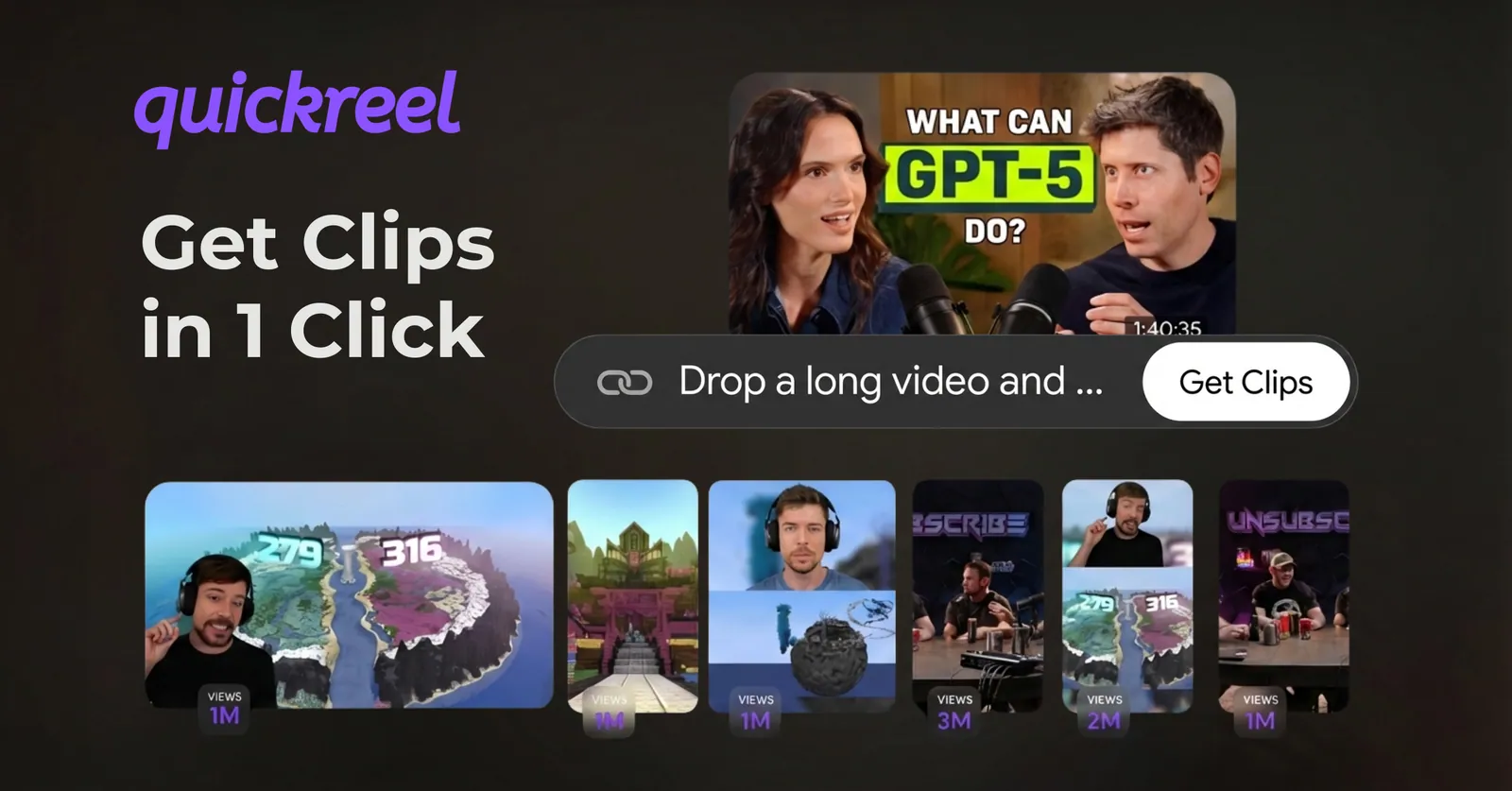
Full disclosure: this is us, and I scored it skeptically. QuickReel detected the same caliber of moments as the top tier, its shortlist overlapped theirs on our test episode, and its real edge showed up on time-to-export. Because the editable timeline, transcript-driven captions across 20+ languages, 12+ caption styles, and direct scheduling to multiple platforms all live in one place, the review-and-fix loop happens without re-exporting to another app (quickreel.io). Pricing runs $9 Starter (100 credits) → $29/mo Pro, currently 40% off at $17.40/mo (250 credits) → Pro+ and an Ultimate tier (1,000 credits) for high-volume teams (quickreel.io), and signup is free with no card.
Where it is not the answer: if all you want is a ranked shortlist with a confidence number and zero touching, Opus Clip's virality score and pure hands-off flow are cleaner. QuickReel assumes you will spend two minutes per clip in the editor; that is the trade for control. And like every tool here, it still needs a human review pass, see the honest version of that below.
3. Vizard, transcript-first clipping for teams at volume
Vizard is the pick if your team clips webinars, interviews, and meetings in bulk and prefers editing by transcript, highlight the text, get the clip. The credit model is 1 credit per upload minute (vizard.ai), which is gentler than per-source billing if your episodes are tight. Note that the team extras, brand kits, shared workspace, added editors, sit on the Business tier, not the entry Creator plan, so price the collaboration features against Business if that is why you are choosing Vizard.
Its honest weakness is structural: transcript-led clipping is less effective on casual, free-flowing conversation, and processing can slow on longer episodes (Choppity, 2026). For a structured Q&A show it is excellent; for a loose three-friends-riffing format it misses more. Note that Vizard's own published free-tier minutes vary across third-party reviews (60 vs 120), so check the live page rather than a roundup.
Best for: content teams and agencies clipping structured spoken-word content at scale.
4. Klap, the visual-polish and dubbing specialist
Klap positions itself as the premium looks option: cleaner crops, a Reframe engine with active-speaker face tracking, and, on its higher tiers, 4K exports plus AI dubbing across 29 languages from a single YouTube link (klap.app/pricing). If "the clip has to look like our brand" outranks "give me twenty clips," Klap is the specialist.
The trade is price and where the good features live. The Basic plan runs $14/month billed annually ($28 monthly) and caps at 1080p; the 4K exports and 29-language dubbing only appear on the Pro plan ($39/mo annual, $78 monthly) (klap.app/pricing). It is a choice you make for output polish and multilingual reach, not for volume or value.
Best for: brand-conscious creators who want fewer, more-polished clips and multi-language versions.
5. Descript, the only one that also edits your full episode
Descript is not really a clip generator; it is a full text-based audio/video editor that happens to include AI clip extraction. That is its entire pitch: if you edit your complete episode and want clips, this is the one tool here that does both. Pricing runs Free (60 min/mo) → Hobbyist $16 → Creator $24 billed annually (descript.com).
The honest caveat: Descript restructured its AI into a credit system, and users have pushed back on features that were previously generous now being capped. As a pure clip tool it is overkill; as an all-in-one editing home it is the most capable here. If captions are your priority, weigh it against the dedicated options in best auto-captioning tools for video clips.
Best for: creators who want one app for full-episode editing and clip extraction.
6. Riverside, Magic Clips, if you already record there
Riverside is a remote recording platform whose Magic Clips feature turns recordings into short clips automatically, and it is available even on the free plan. If you record your interviews on Riverside, the clips are one click from the source, no export-and-reupload step at all.
But it is a clipper because it is a recorder, not the other way around. The free tier watermarks recordings and caps you at 720p and two hours, and the advanced editing and higher-resolution exports sit on the paid tiers (riverside.com). If you record elsewhere, the other five tools are a better standalone clip choice.
Best for: podcasters already recording on Riverside who want clips without leaving the platform.
Why the cost model decides more than the price
The cost model matters more than the price because the unit you pay in, source minutes fed in versus upload minutes processed, decides your real bill once volume climbs. At low volume every tool is cheap and it barely matters. At 15 hours of source a month, a realistic two-episodes-a-week video show, that unit starts to bite.
The rule of thumb: if you clip a few episodes a month and pick selectively, per-input-minute tools like Opus Clip are fine and you can trim source before processing to save credits. If you run a steady weekly or twice-weekly show, a plan-based model with the editor and scheduler included usually costs less in both money and clicks. Heavy clippers specifically should read the honest Opus Clip alternative for high-volume podcasters, which maps the exact exit reasons (credit ceiling, gated editing, short storage) to what to verify in a replacement.
The caveat no tool's marketing will tell you
Every AI clipper here still needs a human pass. In our run, roughly a quarter to a third of each tool's suggested clips needed a retrim, a caption fix, or a discard before they were postable, names, numbers, and jargon are where auto-captions break, and the model finds the region of a good moment, not the exact frame. That matters because a large share of social video is watched silently, with about 85% of Facebook video viewed without sound in publisher-reported figures (Digiday, 2016), so a captioned clip with two transcription errors reads as sloppy to a muted viewer. The tools that win are the ones where fixing those clips is fast, not the ones that claim you never have to. For the rubric I run every suggestion through, see how to pick the best AI-suggested clips.
Verdict: who should pick what
- Want a ranked shortlist and zero editing? Opus Clip. Best detection and virality score; just budget for per-input credits and the Pro gate.
- Run a steady weekly show and want to edit and schedule in one place? QuickReel. Editable timeline, captions in 20+ languages, scheduling, and credits that don't meter your source length, free to try with no card.
- Clipping at team volume from transcripts? Vizard.
- Editing full episodes anyway? Descript.
- Already on Riverside? Use Magic Clips.
- Need brand-perfect, multilingual clips over volume? Klap.
For the deeper two-tool head-to-heads, the QuickReel vs Opus Clip comparison runs the worked monthly-cost math, and best Opus Clip alternatives in 2026 maps each option to the specific pain point it solves.
FAQ
What is the best free AI podcast clip generator? For a genuinely usable free tier, QuickReel (free signup, no card) and Riverside Magic Clips (on the free plan) are the most workable, since Opus Clip's free tier watermarks exports and deletes them after 3 days (opus.pro). Always test a free tier on your own episode before paying, detection quality is closer than the marketing suggests.
Do AI clip generators actually pick good clips? They pick a solid shortlist. On our clean two-speaker interview the top tools' shortlists overlapped heavily, and the best picks were postable after a quick trim. But a quarter to a third still needed a discard or retrim, the AI finds the region, you choose the exact frame and fix the caption.
Which tool is cheapest for a weekly hour-long podcast? It depends on the cost model, not the sticker price. A weekly 60-minute show is ~240 source minutes/month, which exceeds Opus Clip's $15 Starter (150 min) and fits its $29 Pro (300 min) (opus.pro). Plan-based tools like QuickReel charge for the plan rather than every source minute, which is usually cheaper at steady weekly volume.
Are AI captions accurate enough to post without checking? No. Auto-captions are strong on ordinary speech but reliably stumble on names, numbers, and niche jargon, and most social video is consumed silently, about 85% of Facebook video is watched without sound in publisher-reported figures (Digiday, 2016), so errors are visible. Always read each clip's captions once before posting.
Can one tool clip and schedule, or do I need two? A few do both. QuickReel includes scheduling to multiple platforms inside its plans, while Opus Clip focuses on generation and leaves scheduling to a separate tool you connect afterward. If a one-app workflow matters to you, that bundling is a real differentiator at volume, fewer exports, fewer reuploads, one place to fix a clip before it posts.