
Best Auto-Captioning Tools for Video Clips

For captioning video-podcast clips, pick the tool by how it handles your hardest audio, not your cleanest. On clean studio English nearly every tool lands at 95–98% word accuracy, so that number tells you almost nothing, independent 2026 benchmarks put the top engines within one to two points of each other there (Coval STT benchmarks, 2026). The gap opens on accents, jargon, and two people talking over each other. Rank on that, plus how fast you can fix the misses, and the field reorders.
That is the angle of this roundup. We are not going to repeat the marketing claim that one app hits 99% accuracy. We are going to tell you which engine each tool runs on, where each one breaks on real podcast audio, and which makes the correction pass fastest, because the correction pass is the actual job. Below is the verdict, the verified June 2026 pricing, and an honest read on each, including where rivals beat us.
The short answer, by who you are
| You are... | Pick | Why |
|---|---|---|
| A weekly podcaster who edits and posts clips | QuickReel | Transcript-driven caption editor + 20+ languages + scheduling in one place; fast correction loop |
| Clipping fast-talking, crosstalk-heavy interviews | A tool on AssemblyAI or Speechmatics | These engines lead on noisy, accented, overlapping speech (Coval, 2026) |
| A solo creator who wants the best-looking animated captions | Submagic or Captions | Deepest caption animation and template libraries; correction is fine, just not their focus |
| Editing your full episode anyway | Descript | Text-based editing where fixing a caption is editing the video |
| On a tight budget, English-only, clean audio | CapCut or a free tier | Accuracy is fine on easy audio; the gap only shows on hard audio (CapCut's free captions cap at 10 min/video) |
The honest headline: on clean audio, your choice barely matters. On hard audio, it matters a lot, and the tool that wins is the one that gets you from "wrong word" to "fixed" fastest. Read on for why, and which is which.
Why "accuracy" is a near-useless number on its own
Most caption tools do not have their own speech recognition. They sit on top of one of a handful of shared engines, OpenAI's Whisper, Deepgram, AssemblyAI, or Speechmatics, and add a UI, animation styles, and an export pipeline. That is why their clean-audio accuracy clusters so tightly: they are often transcribing with the same model underneath.
Independent 2026 benchmarks put the top engines within one to two points of each other on clean English, the top tier clusters at roughly 2–5% word error rate, the convergence everyone is hitting (Coval, 2026). For context, AssemblyAI's own benchmarks put its Universal-3 Pro model at about a 4.5% average English WER, and professional human transcribers run about 1–2% (AssemblyAI benchmarks; NovaScribe, June 2026). So the marketing number ("98% accurate") is measured on the easy case and tells you nothing about your noisy three-guest episode.
Where the gap actually opens: accents and crosstalk
The differences show up on hard audio, and the magnitude is bigger than most roundups admit. On the same model, WER can jump to 30–50% for strongly accented speech versus 2–8% for native speakers (Coval, 2026). That is not a rounding error, it is the difference between captions you skim-fix and captions you rewrite. Generic Whisper carries a documented bias in dialect and accent recognition and no native speaker labeling; the dedicated commercial engines pull ahead exactly there.
Speechmatics is the most consistently cited leader on accents and multilingual audio, and it has a dated, specific gain to point to: its Ursa 2 model delivers an 18% WER reduction across 55 languages over Ursa 1, with code-switching about 35% better than the nearest competitor (Coval, 2026). If your show mixes English with another language mid-sentence, that is the engine you want under your caption tool.
Crosstalk, two people talking over each other, is the hardest case, and it is measured separately. AssemblyAI tests overlapping speech and combines transcription with speaker labeling in its newer models, which post lower error and faster speaker-turn detection than the prior generation; its Universal-3 Pro release (Feb 3, 2026) also added keyterm prompting of up to 1,000 terms to bias the model toward your names and jargon, up from 200 in the prior generation (AssemblyAI keyterms docs). Whisper, by contrast, does not label speakers at all without a bolt-on. If your show is two friends interrupting each other, the engine under your caption tool decides whether the transcript is usable.
There is a caveat to state plainly, because most roundups hide it: published WER numbers use clean, well-recorded audio and routinely understate real-world performance. An engine that shows 5% on a benchmark can deliver 15–20% on a noisy, accented interview (Coval, 2026). Vendor benchmarks compound this: each firm tests on its own dataset (Deepgram on a proprietary 2,700-file set, AssemblyAI on an English-only set), so the headline numbers are not directly comparable. The only number that matters is the one you get on your audio. Run a two-minute sample of your worst episode through any tool before you commit.

The axis the category hides: how fast you can fix it
Because every tool gets words wrong, the differentiator is correction speed. And the errors are not random, they cluster on the exact words you most need right. Accuracy on alphanumeric IDs and proper nouns drops to 50–70% in many providers' production output, even when overall WER looks low (Coval, 2026). A muted viewer reading "Sequoia" rendered as "secoia" reads the whole clip as sloppy. So the question is not "did it get the words right", it is "when it gets a word wrong, how many clicks to fix it."
The fastest correction loops share three traits: you edit the transcript inline (click the word, retype it) instead of fiddling with a separate SRT; you can save a custom vocabulary so "Sequoia" or your co-host's name is never wrong again; and the timing stays locked when you change a word so you do not re-sync. The slow loops make you export an SRT, fix it in a second tool, and re-import, fine for one clip, miserable for twenty. For the full repair playbook, see how to fix caption accuracy on podcast clips.
The pricing-and-engine table (verified June 2026)
Prices move constantly in this category, CapCut roughly doubled its annual Pro price in early 2026 (from about $78/yr to $179.99/yr) and moved unlimited auto-captioning behind Pro, leaving free captions capped at 10 minutes per video (CapCut pricing 2026), so verify on each tool's page before you buy. Where two prices appear, the lower is the annual-billing rate.
| Tool | Entry paid price | Caption strengths & limits |
|---|---|---|
| QuickReel | $9/mo Starter, $29/mo Pro (40% off promo: $17.40/mo) (quickreel.io) | Transcript editor, 20+ languages, 12+ styles, scheduling; clips + captions in one app |
| Submagic | $19/mo (or $12/mo annual) Starter (submagic.co) | Deepest animated-template library; Starter caps at 15 videos/mo, 2-min length; translation on Pro |
| Captions | $9.99/mo Pro (captions.ai) | 100+ caption templates, strong animation; credit system, gen-AI gated to Max ($24.99) |
| Veed | $12/mo Lite annual (veed.io) | Subtitle-first, 100+ languages; free tier caps auto-subs at 30 min/mo, translation Pro-only (20 min/mo) |
| CapCut | Pro $19.99/mo or ~$179.99/yr (CapCut pricing 2026) | Fast, strong animated captions; basic auto-captions still free (10 min/video), unlimited captioning now Pro-only; Pro price roughly doubled in early 2026 |
| Descript | $16/mo Hobbyist annual (descript.com) | Fix a caption by editing text = editing the video; full editor, AI capped by credits |
A note on the free tiers, because that is where most readers start: Submagic's free plan gives 3 videos a month, watermarked, capped at 1m30 (submagic.co); Captions' free tier watermarks and runs on limited lifetime credits (captions.ai); Veed's free plan caps auto-subtitles at 30 minutes a month and watermarks exports (veed.io). QuickReel's signup is free with no card. If a usable free tier is your gate, the best free tools to clip podcasts without a watermark breaks down which ones survive contact with a real episode.
The tools, reviewed honestly
1. QuickReel, captions inside the clip workflow, fast correction, 20+ languages
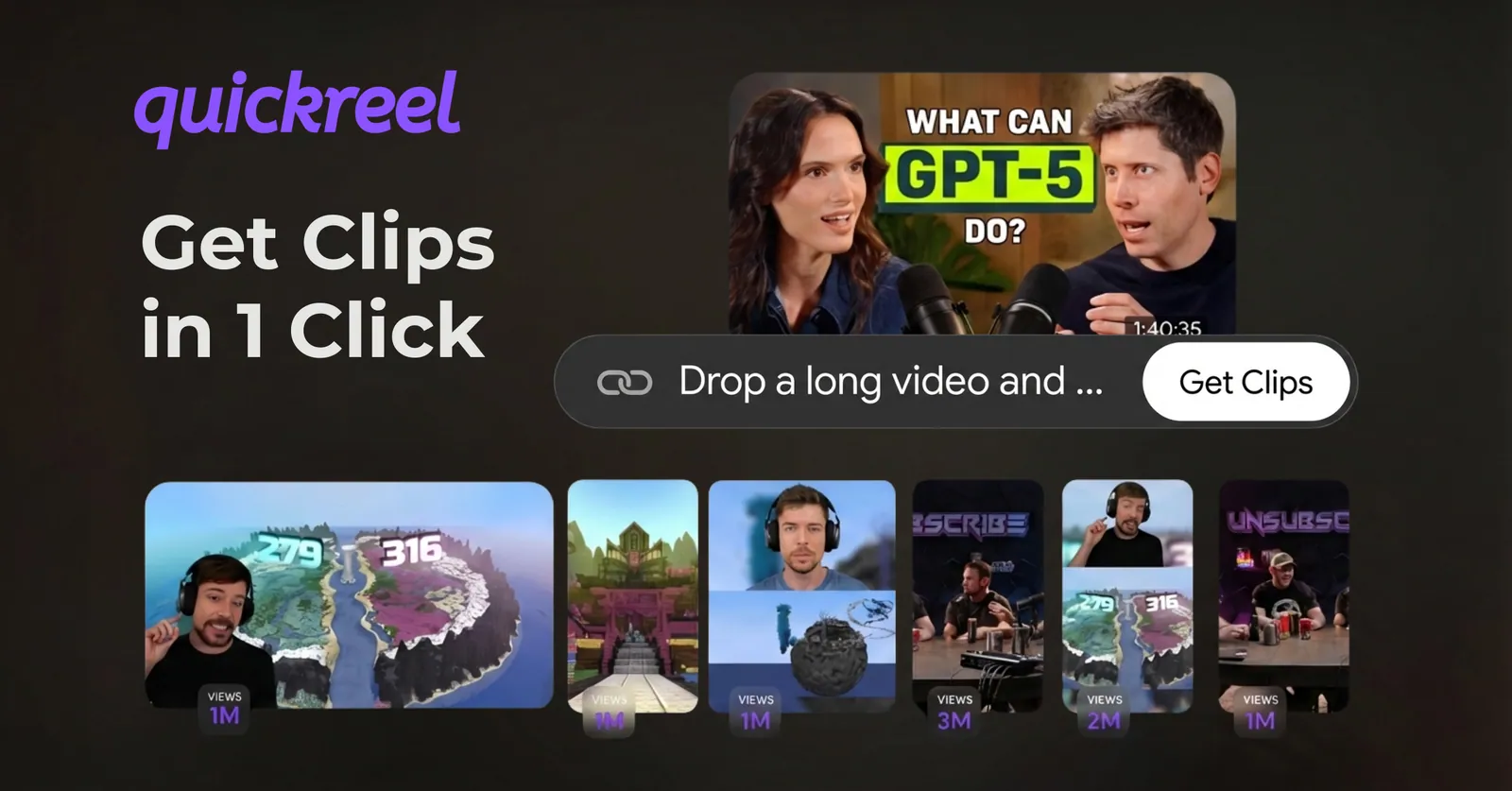
Full disclosure: this is us, and I scored it the way I score everyone, by the hard cases. QuickReel's captions run through a transcript-driven editor, so fixing a wrong name means clicking the word and typing, not exporting an SRT; the timing stays locked and the preview updates live. Captions come in 12+ styles across 20+ languages, and because clip generation, captioning, and scheduling to multiple platforms live in one app, the correction-and-post loop does not bounce between tools (quickreel.io). Pricing runs $9 Starter (100 credits) → $29 Pro (250 credits), with Pro currently 40% off at $17.40/mo, signup free and no card.
Where it is not the answer: if your only job is the most elaborate animated caption look, bouncing emoji, per-word color pops, trend templates, Submagic and Captions have a deeper template library aimed purely at that. QuickReel's styles are clean and broad rather than maximalist. And like every tool here, it still needs you to read each clip's captions once before posting; the engine gets the region right, you catch the proper noun.
2. Submagic, the best animated caption templates
Submagic is the specialist for clips where the caption style is the point: word-by-word reveals, keyword pops, trend-matched templates that look native to TikTok and Reels. If your brand lives on caption animation, this is the deepest library of it. The engine accuracy is competitive on clean audio, and the editor lets you correct words directly.
The honest limits are the plan caps, not the captions. The Starter plan runs $19/mo ($12/mo billed annually) and allows 15 videos a month at a 2-minute length ceiling; Pro at $39/mo ($23/mo annual) lifts that to 40 videos at 5 minutes (submagic.co). For a weekly show producing a dozen-plus clips, you will feel the Starter video cap quickly. It is also a one-clip-at-a-time tool by design, there is no built-in multi-platform scheduler, so it captions beautifully and hands the clip back to you to post elsewhere.
Best for: creators whose differentiator is caption animation and who clip in modest volume.
3. Captions, strong animation, polished mobile-first editor
Captions (the app) built its name on talking-head clips with clean, good-looking word-by-word captions and 100+ templates, with a polished editor that works well on mobile (captions.ai). For solo creators filming themselves, the capture-to-caption flow is among the smoothest, and accuracy on clean single-speaker audio is solid.
Two honest caveats. First, it runs on a credit system, Pro at $9.99/mo includes 200 monthly credits, and the heavier AI features (AI Twin, AI actors, text-to-video) are gated to the Max plan ($24.99/mo, 500 credits), where processor-heavy tasks can burn through them faster than you planned (captions.ai). Second, it is built around single-speaker talking-head video; for multi-guest podcast interviews with crosstalk, a tool on a stronger diarization engine handles speaker-heavy audio better. The Pro plan removes watermarks and is the realistic entry point.
Best for: solo talking-head creators who want polished captions and a clean mobile editor.
4. Veed, subtitle-first, the localization pick
Veed approaches captions as subtitles first, which makes it the strongest pick when languages are the priority: it supports 100+ languages with contextual translation and glossary support, and reviewers consistently put its English accuracy in the 95%+ range (Veed vs CapCut, 2026). If you publish the same clip in several languages, Veed's localization depth is the real differentiator here.
The trade is in the free tier and the translation gating. The free plan caps auto-subtitles at 30 minutes a month and watermarks exports; video translation is Pro-only and limited to 20 minutes a month even there (veed.io). So the localization strength you are choosing Veed for is metered tightly until you are on a higher plan. As a browser-based full editor it is more than a caption tool, which is a plus if you also need trimming and basic editing in the same place. For the broader subtitle-translation workflow, see how to translate podcast subtitles.
Best for: creators publishing clips in multiple languages who want deep localization.
5. CapCut, fast and cheap, with a 10-minute free caption cap
CapCut earned its reputation as the best low-cost option for social clips: fast processing, often under 30 seconds for a short video, and strong animated word-by-word captions, powered by ByteDance's speech model, which is notably good on Mandarin and Japanese (CapCut pricing 2026). On clean English it is fully competitive, and 1080p export and basic auto-captions are still on the free tier.
The real catch is the early-2026 pricing overhaul. CapCut split its plans, introduced a Standard tier at $9.99/mo, and pushed Pro to $19.99/mo (about $179.99/year, roughly double the prior annual rate) (CapCut pricing 2026). Free auto-captions are now capped at 10 minutes per video; unlimited captioning and 4K export require Pro. So a podcaster captioning long episodes hits the cap fast and ends up on a paid plan anyway. Worth a separate flag: CapCut was briefly pulled from US app stores in January 2025 alongside other ByteDance apps, so if you are a new US user, confirm it is installable for you before you build a workflow around it.
Best for: creators with English or Asian-language audio who want fast, cheap captions and clip short enough to stay near the free cap.
6. Descript, fix a caption by editing the text
Descript is not a caption tool; it is a text-based audio/video editor where the transcript is the timeline. That makes its correction loop conceptually the cleanest here: a wrong word is just a typo you fix in the document, and the video follows. If you are already editing your full episode in Descript, captioning a clip is nearly free effort (descript.com).
The honest caveat is scope and cost. Descript is overkill if all you want is captions on clips, you are buying a full editing suite, and the company moved its AI features to a credit system that drew pushback for capping things that were previously generous. Pricing runs Free (limited) → Hobbyist $16 → Creator $24 annually. As a dedicated caption-and-clip tool it is heavier than the others; as an all-in-one editing home it is the most capable.
Best for: creators who edit full episodes in a text-based editor and want clip captions in the same place.
How we evaluated
This roundup weights two axes the category usually ignores: real-world accuracy on hard audio (accented, noisy, crosstalk-heavy podcast interviews, where engines diverge) and correction speed (clicks from a wrong word to a fixed one). We grounded the engine-level accuracy claims in independent 2026 benchmarks rather than vendor marketing, Coval's cross-provider STT comparison and NovaScribe's tested transcription roundup, both of which cross-check against the public Hugging Face Open ASR Leaderboard (Coval, 2026; NovaScribe, June 2026).
Two caveats. First, we make QuickReel, so we held it to the harshest read and named where rivals beat it on animation depth and localization. Second, accuracy figures are directional ranges, not a single controlled lab run, and benchmark suites differ between vendors, your audio decides your number, which is exactly why we keep telling you to test a hard two-minute sample yourself.

The caveat no caption tool's marketing will tell you
No auto-captioning tool is post-without-checking. The reason is structural: errors cluster on the highest-value words, names, numbers, brands, punchlines, where alphanumeric and proper-noun accuracy can fall to 50–70% even when overall WER reads low (Coval, 2026). So the one word the model fumbles is often the one your clip is about. And it matters because most social video is watched silently: a 2019 Verizon Media and Publicis Media survey of 5,616 US adults found 92% of mobile users watch video with the sound off (Verizon Media + Publicis Media, via 3Play Media), so a captioning error is not a small blemish, for a muted viewer it is the whole experience. Budget 30 seconds to read each clip's captions before it posts. Tools that make that pass fast win; tools that promise you never have to are selling the wrong thing. The one trick that pays off repeatedly: load your recurring names and jargon into a custom vocabulary once, and highlight your keywords while you are in there.
Verdict: who should pick what
- Run a weekly show and want captions, languages, and posting in one place? QuickReel. Fast transcript-correction loop, 20+ languages, scheduling included, free to try with no card.
- Captioning fast-talking, crosstalk-heavy interviews? Pick a tool built on a strong diarization engine (AssemblyAI or Speechmatics underneath); test on your worst audio first.
- Your brand is the caption animation? Submagic or Captions, for the deepest template libraries, accepting the volume and credit caps.
- Publishing in multiple languages? Veed, for localization depth, knowing translation is metered until a higher tier.
- English or Asian-language audio and clips short enough to stay near the free cap? CapCut, just plan for the 10-minute free-caption limit.
- Editing the full episode anyway? Descript, where fixing a caption is just editing text.
For the wider clip-generation picture beyond captions, the best AI podcast clip generators we tested scores the same episode through six tools, and the QuickReel vs Opus Clip comparison runs the monthly-cost math for heavy clippers.
FAQ
What is the most accurate auto-captioning tool? On clean studio English, the top tools are effectively tied at 95–98% accuracy because they share the same underlying engines, which cluster at 2–5% word error rate (Coval, 2026). The real differences show up on accented and overlapping speech, where engines built on AssemblyAI or Speechmatics tend to hold up better. Test your hardest audio rather than trusting a headline number.
Are AI captions accurate enough to post without checking? No. Errors cluster on names, numbers, and key terms, accuracy on proper nouns and alphanumerics can drop to 50–70% even when overall WER looks low (Coval, 2026). Since 92% of mobile users watch video with sound off (Verizon Media + Publicis Media, via 3Play Media), those errors are visible. Always read each clip's captions once before posting.
Why do auto-captions get names and jargon wrong? Speech models predict the statistically likely word, and proper nouns and niche terms are rare in their training, so a brand name or technical term is exactly where they guess wrong. The fix is a custom vocabulary; some engines now take a keyterm prompt of up to 1,000 terms (AssemblyAI keyterms docs), so you enter recurring names once and the tool stops mis-hearing them.
Which auto-captioning tool is best for non-English podcasts? Veed leads on language breadth (100+ languages with contextual translation), and QuickReel supports 20+ languages with captioning and scheduling in one workflow (veed.io; quickreel.io). For accented English and code-switching specifically, an engine like Speechmatics, which reports code-switching about 35% better than its nearest competitor, is positioned best (Coval, 2026). Test a real sample in your language before committing.
Do I need a separate tool for captions and for clipping? Not necessarily. Some clip generators include captioning, and some caption tools include basic editing. QuickReel handles clip generation, captioning across 20+ languages, and multi-platform scheduling in one app, while a dedicated caption tool like Submagic captions a clip and hands it back to you to post elsewhere. Fewer tools usually means a faster correction-and-post loop.