
Choosing AI Clip Length: 15s, 30s, or 90s

There is no single best length for a podcast clip. The right length is whatever the moment needs, a one-liner dies if you pad it to 60 seconds, and an argument suffocates at 15. Match length to content type first, then trim to fit the platform. As a default that travels everywhere, aim for 30–60 seconds; go to 90 only when the moment genuinely earns it.
That order matters and most guides get it backwards. They start from platform limits, hand you a number, and you end up stretching a 12-second gut-punch into a slow 45-second clip because "55 is the sweet spot for Shorts." The sweet spot is real, but it's a ceiling to aim under, not a quota to hit. Length should fall out of the idea. If you're still deciding which moments to clip at all, how AI clip detection actually works covers what the model is hunting for before length even enters the picture.
What's the best length for podcast clips?
The best length for podcast clips is 30–60 seconds for most moments, long enough to land one complete idea, short enough that a meaningful share of viewers finish it. Use 15–20 seconds for a single punchy line, and 60–90 for a story or built argument. Length follows content type, then the platform.
Here's the rule in one matrix. Find the kind of moment down the left, read across to your target platform.
Read the matrix as ranges, not commandments. The green cell in each row is the platform where that moment type tends to land best, punchlines on Reels, single tips on Shorts, stories on TikTok. Cross-posting still works; the audiences barely overlap, so the same clip can go everywhere. The matrix just tells you where to lead.
Why length matters more than people think
Length isn't cosmetic. It sets your completion rate, and completion rate is the metric every short-form algorithm leans on hardest. The same idea cut at 22 seconds and at 47 seconds can pull wildly different reach, even with an identical hook, because more people finish the short one. (If you'd rather pick length by goal, reach versus depth versus saves, than by content type, our clip length strategy guide runs that lens instead.)
It also decides whether the clip earns the click to your full episode at all. Clips drive an estimated 20–40% of new-audience acquisition for video shows and can raise discovery reach 2–5× (Podcast Studio Glasgow; single-studio figures, treat as directional), but a clip that overstays its welcome converts nobody. The job is to leave the viewer wanting the rest, not to use up the rest in the clip.
The one number that survives every platform change is the opening. The first three seconds of a clip are where most of the drop-off happens, and they decide whether anyone reaches your carefully chosen length at all, castmagic calls them "absolutely critical for social media success" (castmagic). No length saves a weak open. A strong open buys you the length.
The platform caps you actually have to respect
Most "length rules" online are soft preferences. Two are hard, set by the platforms themselves, and worth committing to memory.
- YouTube Shorts: 3 minutes, since October 15, 2024. Vertical or square video up to three minutes is classified as a Short; go wider than that ratio or longer and it becomes a regular long-form video (Google, YouTube Help). For podcast clips you'll almost never approach the cap, but it means a 90-second clip is comfortably in-format, not a risk.
- Instagram Reels: up to 3 minutes, but shorter is favoured for reach. Instagram expanded Reels to three minutes in early 2025; the consistent guidance since is that shorter Reels get surfaced to non-followers more readily, with engagement peaking roughly in the 30–90-second band (creator/agency reporting, which conflicts on the exact discovery cutoff, treat the 90-second line as directional, not official).
TikTok allows far longer clips than you'd want to post from a podcast, so its cap is a non-issue. The practical constraint there is the same as everywhere: completion rate, which falls as length climbs.
There's real data behind the upper-middle band. Inflow Network analysed 5,400 YouTube Shorts and found that while most Shorts cluster in the 20–40-second range, the 50–60-second band pulled the most views, about 1.7 million, making 30–60 seconds the practical sweet spot (Inflow Network). Read it with one caveat the date forces on you: the study is from around April 2023, when Shorts were still capped at 60 seconds, so it can't speak to today's three-minute format. What it does tell you is that the longest end of the then-available range outperformed the short end, the ultra-quick cut left views on the table.

When to let the AI auto-pick vs force a length range
Default to auto when you're clipping a fresh episode and don't yet know what's in it. Force a range when you already know the platform, the goal, or the kind of moment you're after. The decision is about how much you already know, auto explores, a forced range exploits.
Use auto length when:
- You're doing a first pass on an episode and want the model to find the natural boundaries of each moment.
- The episode mixes formats, a punchline here, a long story there, and you don't want one length flattening all of it.
- You're batch-clipping a whole back catalogue in one pass and just want a wide shortlist to triage later.
Force a length range when:
- You're posting to one platform with a known preference (a tight 15–30s ceiling for Reels-first, say).
- You need a specific count of clips at a consistent length for a campaign or a series.
- The AI's auto picks keep running long and burying the one idea, clamp the ceiling and it cuts tighter.
The honest catch: auto isn't magic, and a forced range isn't a straitjacket. Whatever the model returns, you still re-trim by hand and pick the suggestions worth posting. In our own editing, length is the single most common thing we adjust after generation, usually shaving the first second or two of wind-up off the front. The setting gets you close; your trim gets you there.
How length changes which moments the AI even surfaces
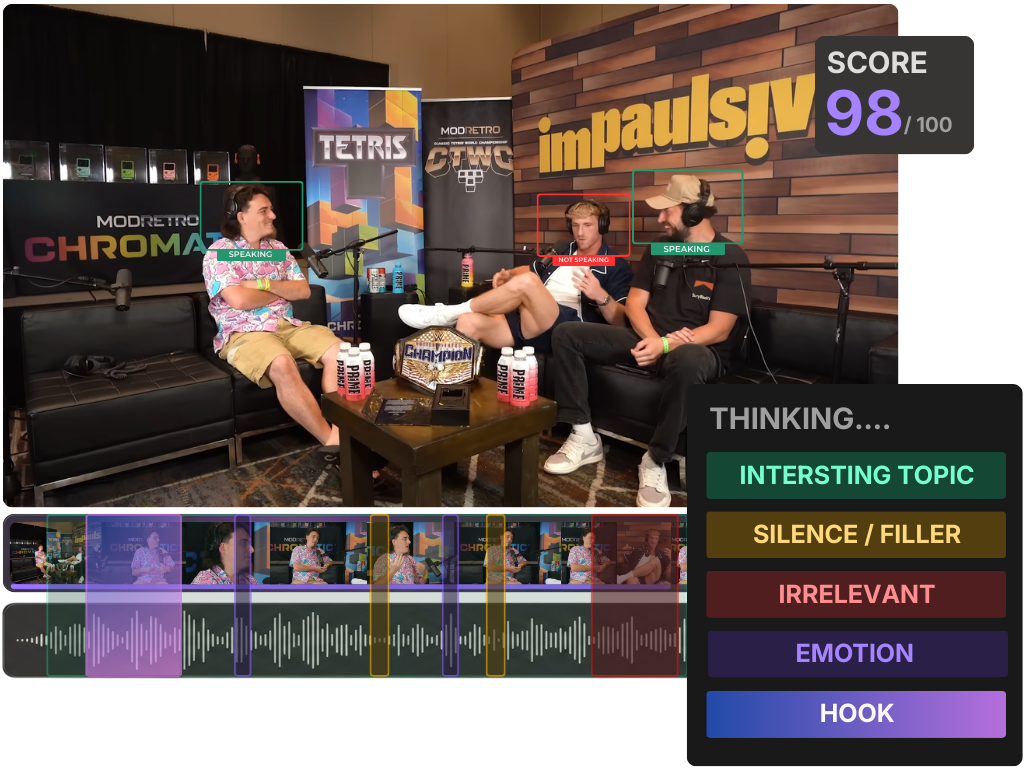
This is the part almost no guide mentions. Your target length doesn't just trim the clips, it changes which moments make the list at all. The model is scoring spans of transcript for a self-contained payoff. Ask for 15–20-second clips and it hunts for punchlines and standalone lines. Ask for 60–90 it looks for arcs: a setup, a turn, a landing.
So a short target quietly filters out every great story in the episode, because no story resolves in 18 seconds. A long target buries your sharpest one-liners inside slower segments. Set the range too narrow on the first pass and you never even see the best moment of the episode, it was never a candidate.
The practical move: run a wide or auto pass first to see everything, then re-run tight for a specific platform. First pass for discovery, second pass for production. You'll catch the story the narrow setting would have hidden, and still get your stack of crisp Reels-length cuts.
Common mistakes with clip length
- Padding a short moment to hit a "sweet spot." A 14-second knockout line beats the same line stretched to 50. If the idea is done, end the clip. Trailing silence and a slow exit are where completion rate goes to die.
- One length for every platform. Reels rewards the shortest cut; Shorts tolerates length best; TikTok sits in between. Lead each platform with the length that fits it, even if it's the same underlying moment.
- Forcing a tight range on the first pass. You'll never see the episode's best story, because it can't resolve inside your ceiling. Discover wide, then produce tight.
- Cutting at a number instead of an idea. "Make it 30 seconds" is not an edit. Cut where the thought lands, then check the number. A clean exit one beat early beats a tidy duration every time, for suspense-driven content especially, where to end a clip for maximum suspense is its own craft.
- Trusting the duration the AI hands you. Suggestions skew long. The model rewards a complete thought, and complete thoughts ramble. Re-trim toward the single idea; the virality score it shows you measures "interesting," not "the right length."