
Build vs Buy: An In-House Clipping Pipeline

Build your own clipping pipeline only if you're processing enough volume to amortize an engineer, or if clipping is core to your product and the tools can't do what you need. For almost everyone else, buy. The per-episode compute to transcribe, pick moments, reframe, and render a video is genuinely cheap, under a dollar at any sane volume. The expensive part is the engineering time to build it and the maintenance time to keep it working, and that cost doesn't shrink with scale the way a subscription does.
I run clip-quality benchmarks, and I've watched several teams talk themselves into a build because the API math looked trivial. The API math is trivial. It's also the wrong number to anchor on. Below is the full cost of a real pipeline, every line, with prices checked against live 2026 vendor and API pages, plus a break-even volume calculation you can drop your own numbers into. Re-verify any figure before you budget against it; SaaS and cloud prices move.
What does a clip pipeline actually need to do?
A working AI clip pipeline has five jobs, and a build means owning all five. It ingests and transcribes the episode, picks the moments worth clipping, reframes wide video to vertical and tracks the speaker, burns in captions and renders the output, and then keeps doing all of that reliably as platform specs, model APIs, and your own edge cases change. The first four are code. The fifth is a salary.
Most build estimates price the first four and quietly skip the fifth. That's the entire mistake.

How much does the compute actually cost per episode?
Per episode, the raw compute is cheap, call it well under a dollar for a typical hour-long video. Transcription runs about $0.36 an hour, the clip-selection model call is a few cents on the transcript, and rendering a batch of vertical clips is a fraction of an hour of GPU time. Stack those and a single episode's variable cost lands somewhere around $0.50–$0.90. That number is real, and it's also why the per-episode math is a trap: it's the smallest line in the whole build.
Here are the verified inputs for a one-hour episode, each priced against live 2026 pages.
| Pipeline step | Tool / rate | Cost per 1-hour episode |
|---|---|---|
| Transcription | GPT-4o Transcribe / Whisper at $0.006/min (diyai.io, 2026) | ~$0.36 |
| Clip selection | LLM on the transcript (~15K tokens in, ~2K out) | ~$0.05–$0.13 |
| Reframe + render | NVIDIA T4 at ~$0.30–$1.04/hr on-demand (getdeploying, 2026), ~10–20 min/episode | ~$0.05–$0.35 |
| Variable total | ~$0.50–$0.85 |
A note on the clip-selection model, since it's the line people guess at: feeding an hour-long transcript to a capable model and getting scored moment suggestions back is cheap because transcripts are small. A roughly 15K-token transcript with a 2K-token response is a few cents of inference at current frontier-model rates, and a lighter model drops it to a fraction of that. Either way it rounds to pennies, so the model call is never the line that decides a build.
So the headline build pitch, "we can run this for cents per episode", is true and beside the point. The real comparison isn't compute vs subscription. It's total cost of ownership vs subscription, and ownership has two lines the API bill doesn't show: the build and the maintenance.
What does the build itself cost?
The build is the line that decides this. A pipeline that just chains four APIs together, transcript in, moments out, crop, render, is a weekend prototype. A pipeline that handles real podcasts is not: multi-speaker reframing that doesn't whip between faces, caption timing that survives crosstalk, dead-air trimming, failed-job retries, format specs per platform, and a review queue a human can actually use. That's weeks of senior engineering, not a weekend.
Use the US Bureau of Labor Statistics median software developer wage of $133,080/year (BLS, May 2024) as the anchor. Loaded with benefits and overhead, call it roughly $90/hour of real cost. A genuinely minimal production pipeline, not a prototype, is conservatively 4–6 weeks of one engineer: at ~$90/hour over 160–240 hours, that's $14,000–$22,000 before a single clip ships. Build something with the reframe quality of a commercial tool and you're well past that.
Then maintenance, which is the line teams systematically zero out. Platforms change aspect specs and safe zones; the transcription and model APIs version and reprice; your own pipeline accumulates edge cases the moment real episodes hit it. Budgeting even 4 hours a week of engineering upkeep is ~$18,700/year at the loaded rate, and that's the floor, because the first time the pipeline breaks the night before a launch, the real cost is the launch, not the hour.

Where does build break even with buy?
In year one, build doesn't break even with buy until you're running roughly 650 hour-long episodes a month at QuickReel's pricing, the volume where stacked subscription spend finally matches the full first-year build bill (a ~$37K base of build plus maintenance, plus compute that pushes it to ~$42K at that volume). Below that, buying is cheaper on pure dollars and far cheaper on risk. The build column barely moves with volume because compute is the cheap line; the buy column rises with episode count but stays under a developer's salary for a long time. The crossover is a salary, not a credit balance.
Here's the year-one comparison, built from the verified inputs above. Build = an $18,000 one-time build (midpoint) + $18,700/year maintenance + ~$0.70/episode compute. Buy = QuickReel's verified ladder, with each hour-long episode costing ~60 credits at ~1 credit per source-minute: Pro at $17.40/mo promo for 250 credits, scaling up to Ultimate at $89/mo for 1,000 credits and 10 seats (quickreel.io/pricing, checked 28 June 2026). At higher volumes you stack Ultimate seats to cover the credits.
| Monthly episodes | Build, year one | Buy (QuickReel) |
|---|---|---|
| 10 (~600 credits/mo) | ~$36,800 | ~$1,068/yr (1× Ultimate) |
| 30 (~1,800 credits/mo) | ~$36,950 | ~$2,136/yr (2× Ultimate) |
| 100 (~6,000 credits/mo) | ~$37,540 | ~$6,408/yr (6× Ultimate) |
| 300 (~18,000 credits/mo) | ~$39,220 | ~$19,224/yr (18× Ultimate) |
Read the table the way it's meant to be read: the build column is almost flat because the expensive part is fixed engineering, not per-episode compute. The buy column does climb with volume, credits aren't free, but even at 300 episodes a month it's roughly half a single engineer's loaded cost. In year one you don't cross into "build is cheaper" until stacked subscription spend tops the full build bill, about $37K of build plus first-year maintenance, which at QuickReel's pricing means roughly 650 hour-long episodes a month. (Two caveats keep this honest: the build column itself keeps creeping up with compute as volume rises, so at the crossover the build is nearer $42K than $37K; and once the build is sunk, the ongoing break-even against maintenance alone arrives far sooner, closer to 340 episodes a month. Year one is the conservative number; steady state favours the build earlier.) The honest version of "build to save money" is that it almost never saves money on its own; it pays off only when you already have the engineer, the volume is high, and clipping is something you need to control end to end.
When building actually makes sense
There are real cases for a build, and they're honest ones. None of them is "to save money on the subscription."
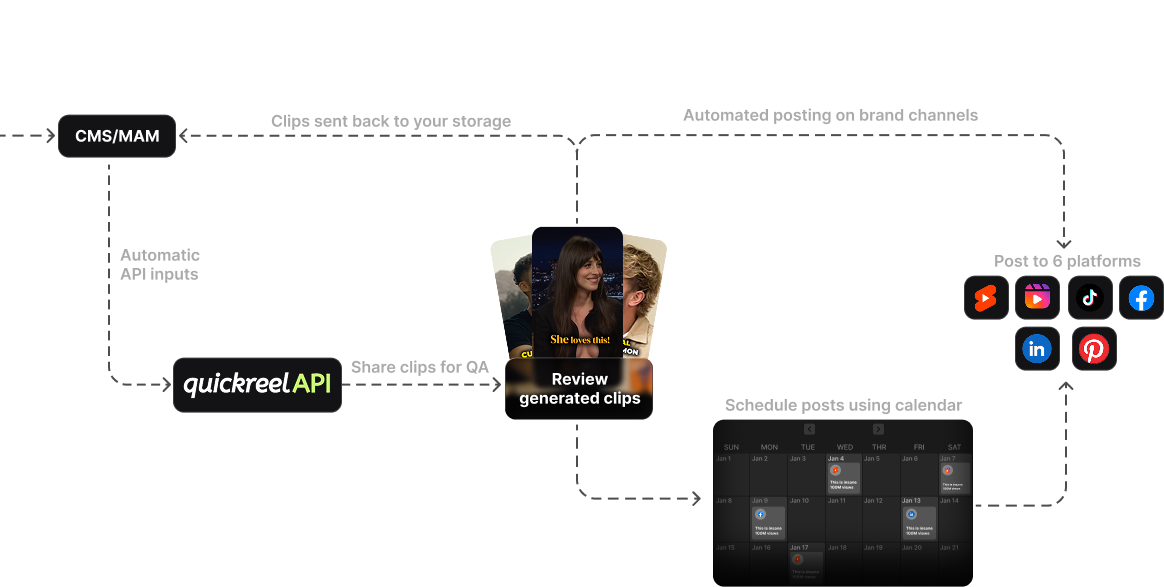
- Clipping is your product. If you're shipping clipping to customers, an agency platform, a media tool, a network's internal CMS, you need to own the pipeline because it's the thing you sell. Differentiation lives in the workflow, and you can't differentiate on a vendor's. Teams in this position should weigh what an API-first clip tool gives you before deciding to build from zero, because a programmable tool is often the middle path.
- You have a hard requirement no tool meets. On-prem-only processing for compliance, a proprietary scoring model trained on your own performance data, a language or format nobody supports. If the requirement is real and specific, build it.
- Your volume is genuinely enormous and you already have the engineers. At thousands of episodes a month with an existing infra team, the loaded build cost amortizes and the per-episode compute saving compounds. The crossover from the table above is reachable here, but you got there on volume plus existing capacity, not on the API price.
The honest reality check that applies to every build: an AI pipeline still produces clips that need a human review pass. In our own clip-quality benchmarks at QuickReel, a meaningful share of auto-selected moments still need a trim, a tighter end, or a cut dropped before they ship, and building the pipeline yourself doesn't change that, because the model does the same job either way. You own the review queue too. Detection is close to a commodity: in our side-by-side tests, the major tools surface largely the same set of strong moments from the same episode. What separates a good pipeline from a bad one is the workflow around the detection, and that is exactly the expensive, fiddly part you'd be building.
How the buy option actually prices out
If you land on buy, the comparison shifts to which tool, and the field is close on detection but spread on workflow and price. QuickReel sells output credits, roughly one credit per minute of source, with Pro at $17.40/mo promo ($29 list) for 250 credits and Ultimate at $89/mo for 1,000 credits and 10 seats (quickreel.io/pricing). Opus Clip lists a free tier with a watermark, a $15/mo Starter that already removes the watermark but locks the editor and caps export at 720p, and a $29/mo Pro that adds editing, 1080p export, B-roll, scheduling, and 16:9 output (opus.pro/pricing, both checked 28 June 2026). At the volume most teams actually run, either one costs a fraction of a single build.
The fair way to choose between buy options is to ignore the sticker and compute cost per finished clip, folding in your own review time, which dominates at any volume. We walk through that exact method in how to calculate your true cost per clip. For the head-to-head detection and edit-quality comparison, the best AI podcast clip generators, tested and the best Opus Clip alternatives in 2026 do the legwork. Teams running clips for clients should also read the agency-focused breakdown and the multi-seat team comparison, since seat pricing and brand templates change the math at scale.
FAQ
Is it cheaper to build my own AI clipping tool than to subscribe? Almost never, on its own. The per-episode compute is cheap, under a dollar for an hour-long episode, but a production build costs roughly $14,000–$22,000 in engineering time plus ongoing maintenance, against a subscription that runs in the low thousands a year even at 100 episodes a month. You'd need very high volume and existing engineering capacity for the build to pay off.
How much does it cost to run a clip pipeline per episode? For a one-hour episode: about $0.36 to transcribe at $0.006/min (diyai.io), a few cents for the clip-selection model call, and a fraction of an hour of GPU time to render, NVIDIA T4 runs roughly $0.30–$1.04/hr on-demand (getdeploying). Total variable cost lands around $0.50–$0.85.
What's the hidden cost everyone forgets in a build? Maintenance. Platforms change specs, APIs version and reprice, and real episodes generate edge cases your prototype never saw. Even 4 hours a week of engineering upkeep is roughly $18,700 a year at a loaded developer rate, and that's the floor, it doesn't get cheaper as you scale, which is the opposite of how the compute behaves.
Does a self-hosted pipeline skip the human review step? No. Every AI clipper, built or bought, produces moments that need a human pass, in our own clip-quality benchmarks at QuickReel, a meaningful share of auto-picks still need a trim or a dropped cut before they ship. Building your own means you own that review queue too. Detection is close to a commodity; the workflow around it is the hard, expensive part.
When does building actually make sense? When clipping is your product (you sell it to customers), when you have a hard requirement no tool meets (on-prem compliance, a proprietary scoring model, an unsupported language), or when your volume is enormous and you already employ the engineers. None of those reasons is "to save money on the subscription."