
Best Clip Generators With an API (2026)

If you want to generate podcast clips from code, five APIs are worth shortlisting in 2026: Vizard for the cleanest self-serve start, OpusClip for the deepest SDK and tooling story, Klap for API access on every plan, QuickReel for a full pipeline (clip, caption, B-roll, auto-post) behind one key, and Sieve if you want to assemble your own clipper from primitives. Which one wins depends on three things you can check before writing a line of code: can you get a key without a sales call, does it support webhooks or only polling, and what does a minute of video actually cost.
This is not the same question as "which clipper makes the best clips." The clip-quality gap between modern tools is narrow, most now detect roughly the same 80% of moments, so the differentiator is the post-detection workflow, not the detection itself (autoclip.dev buyer's guide, 2026). For an API, "workflow" means latency, error handling, rate ceilings, and the bill at volume. That is what this comparison grades. Every number below was checked against each vendor's live docs and pricing in June 2026; SaaS prices and rate limits move, so re-verify against the linked source before you sign a contract.
The technical capability table
Here is the shortlist on the fields that decide an integration. "Self-serve" means you can generate a key from the dashboard without contacting sales. "Min charge" is the smallest billable unit per submission.
| API | Access & auth | Async model |
|---|---|---|
| Vizard | Self-serve key from Creator plan up; Bearer key | Webhook or polling (30s interval suggested) |
| OpusClip | Self-serve free tier; key in dashboard; Pro/Max/Business | Webhook or polling; 6+ SDKs, MCP server |
| Klap | Self-serve on every plan; Bearer key | Polling task status (no documented webhook) |
| QuickReel | Request access, then self-serve key; Bearer key | Webhook or get-project polling |
| Sieve | Self-serve key; pay-as-you-go credits | Webhook or polling; you compose the pipeline |
And the parts that hit your invoice and your queue:
| API | Rate limit (submit) | Billing unit & min charge |
|---|---|---|
| Vizard | 3 req/min, 20 req/hour (raise on request) | 1 credit = 1 input minute; no per-job minimum |
| OpusClip | 30 req/min per key | 1 credit = 1 input minute; 10-credit project minimum (API) |
| Klap | Not published; per-operation pricing | Per-operation, billed by processed length |
| QuickReel | Not published; contact for high volume | Credit-based; 1 credit ≈ 1 processed minute |
| Sieve | Generous; compute-bound | Pay-per-second of compute (no flat per-minute) |
The single most useful takeaway: OpusClip's submit ceiling is ten times Vizard's (30/min vs 3/min). If you batch a back catalog or run a multi-tenant product, Vizard's 3-per-minute limit means you queue submissions client-side or email them for a raise. For a steady drip of one episode at a time, it never matters.

How we evaluated
I read each vendor's live API docs and pricing in June 2026 and graded on five things a developer actually files a ticket about: whether you can get a key without sales, what the endpoints cover beyond "make clips," the submission rate ceiling, webhook support versus polling-only, and the effective cost per processed minute on the cheapest API-enabled plan. I did not re-test clip quality here, that is the job of our hands-on roundup of AI podcast clip generators, which scores the output, not the integration. Where a vendor does not publish a number (rate limits, exact API pricing), the table says so rather than guessing.
One honest caveat that applies to all five: an API does not remove the review step. Plan to keep only about 20–40% of the clips an AI suggests after a human looks at them (Fluxnote, 2026), an API moves that review from a web dashboard into your own UI, it does not delete it. If your plan is "fire the API and post whatever comes back," budget for the misses.
Vizard, the cleanest self-serve start
Vizard is the API I would hand a developer who wants to ship this week. You log in, open Workspace Settings, click the API tab, generate a key, and you are submitting jobs, no application, no call (Vizard quickstart). The model is two calls: POST /project/create returns a projectId, then you either poll /project/query/{projectId} every 30 seconds or register a webhook URL in your workspace and get pinged when clips are ready (Vizard docs). It ingests remote files, YouTube, Google Drive, Vimeo, and StreamYard, which covers most podcast sources.
What's good: API access is included on every paid plan, not gated to enterprise. Billing is the simplest of the group, 1 credit equals 1 uploaded minute, regardless of how many clips you generate, so a 60-minute episode costs 60 credits whether you keep 5 clips or 50 (Vizard pricing docs). Code samples ship in Python, Java, Go, and cURL, plus an n8n template.
What's not: the submission rate limit is the tightest here, 3 requests per minute and 20 per hour on the create endpoint (Vizard rate-limit docs). Vizard will raise it for high-volume customers by email, but out of the box it forces you to queue. The Creator plan that grants API access runs about $29/month on monthly billing or roughly $16.90/month annual, for 600 credits (~600 minutes) (Vizard pricing; price varies by source and promo, verify live).

OpusClip, deepest tooling, real free tier for the API
OpusClip has the most built-out developer story. There are 6+ official SDKs (Node, Python, Go, PHP, Ruby, Java), a public OpenAPI spec, an llms.txt, and a native MCP server with a one-line install in Claude, Cursor, Cline, and Continue (OpusClip API). The endpoint set goes past clipping: create a project, query clips, apply brand templates, edit clips (trim, extend, fix caption typos), share a project, and post to social (OpusClip API reference). It supports webhooks for real-time completion notifications.
What's good: the submission ceiling is 30 requests per minute per key, ten times Vizard's, and concurrency is 4 parallel projects on Pro Beta and Max, jumping to 50 on Business (OpusClip API reference). The API now has a self-serve free tier, so you can build without a sales call, which was not true a year ago. Credits are 1 per input minute, same as Vizard. Opus is also the category's scale leader, a $215M valuation as of its March 2025 SoftBank round, and 170M+ clips generated (Sacra), which is some signal the API will not vanish.
What's not: the API carries a 10-credit project minimum, submit a 4-minute clip and you are still billed 10 credits, which web submissions are exempt from (OpusClip API reference). That penalizes pipelines that send lots of short videos. API access sits on Pro (Beta), Max, and Business plans; the consumer Starter ($15) and Pro ($29) tiers are the reference points, with Business priced by contract (OpusClip pricing). If most of your inputs are short, the minimum charge erodes the price advantage.
Klap, API on every plan, simplest mental model
Klap removes the access friction entirely: the API is open to every customer on every plan, including the entry tier, with no application or approval (Klap docs). Auth is a Bearer key from klap.app/rest-api, base URL https://api.klap.app/v2, and the surface is three endpoint groups, Tasks (create and monitor), Projects (manage generated shorts), and Exports (render the final file) (Klap docs). The two core operations are generate-shorts and caption/reframe, plus managed sub-users and an embeddable editor if you are building a product on top.
What's good: zero gating is rare and genuinely useful, you can prototype on the cheapest plan before committing. Pricing is transparent per operation in the docs, and the app tiers are public: Basic ~$14/month, Pro ~$39/month, Pro+ ~$94/month on annual billing (Klap pricing).
What's not: Klap's status model is polling, not webhooks, you create a task and poll the task endpoint until it reaches ready (Klap docs). That is fine for low volume but means more idle requests and more code than a callback. Klap also does not publish a hard submission rate limit, so plan for backoff and watch for 429s in production.

QuickReel, the full pipeline behind one key
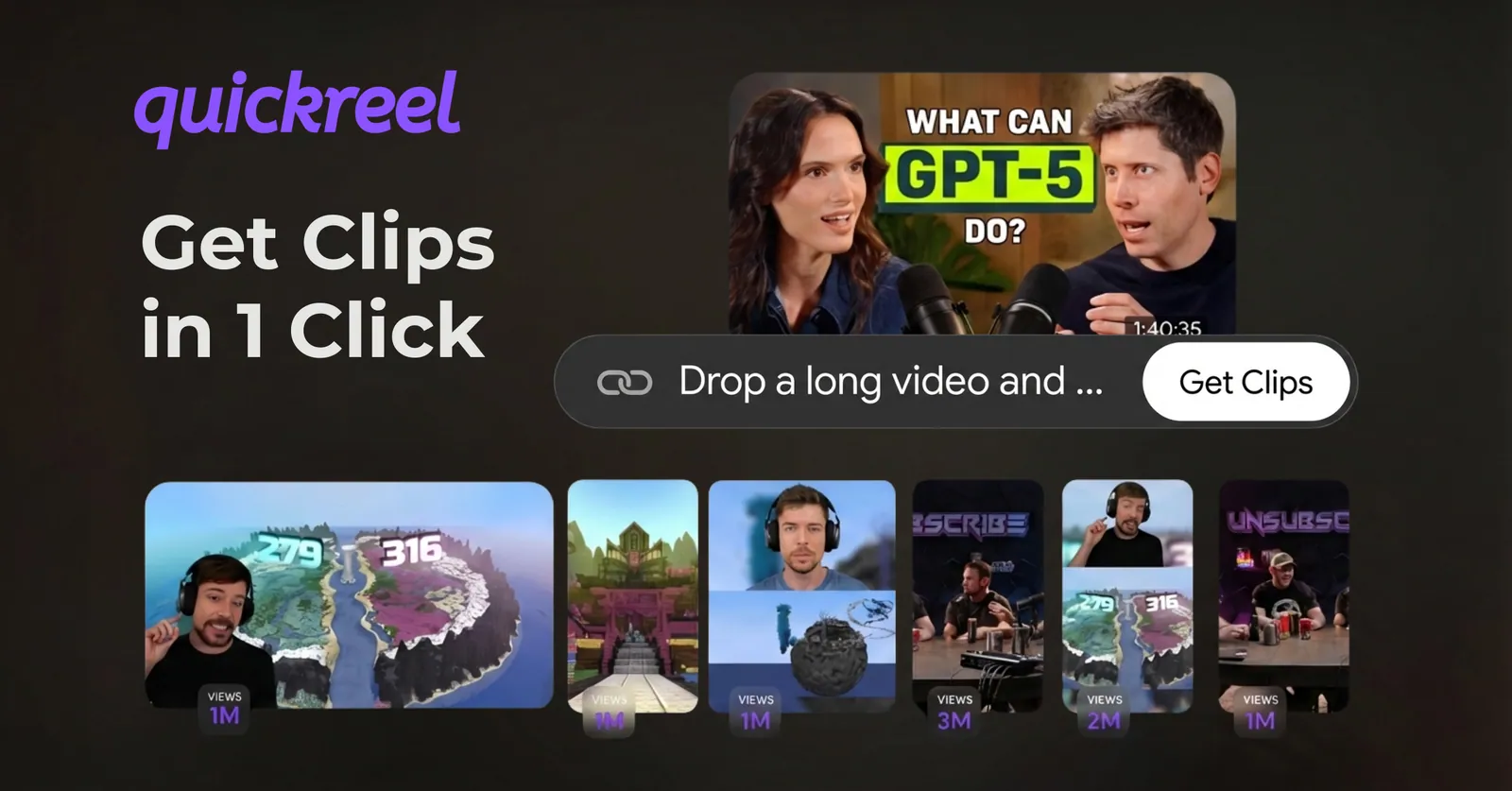
I work on QuickReel, so read this section knowing that. The honest pitch for the API is scope: it is not only a clipper. The endpoints under https://mango.quickreel.io/api/v2 cover AI Clipping, AI Subtitle (animated captions and transcription), AI Edit (templates), AI BGM, AI B-Roll, Autopost to social platforms, plus TTS and text-to-video, all behind one Bearer key (QuickReel API docs). Each endpoint returns async, register a webhook or poll the get-project endpoint by ID (QuickReel docs). It runs in 40+ languages and is built for the case where you want clip, caption, B-roll, and the post-to-six-platforms step in a single pipeline rather than stitching three vendors.
Where it fits: media houses and multi-channel operators who want the whole repurposing chain, not just the cut, automated. If your product needs to clip, caption, add B-roll, and schedule, doing it through one API and one bill is fewer moving parts than calling a clipper, a caption tool, and a scheduler separately. The web side is freemium with no trial gate: Starter is $9/month for 100 credits, Pro is $17.40/month (promo; $29 list) for 250 credits, scaling to Ultimate (QuickReel pricing).
Where it does not: API access starts with a "request access" step on the API page rather than a one-click key like Vizard or Klap, and QuickReel does not publish a fixed submission rate limit, high-volume users are asked to contact the team. If your entire requirement is "clip and nothing else," a single-purpose API with a published rate limit may be the lighter choice. The pipeline breadth only pays off when you use more than the clip step.
Sieve, build your own clipper from primitives
Sieve is the odd one out, and the right answer for a specific team. It is not a packaged "URL in, clips out" clipper; it is a developer platform of video AI primitives, transcription, scene detection, silence detection, semantic analysis, highlight extraction, that you compose into a pipeline (Sieve). News and sports teams use it to build custom highlight reels and time-coded summaries. If you have an opinionated definition of a "good moment" that a black-box clipper will not honor, Sieve lets you encode it.
What's good: maximum control and pay-per-second billing measured on actual compute, so you only pay for what you run (Sieve, eesel). No per-job minimums, no opaque credit conversions.
What's not: you build the clipper. There is no one-call "make me clips" endpoint, you wire transcription to detection to rendering yourself, which is days of engineering, not an afternoon. And the pay-per-second model gets murky when you call third-party models through Sieve: independent analysis notes Sieve adds markup on outside providers like ElevenLabs and OpenAI, so estimate the full chain, not just the in-house pieces (eesel). Choose Sieve only if "good enough automatic clipping" genuinely is not good enough for you.

The async pattern they all share
Every one of these APIs is asynchronous, and the shape is identical. You submit a long video, get back a job ID immediately, then learn the clips are ready one of two ways: a webhook your server registered, or a poll loop you run yourself. Build for webhooks where they exist (Vizard, OpusClip, QuickReel, Sieve) and fall back to polling only where you must (Klap). Webhooks cut idle requests and latency; polling is simpler to debug but noisier.
Which API should you pick?
Pick by the constraint that hurts most, not the feature list. Ship fast and low-volume: Vizard. High throughput or multi-tenant: OpusClip, for its 30/min ceiling and SDKs. Zero gating to prototype: Klap. The whole clip-caption-B-roll-autopost chain in one bill: QuickReel. A custom definition of a good moment: Sieve, built from primitives.
- Ship this week, low volume: Vizard. Fastest self-serve key, cleanest two-call flow, simplest 1-credit-per-minute math. Live with the 3/min limit or email for a raise.
- High throughput or a multi-tenant product: OpusClip. The 30/min ceiling and 50-project concurrency on Business are built for scale, the SDKs save days, and the MCP server is genuinely handy. Watch the 10-credit job minimum on short inputs.
- Want zero gating to prototype: Klap. API on every plan. Accept polling.
- Need the whole chain, clip, caption, B-roll, auto-post, automated: QuickReel. One key, one bill for the full pipeline in 40+ languages. Worth it only if you use more than the clip step; request access first.
- Have a custom definition of a good moment: Sieve. Build it from primitives. Budget the engineering and the third-party markup.
If you are still choosing the underlying clipper rather than the integration, start with the tested ranking of AI podcast clip generators and the best OpusClip alternatives for output quality, then come back here for the API layer. A head-to-head on the two best-known options is in our QuickReel vs OpusClip comparison. Teams clearing a back catalog should also read the bulk clip generator comparison; anyone weighing captions specifically should see the auto-captioning tools roundup; and agencies running this for multiple clients will want the clip tools built for agencies, where the API often pairs with a scheduler.
FAQ
Which clip generator has the best API for developers? There is no single winner, it depends on your constraint. Vizard is the easiest self-serve start, OpusClip has the deepest SDK and tooling story and the highest published rate limit (30 req/min), Klap offers API access on every plan, and QuickReel exposes a full clip-caption-B-roll-autopost pipeline behind one key. Match the API to your bottleneck.
Does OpusClip require a sales call for API access? No, not anymore. OpusClip now offers a self-serve free tier for the API, so you can generate a key and start building without contacting sales (OpusClip API). API access sits on the Pro (Beta), Max, and Business plans, with Business priced by contract for the highest concurrency.
How is clip-generation API pricing usually calculated? Most clip APIs charge by input length, not output. On Vizard and OpusClip, 1 credit equals 1 minute of uploaded video, so a 60-minute episode costs 60 credits whether you keep 5 clips or 50 (Vizard docs; OpusClip reference). Watch for per-job minimums, OpusClip's API bills at least 10 credits per submission.
Do these APIs support webhooks or only polling? Vizard, OpusClip, QuickReel, and Sieve support webhook callbacks so your server is notified when clips are ready; all of them also allow polling. Klap's documented model is polling the task status endpoint until it returns ready. Build for webhooks where available, they cut latency and idle requests.
Can I clip directly from a YouTube URL via API? Yes, on most of them. Vizard accepts remote files, YouTube, Google Drive, Vimeo, and StreamYard (Vizard quickstart). OpusClip and QuickReel take long-form video URLs as well. Sieve accepts whatever you feed its transcription and detection steps. Always check each vendor's supported-source list before assuming a source works.
Do I still need human review if I automate clipping through an API? Yes. An API automates the cutting, not the judgment. Expect to publish only about 20–40% of what an AI suggests once a person screens it (Fluxnote, 2026). The API moves that review into your own interface, it does not remove it. Plan a review step or expect to post misses.