
When Your AI Clipper Missed the Good Moment

When an AI clipper skips the moment you knew was the best in the episode, it is almost never a bug. The model scores measurable signals, topic shifts, sentiment spikes, energy, pauses, and some of your strongest moments produce none of those. The fix is a ten-minute manual sweep over four specific blind spots the model structurally cannot see: slow-burn stories, inside jokes and callbacks, visual moments, and quiet vulnerable lines.
That is the whole method, and the rest of this page is how to run it. You do not need to abandon the AI. You need to know exactly where its recall ends and your eyes take over.
Why bother chasing the moments it missed
Clips are the discovery engine for a video show, so a missed great moment is a missed audience, not a missed nicety. One studio's client data puts clips at 20–40% of new audience, with reach lifts of 2–5× (Podcast Studio Glasgow), read that as a directional range from a single firm's accounts, not a platform-wide guarantee. Separately, 57% of listeners now say social media clips drive their podcast discovery, the first year that surpassed friends and family (Inside Radio).
Here is the uncomfortable part. The AI is optimizing for what it can measure, and what it can measure is correlated with what travels, but not identical to it. Your funniest callback, the one your regulars would tag three friends on, can score a flat zero on every signal the model reads. If you only ever post the suggested list, you are systematically leaving your best inside-the-fold moments on the cutting room floor.

What "recall" means here, and why there's a ceiling
Detection has two failure modes. Precision errors are when the model suggests a dud, easy to catch, you just delete it. Recall errors are when a real winner never appears on the list at all. Recall errors are invisible by definition: you cannot delete a suggestion that was never made. That is why they cost you the most and get audited the least.
The ceiling exists because of how the pipeline works. As covered in how AI clip detection actually works, the model leans hardest on the transcript, partly because most social video is watched muted, a widely cited figure puts it near 85%, though that traces to 2016 publisher data and the same report cites individual publishers as low as 50–80% (Digiday). A transcript-first model is brilliant at catching a sharp verbal exchange. It is structurally blind to anything whose value lives outside the words, in pacing, in shared memory, in the picture, or in a deliberately small delivery. Those four categories are the recall ceiling.
The four moments the model structurally can't see
This is the framework. Each blind spot maps to a detection signal the moment fails to trip, which tells you exactly why it got skipped, and exactly how to spot it yourself.
Slow-burn stories. A great story has a setup, a wind, and a payoff that can sit four minutes apart. The model segments into 15-to-90-second windows and scores each in isolation, so a story whose value only exists end-to-end never produces one high-scoring window. The setup looks ordinary; the payoff looks unmotivated without it. You recover these by editing across the model's window, not inside it.
Inside jokes and callbacks. A line that detonates because your regulars remember episode 12 carries almost no signal on its own. The words are flat, the sentiment is neutral, and the model has no memory of your back catalogue to know it is a callback. The humor is in shared context the transcript does not contain. You are the only one who can flag these, because you are the one who built the context.
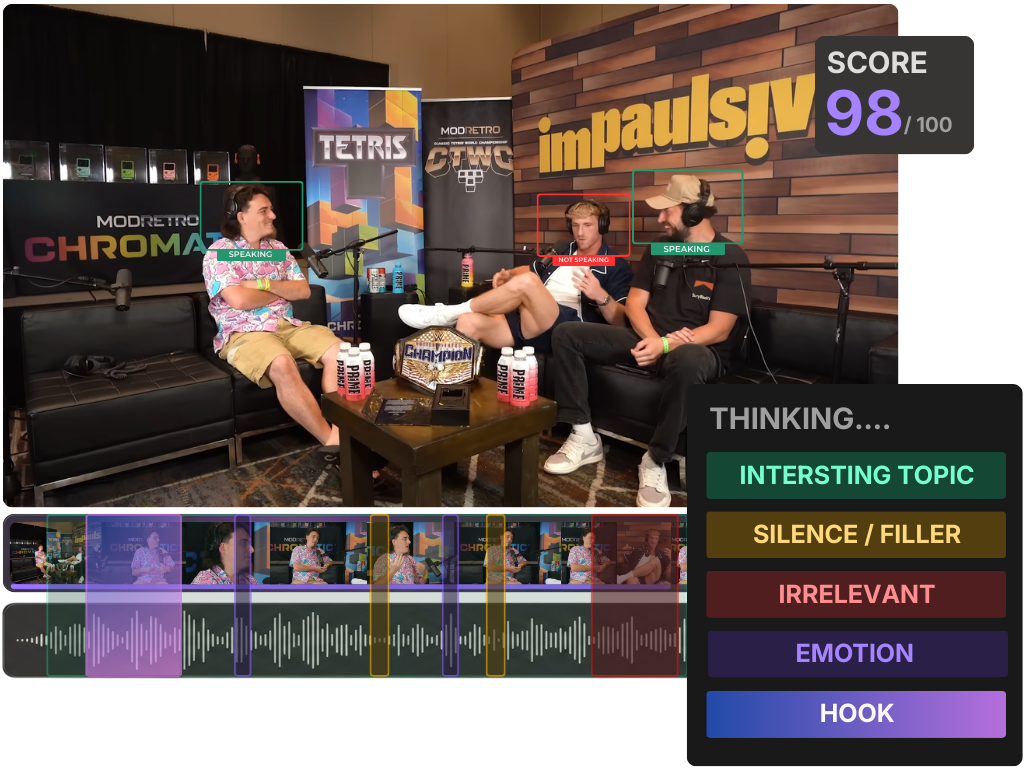
Visual moments. A guest's face when they realize they are wrong, a prop held up to camera, a number written on a whiteboard, the transcript for all of these reads as a filler line or nothing at all. Most clippers score the words and the audio first; visual cues, where they exist, are used for framing, not for picking. If the payoff is something you see, the model is looking the wrong way.
Quiet vulnerable lines. The most-shared confession on a show is often the softest one, said slowly, at low volume, after a pause. The energy signal reads that as low-stakes, exactly backwards from how a human hears it. Calm delivery of a heavy truth scores like calm delivery of a grocery list. These are the moments the model is most confidently wrong about.

The ten-minute manual sweep
Run this after you get the AI list, not instead of it. The model already found the verbal winners; your job is the four blind spots, and you do it from the transcript, which is faster than scrubbing the video. Four passes, one per blind spot.
- Pass one, story payoffs. Open the full transcript and search for your own reactions: "ha," "wow," "no way," laughter tags, "that's wild." Each one usually sits at the end of a story the model fragmented. When you find a payoff line, scroll up to where the setup begins and mark that timestamp as the clip start. You are reassembling the arc the windowing broke apart.
- Pass two, callbacks and inside jokes. This one only you can do, and it takes two minutes. Skim for any line that made you laugh in the room but reads flat on the page. If it is funny only because of a previous episode or a running bit, it is a callback. Mark it. Your regulars are the audience most likely to share, and this is the clip they share.
- Pass three, visual beats. Put the video on 2× speed with the sound off and watch the faces and hands, not the captions. Stop on any genuine reaction, demonstration, or on-screen object. A muted scrub of a 45-minute episode takes about three minutes and surfaces every moment whose value the transcript erased.
- Pass four, quiet lines. Go back to the transcript and read for content, ignoring delivery. Look for the soft admission, the "I've never told anyone this," the under-stated truth. These are the lines the energy signal buried. Cut them tight, lead with the line itself, and let the stillness carry the clip.
A useful rule for the whole sweep: if you remember a moment two days after recording but it is not on the AI list, that is almost certainly a recall miss, and it goes straight into the queue. The rubric in how to pick the best AI-suggested clips then applies to your recovered clips exactly as it does to the model's.
Common mistakes when recovering missed moments
Treating the AI list as exhaustive. The suggestions are a high-precision shortlist, not the full set of good clips. If you never sweep, your recall errors stay invisible and your best inside-the-fold moments never ship. Budget the ten minutes; minute for minute, it is the most valuable editing you do.
Posting the slow-burn at full length. Recovering a story is not the same as posting the whole four minutes. Find the tightest version that still includes the setup the payoff needs, often you can compress the wind-up hard and keep only the turn. Length is not comprehension.
Cutting a quiet line on the model's energy logic. The instinct, trained by the AI, is to start clips on a loud beat. A vulnerable line is the opposite: open on the stillness, put the line in the first caption, and resist adding music that fights the tone.
Forgetting the callback needs a hook for strangers. A clip that lands for regulars can baffle a new viewer. If a recovered inside joke is going to a cold audience, add a one-line caption that supplies the missing context. For narrative genres where the ending does the work, where to end a true crime clip for max suspense is the same discipline applied to cut points.
Skipping the muted scrub because it feels slow. Three minutes of watching faces is the only way to catch visual moments, and it is the blind spot with the least overlap with the transcript. Do not drop it; it is where the model is most reliably absent.
Where the tools fit
No AI clipper closes the recall ceiling, because the ceiling is a property of scoring measurable signals, not a feature any one tool lacks. Across modern clippers, detection finds roughly the same verbal winners; the honest framing is that every one still needs a human to select the keepers and catch the nuance the model misses, even production studios that lean on AI transcription end up hand-picking the final set (Podcast Studio Glasgow). The sweep above is that review, aimed precisely at what the model cannot reach.
What a tool can do is make the sweep fast. QuickReel gives you the AI shortlist plus a searchable transcript and an editable timeline in one place, so reassembling a slow-burn story or trimming a quiet line is a drag, not a re-export loop, and you can batch-clip a whole episode in one pass before you sweep the back catalogue. Treat the suggestions and the virality score as a starting shortlist, then add the four moments only you can see. That combination beats either the model alone or the manual grind alone.
FAQ
Why did my AI clipper miss my best moment? Because your best moment likely produced none of the signals it scores, no sharp topic shift, no sentiment spike, no energy jump. Slow-burn stories, inside jokes, visual beats, and quiet lines all carry their value outside the transcript and audio the model reads, so they fall below its detection threshold.
How do I find clips the AI didn't suggest? Run a four-pass sweep on the transcript: search your own reactions to find story payoffs, skim for callbacks that read flat, scrub the muted video at 2× for visual beats, and read for quiet vulnerable lines. It takes about ten minutes for a 45-minute episode and targets exactly what the model can't score.
Is it worth checking, or is the AI usually right? The AI is usually right about what it does suggest, precision is high. The problem is recall: the winners it never surfaces, which you can't see in the list. Those misses are disproportionately your most shareable, context-dependent moments, so the sweep pays for itself.
Do solo shows or interview shows lose more to the recall ceiling? Solo shows tend to lose more. Interview formats hand the model clean question-answer units it scores well, while solo monologues lean on storytelling and callbacks, exactly the slow-burn and shared-context moments the model is blind to. If you host solo, the manual sweep matters more.
Can I just lower the clipper's confidence threshold to catch more? Lowering the threshold surfaces more borderline verbal moments, but it does nothing for the four blind spots, because those score near zero regardless of where you set the cutoff. You get more noise to delete, not the missing winners. The sweep is the only thing that reaches them.