
How to Fix Talking Too Fast (or Too Slow) on a Podcast

To stop talking too fast on a podcast, slow your breathing first, not your mouth, take a small breath at every natural pause and let it set your speed. To fix talking too slow, do the opposite: cut the dead air between phrases and let your sentences run together more. Aim for roughly 150–160 words per minute, the band radio hosts and audiobook narrators use (improvepodcast).
Most pacing advice fails because it treats fast and slow as one problem, "just relax." They are opposite problems. The fast talker is rushing past their own thoughts and needs to add space. The slow talker is leaving too much space and needs to close it. Reach for the wrong fix and you make it worse: tell a nervous fast-talker to "be more deliberate" and they freeze; tell a halting slow-talker to "calm down" and they slow further. The rest of this guide separates the two, gives you a number to aim for, and hands you one technique, breath-as-comma, that regulates speed in real time without you thinking about it.
What is a good speaking pace for a podcast?
A good podcast pace is about 150–160 words per minute: a touch faster than ordinary conversation, slow enough that every word lands. The average conversational rate for US English speakers is around 150 wpm, per the National Center for Voice and Speech (VirtualSpeech). Radio hosts, podcasters, and audiobook narrators sit at the top of that band because it stays clear over long stretches.
The numbers are a target, not a metronome. Normal conversation runs 120–150 wpm, so dropping below 120 reads as slower-than-talking and listeners drift; pushing past the 150–160 band means you're going faster than the rate people comfortably follow over a long episode (VirtualSpeech). For reference points: Al Gore speaks around 133 wpm, Steve Jobs around 158, and Tony Robbins around 201, fast enough that he trades some clarity for energy (improvepodcast). You don't need to hit a number to the decimal. You need to know which side of the band you fall on, because that tells you which fix to use.
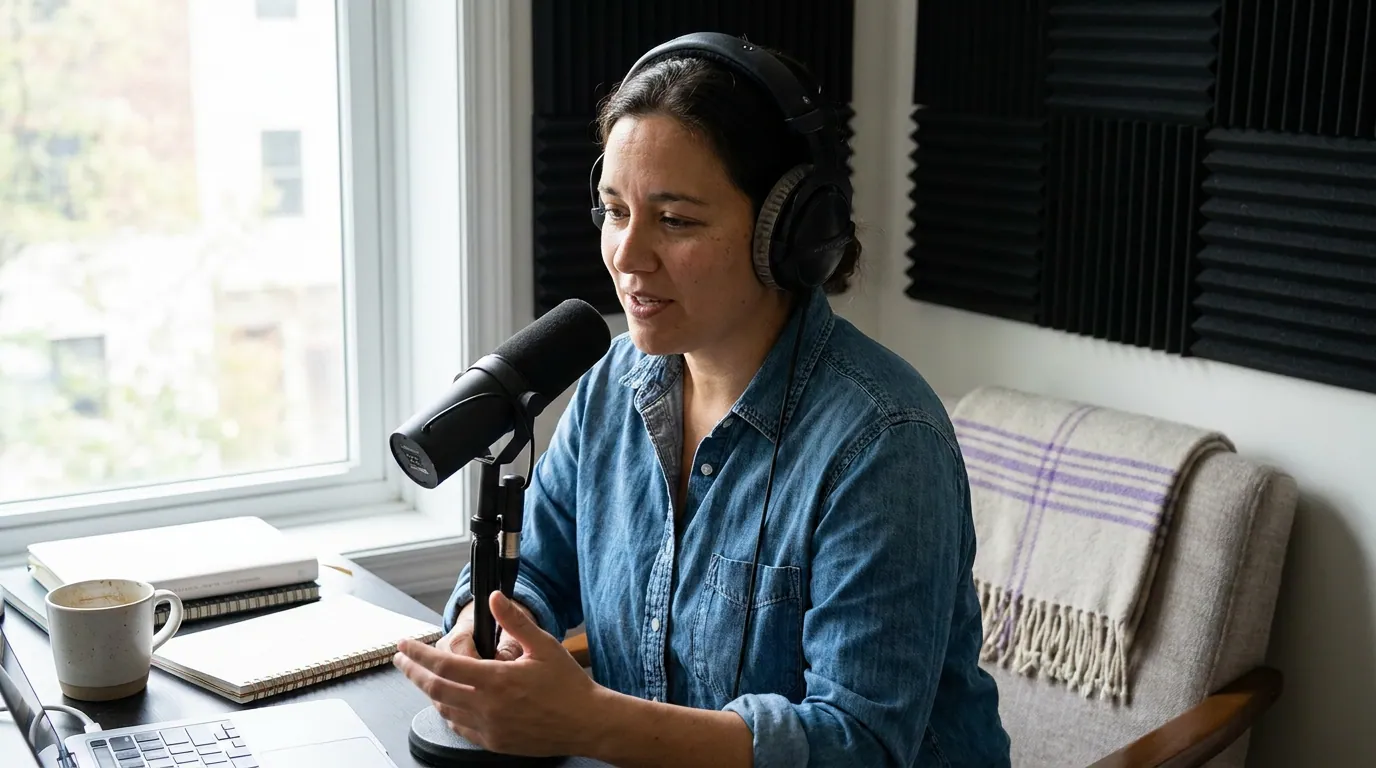
First, find out which problem you actually have
Record yourself answering one normal interview question, "what do you do, and how did you get into it?", for about a minute, then count. Paste the audio into any free transcription tool, copy the text into a word counter, and divide by the minutes. That single number tells you more than any amount of self-diagnosis, because almost nobody guesses their own rate correctly. Fast talkers think they're normal; nervous slow talkers think they're rushing.
The transcript catches a second thing the number misses: variance. Read it back. If every sentence runs at the same clip with no rests, your problem isn't the average, it's monotony, and the fix is the same breath technique below. A flat 150 wpm with no light and shade is harder to listen to than a varied 165. Pace is rhythm, not raw speed.
How to stop talking too fast
Fast talking is almost always a breathing problem, not a mouth problem. When you're nervous you take shallow breaths, run out of air mid-thought, and speed up to reach the next pause before you suffocate. So the fix starts above the words. Here is the order that works.
- Breathe from low and slow before you answer. One deliberate belly breath before you start speaking resets the whole system. Do this in your pre-record vocal warm-up and again in the two seconds before your first answer.
- Use breath as punctuation. This is the core technique, full method below. In short: take a small, quiet inhale at every natural comma and period. The breath is the brake.
- End sentences fully, then stop. Fast talkers chain sentences with "and… and… so…" to avoid the silence of a finished thought. Let the sentence end. The half-second of quiet feels like an hour to you and like nothing to the listener.
- Pick one idea per sentence. Rushing often comes from cramming three thoughts into one breath. Say one. Breathe. Say the next. The pace fixes itself.
- Drop your volume slightly. Speaking a touch quieter forces your body off the adrenaline setting and naturally pulls the speed down with it.
What does not work: consciously "talking slowly." It produces a stilted, hostage-video cadence because you're fighting the symptom while the shallow breathing keeps pushing you forward. Treat the breath and the speed follows.
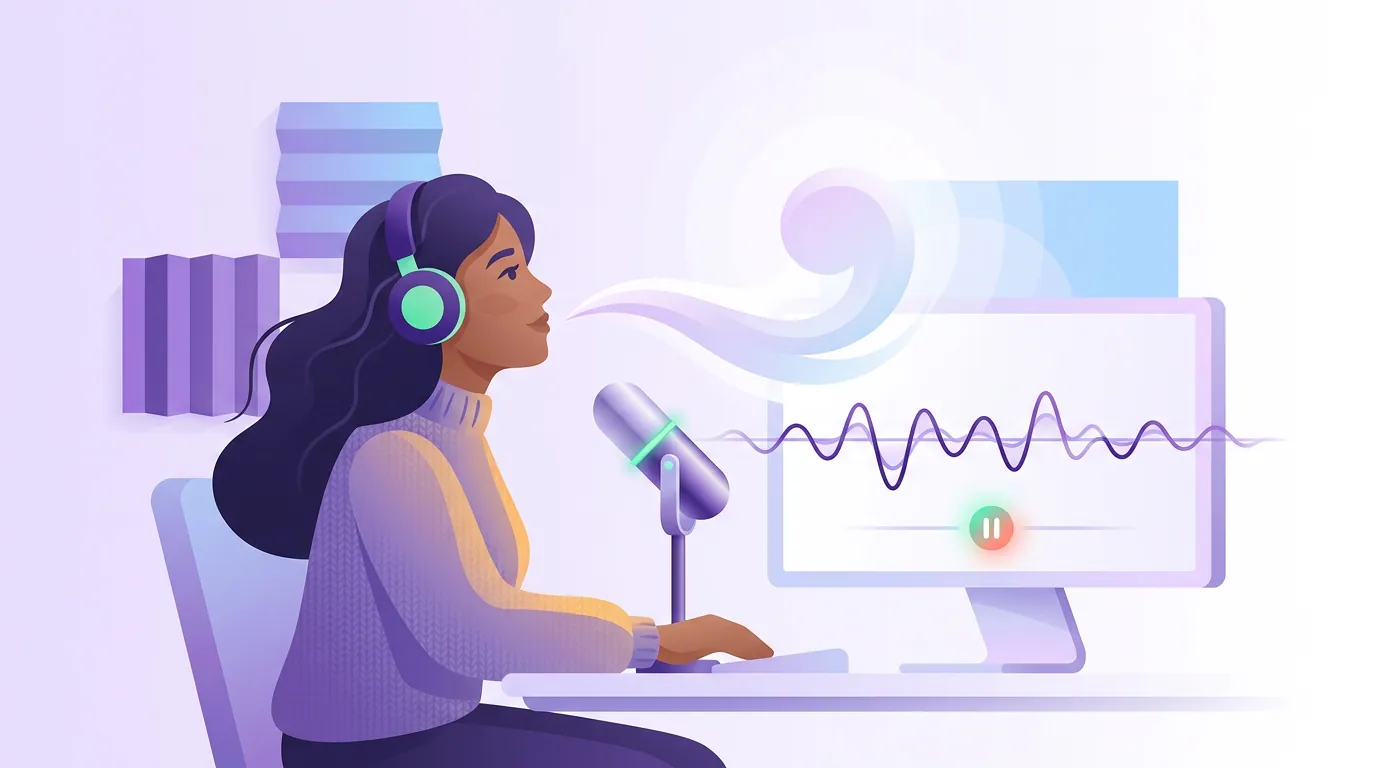
The breath-as-comma technique
This is the single most reliable way to control speed in real time, and it works for both problems. The idea: stop thinking about speed at all, and instead place a small, quiet inhale at every point where you'd write a comma or a period. Your breathing becomes the punctuation, and correct punctuation enforces correct pace automatically.
For the fast talker, the breaths force the gaps you're skipping, you physically cannot rush through a comma if you're taking a breath there. For the slow talker, the rule does the reverse: you only breathe at the natural break, not in the middle of a phrase, which kills the long mid-sentence stalls that make slow delivery feel like wading. Same rule, opposite effect.
The breaths are small and silent. You are not gasping. A good mic at a sensible distance won't pick up a soft nasal inhale, and even if it does, a light edit removes it. Practice on one paragraph read aloud: mark every comma and period, breathe at each, and feel how the sentence finds its own tempo.
How to fix talking too slow
Slow delivery is rarely about literal speed, it's about gaps. The clock might say 140 wpm, which is fine, but if half of that is filled with "um," long thinking pauses, and trailing "…you know?" endings, it feels glacial. So the fixes target the gaps, not the words per minute.
- Decide before you speak, then commit. Slow talkers often think out loud, which produces long stalls mid-sentence. Take a half-second to pick your first sentence, then deliver it without searching. Decisiveness reads as energy.
- Close the gaps between phrases. Let sentences flow into each other instead of resting between every one. The breath-as-comma rule helps here too: breathe only at the real breaks.
- Cut the hedges. "I guess," "sort of," "I mean," and a rising "…right?" at the end stretch sentences and sap momentum. These overlap with filler words like "um" and "like", clearing them tightens pace and confidence at once.
- Raise your energy a notch. Slow often travels with low energy. Sit forward, gesture, smile while you talk. Physical animation pulls the voice up to match.
There's a real edit in your favor here. Long pauses and dead air are the easiest thing to fix after the fact, a clip editor trims them in seconds, so a slightly slow recording cleans up better than a frantic fast one. That's a reason not to over-correct into rushing.
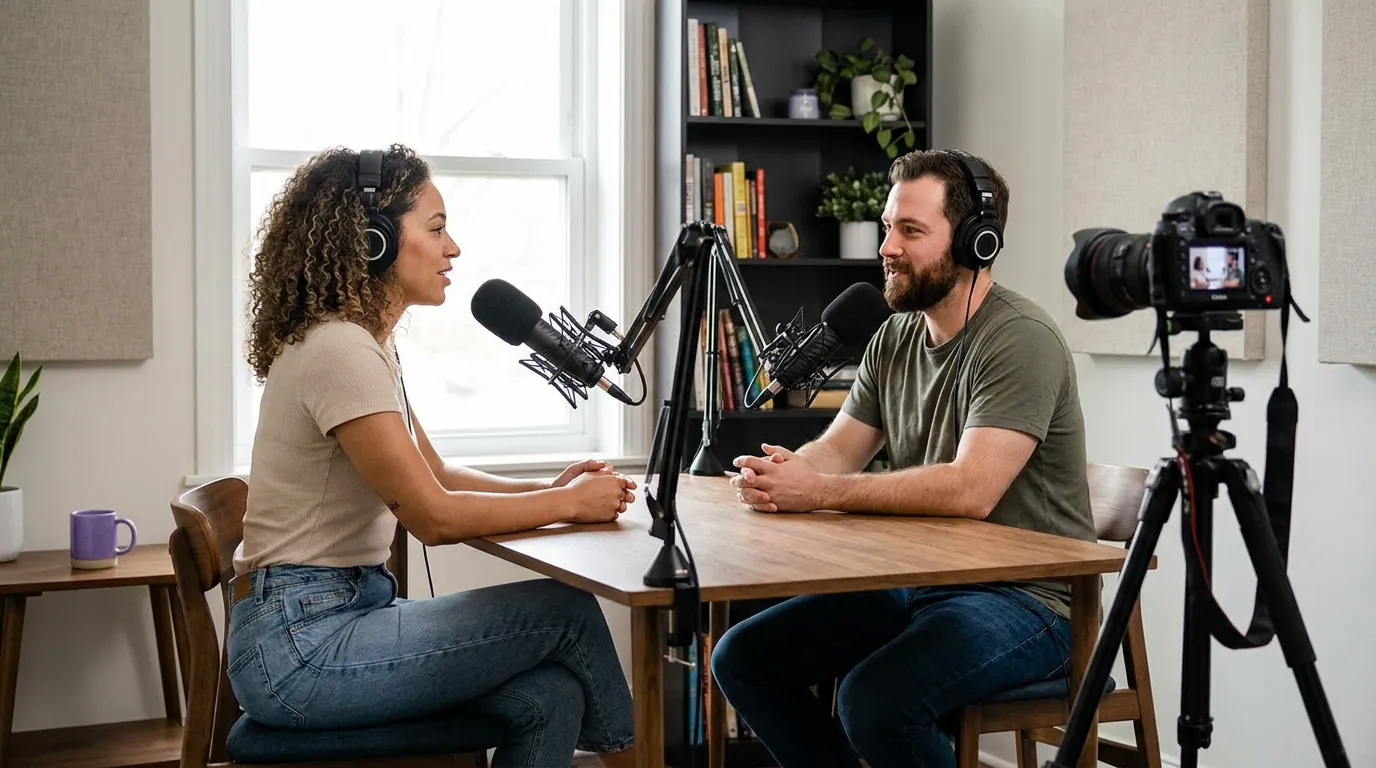
Common mistakes that quietly wreck your pace
These are the ones that catch people who already know "don't talk too fast."
- Speeding up when you're excited about your own point. The most interesting moment is the one you rush. Notice the surge and breathe into it, that's the line a host wants to clip, so let it land.
- Slowing to a crawl on hard questions. A long stall reads as uncertainty. It's fine to say "good question, give me a second" out loud rather than fill the gap with a slow, hedging run-up.
- Holding one speed the whole time. Even a perfect 155 wpm gets dull if it never varies. Speak faster on passion and urgency, slower on the important or serious point, variation is the actual skill, not a fixed number (improvepodcast).
- Fixing pace and ignoring the eyes. On video, a rushed answer paired with darting eyes reads as doubly nervous. Pace and where you look on camera work together; settling one helps the other.
- Over-editing in your head while recording. Monitoring every word slows you into stilted speech. Set the breath rule, then trust it and talk to the host like a person, basic guest etiquette is to stay in the conversation, not in your own analysis.
Frequently asked questions
How do I stop talking too fast when I'm nervous? Fix the breathing, not the speed. Take one slow belly breath before you answer, then place a small quiet inhale at every comma and period as you speak. The breaths force the gaps you skip when rushing. Consciously "talking slowly" rarely works because it fights the symptom while shallow breathing keeps pushing you forward.
What words-per-minute should I aim for on a podcast? Roughly 150–160 words per minute, slightly faster than ordinary conversation (~150 wpm per the National Center for Voice and Speech), which radio hosts and audiobook narrators use because it stays clear over long stretches (VirtualSpeech). Below 120 reads as slower than normal talking; well above 160 you outrun what listeners comfortably follow. Treat it as a band, not a metronome, and vary your pace deliberately.
Is it worse to talk too fast or too slow on a podcast? Too fast costs you comprehension; too slow costs you attention. Both lose listeners, but slow is usually easier to fix in editing, long pauses and dead air trim out in seconds, while a frantic delivery can't be slowed down after the fact. If you're unsure which way to err, err slightly slow and clear.
How do I know if I actually talk too fast? Record a one-minute answer, transcribe it, and divide the word count by the minutes. Almost nobody guesses their own rate correctly. The transcript also shows variance, if every sentence runs at the same clip with no rests, monotony is your real problem, not the average speed.
Can I just fix pacing in editing instead? You can clean up dead air and tighten slow stretches, but you can't un-rush a fast, breathless take, the words are already crammed. Editing helps most with the slow-and-spacious version, which is another reason not to over-correct into rushing. Get the breathing roughly right on the recording and let the edit do the polish.
Related guesting guides
- How to stop saying um and like when you're interviewed, the filler-word fix that pairs with pacing.
- A 5-minute vocal warm-up before you hit record, where the belly-breathing reset lives.
- How to look confident on camera as a first-time guest, the visual half of sounding settled.
- Where to look on a video podcast: camera vs. the host, eyes and pace read as nerves together.
- Podcast guest etiquette: the unwritten rules, the broader code for being a guest hosts re-book.