
How to Stop Saying Um and Like in Interviews

To stop saying um and like in an interview, don't just try to pause more. Record a two-minute practice answer, count your fillers per minute, and find out why you reach for them, you stall to think, you bridge between thoughts, or you stress a word. Each cause has a different drill. Generic advice fails because it treats one symptom with one fix.
Most coaching on this hands you a single instruction, "replace the um with a silent pause", and then acts surprised when it doesn't stick. It doesn't stick because "um" is not one habit. It's three different habits that happen to make the same sound. A person who says "like" to buy thinking time needs a completely different drill from someone who says "like" as a verbal exclamation point. Fix the wrong one and you'll grind for weeks with nothing to show.
This guide gives you a diagnostic first, then a targeted drill for whichever trigger you actually have. Twenty minutes of the right practice beats five hours of the wrong kind.
Why filler words matter on a recorded interview (more than in a meeting)
Fillers matter more on a recorded interview than in a meeting for two reasons: permanence and reach. A meeting evaporates; an interview gets edited, clipped, and posted. Filler words are normal in live conversation, your brain runs ahead of your mouth and "um" fills the gap, but a clip is now how most people find shows: 57% of listeners rely on social media for podcast recommendations, the first time it surpassed friends and family (InsideRadio, 2025).
That matters for you as a guest. A 45-second clip of your best answer is the single thing most likely to send a new person to the full episode and then to you. A good editor can cut around the occasional "um," but a clip that's one filler every four words is unusable no matter how sharp the idea underneath it is. Fewer fillers means more of your answers survive the edit and travel, and clips can drive a meaningful share of a show's new audience (Podcast Studio Glasgow).
The goal isn't zero. Trying to eliminate every filler makes you sound robotic and, worse, makes you so self-conscious that the count goes up. The goal is to get below the threshold where a listener notices, and that's a measurable target, not a vibe.
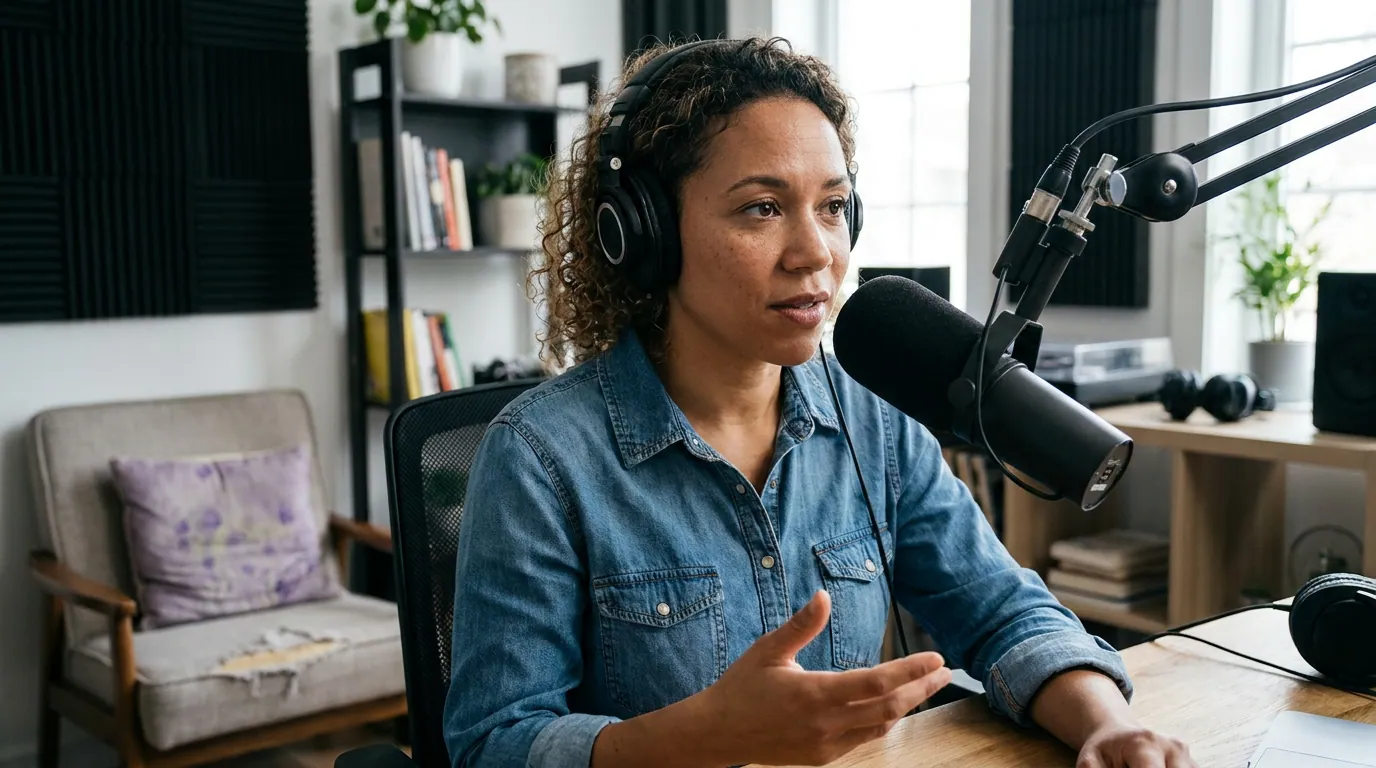
Step 1: Get your baseline, filler words per minute
You can't fix what you haven't counted. Record yourself answering one real question, pick something a host might actually ask you, like "how did you get into this?", for two uninterrupted minutes. Phone voice memo is fine. Don't script it; the whole point is to catch your natural speech under mild pressure.
Then play it back with a pen and tally every "um," "uh," "like" (the filler kind, not "I like coffee"), "you know," "so," "right," "basically," and "I mean." Divide the total by two. That number is your fillers per minute (FPM).
Here's the honest benchmark range I use when I coach guests, it's a working rule of thumb from listening to a lot of interviews, not a published study, so treat it as directional:
| Fillers per minute | How it lands to a listener |
|---|---|
| 0–2 | Polished. Unnoticeable. |
| 3–5 | Natural and fine. Don't over-correct. |
| 6–9 | Noticeable; an editor has to work around you. |
| 10+ | Distracting; clips become hard to cut. |
If you're at 3–5, you can stop reading and go warm up your voice instead. If you're at 6 or above, the next step is where the real work is.
Step 2: Find your trigger type, the actual diagnostic
This is the part everyone skips. Listen to your recording a second time and, at each filler, ask: what was I doing in that exact moment? Almost every filler falls into one of three buckets, and which bucket dominates tells you which drill to run.
Transition fillers happen at the seams between ideas. You finished a thought, you know the next one, and the "um" is just a runway while you switch tracks. These are the easiest to fix because the thought isn't missing, only the bridge is.
Stalling fillers happen mid-thought when you're searching for the exact word and your mouth refuses to wait in silence. This is the most common type and the one people mislabel as "nervousness." It's usually not nerves; it's a hatred of silence.
Emphasis fillers are the "like" and "you know" that land before the important word, almost like air quotes. They're a deep speech habit, often picked up socially, and they're the slowest to shift, but also the least damaging if mild.
Tally how many of your fillers fall in each bucket. The biggest pile is your primary trigger. Most people have one dominant type plus a smaller second one. Work the dominant one first.

Step 3: Run the drill that matches your trigger
Now the targeted part. Pick the drill for your dominant bucket and do it for ten minutes a day for a week before your interview. Don't do all three, that's how people overwhelm themselves and quit.
If your trigger is transitions: the full-stop drill
Record yourself answering questions, and at every seam between thoughts, force a hard period. Land the last word of the thought, close your mouth, breathe in through your nose, then start the next sentence. The breath does two things: it fills the silence so you don't feel the urge to, and it physically can't coexist with an "um."
Practice with a metronome of your own making, say a thought, tap the table once (that's your period), say the next thought. The tap trains your body that a transition is a beat, not a sound. Within a few days the tap becomes an internal habit and the table goes quiet. This is also the fastest route to sounding more deliberate, which doubles as a confidence cue on camera.
If your trigger is stalling: the "say less, slower" drill
Stalling means you're outrunning your own vocabulary. The fix is not "think faster", it's to give yourself permission to take the easy word. Re-record your answers with one rule: when you feel the hunt for a fancier word coming, take the plain one. "Big," not "um, transformative." You can always sharpen the language later; in a live interview, the plain word said cleanly beats the perfect word said with three uhs in front of it.
Pair this with slowing your overall pace by about 10%. Stalling fillers love speed, because at speed you commit to a sentence before you know how it ends. If talking pace is your bigger issue, work fixing your speaking speed alongside this one, they reinforce each other.
If your trigger is emphasis: the read-aloud-then-improvise drill
Emphasis fillers are wired in, so you fight them with awareness, not willpower. Read a paragraph of a book aloud, you literally cannot insert "like" into someone else's written sentence, so your mouth gets a rep of clean delivery. Then immediately improvise a 60-second answer on the same topic and notice how it feels to keep that cleanliness. Record both. Over a week the contrast trains your ear to catch the "like" as it's forming, which is the only moment you can actually stop it.
Step 4: On the day, three live moves that hold
Drilling builds the habit; these three moves protect it under live pressure.
- Warm up first. Cold mouths stall more. Five minutes of vocal warm-up before you hit record loosens your articulation so words arrive faster and you stall less, here's a 5-minute vocal warm-up to run beforehand.
- Slow your first answer on purpose. Your filler rate is highest in the opening 90 seconds while your nerves settle. Take the first answer 20% slower than feels natural. It buys your brain margin and sets the pace for the rest.
- Let silence sit. When you blank, close your mouth and wait. A one-second pause feels like an hour to you and like nothing to the listener. Editors love a clean pause; they can trim it to zero. They can't trim an "um" out of the middle of a word.

Common mistakes that keep the habit alive
- Trying to hit zero. Over-correction makes you stilted and spikes your self-monitoring, which spikes the fillers. Aim for under the noticeable threshold, not perfection.
- Drilling all three triggers at once. You'll fix none. One dominant trigger, one week, then re-measure.
- Practicing only scripted reads. Reading aloud is a warm-up, not the test. Fillers live in improvisation under pressure, so most of your reps must be unscripted answers to real questions.
- Skipping the re-measure. Without a second FPM count after a week, you're guessing. Record, count, compare. The number tells you the truth your ear won't.
- Blaming nerves for everything. Most fillers are a silence-avoidance habit, not anxiety. Real nerves are worth addressing separately, but don't let "I'm just nervous" excuse a fixable mechanical habit.
How long until it actually improves?
Most people drop one to three fillers per minute within a single focused week if they're drilling the right trigger. The habit doesn't vanish, it relaxes its grip enough to fall below the noticeable line. Lasting change (where clean delivery is your default even when tired) takes a few months of light, consistent reps, not a crash course the night before.
The payoff is entirely in the diagnostic. Spend the 20 minutes to record, count, and label your trigger, and your practice gets four times more efficient because every rep is aimed at the actual cause. Skip it, and you're back to "just pause more", which is why you're reading this in the first place.
FAQ
Is it bad to say um in a podcast interview? A few are completely fine and even sound natural, 3 to 5 per minute won't register to a listener. It becomes a problem above roughly 6 per minute, where it distracts and makes your answers harder to clip and edit. Aim for under the noticeable threshold, not zero.
Why do I say "like" so much? Usually one of two reasons: you're stalling for thinking time, or it's an emphasis tic that lands before key words. Record yourself and check where the "like" falls, mid-thought means stalling, before-the-point means emphasis. Each has a different drill in this guide.
Does slowing down really reduce filler words? Yes, especially for stalling-type fillers. At high speed you commit to a sentence before you know how it ends, so you stall mid-way. Taking your pace down about 10% gives your brain margin to find the next word in silence instead of with an "um."
Should I just edit the fillers out afterward? You can, and a good editor will trim the obvious ones. But editing can't save an answer that's one filler every few words, and clips are how people discover shows (InsideRadio, 2025). Cleaner delivery means more of your answers survive the cut and travel.
Will trying to stop make me sound robotic? Only if you aim for zero and over-monitor. The fix isn't suppressing every sound, it's replacing the filler with a breath at transitions and a brief silence when you stall. Done right, you sound more deliberate, not stiffer.
Next, get the rest of your on-mic delivery right: look confident on camera as a first-time guest, know where to look, camera vs. the host's face, and brush up on the unwritten guest etiquette rules hosts wish you knew.