
Record Your Podcast So AI Clips It Better


The biggest lever on AI clip quality is not which clipper you pick, it is how you record. Speak in self-contained chunks, name the topic out loud before you discuss it, restate people's names instead of relying on "he said," and leave a clean beat of silence at the start and end of every strong thought. Do that, and the AI surfaces sharper clips because you handed it sharper raw material.
Most people try to fix clips after the fact, fighting the export. The faster fix is upstream. An AI clipper can only score the moments you actually recorded, captioned from a transcript of words you actually said. Improve the words and the audio, and every clip improves before you touch a timeline.
Why the recording, not the tool, decides your clips
Clips are the discovery engine for a video show, not a nice-to-have. By one studio's client data they drive 20–40% of new audience and can lift reach 2–5× (Podcast Studio Glasgow), take that as a directional range from a single production house, not a platform-wide audit. When clips are how strangers find you, the quality of the source recording compounds across every clip you ever cut from it.
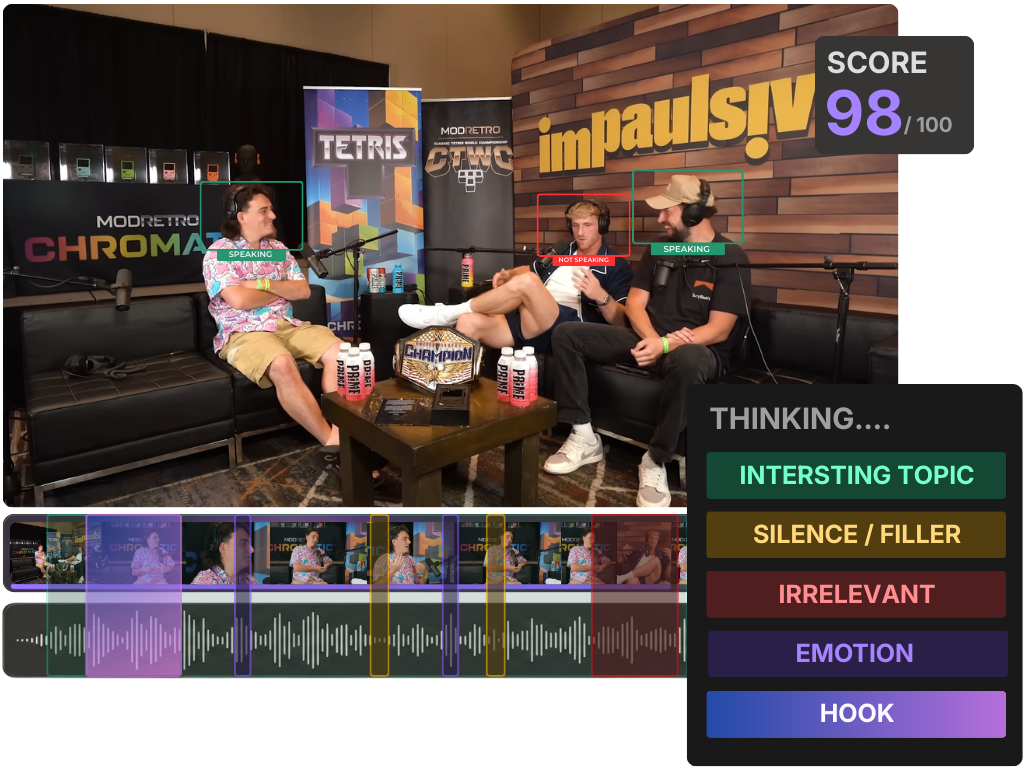
Here is the mechanism. An AI clipper reads a transcript and listens to the audio, then scores stretches of talk on a few measurable signals, topic shifts, question-answer pairs, emotional spikes, energy, and pauses (the full breakdown is in how AI clip detection actually works). Every one of those signals is something you control while recording. A messy recording gives the model weak, ambiguous signals; a deliberate one gives it clean ones.
There is one more reason to record for the transcript specifically. A widely repeated figure puts around 85% of social video views happening with the sound off (Digiday, from 2016 publisher-reported data), treat it as directional, since studies range from roughly 69% to 85% and none is a clean platform audit. The point survives the caveat: most people will read your clip, not hear it. The transcript is both what the AI scores and what your captions show. Clean speech is clean captions.
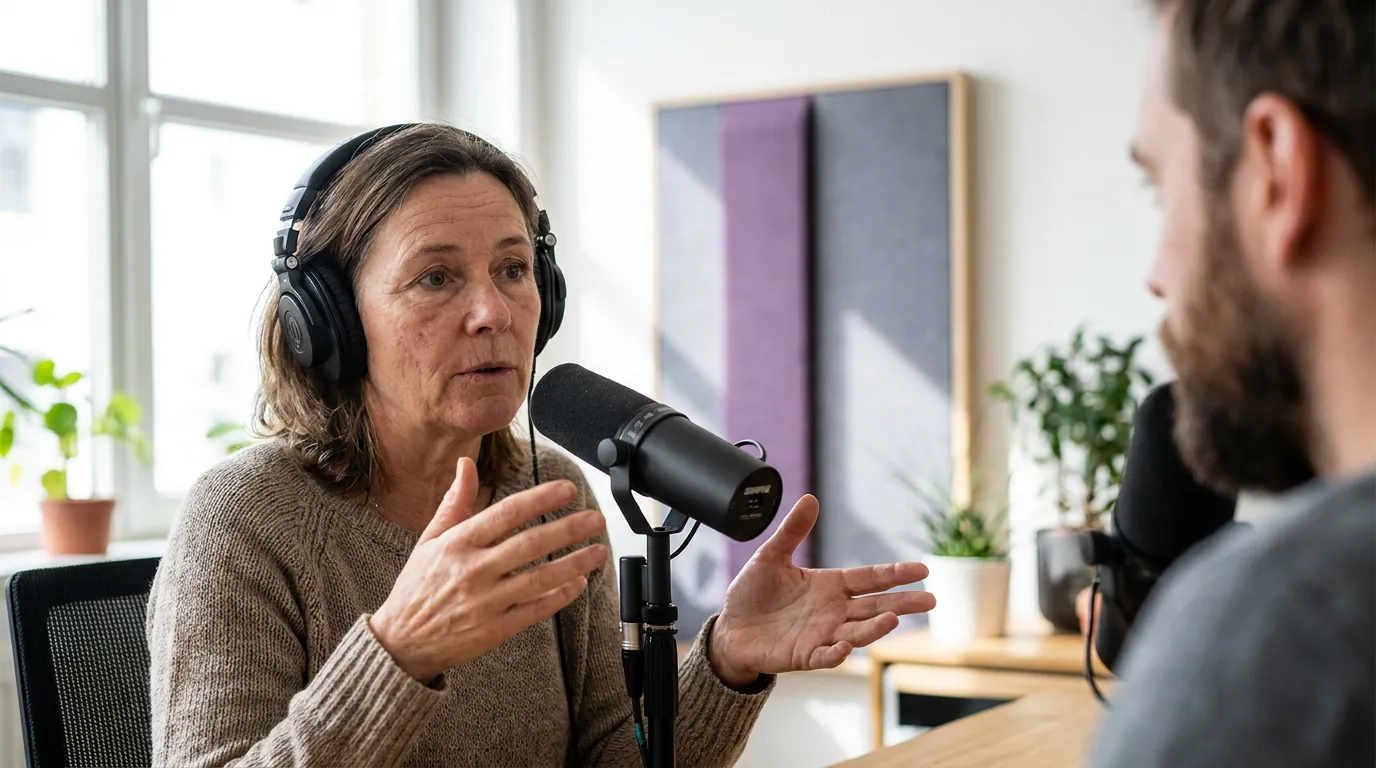
The five recording habits that make clips better
These are the things you do at the mic, in order of how much they move clip quality. None requires new gear. All require a little intention.
1. Tell self-contained stories
This is the single biggest lever. A clip works when a stranger with zero context understands it in the first five seconds. So when you tell an anecdote, set it up inside the anecdote: the year, the stakes, the person, the surprise. "Back in 2019 I'd just blown my last $4,000 on inventory that wouldn't sell" is a clip on its own. "And then that happened, like I mentioned" is not, the model has no edge to cut on and the viewer has no way in.
Practically, narrate as if the listener just walked in. State the premise, build, land the payoff, then stop. The detection model rewards exactly this shape because it produces a sharp topic break on both sides, a self-contained window is the strongest predictor that a stranger will follow it.
2. Record clean audio
Everything downstream rides on the transcript, and the transcript rides on your audio. A muddy room, plosive pops, or two people talking over each other produces transcription errors, and a wrong word becomes a wrong caption on a muted clip. Three fixes, cheapest first: get close to the mic (a hand-width away, speaking across it not into it), kill the obvious room noise (close the window, turn off the fan, add soft furnishings), and let people finish before you respond so the diarizer can tell your voices apart.
You do not need a $1,500 rig. Podcast mics run $50 to $400, with a solid option around $150 (Ausha), and a $60 dynamic mic used well beats a pricey condenser in an echoey kitchen. The gap that matters is technique in a quiet room, not the price on the box.
3. Drop verbal chapter markers
Say the topic out loud before you discuss it. "Okay, here's the thing nobody tells you about pricing a SaaS product" gives the model a clean topic boundary and a ready-made hook line for the caption. These verbal markers are the conversational version of chapter headings, they create the sharp embedding shift the model uses to find where a clip starts.
This costs nothing and feels natural once you do it twice. It also makes your episode easier to skim later when you or your editor are hunting moments by eye. Interview hosts get this for free, since a clear question is itself a chapter marker; solo hosts have to supply it deliberately.
4. Restate names and references
The model cuts a 30-second window out of a 50-minute conversation, and everything before that window vanishes. So "as he was saying" leaves the viewer asking who. Restate the proper noun every few minutes: "When I interviewed the founder of Notion, Ivan Zhao, he told me…" instead of "he told me." Same for the company, the book, the study you're citing.
This is the habit that survives the cut. A clip that name-checks its subject reads as authoritative and self-contained; a clip full of "that thing we discussed" reads as a fragment. It also gives the transcript real entities to attach to, which helps the model judge a window as a complete thought.
5. Leave deliberate pauses
Take a clean beat of silence before you launch a strong point, and another after you land it. The model uses pauses mostly to find cut boundaries, silence marks where a clip can start and end without clipping a syllable. A well-placed pause is you telling the AI "cut here." Step on your own lines and the best the tool can do is cut you off mid-breath.
This is also the easiest habit to forget in the flow of a good conversation. If you feel a great line coming, breathe first. That breath becomes the clean entry point on the clip.
Common mistakes that sabotage your clips at the source
Recording in a live, echoey room. Reverb smears consonants, the transcript guesses, and your captions inherit the guess. Soft surfaces and close mic technique fix most of it before any software does.
Talking over your guest. Overlapping speech wrecks diarization and produces transcripts that attribute the wrong line to the wrong person. The single most-clippable interview habit is the deliberate handoff, let the answer finish, leave a beat, then respond.
Burying the payoff in a tangent. If the best line arrives in the middle of a five-minute ramble with no clean edges, the model has nothing to cut against. Land the point, pause, and move on. Resolve a thought before you chase the next one.
Never saying who or what you mean. Pronoun-only speech ("he," "they," "that study") strips every clip of context. The fix is one restated name per window, cheap insurance against a fragment.
Mumbling the hook. Your strongest line delivered at half volume into your chest scores low on energy and transcribes poorly. The best moment recorded badly still loses to a decent moment recorded clean.
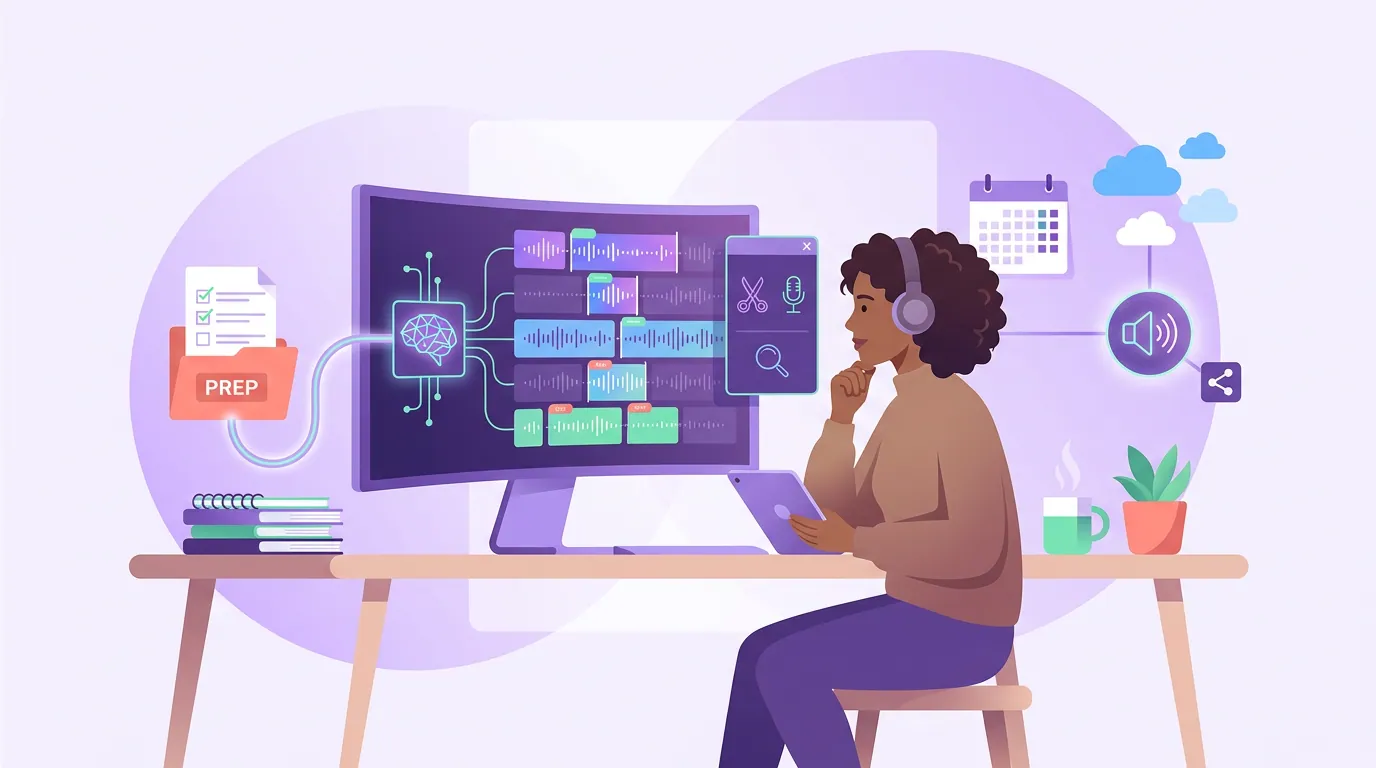
After the recording: where prep meets the tool
Recording well does not retire your judgment, it raises the floor on what the AI hands you. You still review. A prepared episode means the shortlist is sharper and the cleanup is faster, but no clipper on the market is good enough to post unread, every suggestion still earns a human look before it goes live. Run each one through the rubric in how to pick the best AI-suggested clips, and read the confidence number for what it is, a sorting hint, explained in what an AI virality score really tells you.
When you've recorded a clean back catalogue, the payoff is volume: batch-clip a whole episode in one pass turns a well-recorded hour into a week of posts. And for narrative genres where the cut point carries the suspense, your deliberate pauses give the editor real options, see where to end a true crime clip for max suspense.
QuickReel scores the same signal family you just learned to feed, then hands you an editable timeline, transcript-driven captions, and direct scheduling, so when your recording is clean, the path from episode to posted clip is short. It is an accelerant for good raw material, not a rescue for bad. That is the honest framing for every clipper on the market.
FAQ
Does better audio actually change which clips the AI picks? Yes, indirectly. The model scores a transcript, and clean audio produces an accurate transcript. Muddy audio creates transcription errors that lower a moment's signal strength and show up as wrong captions on a muted clip. Better audio means the AI scores what you actually said.
What's the one recording habit with the biggest payoff? Tell self-contained stories. Set up the stakes inside the anecdote so a stranger understands it cold, then land the payoff and stop. This creates sharp topic boundaries the model cuts on and gives the viewer a way in, the strongest predictor that a clip travels.
Do I need expensive gear to get clippable audio? No. A budget dynamic mic used with good technique in a quiet room outperforms a pricey condenser in an echoey one. Podcast mics run $50–$400, with a solid option near $150 (Ausha); the gap that matters is mic technique and room noise, not the price of the mic.
Should solo hosts record differently than interview shows? Mostly the same, with one addition. Interviews get topic boundaries and Q&A structure for free from the questions. Solo hosts have to supply them, say the topic out loud before each segment and pose a question aloud before answering it, so the model gets the same clean structure.
How do pauses help if listeners watch on mute? Pauses don't help the viewer hear anything, they help the tool cut cleanly. Silence marks where a clip can start and end without clipping a word, so a deliberate beat before and after a strong line gives the AI clean boundaries and your caption a clean entry.