
Clipping Interview Shows: Mine the Guest


The best clip from an interview podcast is almost never your question. It's the guest's unguarded answer, the moment they go off the script they rehearsed, admit something they don't usually say, or take a position their own field would argue with. Tag those three kinds of moment as they happen, then cut so the answer leads and your setup disappears.
Most interview hosts clip themselves. They pull the sharp question they're proud of, or the back-and-forth where the conversation felt electric in the room. In the feed that reads as a host showing off. The moment that travels is the one where the guest stopped performing, where you can hear them think, hedge, then say the real thing anyway.
This guide gives you a way to catch those moments live, a tagging system so you can find them in minutes after the recording, and the specific cut that protects the answer instead of burying it under your question.
Why are the guest's moments more clippable than yours?
Because the guest is the unknown. Your audience already knows your takes, they're here every week. The guest brings the only thing in the room your regulars haven't heard, and the strongest clips are the ones where the guest says something even they didn't plan to. A host's polished question is a known quantity; a guest's unguarded answer is news.
The pull is real and worth the work. Short-form clips drive an estimated 20–40% of new-audience acquisition for video shows and can raise reach 2–5× (Podcast Studio Glasgow; single-studio figures, directional). And 57% of listeners now rely on social media for podcast recommendations, the first time that surpassed friends and family (InsideRadio). For an interview show, that discovery has a second payoff: a clip of the guest saying something memorable gets reshared by the guest's audience, not just yours. You borrow their reach.
There's a catch with AI clippers here. Detection models reward energy and density, which means they often surface the lively cross-talk, you and the guest talking over each other, laughing, riffing. That feels like a highlight but rarely cuts clean, because two voices stepping on each other don't read on mute. How AI clip detection actually works breaks down the signals; the practical takeaway is that the model loves the moment the room loved, and the room is a bad judge of what plays in a feed.
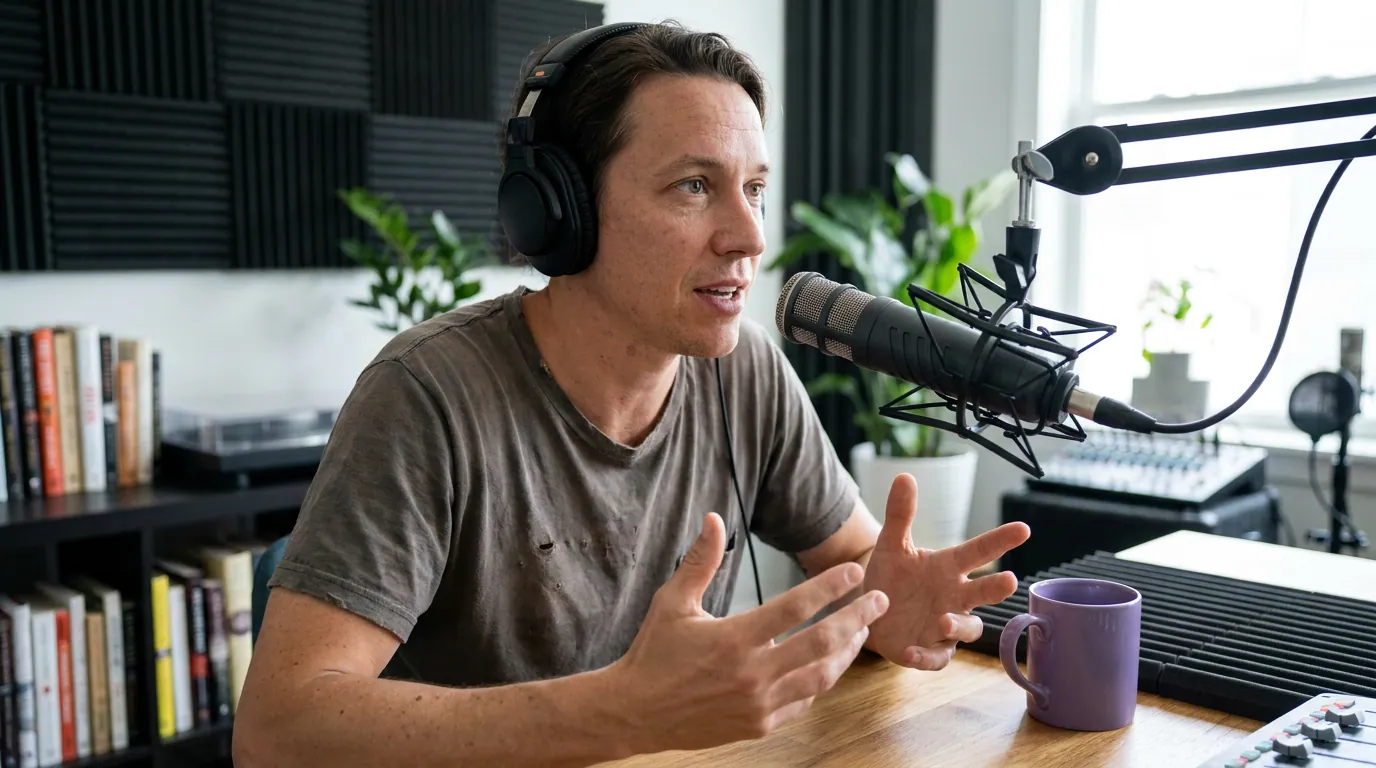
The three tags: marking guest moments as they happen
The fix is to tag moments live, while you're still in the conversation, instead of relying on memory afterward. Three tags catch almost everything worth clipping from a guest: off-script (they left their rehearsed answer), vulnerable (they admitted a cost, a doubt, or a failure), and contrarian (they took a position their field would dispute). When you hear one, drop a marker, a timestamp note, a clap, or a quick line in the show doc. You're casting the clips before you've finished recording.
Off-script, they stopped performing
Every guest arrives with rehearsed answers, especially anyone who's done the podcast circuit. Those answers are clean and useless, the audience has heard them on five other shows. The clip is the moment the guest leaves the script: a "honestly, I've never said this on a podcast," a long pause before they answer, a sentence they start, abandon, and restart. The restart is the tell. They're choosing words in real time instead of reciting, and that's the only part that sounds new.
You can cause more of these. Ask the question they didn't prep for, a follow-up to their answer, not the next item on your list. "Wait, why?" gets more off-script moments than any clever opener. When you feel the conversation leave the rails in a good way, tag it. That's a clip forming.
Vulnerable, they named a cost
The second tag is for honesty that costs the guest something. Not a sad story for its own sake, a real admission: a number that didn't work, a decision they regret, a doubt they still carry. Founders who say "we almost ran out of money twice and I didn't sleep for a year" get shared; founders who say "it was a journey" get scrolled. Vulnerability travels because it's rare, and it's rare because it's uncomfortable to say into a mic.
Handle these with care. A vulnerable moment is the easiest to clip and the easiest to misuse. Never cut an admission in a way that strips the context that made it safe to share, that breaks the guest's trust and, over enough episodes, your ability to book good guests. If you're unsure whether a vulnerable clip reads fairly, send it to the guest before you post. Most will say yes, and the ones who flag a problem just saved you from a bad relationship.
Contrarian, they took a side
The third tag is the position the guest's own field would dispute. This is the interview cousin of the screenshot test for business shows, turning a business podcast into shareable clips goes deep on finding the one defensible claim, and the same logic applies to a guest. The difference is that a guest is often freer than a host to take a side, because it's not their show's reputation on the line. Push gently toward it: "What does everyone in your industry get wrong?" is a question engineered to produce a contrarian tag.
The bar is defensibility, not heat. A contrarian clip should be a position the guest would repeat in a room full of their peers, not a hot take you manufactured by cutting. If it would collapse the second someone replied, it's not a clip, it's a liability with captions.
How to cut the clip so the answer leads
Once you've found a tagged moment, the edit decides whether it lands. The single biggest mistake in interview clips is opening on the host's question. Your question is setup, and setup is dead air in the first three seconds, the exact window where capturing attention is associated with a meaningful engagement lift (castmagic; directional, single-source). Start on the guest's answer and let the question live in the caption if it's needed at all.
- Open on the answer, not the question. Cut so the first words are the guest's. If the question is essential for context, compress it into one line of on-screen text, never the first four seconds of audio.
- Keep one beat of reasoning, drop the throat-clearing. Trim the guest's "um, so, I think what I'd say is" before the real sentence, and the tangent after it. Aim for the moment plus the single sentence that earns it.
- Caption the guest, name the guest. Put the guest's name and one credential on screen. People share clips of someone, the name is part of the hook, and it's what gets the guest's own audience to reshare.
- End on the strongest line, then stop. Interview clips bleed out when they trail into the host's "yeah, totally" or the next question. Cut on the guest's last strong word.
The feed is more crowded every month. A growing pool of freelance clippers floods TikTok, Reels, and Shorts with chopped-up long-form footage, often posting the same clip to several platforms hoping one hits. When that many clean two-shot clips are competing for the same scroll, the one that opens on a guest's real admission is the one that stops it. When you're choosing among the AI's suggestions, this is the filter, how to pick the best AI-suggested clips covers scoring candidates, and the three-tag method is the interview-specific layer to run on top.
Common mistakes clipping an interview podcast
- Clipping your own question. The sharp question felt like a win in the room. In the feed it reads as the host taking the spotlight from the guest. Clip the answer; the question, if it's needed, goes in one caption line.
- Picking the AI's "liveliest" moment. Detection rewards energy, which surfaces cross-talk and laughter. Overlapping voices don't read on mute and don't cut clean. Read the transcript and pull from your tags instead of trusting the rank.
- Posting a vulnerable moment without a check. The easiest clip to misuse is the honest one. Strip the context that made the admission safe and you've burned a guest. When in doubt, send the cut to the guest first.
- Manufacturing a hot take. Cutting a qualified answer into a fake contrarian stance gets you one bad week of engagement and a guest who warns their network about you. Contrarian means the guest would own it as cut.
- Forgetting the guest's name on screen. A clip of "some guy" doesn't get reshared by the guest's audience. The name and credential are part of the hook and the reason your reach doubles.
A note on genre transfer: the three-tag method is built for interviews, where the guest is the asset, but the instinct adapts. Clipping comedy podcasts without killing the joke protects timing instead of an admission; which true crime moments actually clip well and where to end a true crime clip for max suspense hinge on tension rather than honesty. Different shows, same move: find the one element the clip lives or dies on, and cut to protect it.