
Business Podcast Clips That Travel: The Screenshot Test

A business podcast clip travels on one thing: a single defensible opinion, not a story or a tidy framework. Find the one sentence a CFO would screenshot and forward with "this is either genius or insane," cut tightly around it, and caption it as a flat claim. Everything else in the episode is context for that line.
This is the part most business shows get backwards. They clip the warm, narrative moment, the founder's origin story, the "here's how we 10x'd revenue" recap, because it feels like the highlight. In the feed it reads as a commercial. The moment that actually moves is the one where someone said the quiet thing out loud: a stance their own industry mostly disagrees with, stated plainly, with their name on it.
This guide gives you the screenshot test for spotting that line, the cut that protects it, and the reason generic-advice clips die no matter how clean the captions are.
Why do business podcast clips underperform?
Most business clips die because they say something everyone already agrees with. "Focus on your customers." "Hire slow, fire fast." "Cash flow is king." These are true, which is exactly the problem, a true thing nobody disputes gives a viewer no reason to stop, react, or share. There's no friction, so there's no engagement, so the feed buries it.
The pull is real even in a crowded format. Short-form clips drive an estimated 20–40% of new-audience acquisition for video shows and can raise reach 2–5× (Podcast Studio Glasgow; single-studio figures, directional). And 57% of listeners now rely on social media for podcast recommendations, the first time that surpassed friends and family (InsideRadio). Distribution rides on clips. But the clip has to earn the stop, and consensus never does.
There's a second reason, specific to AI clippers. Detection models optimize for interesting and dense, they reward a guest rattling off a polished framework because it scores high on speech energy and keyword load. That polished recap is often the least clippable thing in the episode, because it's the part the guest has said a hundred times. How AI clip detection actually works explains the signals; the takeaway is that the model's top pick and your most defensible claim are frequently not the same clip.

The screenshot test: finding the one clippable line
A line is worth clipping when it passes four checks: it states a position, a smart person could disagree with it, the speaker would defend it by name, and it stands alone without the episode around it. Miss any one and you have advice, not a claim, and advice doesn't travel. Run the test against the transcript, not your memory of the recording, because the line you remember is rarely the line that scores.
Check 1, It states a position
Scan the transcript for opinion verbs and stance words: "overrated," "wrong," "the real reason," "nobody talks about," "I'd never," "we stopped doing." A position has a subject and a verdict. "We focus on retention" is a description. "Most SaaS companies measure retention wrong, and it's costing them the renewal" is a position. The second one has an edge you can cut around.
Check 2, A smart peer could disagree
This is the check that kills 80% of candidates, and it's the one teams skip. Read the line and ask: would a competent person in this industry argue back? If the honest answer is no, if it's a truism dressed as insight, drop it. "Customer service matters" fails. "Most B2B founders are wasting money on conferences, and the pipeline data proves it" passes, because plenty of founders would fight you on it. Disagreement is what produces the comment, the quote-repost, the duet. The comments are the distribution.
Check 3, The speaker would defend it by name
A defensible claim is different from a cheap hot take. The test is whether the speaker would stand behind it in a room full of peers with their name attached. A manufactured provocation collapses the moment someone replies; a defensible claim invites the reply because the speaker has the reasoning behind it. This is also your reputational guardrail, never clip a line out of context to manufacture controversy the guest didn't intend. That breaks trust with the guest and, eventually, the audience.
Check 4, It stands alone
The line has to read as a single screenshot with zero setup. If understanding it requires "well, earlier in the episode we established…," it isn't a clip, it's a chapter. Look for sentences that are complete arguments on their own. A clean test: paste the transcript line into a notes app as plain text. If it lands as a statement with no surrounding scaffolding, it stands alone. If it reads as a fragment, keep looking.
How to cut the clip so the claim survives
Once you've found the line, the edit protects it. Lead with the claim in the first three seconds, those opening seconds decide whether a viewer keeps watching or scrolls past (castmagic), so do not open with the host's question or a slow wind-up. Start on the verdict, then let the speaker earn it.
- Open on the claim, not the setup. Cut so the first words are the position itself. If the strong line is the guest's answer, you can drop the host's question entirely or compress it to one caption line of context.
- Keep the reasoning, drop the throat-clearing. A defensible claim needs its one best supporting sentence so it doesn't read as a drive-by. Cut the "um, so, I think what I'd say is" before it and the tangent after it. Aim for the claim plus one beat of why.
- Caption the claim as a statement, not a question. The on-screen text and the post caption should restate the position as a flat assertion. "Conferences are a waste of B2B budget" outperforms "Are conferences worth it?" because a stance invites a reaction and a question invites a scroll.
- End on the strongest word, then stop. Business clips bleed engagement when they trail into "but it depends" qualifiers. Cut on the period of the claim's last clause. The nuance belongs in the full episode, which is exactly where you want curious viewers to go.
Keep these tight, 20 to 45 seconds is usually enough for a claim plus one reason. Length isn't the variable that matters; the absence of consensus is.
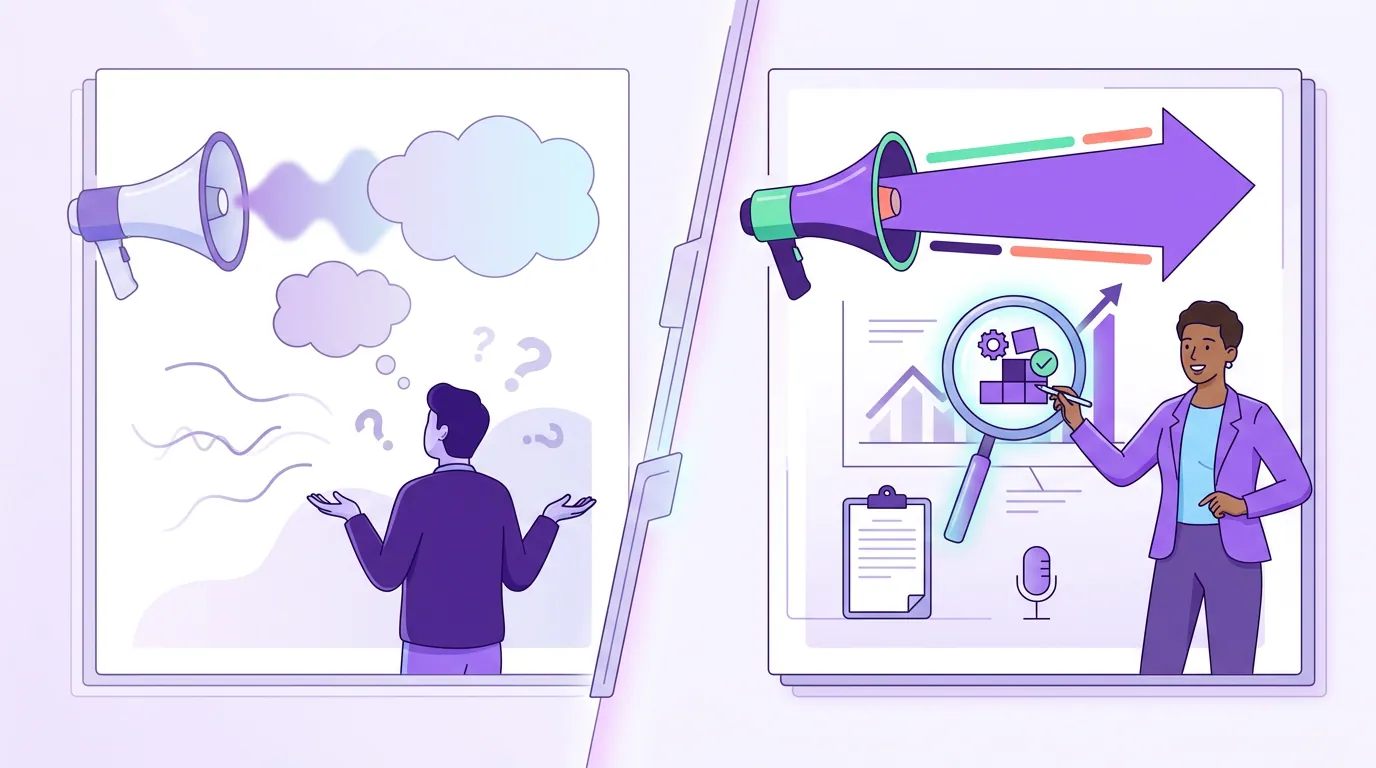
What generic advice looks like vs a defensible claim
The difference between a clip that gets ignored and one that gets shared is rarely production quality. It's whether the line takes a side. Here's the same business idea written as forgettable advice and as a claim someone would screenshot.
Same topic, same speaker, same forty seconds of footage. The left version is a poster in an airport. The right version is a position someone forwards to their team with a one-word reaction. The feed gets more crowded every month, with clipped podcast cuts flooding every platform. When everyone is posting consensus advice on a clean template, the line that takes a side is the one that stops the scroll. When you're choosing among the AI's suggestions, this is the filter, how to pick the best AI-suggested clips walks through scoring candidates, and the screenshot test is the business-specific layer to apply on top.
Common mistakes clipping a business podcast
- Clipping the origin story. The founder's "how I started" arc feels like the emotional peak, but it's a story, and business viewers don't share stories, they share positions. Save the narrative for the long-form. Clip the opinion the founder formed because of that story.
- Picking the AI's most "energetic" moment. Detection rewards a fast, dense, confident delivery, which often surfaces a rehearsed framework recap. Polished and clippable are not the same thing. Read the transcript and apply the screenshot test before trusting the rank.
- Softening the claim to be safe. Teams hedge the strong line into "well, it can depend" to avoid looking provocative. The hedge removes the exact friction that makes it travel. If the claim is defensible, let it stand undiluted and let the comments carry it.
- Manufacturing controversy the guest didn't mean. The opposite failure. Cutting a qualified statement into a fake hot take burns the guest and, over time, the show's credibility. Defensible means the speaker would own it as cut, in full context.
- Captioning the claim as a question. "Is X overrated?" invites a scroll; "X is overrated" invites a reply. The caption is half the clip. State the position.
A note on genre transfer: the screenshot test is built for B2B, where consensus is the enemy, but the underlying idea, cut around the line that takes a side, adapts. Clipping comedy podcasts without killing the joke protects timing instead of a claim; fitness podcast clips: talk vs demonstration weighs a stated principle against a shown movement; and which true crime moments actually clip well hinges on suspense rather than opinion. Different genres, same instinct: find the one element the clip lives or dies on, and edit to protect it.