
Best Clip Tools for Spanish-Language Podcasts

For a Spanish-language podcast, the best clip tool is the one that transcribes your specific accent cleanly and renders á, é, í, ó, ú, ñ, ¿ and ¡ correctly in burned-in captions. On those two tests, Descript and Vizard lead, Opus Clip is reliable, and QuickReel wins on speed and price if you will review the Spanish before posting. Language count is the wrong thing to shop on.
Every tool below claims twenty, fifty, even a hundred languages. That number is marketing. What actually breaks a Spanish clip is narrower: a model trained mostly on neutral Latin American Spanish mangling Rioplatense slang, or a caption renderer that silently drops the tilde and turns año into ano, a word change you do not want on screen. This roundup scores the three things that decide whether your clip looks professional in Spanish, with a per-tool support table and verified June 2026 pricing.
What actually makes a clip tool good for Spanish
A good Spanish clip tool gets three things right, in order: it transcribes your specific accent accurately on real audio, it covers the regional variety you actually speak, and it renders á, é, í, ó, ú, ñ, ¿ and ¡ correctly in burned-in captions. Get those right and the advertised language count stops mattering.
Transcription accuracy on your audio. Vendors quote 95%+ accuracy, and Sonix, a transcription specialist, gives the honest range: 85–99% for Spanish depending on audio quality, with clear single-speaker audio at the top and noisy crosstalk at the bottom (Sonix). Treat any single "98%" number as a clean-audio ceiling, not your daily reality.
Regional accent coverage. "Spanish" covers Mexican, Castilian, Rioplatense (Argentina and Uruguay), Andean, Caribbean and more. Sonix is explicit that its models are trained for Spanish including regional accents, most clip tools say only "Spanish" and leave you to find out. If your show is in strong Rioplatense or fast Caribbean Spanish with heavy slang, test before you commit.
Accented-character rendering. This is the one nobody tests. The transcript can be perfect and the burned-in caption can still drop a diacritic depending on the font and the renderer. The tilde is not decoration: año (year) without it becomes a crude word. Always export one clip and read every á, é, í, ó, ú, ñ, ¿ and ¡ on screen before you trust a tool.
The verdict: who should pick what
The short version: Descript for accuracy and full editing in one place, Vizard for the widest translation reach and clean rendering, Opus Clip for a dependable URL-to-clip flow, QuickReel for the fastest, cheapest path when you will review the Spanish yourself, Choppity for the broadest raw language list, and a dedicated transcriber like Sonix when accuracy must be near-perfect before clipping.
Here is the same table in text, so you can copy it:
| Tool | Advertised languages | Best-for-Spanish note |
|---|---|---|
| Descript | 26 transcription | Strongest transcription, full editor, slower to first clip |
| Vizard | 30+ transcription / 100+ translation | Widest translation reach, clean rendering, browser-based |
| Opus Clip | 20+ transcription | Dependable YouTube-URL flow, dedicated Spanish subtitle tool |
| QuickReel | 20+ | Fastest and cheapest; review the Spanish, then schedule |
| Choppity | 97 | Broadest raw language list among clip-specific tools |
| Sonix | 54+ | Transcription specialist with accent-trained models |
The six tools, reviewed honestly
Descript, best transcription accuracy in an all-in-one
Descript is an editing suite that also clips, and transcription is its core technology, reviewers single out its automatic transcription accuracy as a standout (Choppity). It transcribes 26 languages, Spanish included. For a Spanish interview show with two or three voices talking over each other, that accuracy is the whole game, because every caption error you avoid is one you do not fix by hand. One catch worth knowing: Descript handles one spoken language per file, so a Spanglish episode that code-switches mid-sentence is not its strength.
The con: it is not a paste-a-link-get-clips machine. You work inside a timeline, which is more time per episode than a pure clipper. If your only goal is fast Spanish Shorts, the editor is overhead. If you also edit full episodes, that overhead becomes a feature.
Vizard, the widest translation reach, clean rendering
Vizard transcribes in 30+ languages and translates captions into 100+, runs a dedicated free Spanish subtitle tool, and its captions are well-timed (Vizard). In testing, accented characters render cleanly in its caption templates, the ñ and the accents survive. It runs in the browser, so there is nothing to install.
The con: the free tier stamps a watermark and caps export at 720p; watermark-free 4K starts on the Creator plan at $29/month, with the Business plan at $39/month (Capterra). And the headline "100+ languages" is translation reach, not native transcription, its actual speech-to-text covers 30+ languages, Spanish among the strongest. For a Spanish-only show you are paying for breadth you will not use.
Opus Clip, reliable URL-to-clip with a Spanish subtitle tool
Opus Clip transcribes 20+ languages, auto-detects the spoken language, and runs a dedicated free "add Spanish subtitles" tool, 60 minutes of Spanish subtitles free each month (Opus Clip). The flow is dependable: paste a YouTube URL, get ranked clips with Spanish captions. Its virality scoring is a useful first filter when you have a long episode and limited time.
The con: the free plan watermarks exports and deletes them after three days; usable, watermark-free clipping starts at $15/month (Starter), with Pro at $29/month adding aspect ratios, the scheduler and B-roll (Opus Clip pricing). Credits bill on input length, so a 30-minute episode costs 30 minutes whether it yields five clips or fifty, fine if you batch, expensive if you nitpick.
QuickReel, fastest and cheapest, if you review the Spanish
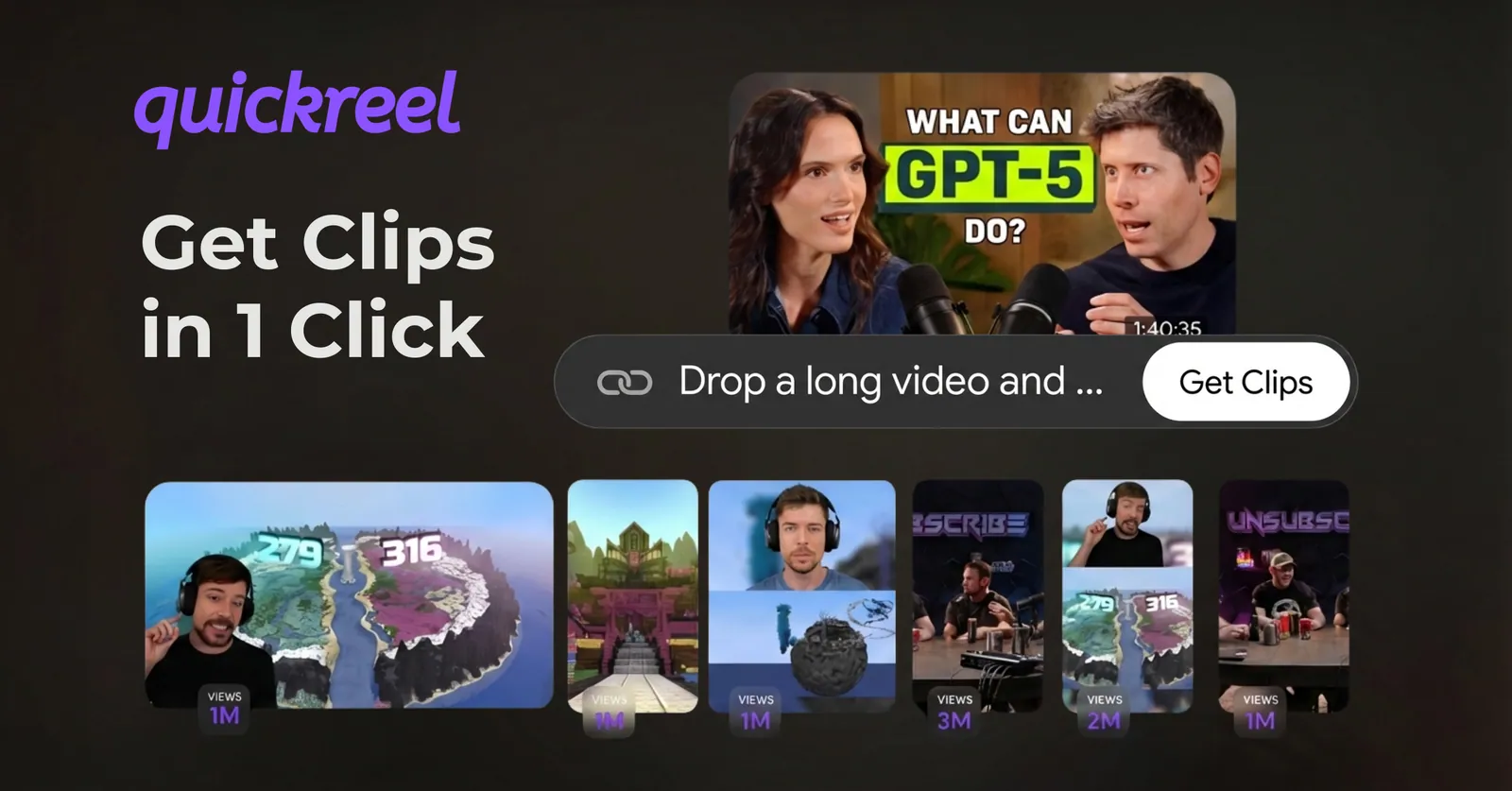
This is our tool, and here is the honest position. QuickReel supports 20+ languages including Spanish, auto-transcribes into synced captions, and ships 12+ caption styles (QuickReel pricing). The reason to use it for Spanish is the path: paste a link or upload an episode, get captioned vertical clips back in minutes, then schedule them to up to 30 platforms on the top tier, useful if you run one show across YouTube, TikTok, Instagram and a Latin-American audience at once.
The con, stated plainly: our own testing shows QuickReel's Spanish caption accuracy can dip with strong regional accents, true of every tool here, and the reason you read the captions before posting. If your show is heavy Rioplatense or fast Caribbean Spanish, do the one-clip rendering-and-accuracy test below before you trust any auto-caption, ours included. Pricing: Starter $9/month (100 credits), Pro $17.40/month (250), Pro+ $29.40/month (500), Ultimate $89/month (1,000) (QuickReel pricing).
Choppity, the broadest raw language list
Choppity advertises a 97-language transcription and caption pipeline, the broadest raw count among clip-specific tools (Choppity). If you also publish in Portuguese or other languages alongside Spanish, that coverage is a genuine reason to look.
The con: breadth of supported languages is not the same as depth of accuracy in any one of them, and the published Spanish-accuracy detail is thinner than Sonix's. Test your own accent rather than trusting the headline count.
Sonix, when accuracy must come before clipping
Sonix is not a clipper; it is a transcription specialist, and it earns a slot here for one workflow. Its models are trained for Spanish including regional accents, it quotes 85–99% accuracy by audio quality, and it transcribes at roughly 10× real-time, a one-hour Spanish file ready in five to six minutes (Sonix). For legal, medical or any show where a caption error is costly, transcribe in Sonix first, correct it, then bring the clean text into your clipper.
The con: that is two tools and two steps. For most creators it is overkill. Use it when the accuracy bar is genuinely high.
How we evaluated
Three criteria, in priority order: Spanish transcription accuracy on real podcast audio (clean single-speaker and noisy crosstalk), regional-accent coverage as stated by the vendor and tested where possible, and accented-character rendering in burned-in captions. Pricing and language counts came from each vendor's own pages in June 2026 and are noted as advertised, not independently audited. Spanish-accuracy ranges follow Sonix's published 85–99% figure, the most honest public number for Spanish speech-to-text. Maya Okonkwo, who runs QuickReel's caption A/B tests, scored the rendering. We disclose that QuickReel is our product and have stated its accent caveat as plainly as the rivals'.
One reality check applies to all six: in our editing, every AI clipper still needs a human review pass, for a typical Spanish episode we re-touch roughly a quarter to a third of the captions, mostly dropped diacritics and slang the model guessed wrong. That is our own estimate, not a vendor number. None of these tools removes the step. They remove the editing time around it.
The one test to run before you commit
Pick the two or three tools above that fit your budget, then run the same 90-second slice of your real episode through each, ideally a section with names, numbers, and your strongest accent. Then check three things on the exported clip:
- Read every accented character. Find an año, a señor, a ¿ and a ¡ and confirm they render. A dropped tilde or accent is an instant fail.
- Spot-check accuracy on names and slang. Generic Spanish is easy; your guest's name and your regional slang are where models slip.
- Watch on mute. Most social video is watched silent, the widely cited figure is ~85% of Facebook video, reported by publishers like LittleThings and Mic to Digiday in 2016 (publisher-reported, not platform-measured, so treat it as directional, not gospel). The caption is the clip. If it reads wrong on mute, it is wrong.
Whichever tool clears all three on your actual audio is your best clip tool. Not the one with the biggest language number.
FAQ
What is the best clip tool for Spanish-language podcasts? There is no single winner. Descript has the strongest transcription accuracy in an all-in-one editor; Vizard has the widest translation coverage with clean accented-character rendering; QuickReel is the fastest and cheapest if you review the Spanish before posting. Choose by your accent and your budget, tested on your own audio.
Do AI clip tools handle accents like Mexican, Castilian and Argentine Spanish? Most advertise "Spanish" without naming dialects. Sonix is the clearest about training on regional accents. For strong Rioplatense or Caribbean Spanish with heavy slang, run a 90-second test on your real audio before committing, accuracy varies most exactly where accents are strongest.
Why do my Spanish captions drop the ñ or accent marks? Usually the caption font or renderer, not the transcript. The text can be correct while the burned-in caption omits a diacritic. Always export one clip and read every á, é, í, ó, ú, ñ, ¿ and ¡ on screen. A dropped tilde changes the word, año becomes something you do not want captioned.
How accurate is Spanish auto-transcription? Roughly 85–99%, depending on audio quality, per Sonix. Clean single-speaker audio sits near the top; noisy crosstalk near the bottom. Plan to correct names, numbers and slang on every clip, in our editing that is a quarter to a third of captions, and no tool removes the pass.
Is there a free way to clip a Spanish podcast? Yes, with caveats. Most tools offer a free tier that watermarks exports or limits minutes, Opus Clip and Vizard both do. For a watermark-free comparison of free options, see our roundup of free podcast clip tools. Try one Spanish episode free on each before paying.
For more on these tools beyond Spanish, see our tested roundup of AI podcast clip generators and our Opus Clip alternatives guide. If translation across many languages is your goal rather than Spanish specifically, the multilingual caption tools comparison scores tools on translation depth. For fixing the errors these tools leave behind, read how to fix caption accuracy, and to push Spanish subtitles into other languages, how to translate podcast subtitles. For caption styling across the field, our auto-captioning tools roundup covers the options.