
How Often to Post a Video Podcast on YouTube


Post one full episode a week and run three to five Shorts on a separate, more frequent schedule. The mistake most podcasters make is treating both as one upload calendar. They aren't. A long episode is a weekly commitment your subscribers wait for; a Short is a discovery unit that has to feed the algorithm often enough to find new viewers. Give each its own clock and the whole channel gets easier to run.
That's the short answer. The rest of this is the reasoning, why the two formats need different rhythms, the weekly grid that holds up under a solo workload, and how to set the Shorts-per-episode ratio instead of guessing it. None of this works if either schedule is so aggressive it breaks you, so the cadence below is built to be held for a year, not sprinted for a month.
Why cadence on YouTube is two problems, not one
A YouTube podcast channel has two distinct jobs, and each rewards a different posting rhythm. Long episodes build a relationship with people who already subscribed, they want a predictable drop, the same day each week, so the show becomes a habit. Shorts do the opposite job: they reach people who have never heard of you, and the Shorts feed rewards a steadier drip than a once-a-week long episode can supply.
The stakes are real because YouTube is now where video podcasts get found. YouTube reported passing 1 billion monthly podcast viewers in early 2025 (Variety), and 53% of new US weekly listeners now prefer to watch a podcast, up from 30% in April 2022 (Backlinko). Watching is the default discovery mode for new listeners, and on YouTube that discovery splits cleanly between the long player and the Shorts shelf.
There's a reason to keep the long-episode cadence sane, too. The single biggest predictor of a podcast surviving is publishing consistency, and nearly half of all podcasts never make it past their first three episodes (Command Linux). A weekly episode you can actually keep producing beats a twice-weekly schedule that burns you out by episode eight.
The two-clock model
Stop scheduling YouTube as one feed. Run two clocks side by side: a slow clock for long episodes and a fast clock for Shorts, both fed by the same recording. The long clock is about reliability, same day, same time, every week. The fast clock is about frequency, enough Shorts that the discovery feed keeps testing you on new viewers between episodes.
The reason to separate them is that they fail in opposite directions. Post long episodes too often and quality drops, subscribers fall behind, and you burn out, the exact path to podfade. Post Shorts too rarely and the discovery feed never gathers enough signal to learn who your viewer is, so reach stalls no matter how good the episode was. One calendar can't optimize for both. Two clocks can.
This also matters for how Shorts feed the main show. The job of a Short isn't a view, it's a subscriber who comes back for the long episode. The clips-to-channel funnel for YouTube podcasts walks through that handoff in detail; the cadence here is just the engine that keeps the funnel fed.
How often to post the long episode
Once a week, on a fixed day and time. For nearly every video podcast, solo or small team, weekly is the cadence that balances quality, subscriber expectation, and a workload you can sustain. Twice a week only makes sense if you have a producer or a deep back catalog of recorded episodes; below weekly, you struggle to build the habit that turns a casual viewer into a subscriber.
The fixed slot matters as much as the frequency. Subscribers learn your drop time the way they learn a TV schedule, and a consistent day trains YouTube to surface your episode to your subscriber base on release. Pick a day, pick an hour, and protect it. If you're still chasing your first major subscriber milestone, the cadence is the foundation underneath everything in getting your first 1,000 YouTube subscribers as a podcaster, consistency is what compounds, and an erratic schedule resets the compounding every time you skip.
If you can only reliably produce an episode every two weeks, do that on a fixed fortnightly slot rather than promising weekly and missing. A schedule you keep beats a schedule you announce.
How many Shorts per episode (and the reasoning)
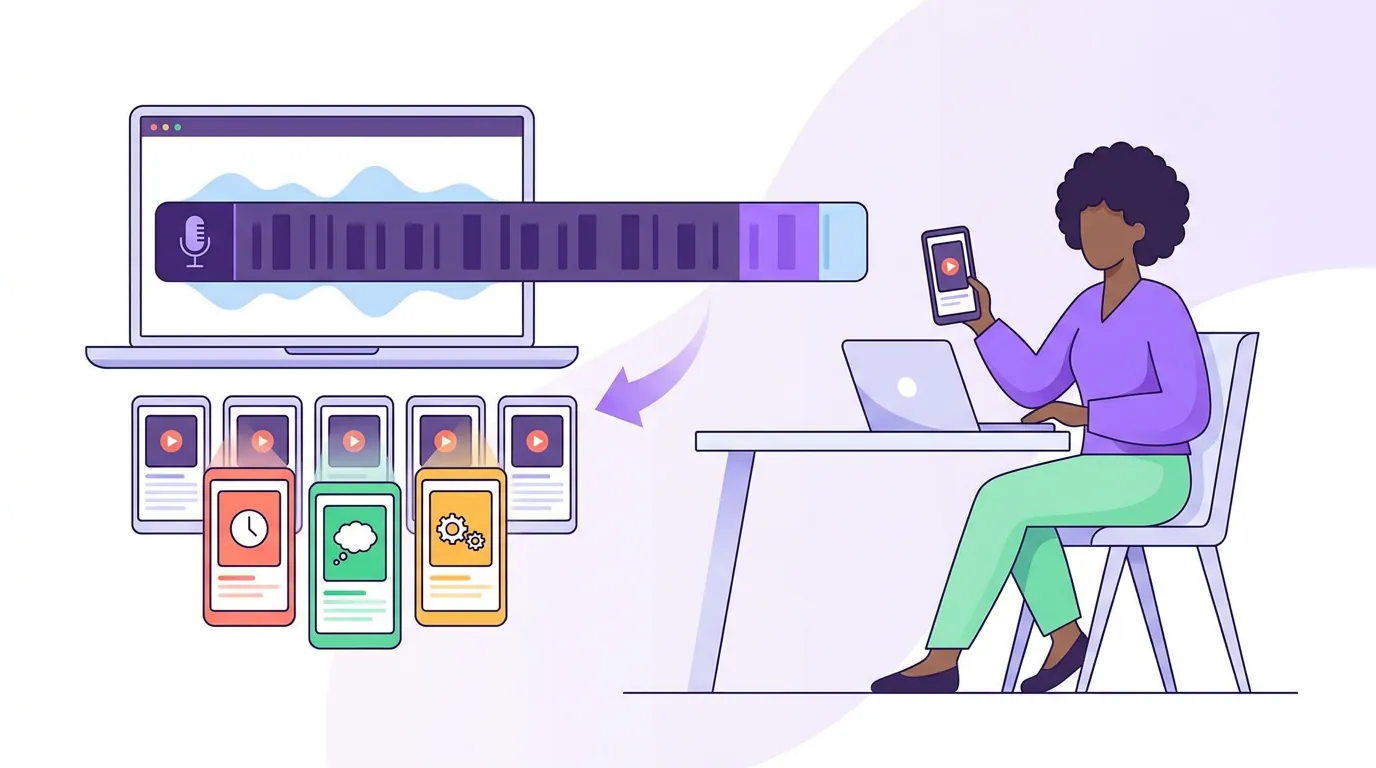
Three to five Shorts per episode, posted across the week, not all at once. A single 30–90 minute recording holds enough strong 30-to-60-second moments to fill that without scraping, and spreading them keeps a steady presence in the Shorts feed between long uploads. Below three, the discovery feed barely gets to test you; above five from one episode, quality usually slips because you start posting moments that weren't actually clip-worthy.
The ratio comes from three constraints, not from a magic number. First, supply: a typical episode genuinely contains three to five moments that stand alone, a sharp answer, a disagreement, a story with a turn. Forcing a sixth usually means posting filler, and a weak Short trains the feed to show you less. Second, frequency: the Shorts feed wants a regular signal, and three to five posts spaces neatly across a seven-day week with rest days built in. Third, sustainability: four Shorts plus one episode is a workload a solo host can batch in an afternoon, which is the only kind of cadence that survives past month three.
Spread the Shorts so they surround the episode rather than dumping them on release day. A teaser the day before primes subscribers for the drop; the rest fill the gap until next week, which is exactly when a channel goes quiet and loses momentum. There's a whole format playbook behind which moments to pull and how to package them in a Shorts strategy built for podcast channels, cadence decides when, that decides what.

The steps to run the cadence
- Record once, weekly. One session produces both clocks' worth of content. Don't record separately for Shorts, pull them from the episode.
- Lock the long-episode slot. Pick a day and hour, publish there every week, and treat it as immovable. Use YouTube's scheduled-publish so the episode drops on time even if you're away.
- Cut three to five Shorts from the episode. Choose the moments that already earned a reaction in the room. An AI clipper finds candidates fast, but plan to review and trim them, more on that below.
- Spread the Shorts across the week. One teaser the day before the episode, the rest filling the gap until the next drop. Skip a day or two on purpose so the pace stays holdable.
- Watch retention, then adjust. Hold this cadence for four to six weeks before changing anything. If your long-episode average view duration holds and your Shorts are still finding new viewers, only then consider raising the Shorts count.

Common mistakes that wreck a YouTube cadence
- Posting all the Shorts on episode day. It spikes one day and goes silent for six. Fix: spread them; the feed rewards a steady drip, not a dump.
- Chasing a daily-Shorts pace from a single weekly episode. Five quality moments don't stretch to seven days without padding. Fix: post three to five strong Shorts, not seven weak ones, a bad Short suppresses your next one.
- Moving the long-episode slot around. An inconsistent drop day resets the habit you're trying to build with subscribers. Fix: same day, same time, scheduled in advance.
- Treating views as the goal. A Short that "did numbers" and a Short that grew the show are different events. Virality without a funnel is empty engagement, views are not conversions. Fix: track subscribes and the click-through to the long episode, which is the whole point of turning Shorts viewers into long-episode watchers.
- Skipping the human review on AI-cut Shorts. Auto-detection is fast but blunt. Fix: budget the review time so no Short ends mid-sentence or opens on a flat line.
Tools that make the cadence cheap to run
Two things make this sustainable: a fast way to cut the Shorts and YouTube's own scheduler. An AI clipper (QuickReel, Opus Clip, and others) turns the long episode into Short candidates in minutes, which is what makes three to five a week realistic instead of an editing slog. Be honest about the limit, though: no AI clipper picks the moment and trims it perfectly every time, so budget a review pass to catch a clip that ends mid-thought or starts weak. The tool gets you most of the way; you finish the last stretch.
For the long episode, YouTube's scheduled-publish handles the fixed slot for free. For the Shorts, schedule them the same way or in whatever clipping tool exports directly to the channel, the fewer clicks between a finished Short and a posted one, the more likely you keep the cadence. The growth this attracts has to land somewhere it sticks: send new subscribers toward an email list built from zero and greet them with a welcome sequence for new podcast subscribers, because a subscriber you can reach directly is worth more than one who depends on the algorithm reshowing your next upload. Clips drive 20–40% of new audience for video shows (Podcast Studio Glasgow), the cadence is how you keep that engine running without it running you.
FAQ
How often should I post a video podcast on YouTube? Post one full episode a week on a fixed day, plus three to five Shorts spread across the week on a separate schedule. The long episode keeps subscribers; the Shorts feed discovery. Treating them as one upload calendar is the most common mistake, because each format rewards a different rhythm.
Is it bad to post Shorts every day? Not inherently, but a single weekly episode rarely contains seven Shorts worth posting. Daily Shorts from one episode usually means padding, and a weak Short trains the feed to show you less. Three to five strong Shorts a week beats seven mediocre ones. Only go daily if you have multiple episodes or other footage to pull from.
Should the long episode and Shorts post on the same day? No. Post one teaser Short the day before your episode to prime the drop, then spread the rest across the gap until next week. Dumping everything on episode day spikes one day and leaves the channel silent for six, which is when momentum dies.
How long should the long episode be? Length matters less than consistency. Whether your episodes run 20 minutes or 90, what builds the subscriber habit is the same day and time every week. Cut the episode to its natural length and protect the slot rather than padding to hit a runtime.
When should I increase how often I post? After holding this cadence for four to six weeks and confirming two things: your long-episode average view duration is steady and your Shorts are still reaching new viewers. If both hold, add a Short before adding a second long episode, Shorts are cheaper to scale and they feed discovery, which is usually the bottleneck.