
A YouTube Shorts Strategy Built for Podcasts


Run Shorts as a discovery layer with its own rules, not as trailers for your episodes. Cut moments that loop, reframe your horizontal interview so one speaking face fills the vertical frame, and post three to five a week. The goal is not Shorts views, it is pulling those viewers up into your full episodes on the same channel.
Most podcast channels treat Shorts as a bolt-on: chop a random minute, slap it vertical, post it. That gets views and almost no subscribers. Shorts and long-form are two different products that happen to share a channel, and YouTube's Shorts feed rewards a specific shape of video, fast, looping, self-contained, that has little to do with what makes a good 45-minute interview.
This guide covers the part that is genuinely Shorts-specific: which moments to cut, how to reframe a two-person horizontal shoot, and how to build the bridge from a Short to a long episode. We are not covering clip-export mechanics here.
Why Shorts are worth it for a podcast channel
YouTube is where podcast discovery happens now, and Shorts are its discovery surface. YouTube passed 1 billion monthly podcast viewers in January 2025 (Variety), and it sits as the #1 US podcast platform at 42% of monthly listeners, well ahead of Spotify at 15% and Apple at 7% (Backlinko). If you are choosing one platform to fight for, the math points here.
The growth case for Shorts specifically is that they reach people who would never click a 45-minute video cold. Clips drive an estimated 20–40% of new audience for video shows and can lift reach 2–5× (Podcast Studio Glasgow). And social clips have overtaken word of mouth as the way people find shows, 57% of listeners now rely on social media for podcast recommendations, the first time it surpassed friends and family (InsideRadio).
The honest caveat: Shorts and long-form watch hours are counted and surfaced separately, and a Shorts view is a much lighter signal than a long-form view. A million Shorts views can sit next to a channel that nobody subscribes to. Growth comes from the handoff, not the view count, which is why the rest of this guide is about the handoff.
What makes a Short different from a regular podcast clip?
A Short is a clip engineered to loop. The Shorts feed counts a replay as watch time, so your biggest lever is whether the ending sends a viewer back to the start instead of letting them swipe away. A normal podcast clip ends; a Short closes a circle. That choice separates a Short that travels from one that stalls.
Three other things make Shorts their own format:
They are built to be watched without sound and without context. The viewer arrived from an infinite feed, not from your channel. They have no idea who is talking. So the first frame has to establish stakes, who, and why I should care, before the swipe instinct fires.
They are vertical, and your podcast almost certainly is not. A two-person horizontal interview shot wide is the worst possible source for a 9:16 frame. Reframing well is half the job, and most channels do it badly.
They are judged on loops and swipe-away, not subscribers. Your follower count barely helps a Short. Each one earns its reach on its own watch behavior, which is good news for small channels and bad news for lazy ones.
The loop test: which podcast moments actually loop
Before you cut anything, run every candidate moment through one question: does the last line make the first line land harder? That is the loop test. If the ending recontextualizes the opening, a punchline that pays off a setup, an answer to a question posed at the start, a number that reframes a claim, the viewer rewatches to catch what they missed. If the moment just trails off, it ends, and they swipe.
Three moment-types reliably loop for podcasts:
- Setup-then-payoff. A host poses a provocative question or makes a wild claim at second one; the guest's answer at the end snaps it shut. The loop happens because the open and close are two halves of the same thought.
- The reversal. "Everyone tells you to do X. That is exactly backwards." The viewer rewatches to check they heard the flip correctly.
- The number drop. A specific, surprising figure delivered at the end of a build. People loop to re-read or re-hear a stat they didn't quite catch.
Moments that almost never loop: slow-building stories with no twist, polite agreement between host and guest, and anything where the best line is in the middle and the clip keeps going afterward. If the strongest sentence is at second 20 of a 40-second cut, you have buried the loop. Trim so it lands near the end.

How do you reframe a horizontal interview into a vertical Short?
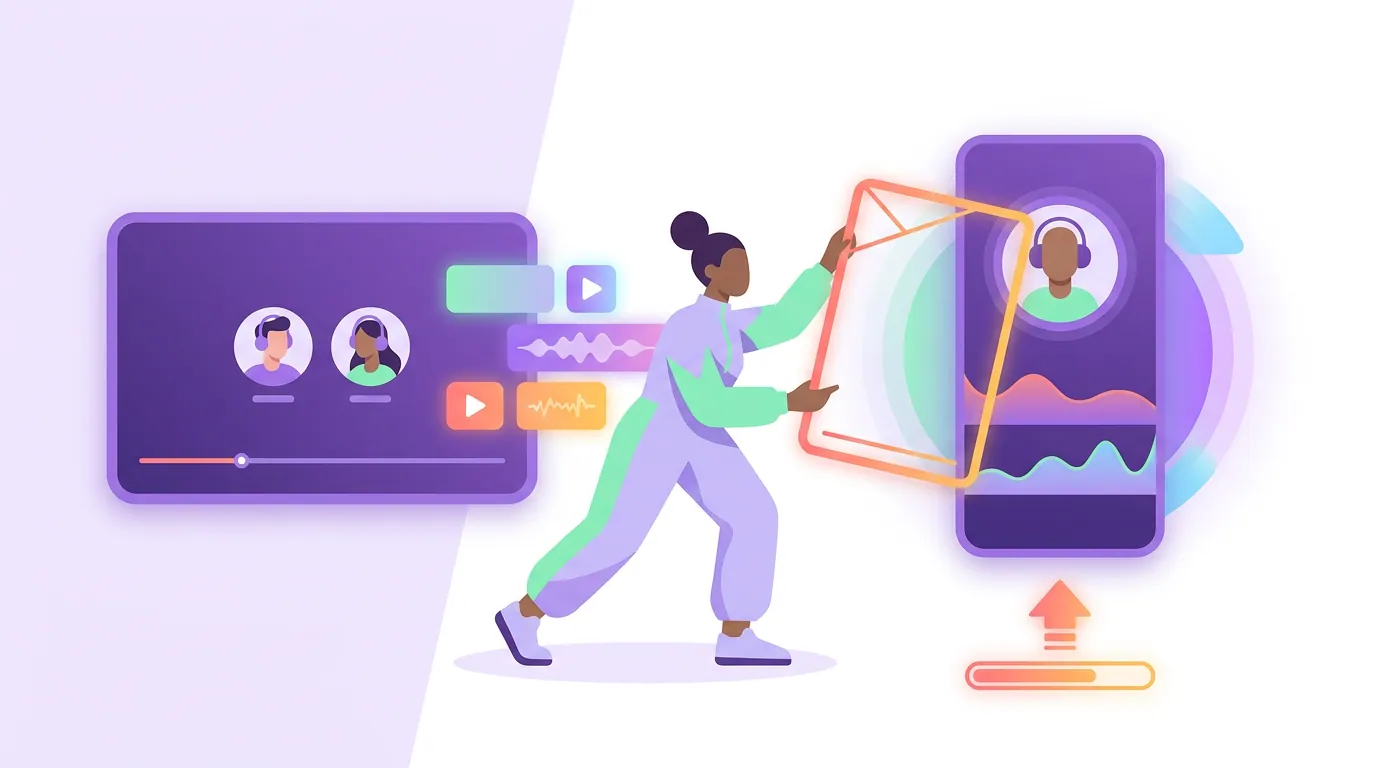
Reframe so one speaking face fills the vertical frame, and cut between speakers as they talk, never leave both heads tiny in the middle with empty bars top and bottom. A 9:16 frame is tall and narrow; a wide two-shot crammed into it wastes the format. The fix is active reframing that follows whoever is speaking.
For a two-person podcast, work this way:
- Single-speaker shots. When one person is talking, fill the frame with their face, eyes in the upper third. This is the default state.
- Cut on the turn. When the other person starts speaking, cut to them. The motion of cutting between faces is itself a pattern interrupt that holds attention.
- Reaction beats. For a punchline, a quick cut to the listener's reaction can land the joke harder than staying on the speaker.
- Captions in the safe zone. Keep burned-in captions clear of the bottom third, where YouTube stacks the title, handle, and action buttons, or they get covered.
If you record with this in mind, a clean two-shot plus separate single cameras, or at least good framing space around each face, the vertical cut gets far easier. For the full distribution picture once your Shorts are reframed and posted, see how the clips-to-channel funnel for YouTube podcasts connects each Short to a subscribe.
The Shorts playbook, step by step
1. Pick moments with the loop test, not by gut
Run every candidate through the loop test above before you cut. Reject anything where the best line is buried in the middle or the ending trails off. You want fewer, better Shorts, not a pile of flat ones.
2. Open on the hook, in the first frame
The viewer decides in roughly a second whether to keep watching. Open on the most surprising line or the clearest stakes, a face mid-sentence on something provocative beats a logo card or a slow intro every time. Cut everything before the hook. If your strongest sentence is at second eight, second eight is now second zero.
3. Reframe vertical and caption for mute
Reframe to follow the speaker, then burn in word-by-word captions kept out of the bottom third. Captions are not optional: most social video is watched on mute, commonly cited at 75–85% (Verizon Media/Sharethrough reported ~75%; Digiday's 2016 Facebook figure ~85%, both publisher-reported and directional). For a podcast, where the value is the words, an uncaptioned Short is dead on arrival.
4. Engineer the loop
Trim so the last line pays off the first. If the moment naturally ends a beat too early or too late, adjust the out-point to land on the payoff. A clean loop is the single highest-leverage edit you can make to a Short.
5. Build the bridge to the full episode
This is the step podcast channels skip. End the on-screen text or the spoken line with a specific pointer: "full conversation on the channel," and pin a comment linking the episode. The bridge from a Short to a long video is what turns discovery into watch time, the Shorts-to-long-form conversion problem is worth solving deliberately, because YouTube counts the two separately.
6. Post three to five a week, on a schedule
Three to five Shorts a week is the practical floor for learning what works without burning out. Volume does not boost any single Short, it gives the feed more data points and gives you more swings. Anchor a couple to episode-release day and spread the rest across the week so your channel never goes dark between episodes.

Common mistakes that kill podcast Shorts
Posting horizontal clips with bars. A letterboxed 16:9 clip dropped into the Shorts feed reads as lazy and wastes the vertical canvas. Always reframe to fill the tall frame.
Ending on a trail-off. If the clip just stops talking, it does not loop, and you have thrown away the format's main advantage. Engineer the payoff to land near the end.
No bridge to the episode. Views with no path to the channel are vanity. Virality without a strategy is empty engagement, views are not subscribers. Always point somewhere.
Captions in the bottom third. YouTube's interface covers the bottom of the frame with the title, handle, and buttons. Captions placed there get hidden on half your views.
Treating Shorts like a numbers game only. A channel can rack up Shorts views and gain almost nobody. Track subscribers and how many Shorts viewers click into a full episode, not just views. Average channels are slow to grow regardless, most creators never get past double digits, and reaching 1,000 subscribers takes roughly 22 months on average (BerryViral). Shorts are a lever, not a shortcut.
Frequently asked questions
How many Shorts should a podcast post per week?
Three to five a week is the sweet spot for a growing channel, enough to feed the discovery algorithm and learn what works without quality slipping. One episode comfortably yields that many strong moments. Anchor a couple to release day; spread the rest across the week so the channel stays active between episodes.
Do Shorts hurt my main channel's long-form views?
No, but they do not automatically help either. YouTube counts Shorts and long-form watch time separately, so a Short rarely cannibalizes a long video. The risk is the opposite: Shorts that earn views but never bridge anyone into the full episodes. Build the bridge deliberately so discovery converts to watch time.
Should I make Shorts vertical or just repost horizontal clips?
Vertical, reframed to follow the speaker. A horizontal clip with black bars wastes the 9:16 canvas and signals low effort to the feed. Reframe so one speaking face fills the frame and cut between speakers on the turn. The reframing is half of what makes a podcast Short work.
How long should a podcast Short be?
Cut to the moment, not to a target length, usually 20 to 60 seconds for a single loop-able beat. Shorter clips loop more easily, which the feed rewards. Resist padding to fill time; every extra second a viewer doesn't need is a chance to swipe away.
Will Shorts get me my first 1,000 subscribers?
They can speed it up, but they are not a guarantee, channel growth is slow, with reaching 1,000 subscribers taking roughly 22 months on average (BerryViral). Shorts work best paired with a clear subscribe ask and a strong main feed. See our playbook on getting your first 1,000 YouTube subscribers as a podcaster for the full path.
Put the Shorts loop to work
Shorts are the cheapest way for a stranger to meet your show, but only if each one is built to loop and built to point somewhere. Cut for the payoff, reframe for the vertical frame, caption for mute, and always bridge to the full episode. Pair this with thumbnails for video podcasts that earn clicks on the long-form side, and capture the people who click through with a podcast email list started from zero so a Shorts view can become a relationship, not a passing view.