
First 1,000 YouTube Subscribers: A Staged Playbook


Getting to 1,000 YouTube subscribers as a podcaster is not one task, it is three. The move that wins your first 100 (seeding clips to strangers) plateaus around 500, where binge-watching and a channel trailer matter more. Treat the climb as staged bands, each with one primary tactic, and stop running the wrong play for your size.
Most guides hand you a single checklist and assume a brand-new channel and a 700-subscriber channel need the same thing. They do not. A channel at zero has no recommendation signal and no back catalog to bingewatch, so it lives or dies on clips reaching cold viewers. A channel at 500 has both, and its bottleneck shifts from reach to retention across videos. Run the early play too long and you stall. Below is the band-by-band playbook, with the ceiling that tells you when to switch.
Why does each subscriber band need a different tactic?
Because the lever that moves a channel changes as it grows. At zero subscribers, YouTube has almost no data to recommend you, so your only reliable reach is short clips that travel on their own merit. By 500, the algorithm has enough signal to suggest your videos, and the job flips to keeping a new viewer watching long enough to subscribe.
Run the same tactic across all three bands and you get diminishing returns at exactly the moment you think you've found what works. The clip-seeding sprint that takes you from 0 to 100 still produces views at 500, but those views stop converting to subscribers as fast, because the people clips reach have often already seen you and decided not to subscribe yet. The fix is not "more clips." It is a different move for the band you're in.
Why this matters: subscribers are slow, and most channels never arrive
A view is not a subscribe, and YouTube subscribers grow far slower than the reach that earns them. Estimates for the average time to 1,000 subscribers cluster around 15 to 22 months of consistent uploading, with a practical range of roughly 3 to 18 months depending on niche and cadence (BerryViral). Read that as "this takes sustained work," not a deadline, those figures come from creator-growth firms aggregating channels they track, not from official YouTube data, and the spread between sources is wide.
The reason it's worth the climb: YouTube is where podcast audiences moved. The platform reported more than a billion monthly podcast viewers in early 2025 (Variety), and 53% of new US weekly listeners now say they prefer to watch a podcast, up from 30% in April 2022 (Backlinko). For a new show, YouTube is the front door, but only if you stop treating subscriber growth as one undifferentiated grind.
Band 1, 0 to 100: seed clips to strangers
At zero, your only job is reach, because the algorithm has nothing to recommend you with yet. Post three to five Shorts a week, cut from your strongest spoken moments, and let them travel to people who have never heard your show. Skip the polish-everything instinct. Volume and a sharp first three seconds beat one perfect video here.
This is the band where clips matter most, because social video has become how people find shows at all. 57% of listeners now rely on social media for podcast recommendations, the first time it passed friends and family (InsideRadio, "The State of Video Podcasting 2025"). At 0 subscribers you have no friends-and-family base on the channel; clips are the only door strangers walk through.
The practical Band 1 routine:
- Cut three to five Shorts per episode from the moments that already made you or a guest react, a strong claim, a laugh, a number that surprised you.
- Caption every clip. Feeds autoplay on mute, so a clip with no on-screen text is a clip most people scroll past without ever hearing a word. Captions are not optional.
- Put the hook in the first second, on screen as text and out loud.
- Link the full episode in the clip's description and pin a comment pointing to it.
The ceiling that ends Band 1: clip views keep coming, but your subscriber count crawls past 100 because viewers watch and leave. That's the signal the move has done its job. Clips reach; they don't, by themselves, convince someone the channel is worth following. For the deeper mechanics of turning that reach into a channel, see the clips-to-channel funnel for YouTube podcasts and a Shorts strategy built for podcast channels.
Band 2, 100 to 500: earn the click on the home page
Now the algorithm has enough signal to suggest your videos, so your bottleneck moves from "can anyone see this" to "will they click and stay." This is the band where thumbnails, titles, and a reliable weekly cadence do the work. The same episode with a sharp thumbnail and a curiosity-gap title can earn several times the clicks of a flat one, and on YouTube the thumbnail decides whether the video is opened at all.
The mistake here is keeping the Band 1 mindset and just making more clips. More reach to the same cold pool produces the same low conversion. Instead, redirect effort: keep the clip cadence steady but pour your new energy into packaging full episodes for the browse and suggested feeds, where a 100-to-500 channel finally has placement to win. Title for what a stranger searches, not for the loyal listener who knows your in-jokes. Practical thumbnail tactics live in thumbnails for video podcasts that earn clicks.
Cadence is the other lever. Publishing weekly, same day, trains both the audience and the recommendation system: a viewer learns when to expect you, and the algorithm gets the regular upload signal it favors for suggested-video placement. The shows that stall are almost never the ones that posted too much, they're the ones that went quiet. Pick a day you can hold for a year, not a week.
Band 3, 500 to 1,000: keep them watching across videos
At 500 you finally have a back catalog and enough subscribers that YouTube will recommend your videos to your own near-audience. The lever now is session depth: getting one viewer to watch a second and third video, because that's what converts a casual watcher into a subscriber and tells the algorithm to push you harder. Three moves do this, playlists, a channel trailer, and end screens.
- Playlists turn one good video into a binge. Group episodes by theme or guest type so a viewer who finishes one rolls into the next without choosing. This is the move that did not exist at 0 (no catalog) and barely helped at 100 (too few videos). At 500 it's your strongest unused lever.
- A channel trailer gives non-subscribers a reason. Set a 60-to-90-second trailer for unsubscribed visitors: who the show is for, what they'll get, why subscribe now. At 500 you have enough channel traffic for this to convert; at 0 almost nobody visited your channel page.
- End screens point to the next video, not "thanks for listening." Send finishers to a specific related video. Sessions are what YouTube rewards, and a longer session is the difference between a watcher and a subscriber. The mechanics of routing Shorts viewers into long episodes are in turning Shorts viewers into long-episode watchers.
The ceiling here is monetization, not growth: 1,000 subscribers opens the door, but you also need 4,000 valid public watch hours in 12 months (or 10 million Shorts views in 90 days) to earn (YouTube Partner Program, official help). If you want the watch-hours math and the episodes-vs-clips upload mix that clears both locks, that's the focus of a podcast's first 1,000 YouTube subscribers.
Common mistakes that stall the climb
These are the patterns that keep otherwise-good podcast channels stuck below 1,000 for far longer than the benchmark.
- Running the Band 1 clip sprint forever. Clips reach strangers, but past ~100 subscribers, reach without packaging and session depth just refills the top of a leaky funnel. Keep clipping, but stop treating "more Shorts" as the answer to every plateau.
- Polishing full episodes before you have anyone to watch them. At zero, a perfectly graded 50-minute video reaching no one loses to five rough clips reaching a few thousand. Spend the production effort where the band rewards it.
- Buying the same advice at every size. The single biggest hidden cost is a generic checklist applied to the wrong band. Diagnose your band first, sub count and whether subs or views are the stuck number, then pick the move.
- Ignoring the channel page until late. A channel trailer and playlists feel like Band 3 work, but setting them up at 400 means they're working the day you cross 500. Build the structure just before you need it.
- Renting your whole audience from the algorithm. A subscribe lives inside YouTube's feed; an email is yours. Start capturing addresses early, a podcast email list from zero and a five-email welcome sequence for new subscribers turn one-time viewers into people you can reach without YouTube's permission.
Tools: where clipping fits, honestly
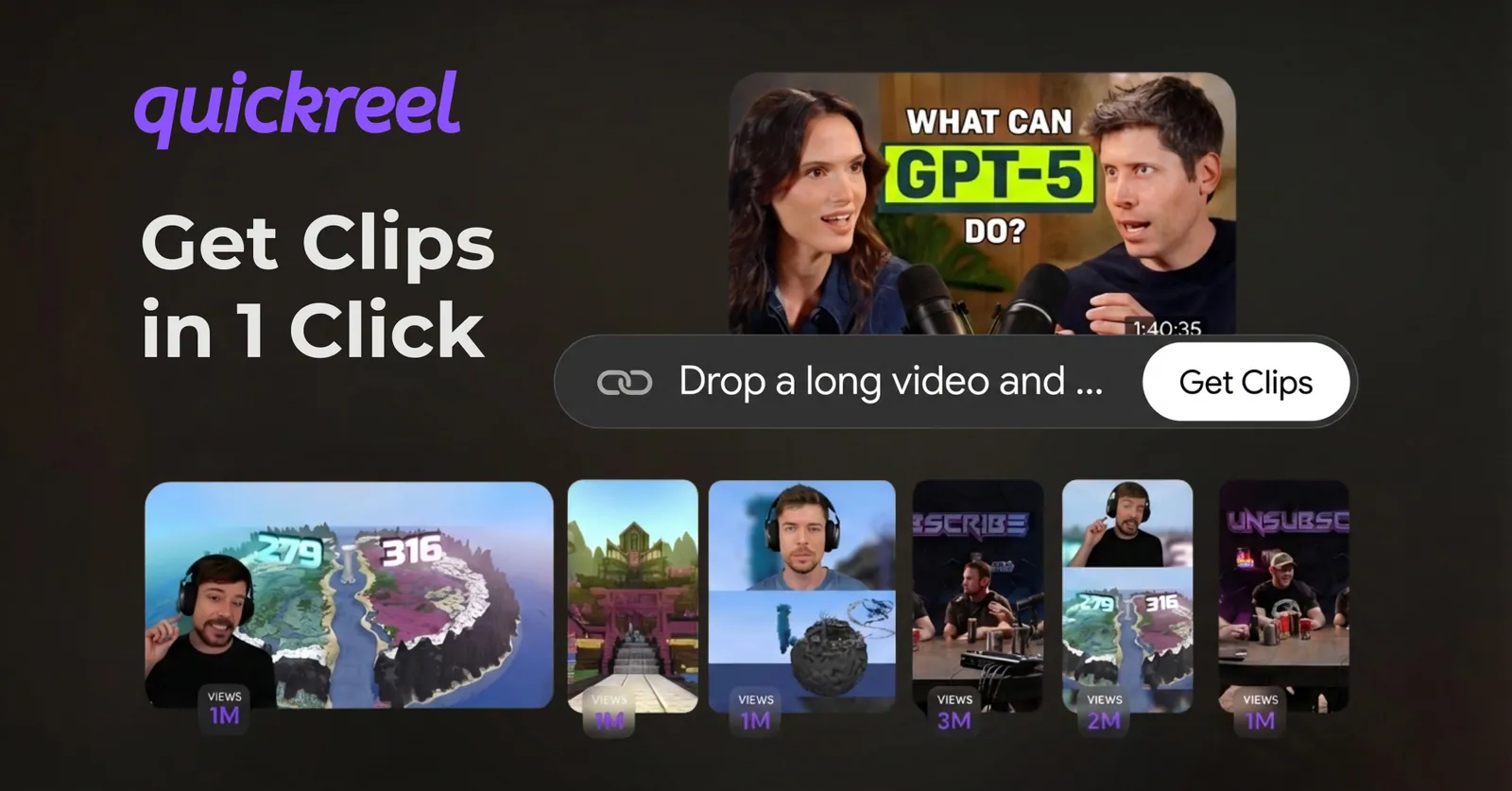
You can run Band 1 entirely by hand, a free editor, manual cutting, manual captions. The cost is time, and time is what kills the three-to-five-clips-a-week cadence that the first band depends on. The honest case for an AI clipper is throughput, not magic: it turns one episode into a batch of captioned vertical clips in minutes so you can sustain the cadence without burning out.
The honest caveat applies to every tool in this category, QuickReel included: AI clipping still needs human review. Expect to re-trim, re-caption, or kill roughly 20-40% of auto-generated clips before posting. A tool gets you to a strong draft fast; your judgment about which moment actually travels is still the deciding factor. If a vendor implies zero review, don't believe it. Used that way, clipping software is an accelerant for Band 1 reach, not a replacement for the editorial choices that make a clip worth watching.
FAQ
How long does it take a podcast to get 1,000 YouTube subscribers? Estimates cluster around 15 to 22 months of consistent uploading, with a practical range of roughly 3 to 18 months depending on niche and cadence (BerryViral). Those figures come from creator-growth firms, not official YouTube data, so treat them as directional. Channels that clip every episode and publish weekly tend to beat the average.
What's the fastest way to get your first 100 YouTube subscribers? Post three to five captioned Shorts a week cut from your strongest spoken moments, with the hook in the first second. At zero subscribers the algorithm can't recommend you, so short clips that travel on their own are your only reliable reach, and 57% of listeners now find podcasts via social media (InsideRadio).
Why did my subscriber growth stall around 500? Because the move that worked early, reaching strangers with clips, converts more slowly once your near-audience has already seen you. At 500 the lever shifts to session depth: playlists, a channel trailer, and end screens that keep one viewer watching multiple videos. Keep clipping, but make binge-ability your primary focus.
Should I post full episodes or clips to grow on YouTube? Both, but the mix shifts by band. Early on, clips carry the reach you need to get found. As you grow, full episodes packaged with strong thumbnails and grouped into playlists do more of the converting, and they're what bank the 4,000 watch hours required to monetize (YouTube Partner Program, official help).
Do clips alone get you to 1,000 subscribers? Rarely. Clips are the best tool for the first band and a steady reach engine after that, but a channel of only Shorts often hits 1,000 subscribers with almost no long-form watch hours, leaving it locked out of monetization and short on the session depth that sustains growth. Clips reach; episodes, playlists, and a trailer convert.