
What to Do When You Stumble Over Your Words on Tape


When you stumble over a word on a recorded podcast, stop, don't push through it. Pause for two beats, take a breath, and re-deliver the entire clause cleanly from your last natural breath point. That hands the editor two takes of the same line, and they keep the clean one. The fumble disappears in the cut.
The instinct nearly everyone has is to correct mid-word, "the the data, sorry, the data shows", and keep barreling forward. That gives the editor a tangle they can only fix with an ugly mid-sentence splice. The clean restart gives them a seam they can hide. Same mistake, completely different outcome, and the only variable is whether you paused first.
This guide covers the exact four-step restart that makes the splice invisible, where to set your restart point so the edit lands cleanly, a decision rule for when to fix a stumble versus leave it because it sounds human, and the editing reality that should take the pressure off your whole recording.
Why a stumble is not the problem, pushing through it is
A stumble feels like a mistake worth apologizing for. It isn't. On a recorded show, a single garbled word is one of the easiest things in the world to remove, as long as you give the editor a clean version to swap in. The problem is never the stumble. It's the seven seconds of half-corrections, apologies, and re-runs that you stack on top of it without ever leaving a clean gap.
This matters more on a podcast than in a live conversation for one reason: the episode gets edited, clipped, and posted before anyone hears it. Clips are now the main way people find shows, 57% of listeners rely on social media for podcast recommendations, the first time it surpassed friends and family (InsideRadio, 2025). That can read as added pressure. It's actually the release valve: because there's an edit between your mouth and the listener's ear, your job isn't a flawless live take. Your job is to hand over raw material the editor can shape, and a clean restart is the most editor-friendly thing you can do.
So the skill isn't never stumbling. Your tongue will trip on a name, a number, a tongue-twister of a phrase. The skill is making the fix clean enough that it edits to nothing.
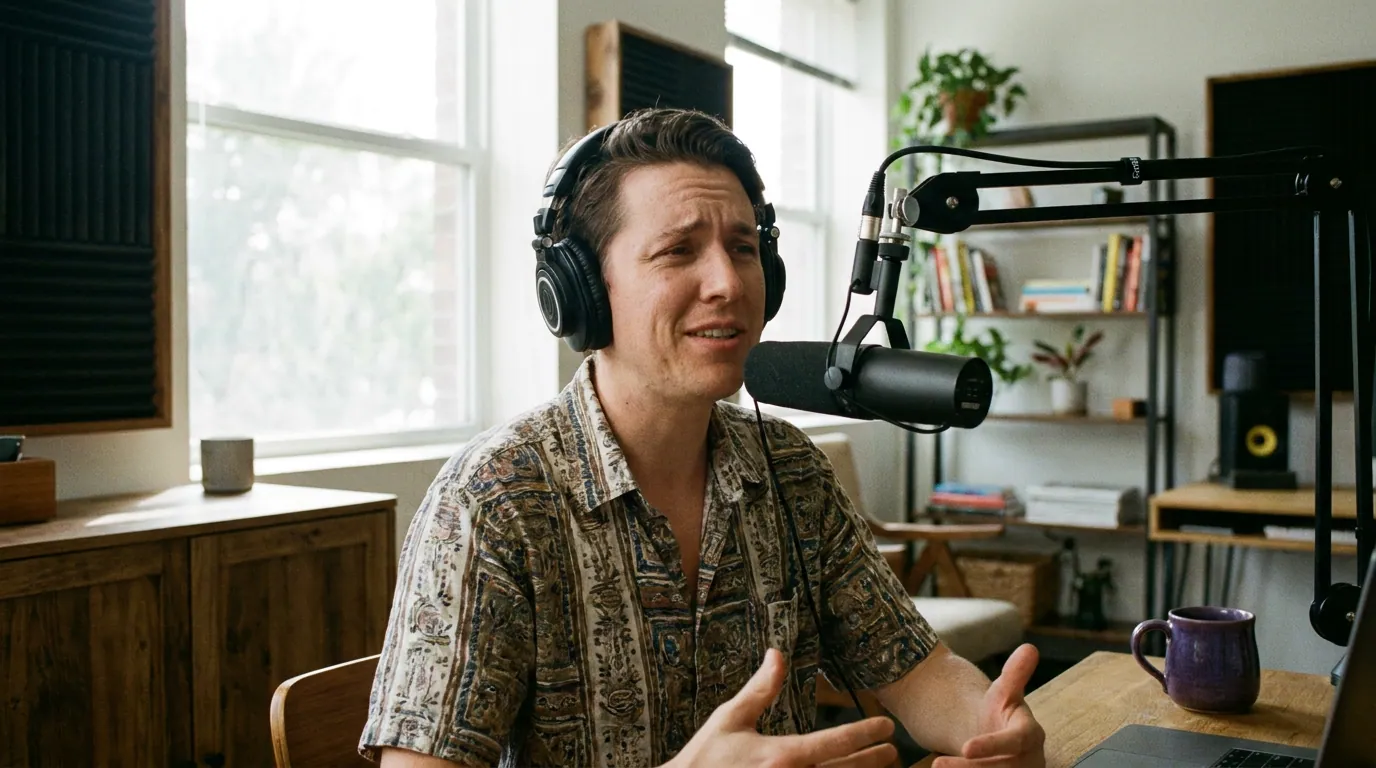
The clean-restart technique: stop, pause, breathe, re-deliver
The whole technique is four moves, in order, and the order is what makes it work. Most guests do steps three and four (try again) without one and two (stop and leave a gap), which is why their fix is as messy as the stumble.
Stop. The moment a word trips, end the sentence. Resist the reflex to correct the single word in flight, "the protocal, protocol", because that mid-word fix is exactly the thing an editor cannot cleanly remove.
Pause two beats. Sit in silence for roughly two seconds. This is the most important step and the one everyone skips. That silent gap is the editor's cut point; without it, your retry is welded to your fumble and the whole thing has to come out or stay in together.
Breathe. One slow breath in through the nose. It physically interrupts the panic-talk reflex and resets your pace, which is usually what caused the trip in the first place, going faster than your mouth can track.
Re-deliver the whole clause. Don't pick up from the broken word. Back up to the start of the clause, your last natural breath point, and say the full thing again, clean. Now the editor has two matched takes and keeps the good one.
Where to set your restart point
The re-delivery only edits cleanly if you restart from the right place. Restart too late, from the broken word, and the editor can't find a natural seam. Restart too early, from three sentences back, and you're re-recording material that was already fine, which wastes tape and risks a tone mismatch.
The rule: restart from the beginning of the current clause, at your last clean breath. A clause is the natural chunk between breaths, "The thing most people miss" / "is that captions aren't optional." If you trip on "captions," you don't restart at "captions." You go back to "is that" and run the whole second clause again.
Match your energy and pace on the retake, too. If you stumbled because you sped up, the clean version should be a touch slower, but keep the same volume and tone so the splice doesn't jump. Editors join takes on the silence; your job is to make the two sides of that silence sound like the same person in the same moment.

When to keep rolling instead of restarting
Not every stumble is worth fixing. A small trip that you recover from inside the same breath, a quick self-correction that lands and keeps moving, often sounds more human than a surgically clean line, and listeners barely register it. Restarting those makes you sound stilted. The decision rule is simple: fix what blocks meaning, keep what just sounds like a person talking.
Restart when the stumble actually broke something: you said the wrong word and it flipped your meaning, you garbled a person's name or a number, or the sentence collapsed into a knot you can't unpick on the fly. Those have to be clean, because a clip built on a wrong fact or a butchered name is worse than no clip.
Keep rolling when the trip was cosmetic, a stutter on the first syllable, a quick "no, sorry, Tuesday" that lands and moves on, a sentence that wobbled but stayed clear. Over-restarting is its own trap: it makes you sound like a guest reading lines instead of one having a conversation, and the relaxed, slightly-imperfect version is usually the one that becomes a good clip. The same ease shows up as confidence on camera.
Common mistakes when you stumble on tape
- Correcting mid-word. "The protocal, protocol, " welds your fumble to your fix. Stop the whole sentence and restart the clause instead, so the editor has a seam.
- Skipping the pause. Jumping straight into the retry leaves no silent gap to cut on, so the good take and the bad one have to live or die together. The two-beat pause is the edit point.
- Apologizing out loud. "Ugh, sorry, let me try that again" drags a two-second fix into a ten-second one and lowers the room. Stay quiet, breathe, redo the line. The dead air is editable; the apology spiral is harder.
- Restarting from the wrong spot. Picking up from the broken word, or backing up three sentences, both produce messy splices. Restart from the last clean breath at the start of the clause.
- Restarting everything. Fixing tiny, human self-corrections makes you sound robotic and burns tape. Keep what stayed clear; only redo what broke the meaning.
- Recording cold. A cold mouth trips more in the first five minutes. A short vocal warm-up before you hit record steadies your opening, and tracking the um and like that creep in when you stall cuts the trips that come from rushing.
FAQ
What should you do if you stumble over your words while recording? Stop the sentence, pause for about two seconds, take a breath, then re-deliver the whole clause cleanly from your last natural breath. That gives the editor a clean take to splice in over the fumble, and the silent gap gives them a seam to cut on. The stumble edits out completely.
Should I apologize when I misspeak on a podcast? No. Apologizing turns a quick fixable trip into a longer awkward moment and drops the energy of the room. Stay silent for a beat, breathe, and simply say the line again. Good hosts expect retakes and don't need an apology, they're trying to make you comfortable, not grade you.
How do I restart a sentence so the editor can cut it cleanly? Leave a clear silent gap before you retry, that gap is the cut point. Then restart from the beginning of the clause at your last clean breath, not from the broken word, and match your pace and tone to the original. Two clean, matched takes joined on silence splice together invisibly.
Is it better to keep going or start over when I stumble? It depends on what the stumble did. Restart if you said the wrong word, garbled a name or number, or tangled the sentence so the meaning got lost. Keep rolling if it was a quick self-correction that landed and stayed clear, those sound human, and over-fixing makes you sound scripted.
Why do I stumble more at the start of a recording? Your voice and nervous system aren't warmed up yet, and nerves push your pace ahead of your articulation. Take your first answer noticeably slower than feels natural, do a few minutes of vocal warm-up beforehand, and remember the opening minutes get edited like everything else, early trips are the easiest to cut.
Build out the rest of your on-mic toolkit: look confident on camera as a first-time guest, cut the um and like that creep in when you rush, and learn where to look on a video podcast, camera vs. the host. A quick pass over the unwritten guest etiquette rules rounds it out.