
Keep Your Voice Strong Through a 2-Hour Recording


To hold your voice through a two-hour recording, treat it like an endurance event, not a sprint: sip room-temperature water every fifteen minutes, rest your voice during the host's questions instead of nodding along out loud, reset your posture every half hour, and stop pushing volume the moment your pitch starts to climb. Fatigue is cumulative, so the fixes have to be cumulative too, small, regular, and built into the recording.
Most guests prepare for the first ten minutes. They warm up, they nail the intro, they land a strong first answer. Then the recording runs ninety minutes longer than that, and somewhere past the one-hour mark the delivery flattens, pitch narrows, energy drains, sentences trail off, and the back-half answers that get clipped and shared sound noticeably worse than the front. The voice did not fail. It ran out of stamina because nothing in the session was set up to protect it. This guide is the plan I give guests before a long-form sit-down so the second hour sounds as alive as the first.
Why does your voice get tired during a long recording?
Your voice tires because speaking is muscular work, and the muscles involved, the vocal folds, the breathing muscles, the small stabilizers in your neck, fatigue under sustained load. Add a dry studio, shallow breathing from nerves, and slumping posture an hour in, and the load climbs while the support drops.
The folds that produce your voice vibrate hundreds of times a second when you speak, and they rely on a thin layer of moisture to do it without friction. A long recording in an air-conditioned room dries that layer out, so the same amount of talking costs more effort as the hour goes on. Meanwhile the part of fatigue you actually hear, the thinning pitch, the loss of warmth, usually comes from breath support collapsing, not from the folds themselves. When you slump, your ribs cannot expand, you run short on air, and you start squeezing the voice out from the throat. That squeeze is what people mean when they say their voice "got tired." Fix the air supply and most of the fatigue you can hear goes with it.
This matters more than it used to because more shows are video, and clips from those shows are now how new listeners find the episode in the first place, 57% of listeners say social media drives their podcast recommendations, the first year it passed friends and family (InsideRadio, 2024). A great answer at minute ninety, delivered in a worn-out voice, becomes a worse clip than the same answer would have been at minute ten.
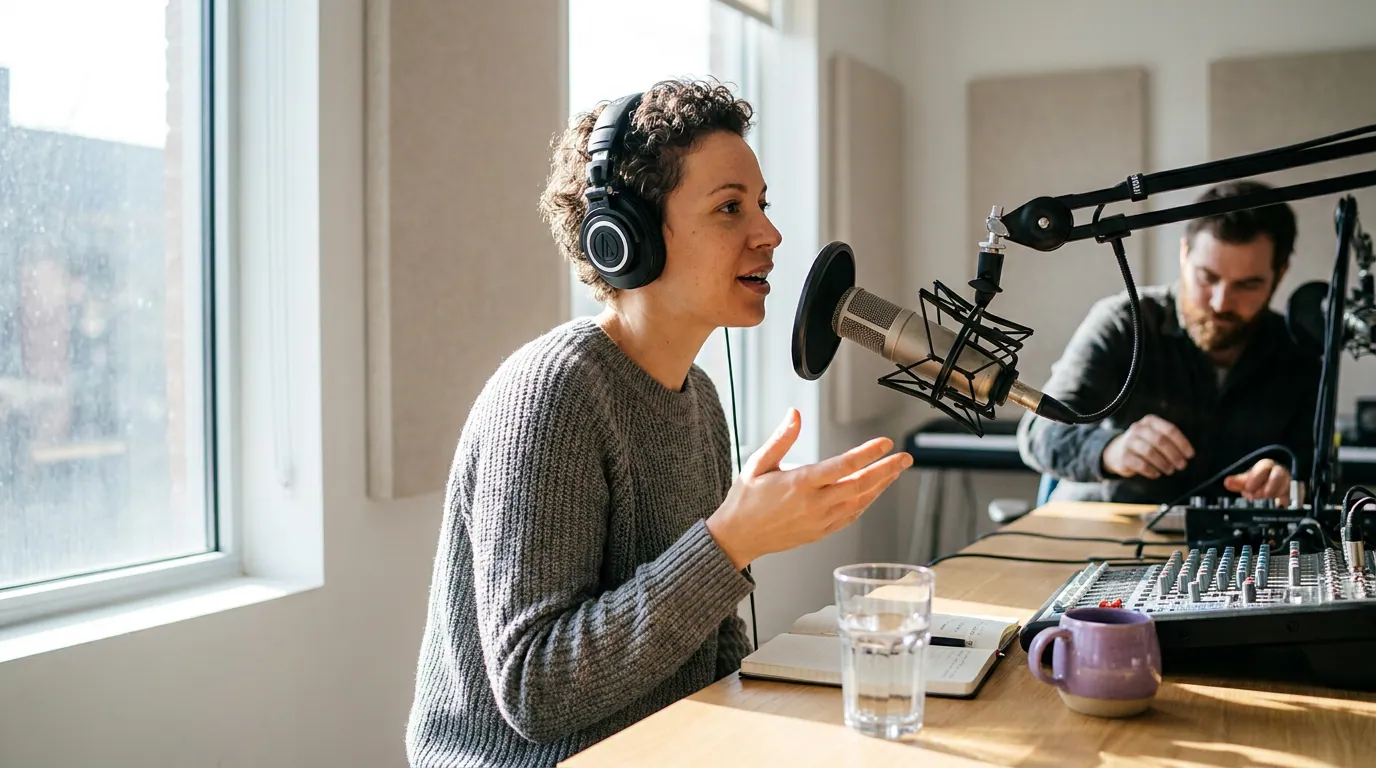
What is the right hydration cadence for a two-hour session?
Sip room-temperature water in small amounts roughly every fifteen minutes, starting before you record, rather than waiting until your throat feels dry. By the time it feels dry, the moisture layer on your folds is already thin and you are talking on a deficit. Steady small sips keep it topped up.
Two specifics matter. First, temperature: room temperature or warm beats ice water, which constricts the muscles around the larynx right when you want them loose. Second, timing: hydration that helps the folds works through your system over time, so the glass of water you drink during the recording is mostly maintenance, the real hydration happened in the hour before. Skip caffeine and alcohol close to the session; both are mild diuretics that pull moisture the wrong way. Keep a plain glass within arm's reach and treat each of the host's longer questions as a built-in sip window.
How do you rest your voice during the recording itself?
Rest your voice in the gaps the conversation already gives you: stay genuinely quiet while the host asks a question instead of filling it with "yeah," "right," and "mm-hmm." Those reflexive nods feel polite, but across two hours they add up to real extra talking, and on video they read as interrupting. Nod with your face instead.
This is the micro-rest most guests never take. A long interview is not one continuous block of you talking; it is your answer, then the host's question, then your answer. The host's questions are free recovery time for your voice, but only if you let them be silent. Replace the spoken nods with eye contact and a slight nod of the head, it signals engagement just as clearly, and it keeps you listening rather than half-formulating your next sentence. If you tend to fill silence out of nervousness, this also quietly cuts your filler word count, which is its own win, more on that in our guide to cutting "um" and "like" out of your answers. Where you do look while you stay quiet matters too; our note on camera versus the host's face covers it.

How should you sit to protect your voice over two hours?
Sit upright: feet flat, weight on your sit bones, ribs stacked over your hips, shoulders dropped, then keep checking, because the body drifts. Good posture keeps your ribcage free to expand, which keeps your breath supply open, the actual engine of a strong voice. Slump and you choke the airflow at the source.
The problem is not finding the posture; it is holding it. Forty minutes into an absorbing conversation you lean toward the mic, round your shoulders, and drop your chin, and your voice loses its floor without you noticing. That is why the cadence above puts a posture reset at the top of every thirty-minute block: a deliberate two-second check to plant your feet, lengthen your spine, drop your shoulders, and level your chin. Keep your chin level rather than jutting it toward the mic; reaching with your neck strains the very muscles you are trying to spare. Let the mic come to you instead.
What are the early warning signs of vocal strain?
The early warning signs are your pitch creeping upward, a tight or scratchy throat, swallowing more often than usual, your volume quietly dropping, and your sentences trailing off at the ends. These show up well before you lose your voice, and each one points to a specific fix you can apply mid-recording without anyone noticing.
The mistake is treating these signals as something to push through. A climbing pitch and a tight throat mean you have switched from breath-supported speaking to throat-squeezed speaking, push harder and you accelerate the damage. The right move is the opposite: back off the volume, lengthen your exhale, reset your posture, and let the breath do the work again. Catch the signs early and you recover inside a sentence or two. Here is the short list I have guests keep in mind, with the fix for each.
Common mistakes that drain your voice early
The plan above prevents most fatigue. These five habits undo it, and they are the ones I see most often.
- Skipping the warm-up because the recording is "just talking." A cold voice has a narrower range and tires faster, so the first thirty minutes cost more than they should. Five minutes of gentle humming and lip trills before you sit down buys you stamina later, the full routine is in our pre-recording vocal warm-up.
- Pushing volume to sound energetic. Energy comes from pitch variation and pace, not loudness. Talking louder for two hours is the fastest route to a worn-out throat. Let the mic carry the volume; you carry the expression.
- Drinking ice water during the session. It feels refreshing and tightens the larynx at the same time. Room temperature or warm keeps the surrounding muscles loose.
- Spoken nodding all the way through. Every "yeah, totally" during the host's question is talking you did not need to do, and recovery time you gave away. Nod with your face instead.
- Ignoring the first warning sign. A climbing pitch at minute fifty is a free warning. Push through it and you are repairing damage for the next hour instead of preventing it.
Does any of this matter if the show is audio-only?
Yes, slightly differently. With the camera off, spoken-nodding habits and slumping cost you nothing visually, but the vocal toll is identical because your voice does not know there is no camera. Everything about hydration, breath support, posture, and the warning signs applies the same way. You just stop worrying about how the micro-rests look.
If anything, audio-only raises the stakes on the voice itself, because the voice is the entire performance, there is no body language carrying part of the message. A flat, tired voice in the back half is more noticeable when it is all the listener has. So keep the posture even though no one sees it; your ribcage does not care about the camera. For the video side of the same conversation, the first-time guest's confidence guide covers what the lens adds on top.
Frequently asked questions
Should I drink tea with honey before a long recording? Warm water or a mild, non-caffeinated tea is fine and the warmth helps loosen the throat muscles. Honey soothes the feeling of irritation but does not coat or "heal" the vocal folds, that is a myth, since nothing you swallow touches the folds directly. Skip strong caffeinated tea close to recording; it is mildly dehydrating.
Is it bad to clear my throat a lot during a long session? Frequent hard throat-clearing slams the vocal folds together and irritates them, which makes you want to clear again, a loop worth breaking. When you feel the urge, sip warm water and swallow firmly instead, or do a gentle silent "huff" of air. If you genuinely need to clear, do it softly and off-mic.
How long before my voice fully recovers after a marathon recording? A healthy voice recovers from one long session with a normal night's rest and hydration; mild tiredness the next morning is common and fades. If hoarseness lasts more than a few days, or you record long sessions back to back without recovery, that is worth easing off for, persistent hoarseness is a medical question, not a technique one.
Can I fix a tired-sounding voice in editing afterward? Only at the margins. Editing can level volume and trim audible breaths, but it cannot put pitch variation, warmth, or energy back into a delivery that has gone flat, those have to be in the recording. This is exactly why the stamina plan matters: the back-half answers are usually the most-clipped, and there is no edit that recovers a voice that already sagged.
Putting it together
Long-form recording rewards the same thing endurance sport does, pacing. Hydrate on a cadence instead of when you are already dry, take the free rest the host's questions hand you, reset your posture every half hour before your body drifts, and treat the first warning sign as a signal rather than something to power through. Do those four things and your minute-ninety answers will sound like your minute-ten ones, which is precisely when the clips that grow the show get made. If you want the most-shareable moments pulled out for you, see our note on guest etiquette around promoting the episode and what the host is doing to keep you comfortable on their end.