
How to Add Energy to Your Voice Without Sounding Fake


To sound more energetic without sounding fake, raise your baseline by one notch, not five. Vary your pitch across a sentence, talk with a slight smile, and lean harder on the verbs than the rest of the words. That reads as engaged. Crank past it and you become an infomercial.
Most people who worry about being monotone make the same mistake when they try to fix it: they overshoot. They picture "energetic" as the morning-radio host or the supplement ad, decide they could never pull that off, and either give up or force it for three minutes before snapping back to flat. The real target is much closer to where you already are. This guide gives you an energy dial to calibrate against, the three levers that add energy you can actually hear, and a matched-energy rule so you land at the right level for the show you're on, not someone else's.
Why does my voice sound flat on a podcast?
Your voice sounds flat because the room strips out the cues a face normally provides. In person, your hands, eyebrows, and posture carry half the energy. On a mic, especially audio-only, all of that vanishes and only the sound is left. A delivery that felt animated in conversation arrives at the listener as level, because the visual half got cut.
There's a second reason, and it's the one nobody warns you about: you can't hear yourself the way the mic does. Bone conduction makes your own voice sound fuller and more dynamic in your head than it is on the recording. So you finish an episode feeling expressive, play it back, and wonder who that monotone person is. You weren't lying to yourself, your monitoring is just biased. That gap is exactly why the fix is calibrated against a recording, not a feeling.
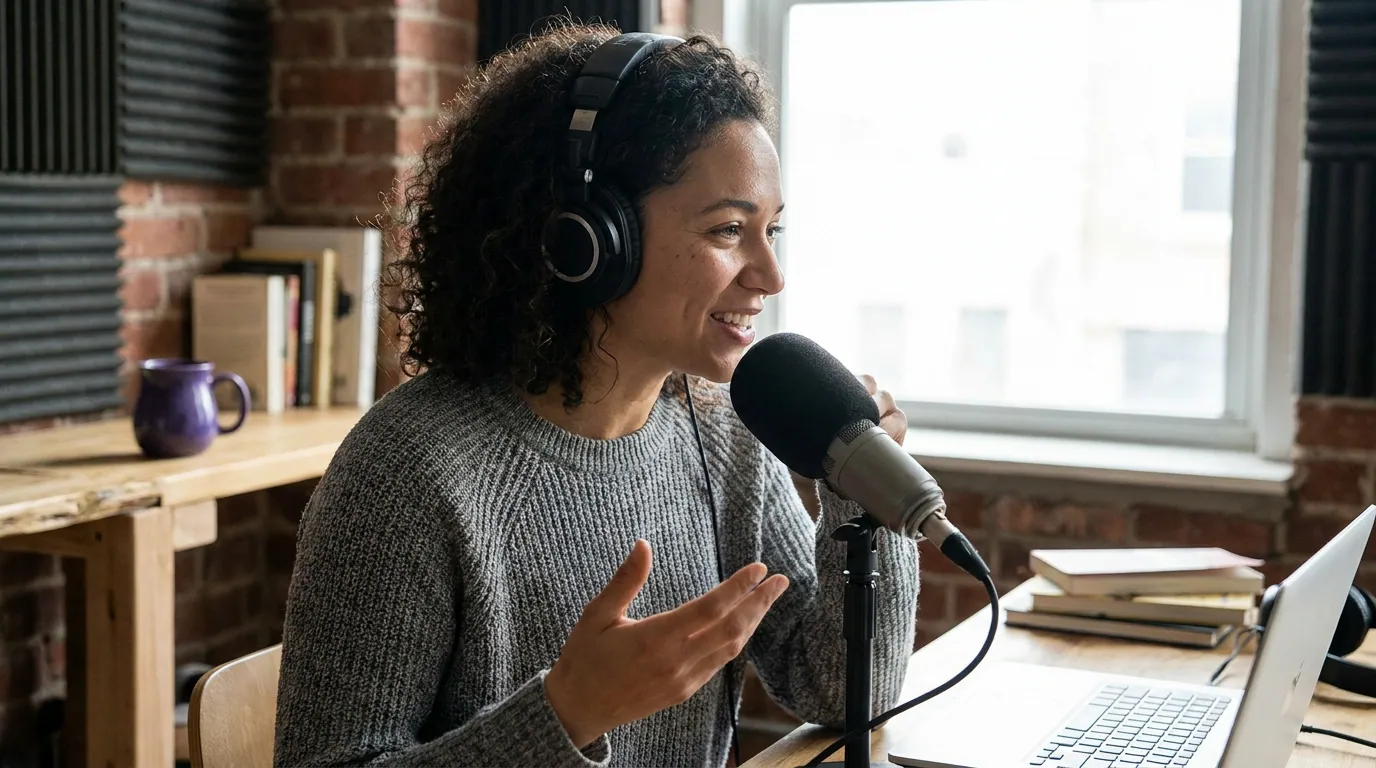
What does "one notch up" actually mean?
One notch up means landing in the zone between flat and forced, engaged, not performed. Picture a dial from 0 to 10. Your nervous monotone sits around a 3, the infomercial voice you fear is a 9, and "engaged" is a 5 or 6. The mistake is aiming for 6 and overshooting to 8.
Over-correctors overshoot because they're guessing in the dark, then recoil back to 3.
A two-point move is almost imperceptible to you and obvious to a listener. That asymmetry is the whole trick. You don't need to become a different person; you need to stop deleting the dynamics you already have.
The three levers that add energy without faking it
You can raise that dial without raising your volume, your speed, or your enthusiasm-for-things-you-don't-feel. Three levers do the work, and none of them require acting.
1. Move your pitch at the ends of sentences
Monotone is, literally, one tone. The cheapest fix is to let the last few words of each sentence change pitch instead of flatlining. Rise slightly on a genuine question. Fall on a point you've landed. The middle can stay neutral, it's the sentence endings that telegraph whether you're invested or running out the clock. Read three sentences aloud and force a different ending pitch on each. It feels exaggerated to you and sounds normal on playback. That's the bone-conduction gap doing its thing again.
2. Talk with a slight smile
A half-smile changes the shape of your vocal tract and brightens the sound, which is why a listener can tell when someone is smiling even on audio with no video. You don't need a grin. A relaxed, slightly-raised expression is enough, and the bonus on a video podcast is that it also fixes the resting-flat-face that reads as boredom on camera. If you find this hard to hold, put a sticky note at eye level near your lens, a dumb trick that works. (We get into the on-camera side of this in looking confident on camera as a first-time guest.)
3. Lean on the verbs
Energy is contrast, and the fastest way to create contrast is to stress the words that carry the meaning. Verbs and the occasional concrete noun do most of that work. "We grew it from nothing in a year" lands; "we grew it from nothing in a year" said flat does not. You're not adding volume across the board, you're adding it selectively, which makes the rest sound deliberate by comparison. Over a full episode this is the single biggest lever, because it's the one that survives even when you're tired.

The matched-energy rule
Here's the part that keeps you from sounding fake: calibrate to the host, not to an imaginary ideal. The right energy level isn't a fixed number, it's relative to the room. A meditation podcast and a sports-debate show want very different versions of "engaged," and the same delivery that fits one feels wrong on the other.
The rule: sit at the host's energy level or one step above it. Never two steps below, never three above. Drop two below and you sound checked-out, like you'd rather be elsewhere. Jump three above and you steamroll the host's tone and read as a guest performing at the room rather than talking with it.
In practice this means the first two minutes are reconnaissance. Listen to how fast the host talks, how much their pitch moves, whether they laugh easily. Then meet them there and add one notch of your own. A high-energy host gives you permission to push; a measured host is telling you to dial back. Either way you're calibrating to a real person in front of you, which is what stops any of this from sounding manufactured.
Common mistakes that make energy sound fake
These are the patterns that turn a real attempt at energy into something a listener distrusts. Each has a specific fix.
- Front-loading energy, then fading. People start strong and slide back to flat by minute five. Energy is a baseline you hold, not a burst you spend. Pick the verb-stress lever, it's the one that survives fatigue, and let the others come and go.
- Faking enthusiasm for something you don't feel. Forced excitement is the most detectable fake there is. If a topic bores you, don't perform interest; get specific instead. Detail reads as engagement even in a calm voice.
- Confusing speed with energy. Talking faster doesn't add energy, it adds anxiety and buries your best lines. Slowing down on the line that matters is often more energetic than rushing, because the pause creates contrast.
- Volume as a substitute for variation. Getting louder across the board flattens you at a higher level, still monotone, just bigger. The levers are about movement and contrast, not raw loudness.
- Ignoring the room. Matching a sports-show delivery to a reflective interview is the clearest tell of a guest running a script. Read the host first. Filler words pile up when you're forcing a register that isn't yours, see cutting the ums and likes.
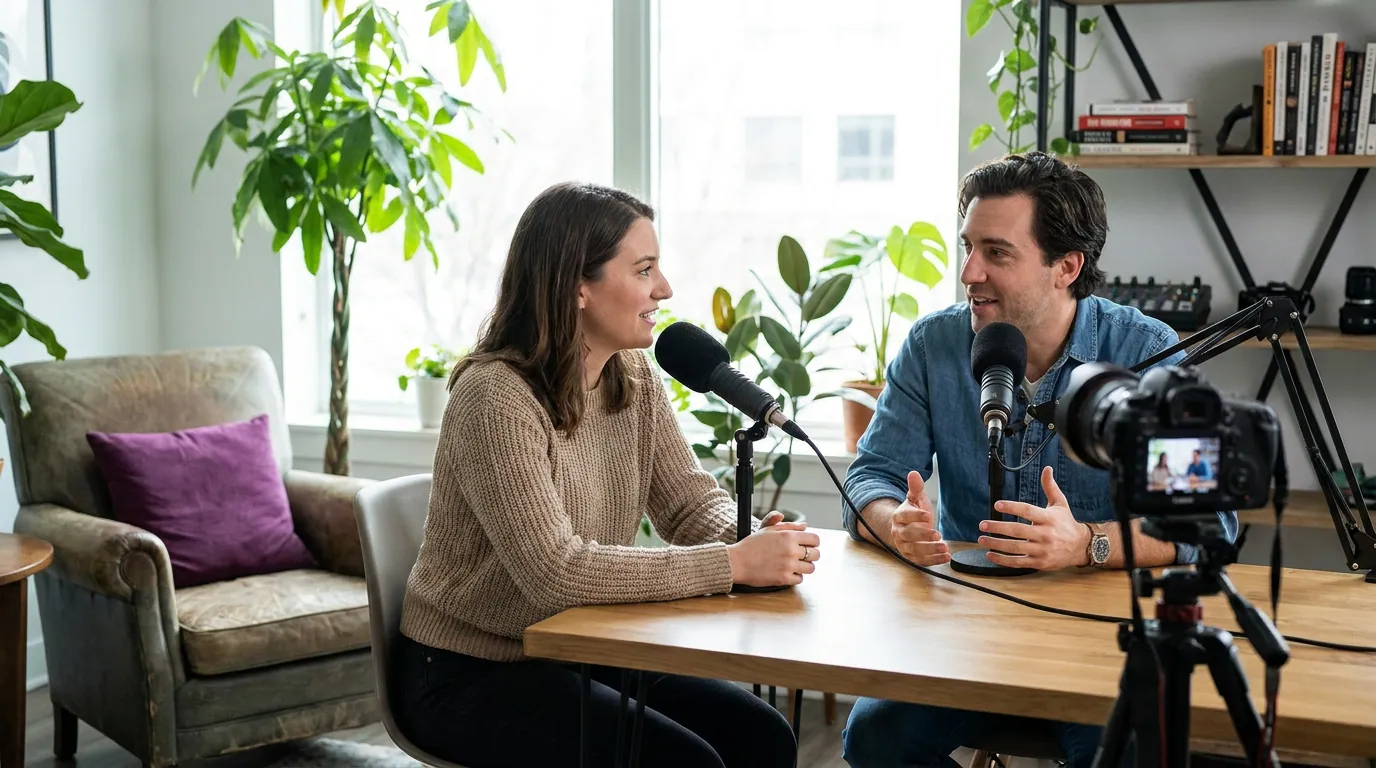
Why this matters more on video podcasts
More than half of new US weekly listeners now say they prefer to watch a podcast over listening (Backlinko, podcast stats). That changes the stakes for delivery, because the flattest-looking moments are the ones a host will skip when cutting clips, and clips are increasingly how a guest appearance finds an audience after it airs. Social video also gets watched on mute a lot of the time; Sharethrough's research found 75% of people often keep their phone muted while a video plays (Sharethrough). Treat both figures as directional, not gospel, but the direction is clear. Visible engagement and a smile read on screen even with the sound off, and social clips drive a growing share of podcast discovery (InsideRadio, on clips fueling discovery). The half-smile lever earns its keep twice over here.
If you do nothing else: hold a half-smile, move your pitch at sentence-ends, and stress the verbs, at the host's level plus one. That's it. (For where to point your eyes while you do it, see camera vs. the host's face on a video podcast.)
FAQ
How do I sound more energetic on a podcast if I'm naturally soft-spoken? Don't get louder, get more dynamic. Vary your pitch at the ends of sentences, talk with a slight smile, and stress the verbs. A soft, dynamic voice reads as far more engaged than a loud, flat one. Energy is contrast and movement, not volume.
Will smiling while I talk really change how I sound? Yes. A smile changes the shape of your vocal tract and brightens your tone, which is why listeners can usually tell when a speaker is smiling even on audio-only. You don't need a grin, a relaxed half-smile is enough to lift the sound and, on video, fix a flat resting face.
How much energy is too much for a podcast? Three or more steps above the host's level is too much. At that point you stop matching the conversation and start performing at it, which reads as fake. Sit at the host's energy or one notch above it, and let the show's tone set your ceiling.
Why do I sound monotone on recordings but not in my head? Bone conduction makes your own voice sound fuller and more dynamic to you than it is on the recording. Your internal monitoring is biased, so you finish feeling expressive and the playback sounds flat. Always calibrate against a recording, not against how it felt.
Can a vocal warm-up fix a monotone voice? A warm-up loosens your range so the levers are easier to reach, but it isn't a cure on its own, you still have to use pitch variation and emphasis on the mic. Do a quick warm-up before you record, then apply the levers during the conversation.
If you're a host on the other side of this, a little warmth makes guests easier to match, see how to make guests feel comfortable on mic, and the broader unwritten rules guests wish hosts knew.