
Turn Clip Viewers Into Podcast Subscribers


A clip viewer becomes a subscriber only by surviving five steps in a row: finish the clip, tap your profile, tap a link, reach a player, and press follow. Most never get past step one. To convert more of them, name your show inside the clip, spoken and on screen, so the ask lands while you still have the whole audience, not after four taps have thinned it to a handful.
That is the heart of the problem. A clip earns reach on a platform built to keep people in that platform; a subscribe happens somewhere else entirely. Between the feed and the follow sit four off-ramps, and each one quietly loses most of the people who were on it a second earlier. If your only "subscribe" message is a link in your bio, you are putting the ask at the fourth leak, after the audience has already shrunk by 95% or more.
This guide maps the clip-to-subscriber funnel as five named leaks, gives a specific fix for each, and shows why the in-clip CTA beats "link in bio" for the one job that matters: turning a passive view into a follow.
How do you convert clip viewers into podcast subscribers?
Treat the path from clip to follow as a five-step funnel and plug the biggest leak first. The biggest leak is step one, people who scroll past in three seconds, and the second is that you never ask for the subscribe inside the clip, where the whole audience still is. Fix those two before your bio link.
Here is the mistake nearly every podcaster makes: they pour effort into the bottom of the funnel, a tidy link page, a smart podcast link, a "listen here" button, while the top of the funnel hemorrhages. A perfect bio link does nothing for the 99% of viewers who never tap your profile. The conversion math is brutal and worth saying plainly: a clip with 50,000 views routinely sends a few dozen people to the episode. That is normal, not failure. But it means the leverage is at the wide end of the funnel, not the narrow one.
So the strategy inverts the usual advice. Make the clip do the recruiting, name the show, say what to do next, and burn it on screen, and let the bio link catch only the motivated tail.
The five leaks in the clip-to-subscriber funnel
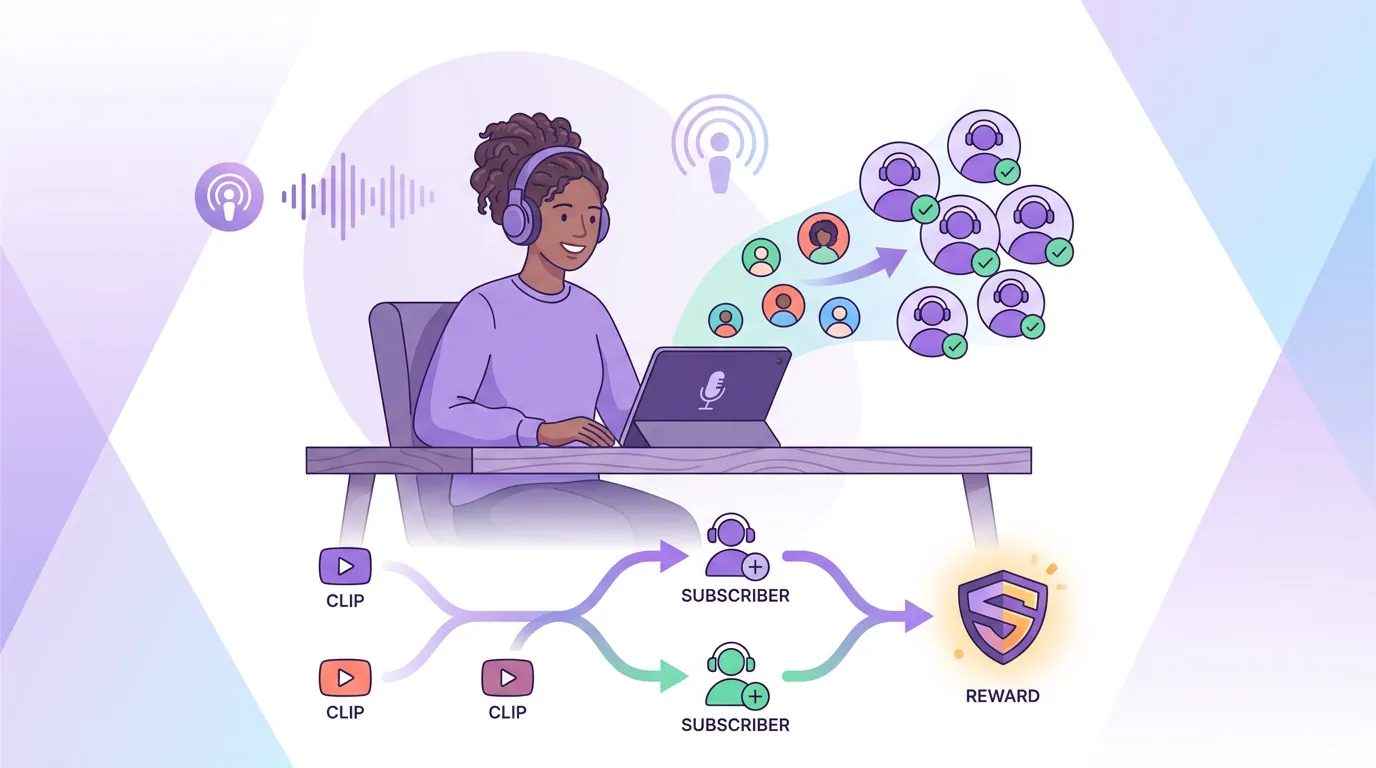
Every new subscriber walks the same path, and every step sheds most of the people on it. Map the path, find your steepest drop, and you know exactly what to fix. The five leaks, in order:
Read the shape, not the exact widths, the numbers vary by show, but the order of magnitude holds. Steps four and five are the off-platform taps, the ones every short-form feed makes hard on purpose; they will always be small. That is precisely why you cannot wait until step four to ask for the subscribe. By then you are talking to the survivors. The ask belongs at step two, while the funnel is still wide.
The rest of this guide takes the leaks one at a time, biggest first.
Leak 1: the clip gets scrolled past
Most of your audience loss happens before anyone could possibly subscribe, in the first three seconds, where a feed viewer decides to stay or flick away. No hook, no funnel. The fix is a cold open that states the payoff: lead with the most surprising line, the sharpest take, or the question the clip answers, not the host saying "so anyway, the other day."
Cut the first 1.5 seconds of dead air and intro shuffle. Open on a complete, intriguing sentence. Captions help here too, a large share of social video is watched on mute (Sharethrough found ~75% of people often keep their phone muted while watching video; publishers told Digiday ~85% of Facebook video was viewed silently back in 2016, both self-reported and directional, not platform-measured), so a silent viewer needs to read the hook, not hear it. If you are not sure which moment hooks hardest, how to A/B test podcast clips without a big audience shows how to find out with a small following.
Leak 2: you never ask for the subscribe (the CTA that beats link-in-bio)
The single most-skipped fix is asking for the subscribe inside the clip, spoken aloud and burned on screen, instead of relegating it to your bio. This beats link-in-bio because the bio link lives at leak four, after profile-tap, while the in-clip ask reaches everyone still watching at the end. Same effort, a far wider audience.
Make the ask concrete and name the show. "If you want the rest of this, the show's called [Name], follow it" outperforms a generic "link in bio" because it plants the show's name as something the viewer can search later, even if they never tap a thing. Search-and-follow is an invisible conversion path that bio links cannot capture, and it only works if you say the name out loud.
A practical stack that works on every platform: spoken CTA in the last five seconds, a burned-in caption card naming the show, and a pinned comment with the route ("Full episode + follow: [show name]"). The bio link is the fourth layer, not the only one. For the deeper native-vs-link tradeoff, which platforms punish caption links and where the bio fits, see native upload vs link-in-bio for podcast discovery.
Leak 3: the profile that loses the tap
When someone does tap your profile, you have about three seconds to confirm they're in the right place before they leave again. The leak here is a profile that doesn't match the clip: a personal handle, a vague bio, a grid that looks nothing like the video they just watched. The fix is consistency, make the profile obviously the home of the show.
Three specifics: put the show's name in the display name (so it matches what you said in the clip and what people search), write a one-line bio that states what the show is and who it's for, and pin your best-performing clips so the grid proves the feed wasn't a fluke. A viewer who tapped through is your warmest lead all week. Don't make them work to confirm they found the right account.
Leak 4: the link that dead-ends
The bio link's only job is to turn a profile-tapper into a follower with the fewest possible clicks, so point it at a "follow the show" destination, not your homepage. A website front door is a leak: the motivated viewer wanted to follow the podcast, and you handed them a navigation problem. Use a smart podcast link that opens their app of choice, or a simple page whose top button is "Follow on [their app]."
Rotate the top link to match what you're posting. If this week's clips are from episode 42, the first button should open episode 42, momentum from the clip carries into a specific episode far better than into a generic "latest." Keep the page to one obvious action; a wall of buttons reintroduces the choice that the funnel exists to remove.
Leak 5: the player where the follow doesn't happen
The final leak is the gap between landing in a podcast app and actually pressing follow, many people listen once and never come back because no one told them the follow is the point. The fix is to make following the explicit, stated goal, and to give a reason: a one-line "follow so the next episode lands automatically" converts better than silence.
This is also where consistency upstream pays off. Someone who heard the show's name in the clip, saw it on the profile, and tapped a link labelled with that name arrives at the player already convinced. The follow is a formality. The leaks compound in both directions, a break at leak two makes leak five almost impossible, while a clean run through one to four makes the follow nearly automatic.
Why this is worth the effort
Clips are now the front door to most podcasts, which is what makes plugging these leaks worth the work. 57% of listeners now rely on social media for podcast recommendations, edging out friends and family at 54%, the first time social discovery has taken the top spot, per Coleman Insights and Amplifi Media's State of Video Podcasting 2025 (reported by InsideRadio). The clip-to-subscriber funnel is the only funnel most of your future audience will ever enter.
Short-form clips are estimated to drive 20–40% of new-audience acquisition for video shows and can raise reach two-to-five times (Podcast Studio Glasgow; single-studio figure, directional). That range comes from one production studio's experience, so read it as a ballpark, not a guarantee. The direction is the point: the clip is doing the recruiting whether you've designed for it or not. And the YouTube case is especially clean, a Short linking to the full episode on YouTube keeps the viewer in-app and removes leak four entirely, which matters because YouTube passed 1 billion monthly podcast viewers in January 2025 (Variety).
Common mistakes that cap your conversion
- Optimizing the bio link while the clips don't ask for anything. The link sits at leak four; the in-clip ask reaches everyone still watching. Fix the ask first.
- A generic "link in bio" with no show name. It can't be searched and it can't be remembered. Say the show's name out loud, search-and-follow is a path bio links can't capture.
- A profile that doesn't match the clip. A vague handle and an off-topic grid lose the warm profile-tapper. Make the display name the show name and pin your best clips.
- Pointing the link at a homepage. The viewer wanted to follow the show, not tour your site. Send them to a "follow on [their app]" page, top button matching the episode.
- Chasing views over the path. A clip with huge reach and no CTA recruits no one. For the difference, see clips that convert vs. clips that get vanity views, decide cadence with how many clips per week actually grows a podcast, and time the post with the best time to post podcast clips by platform.
Tools for building conversion-ready clips at volume
The reason most shows leak is volume: one ~20-minute episode yields 20–30 short pieces (industry norm), and adding a hook, captions, a burned-in CTA, and a per-platform export to each one by hand is where the routine dies. That's the work to automate.
An AI clipper handles the production side, finding moments, auto-captioning, reframing vertical, and exporting per platform, so your effort goes into the conversion calls: which moment hooks, what the spoken CTA says, where the link points. QuickReel fits this: it auto-captions, reframes with speaker tracking, exports vertical and square, supports 20+ languages and 12+ caption styles for a clean burned-in CTA, and can schedule native uploads across platforms (current pricing starts at a $9 Starter tier). The honest caveat that applies to every AI clipper, not just ours: plan to review roughly 20–40% of what it suggests, and the conversion judgment stays human. Tools like Opus Clip and Vizard clip well too; across all of them, the differentiator is how few clicks sit between a YouTube URL and a finished, captioned, CTA-ready post. When you're choosing which moments deserve that push, how to pick the best AI-suggested clips walks through scoring candidates.