
How to Start a Travel Podcast That Isn't a Diary


To start a travel podcast that isn't a diary, build each episode around one transferable idea a listener can use, a theme, a concrete tip, and a destination that proves it, instead of recapping your itinerary day by day. Record on the road with a small portable kit, clean up the field audio in a fixed order, and disclose any affiliate links or press trips clearly. The format, not the gear, is what separates a show people share from a travelogue only your friends finish.
Most travel podcasts fail the same way: they are someone's holiday told in order, with no reason for a stranger to keep listening. "Then we went to the museum, then we found this cute café" is a diary. The shows that grow answer a question the listener has, how to do this place, this kind of trip, this problem, and use the host's travels as evidence. Below is the full build: the episode framework that does the heavy lifting, a portable kit for three budgets, a field-audio cleanup order that rescues noisy recordings, and the disclosure rules that keep a monetizing travel show legal.
Travel shows are usually filed under Society & Culture, one of the top five US podcast genres (Statista top genres). That means a large, willing audience and a crowded shelf, and nearly half of all podcasts never make it past their first three episodes Amplifi Mediaciting podfade data). A repeatable format is the single best defense against quitting, because it removes the "what do I even talk about this week" friction that ends most travel shows.
What makes a travel podcast not a diary?
A travel podcast stops being a diary the moment every episode is built around something the listener can take and use: a theme, a specific tip, and a destination that demonstrates it. A diary is organized by your timeline ("day one, day two"); a show is organized by the listener's need ("how to eat well in a city on $20 a day"). Same trips, different spine. The trip becomes your evidence, not your outline.
The test is simple. After each episode, can a listener who has never met you do something differently, pack smarter, book a region they'd dismissed, avoid a mistake, see a place through a new lens? If yes, it's a show. If the only takeaway is "the host had a nice time," it's a diary. Diaries work for an audience that already loves you; they don't recruit strangers, and strangers are how a show grows.
This doesn't mean stripping out the personal. The best travel shows are full of the host's voice, mishaps, and opinions, those are what make the useful part memorable and worth your subscription over a guidebook. The rule is that the personal stuff serves a transferable point, not the other way around.
The Theme-Tip-Destination framework
Build every episode on three stacked layers. The theme is the one idea the episode is about. The tip is the concrete, do-this-tomorrow advice that delivers on the theme. The destination is where you prove it with a real story. Plan in that order and the diary problem solves itself, because you can't start from "here's where I went", you have to start from "here's what this teaches."
A few formats this framework produces, all of which beat a chronological recap:
- The how-to-do-this-place episode. Theme: doing a destination a certain way. Tip: the three decisions that matter (where to base yourself, when to go, what to skip). Destination: the trip where you got it right or wrong.
- The mistake episode. Theme: a category of travel error. Tip: how to avoid it. Destination: the time it happened to you. Mistakes are the most replayable travel content because they save the listener money or pain.
- The type-of-trip episode. Theme: a style of travel (slow travel, solo female travel, traveling with kids, working remotely). Tip: the system that makes it work. Destination: where you pressure-tested it.
- The guest episode. A local, a long-term nomad, or an expert. Theme and tip come from them; your job is to ask the questions a listener would, not to swap holiday stories.
Write the episode title as the tip or the theme, never as the place alone. "How to spend three days in Lisbon without the crowds" gets searched and shared. "Our Lisbon trip" does not.
What gear do you need to record a travel podcast on the road?
You need three things that survive being thrown in a bag: a recorder, a mic close to your mouth, and headphones to catch problems while you can still fix them. You do not need a studio. The biggest quality jump on the road comes from getting the mic within a few inches of the speaker and blocking wind, not from spending more. Below are three kit tiers; pick the lowest one that fits how you actually travel.
Two things matter more than the brand. First, a windscreen or furry "dead cat" on any mic you use outdoors, wind noise is the single most common ruiner of travel audio, and a foam cap costs a few dollars. Second, record a backup: have your phone capturing the same moment, or use a recorder that writes a second safety track, because you cannot re-record a market in Marrakech once you're home. For specific models, our guide to portable recorders for podcasting on location covers the field, and a solid mic under $100 handles the lav-and-recorder tiers without overspending.
A workable mic runs $50–400 and a full pro rig $500–5,000+ (Ausha equipment costs), but the honest framing from across our own gear testing is that the gap between the cheap and the expensive end of that range matters far less than mic technique. Bad technique in a noisy room beats a good mic held wrong, every time. On the road, "the room" is a street, a train, a beach, so getting the mic close and blocking wind carry even more weight than the price tag. If you want the full budget-by-tier breakdown, see our best podcast mics by budget guide.
How do you clean up field audio recorded on the road?
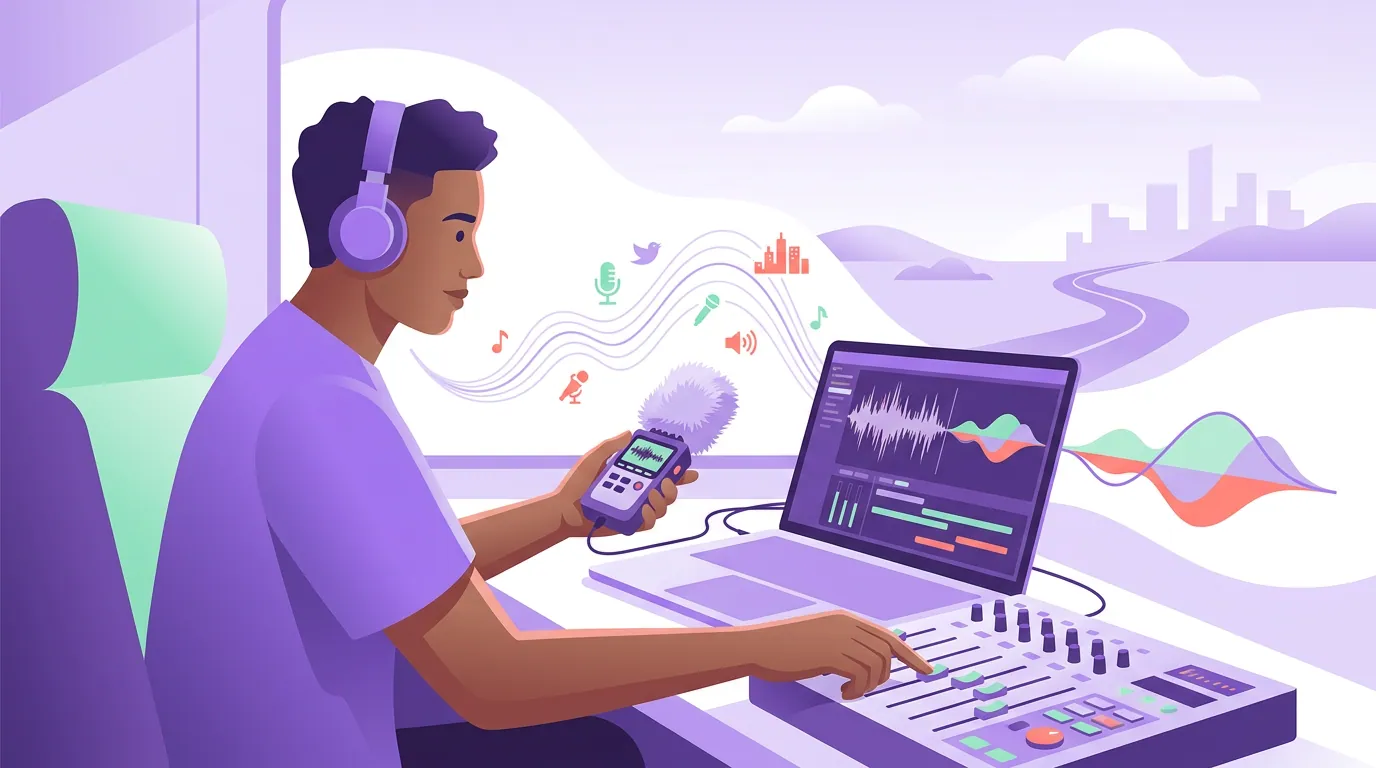
Clean field audio in a fixed order so you don't fight yourself: remove steady background noise first, then level the volume, then deal with wind or clipping last. Most road recordings are fixable if you captured the voice close and loud enough, the cleanup is about taming the environment around a usable voice, not resurrecting a buried one. Work the order below and stop when it sounds clear, not perfect.
The reason the order matters: if you boost the volume first, you boost the background hiss along with the voice, and the noise reduction afterward has more to chew through. Take out the steady noise, then raise the level, then patch the gusts. A few field-specific rules:
- Use ambience on purpose, not by accident. A few seconds of clean street sound at the top of a segment puts the listener in the place. A whole conversation buried under traffic is just noise. Record short, clean ambience clips deliberately and mix them under your narration.
- A high-pass filter kills most rumble. Wind, handling noise, and traffic low-end live in the bottom frequencies. Rolling off everything below roughly 80–100 Hz cleans up road recordings without touching the voice.
- Some gusts are unfixable, cut, don't fight. A microphone overloaded by a wind blast can't be repaired into clean audio. Trim it, paste in room tone or ambience to bridge the gap, and move on. This is normal field work, not failure.
- Match your levels across locations. A travel episode stitches recordings from a plane, a hotel, and a street. Normalize them to a consistent loudness so the listener isn't reaching for the volume knob every cut.
The affiliate and press-trip disclosure rules travel podcasts have to follow
If you recommend a product, hotel, or tour and you get paid, a free trip, or a commission, you have to tell your audience clearly, by US law, not just etiquette. The FTC requires that any "material connection" between you and a brand be disclosed in a way listeners can't miss: stated up front, in plain language, on the podcast itself and in the show notes. Travel is one of the most heavily incentivized niches, press trips, comped stays, affiliate booking links, so this is not optional fine print for a travel show.
The FTC's Disclosures 101 for influencers lays out the rule that maps cleanly onto a podcast: disclose when you have any financial or in-kind relationship, make it hard to miss, and use simple words ("the airline paid for this trip," "this is an affiliate link and I earn a commission"), not vague tags. Two practical translations for audio:
- Say it out loud, near the recommendation. A spoken line, "Quick heads up: this tour company comped our trip, and what I'm about to say is still my honest take", does what the FTC wants. Burying it only in episode 200's show notes does not.
- Put it in the show notes too, next to the link. Every affiliate link gets a plain label. "Affiliate link, I earn a commission if you book" beside the URL covers the written half.
Two more that protect the show beyond the legal minimum. A press trip doesn't buy a good review, the disclosure is what lets you stay honest, because your audience can weigh your praise knowing the trip was free. And affiliate links should point at things you'd recommend unpaid; a travel show's whole asset is trust, and a feed full of paid plugs for mediocre hotels spends it fast. The shows that monetize well disclose more, not less, because the disclosure is what makes the recommendation believable.

Common mistakes when starting a travel podcast
- Recording the trip, then looking for a point. This is the diary trap. Decide the theme and tip before or during the trip so you record the right moments, the market haggle, the local's directions, the booking decision, instead of narrating from memory weeks later.
- No windscreen. The most common technical failure in travel audio. A few-dollar foam cap or furry muff saves more recordings than any plugin. Pack two; they get lost.
- Only one copy of irreplaceable audio. You can re-record an intro at home. You cannot re-record a temple at dawn. Always capture a backup track, and back up your files before you leave the location's Wi-Fi.
- Titling by place, not by promise. "Our week in Vietnam" hides the value. "How to do Vietnam by train in a week" surfaces it and gets searched.
- Skipping or hiding disclosure. Beyond the FTC risk, an undisclosed comped trip that listeners later spot does more reputational damage than any honest "this was free" ever would.
A travel show shares its discipline with other niche-driven formats. It's closer to the research load of a business podcast that wins clients than to a loose comedy show recorded with friends, you're delivering usable advice, not just hanging out. And like a fitness podcast built around a coach's system, the value is the repeatable method behind the stories, not the stories alone.
Frequently asked questions
How do you make a travel podcast that isn't just a diary?
Build each episode around a transferable idea, not your itinerary. Pick one theme (a listener need), give one concrete tip that delivers on it, and use a real destination as the proof. Title the episode by the promise ("how to do three days in Lisbon without the crowds"), not the place. The trip is your evidence; the takeaway is the episode.
What equipment do you need to record a travel podcast on the road?
A recorder, a mic close to your mouth, and headphones, plus a windscreen. The minimal kit is a phone with a clip-on lavalier mic and a foam or furry wind cover. A step up is a handheld recorder for cleaner ambience, and an interview show adds a second lav mic. Always capture a backup track; you can't re-record a location once you've left.
How do you fix noisy travel audio recorded outdoors?
Process it in order: reduce steady background noise first, then level the volume, then handle wind and clipping last. Use a high-pass filter to cut low-end rumble, and trim out wind gusts that overloaded the mic rather than trying to repair them. The fix only works if you recorded the voice close and loud enough in the first place.
Do you have to disclose free trips on a travel podcast?
Yes. US FTC rules require you to clearly disclose any "material connection", a comped trip, a paid partnership, or an affiliate commission. Say it out loud near the recommendation in plain words, and label affiliate links in the show notes (FTC Disclosures 101). Disclosure protects your credibility as much as it meets the law.
How often should a new travel podcast publish?
Consistency beats frequency. A reliable schedule you can keep on the road, often every two weeks for a show that records while traveling, is better than weekly episodes that stop after a month. Since nearly half of all podcasts never get past their first three episodes Amplifi Media, batch-record and bank a few episodes before you launch so a long trip doesn't break your cadence.
Pick the theme before the trip, pack a windscreen and a backup, clean the audio in order, and disclose the free stuff plainly. Do those four things and you have a travel show with a reason to exist, useful, honest, and replayable, instead of a holiday diary that strangers skip. In a top-five genre (Statista), that's how you earn the listener who has never met you.