
Best Portable Recorders for On-Location Podcasts


For most on-location podcasts, the best portable recorder is the Zoom PodTrak P4next (~$180) for one to four people, or the Zoom H4essential (~$200) if you also want a built-in stereo mic for ambience. Both run on AA batteries, both record without a laptop, and the H-series adds 32-bit float so a guest who suddenly shouts won't clip the take.
A field recorder is its own category. It is not a USB mic, and it is not a mixer chained to a computer. It is a battery-powered box you can carry to a cafe, a conference floor, or someone's kitchen table, plug XLR mics straight into, and walk away with clean multitrack audio. That portability is the whole point, so this roundup judges every unit on the three specs that actually decide a shoot: how many XLR inputs it has, whether it records 32-bit float (which removes the gamble of setting levels in a noisy room), and how long it runs on batteries before you're hunting for an outlet.
Prices below are verified against manufacturer and major-retailer pages in June 2026. SaaS and gear prices both move, so re-check the linked page before you buy.
Quick verdict: which recorder for which show
- Solo or run-and-gun, no XLR needed: Zoom H1essential (~$99). Two built-in mics, 32-bit float, pocketable. No XLR inputs.
- One to two mics (interviews, two-person shows): Zoom H4essential (~$200) for the stereo mic plus two XLR inputs, or the Zoom PodTrak P4next (~$180) for a podcast-first layout with sound pads and a phone input.
- Three to four mics (panels, roundtables): Zoom PodTrak P4next (four XLR) or Zoom H6essential (~$330, four XLR plus 32-bit float and a built-in mic).
- Four-plus mics, broadcast-style on location: Tascam Portacapture X8 (~$400) for four XLR with 32-bit float, or the Zoom PodTrak P8 (~$500) for six XLR and a touchscreen, but it records 16-bit only and lasts roughly 1.5 hours on alkaline AA.
Why a field recorder instead of a USB mic or a mixer
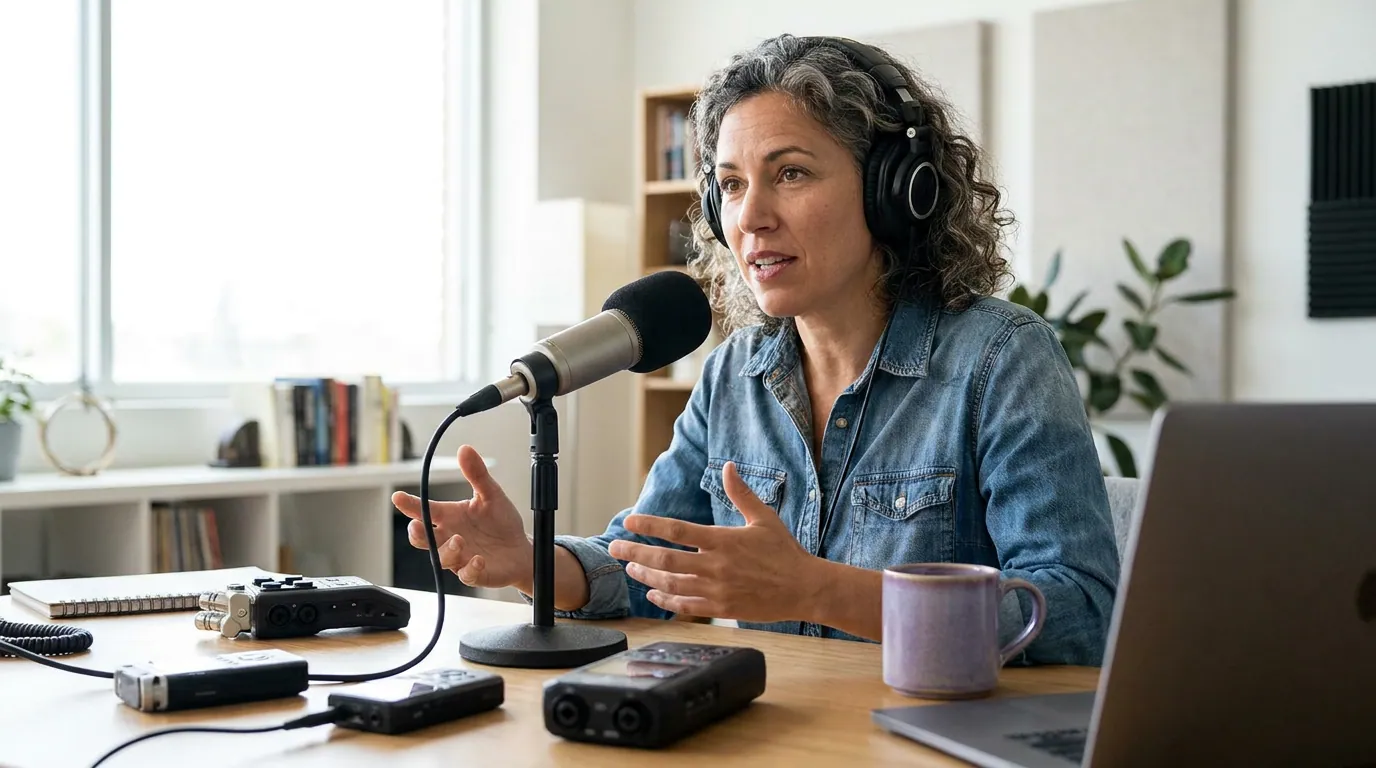
A field recorder earns its place when the recording happens somewhere your computer isn't welcome, a noisy event, a guest's office, a moving car, a hike. A USB mic plugged into a laptop is great at a desk and useless on a train platform. An all-in-one mixer like a RODECaster is a studio anchor, not a carry item.
The category also fixes the single most expensive mistake in field audio: a take you can't use because the level was wrong. In a treated studio you can set gain once and forget it. On location, a guest leans in and whispers, then laughs at full volume two seconds later, and a fixed gain setting can't serve both. That gap between a controlled and an uncontrolled room is the real divide in audio quality, bigger than the gap between a $350 hobby kit and a $1,500 pro rig (Ausha's cost-to-start breakdown puts mics at $50–400 and full setups from roughly $100–350 for a hobby build up to $1,500–5,000+ for a pro one). The fix is 32-bit float, and it's the reason the H-essential line leads this list.
What 32-bit float actually does
32-bit float records such a wide dynamic range that you effectively stop setting input levels at all. Zoom's H-essential recorders ship with no gain knob for exactly this reason, you set the level afterward, in your editor, pulling a too-loud passage down or a too-quiet one up with no audible clipping or noise floor (per Zoom's H1essential page and Creative Field Recording's rundown of the 32-bit float line). On a shoot you don't get a second take, so "you cannot clip this" is worth real money.
The honest caveat: 32-bit float protects you from level mistakes, not from bad input. It will not save a recording made in a wind tunnel, with a mic six feet away, or pointed at an air conditioner. Mic technique and a windscreen still matter more than the format.
The six recorders, reviewed
Here is the category mapped to the spec that decides each tier, with the real trade-off for each unit.
1. Zoom H1essential, the pocket safety net (~$99)
Best for: solo hosts, voice memos in the field, B-roll narration, anyone who needs 32-bit float without XLR.
The cheapest way into 32-bit float. The H1essential has two built-in X/Y mics that capture up to 120 dB SPL, a 3.5 mm mic/line input for a lavalier, and no gain control at all because the format makes one unnecessary (Zoom; price verified at B&H, ~$99, with some retailers near $110). It doubles as a USB-C mic and records to microSD up to 1 TB. One outlier worth flagging: alone in this lineup, it runs on two AAA cells, not AA, and Zoom rates it at about 10 hours on alkaline (18 on lithium), so pack the right spares.
The real limit, and why it's the entry rather than the pick: no XLR inputs. You're stuck with the built-in mics or a 3.5 mm lav, so it can't take a proper dynamic broadcast mic. The small screen also makes monitoring in bright daylight a guess. Treat it as a one-person tool or a backup recorder, not your interview rig.
2. Zoom PodTrak P4next, the on-location workhorse (~$180)
Best for: one-to-four-person interviews and remote-guest shows that need a phone input and sound pads.
This is the recorder most on-location podcasters should buy. Four XLR inputs, each with its own gain, mute, and switchable 48V phantom power and up to +70 dB of gain, enough headroom for a demanding dynamic mic. It runs on two AA batteries, takes a phone in over a TRRS cable with automatic mix-minus (no echo for the caller), and has tappable sound pads for intros and stings (Zoom P4next page; ~$179.99 at Sweetwater). The "next" revision records 24-bit/48 kHz and adds onboard AI noise reduction and voice compression, a real step up from the original P4's 16-bit/44.1 kHz.
The honest con: no 32-bit float. The P4next records 24-bit, which is plenty if you set levels with a few minutes of soundcheck, but it doesn't give you the "can't-clip-it" insurance the H-essential line does. For a seated, controlled interview that's a non-issue; for a chaotic live event, it's a reason to look at the H6essential instead. The original 16-bit P4 is still sold and often discounted below the next, and it's still fine for budget builds, but the next's 24-bit recording and onboard processing are worth the small premium. Pair it with mics that travel, a USB/XLR hybrid runs straight off the P4next's XLR jacks at home and the laptop on the road.
3. Zoom H4essential, 32-bit float for two mics (~$200)
Best for: two-person interviews where you also want a built-in stereo mic for room or ambience.
The H4essential is the sweet spot between the pocket H1 and the four-input H6. You get a 130 dB SPL built-in X/Y stereo mic plus two XLR/TRS combo inputs with phantom power, all recording 32-bit float, so you genuinely never set a level (Zoom; $229.99 MSRP, recently ~$185 on sale at Sweetwater). The four-track mode lets you run both XLR mics and the stereo mic at once, useful for capturing two guests plus the room.
Battery life depends entirely on mode and battery chemistry, and the spec sheet is easy to misread. On alkaline AAs, Zoom rates it at about 9 hours in two-track mode but only ~2.5 hours in four-track mode; lithium AAs roughly double that to ~19 hours and ~8 hours respectively (Zoom). The headline "up to 10 hours" is the two-track alkaline number, so if you'll run all four tracks, carry lithium cells or a USB-C power bank. The con versus the P4next: only two XLR inputs and no built-in sound pads or dedicated phone jack, so it's a recorder first and a podcast console second.
4. Zoom H6essential, four XLR plus 32-bit float (~$330)
Best for: three-to-four-mic panels recorded on location where clip-proof safety matters.
When you need four XLR inputs and 32-bit float in one box, this is it. The H6essential gives you six tracks total, four XLR/TRS combo inputs plus an interchangeable stereo mic capsule (X/Y up to 135 dB SPL), all 32-bit float, with dual A/D converters for extra clean headroom (Zoom; ~$329.99 at Sweetwater). It runs on four AA batteries, with Zoom's quoted runtime spanning about 18 hours (alkaline, two-track) down to roughly 3.5 hours (alkaline, all six tracks), or about 9 hours on lithium when pushing all six. Rate it by that heavy-use number.
The con is what it isn't: a podcast console. No sound pads, no one-touch phone-call channel like the PodTrak units. You're buying it for input count and 32-bit float, not for show-running convenience. If you record panels in unpredictable rooms and can't afford a ruined take, the H6essential is the most defensible pick on this list.
5. Tascam Portacapture X8, the broadcast-leaning four-input (~$400)
Best for: field recordists and documentary-style shows that want 32-bit float, four XLR, and dual-format safety files.
The X8 is the most "pro audio" unit here, and it has come down in price. It offers four XLR/TRS locking combo inputs with individual 24V/48V phantom power and Tascam's HDDA preamps, plus two large built-in stereo mics, recording up to 192 kHz / 32-bit float (Tascam). Its standout trick is dual recording: capture a 24-bit file and a 32-bit float safety file at once, so you always have a fallback (Sweetwater). It launched at $499 and now runs ~$399 at Sweetwater.
Two cons keep it from the top spot for most podcasters. First, the touchscreen-driven, app-style menus are powerful but slower to drive than the PodTrak's physical podcast-first controls. Second, there's no native one-cable phone-call channel with auto mix-minus the way the PodTrak units have, remote guests are doable but less turnkey. If you also shoot video and want timecode and the cleanest preamps, the X8 is excellent; if you mostly run seated interviews, the P4next gets you there faster.
6. Zoom PodTrak P8, six XLR and a touchscreen (~$500)
Best for: larger panels and shows-on-the-road that need six mics and onboard editing.
The P8 is a standalone, DAW-less studio. Six XLR inputs with up to +70 dB of gain (enough for an SM7B), a 4.3-inch color touchscreen, onboard editing, and 36 sound-pad slots across four banks make it the most capable show-runner here (Zoom; $499.99 MSRP, street-priced near $500 per The Podcast Consultant). For a four-to-six-person roundtable you want to run without a laptop, nothing else on this list matches it.
Two specs keep it off the top spot. First, it records 16-bit/44.1 kHz only, no 32-bit float and no 24-bit, the lowest resolution on this list (Zoom). Second, battery runtime makes true field use risky: on four alkaline AA cells Zoom rates the P8 at about 1.5 hours (around 3 hours on NiMH, 5 hours on lithium) before you need AC power (Zoom), fine for a studio you carry between rooms, marginal for a day on a conference floor. Buy it for the input count and the controls, and plan to keep it plugged in or hang a USB power bank off it.
The comparison, at a glance
| Recorder | XLR inputs / 32-bit float | AA runtime · price |
|---|---|---|
| Zoom H1essential | 0 (built-in mics) · yes | ~10 hrs (alkaline, AAA) · ~$99 |
| Zoom PodTrak P4next | 4 · no (24-bit) | 2+ hrs · ~$180 |
| Zoom H4essential | 2 · yes | ~2.5 hrs (4-trk, alkaline) · ~$200 |
| Zoom H6essential | 4 · yes | ~3.5 hrs (6-trk, alkaline) · ~$330 |
| Tascam Portacapture X8 | 4 · yes | multi-hr (varies) · ~$400 |
| Zoom PodTrak P8 | 6 · no (16-bit) | ~1.5 hrs (alkaline) · ~$500 |
Specs and prices verified June 2026 at the linked Zoom, Tascam, Sweetwater and B&H pages. Runtime figures are manufacturer-stated and mode-dependent; treat them as ceilings, not promises.
How we picked
This isn't a lab teardown, it's a buyer's filter built from setting up recording rigs across budget and pro tiers, narrowed to the three things that change the outcome of an actual on-location recording:
- XLR input count decides how many people you can mic properly. Built-in mics are for one person; XLR is for everyone else.
- 32-bit float is the insurance policy for rooms you can't control. We flagged exactly which units have it and which don't, because it's the single biggest reason to pay more.
- AA battery runtime is the spec that quietly ends shoots. We rated each unit by its heavier-use figure, not the marketing headline, and called out the P8's ~1.5-hour alkaline figure (Zoom's own spec) because it catches people out on a long day.
We deliberately left out anything that needs a laptop, an audio interface, or wall power as a baseline, those are studio tools, covered in our podcast mics by budget tier and USB vs XLR guides. The point of this category is recording where the computer can't go.
Common mistakes buying a field recorder
- Buying for input count you'll never use. A six-XLR P8 is overkill for a two-person interview show, and you pay for it in battery life and bulk. Match inputs to the most people you'll ever have at the table, not your dream panel.
- Ignoring the multitrack battery number. "Up to 10 hours" usually means two-track in power-saving mode. Plan around the four-track figure, and carry lithium AAs or a USB-C power bank.
- Assuming 32-bit float fixes bad sound. It removes clipping, not noise, wind, or distance. A budget dynamic mic close to the mouth beats a great mic three feet away every time.
- Forgetting the small stuff. A mini tripod kills handling noise, a windscreen saves outdoor takes, and a fast microSD card prevents dropouts. These cost little and are the difference between a usable file and a wasted trip.
FAQ
What is the best portable recorder for podcasting? For most on-location shows, the Zoom PodTrak P4next (~$180) for up to four mics, or the Zoom H4essential (~$200) if you want 32-bit float and a built-in stereo mic for two-person interviews. Both run on AA batteries and record without a laptop, per Zoom's and Sweetwater's current listings.
Do I need 32-bit float for podcasting? Not always. 32-bit float removes the risk of clipping when you can't set levels carefully, invaluable for live events and loud guests. For seated interviews where you can run a quick soundcheck, a good 24-bit recorder like the PodTrak P4next is fine and cheaper.
How many XLR inputs do I need? One per person who needs a real mic. Two for an interview, four for a small panel, six only for large roundtables. Built-in stereo mics on units like the H1essential cover a single host but can't mic multiple people cleanly.
How long do field recorders last on batteries? It depends on mode and battery chemistry. On alkaline AAs the Zoom H4essential runs about 9 hours two-track but only ~2.5 hours four-track (lithium roughly doubles both); the six-input PodTrak P8 lasts only about 1.5 hours on alkaline, roughly 5 hours on lithium, and is better kept on power (Zoom). Plan for the heavy-use figure and carry lithium spares.
Can a portable recorder replace a studio setup? For recording, often yes, a field recorder plus two good mics is a complete portable studio. For consistent audio you'll still want acoustic treatment, a repeatable episode structure, and usually a light outline rather than a full script when you can't read off a screen. The recorder solves where you capture, not how you produce.
Get the recording right, then make it travel
Pick by mic count first, 32-bit float second, battery runtime third, and you'll skip the two recorders most podcasters return. Once a clean on-location episode is in the can, it's worth more than one upload: a single interview holds enough strong moments for a week of vertical clips that drive new listeners back to the show.
Prices and specs verified June 2026 against the linked manufacturer and retailer pages. Hardware and software prices change, confirm current pricing before purchase.