
How to Review Your Own Podcast Clips to Improve Delivery


To review your own podcast clips usefully, score one 60-second clip against five metrics, filler rate, pace, eye contact, energy, and clarity, give each a 1-to-5, then fix only the lowest-scoring one before your next recording. Watching yourself without a rubric just produces cringe. The rubric turns cringe into a measurable to-do.
Most people review their recordings exactly once, hate what they see, and never do it again. That reaction is the problem, not the recording. You watched the whole thing, felt embarrassed by everything at once, and walked away with no specific thing to change. The fix is to stop watching like an audience member and start scoring like a coach: short clip, fixed checklist, one number per category, one thing to work on.
This guide gives you that checklist, a rule for what to fix first, and a loop you can run after every appearance. The whole review takes about ten minutes and replaces an hour of vague self-criticism.
Why review your own clips at all?
Because the clip is now the audition. A 30-to-60-second clip of your best answer is the single thing most likely to send a new person to the full episode, and 57% of listeners now rely on social media for podcast recommendations, edging out friends and family (54%) for the first time (InsideRadio, 2025). If your delivery is sloppy, the clip dies and the episode goes unwatched.
There's a second reason that matters more for you as a guest. 53% of new US weekly listeners say they prefer to watch a podcast, up from 30% in April 2022 (Backlinko). Video means your face, your eyes, and your energy are part of the message now, not just your words. You can't improve any of that from memory. You have to see it, once, on purpose, with a structure that stops you from spiraling.
Clips also do real work for the show that hosted you: they can drive a meaningful share of a video show's new audience (Podcast Studio Glasgow). Better delivery from you means more clippable answers, which means the host posts more of you, which means more new listeners find their way back to you. The review is self-interest dressed as homework.
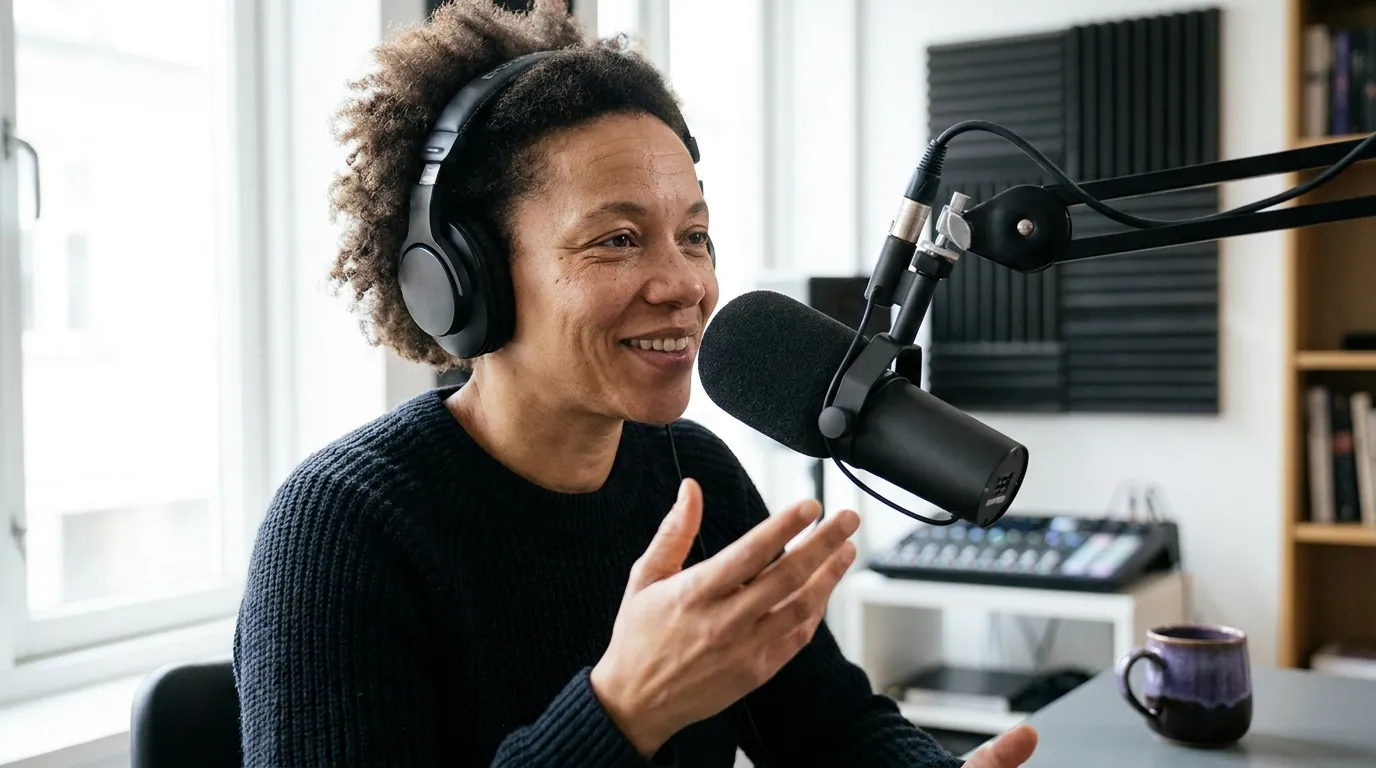
The five-metric delivery rubric
These are the five things a clip lives or dies on, and the only five you should score. Anything else, your shirt, your background, the one weird thing you said, is noise. Watch one clip, ideally 45 to 60 seconds of you answering a real question, and give each metric a 1 to 5. This rubric is the working scorecard I use coaching guests; the bands are calibrated from listening to a lot of interviews, not a published study, so treat the numbers as directional rather than gospel.
Here is what each score actually means, so you're not guessing at the numbers.
| Metric | A 2 looks like | A 5 looks like |
|---|---|---|
| Filler rate | 8+ "um/like" per minute; editor has to fight it | 0–3 per minute; unnoticeable |
| Pace | Breathless rush or stalled drift | Even, with deliberate pauses |
| Eye contact | Eyes mostly off-frame, reading notes | Steady on the lens or the host |
| Energy | Flat, one note, low presence | Clear variety; lifts on the point |
| Clarity | Stranger can't restate your point | One-sentence takeaway lands |
Add the five up. A clip in the low 20s is genuinely good. The mid-teens is normal and fixable. Single digits across the board almost never happens to someone calm enough to be scoring, it's the panic-spiral talking, not the recording.
The rule for what to fix first
Fix your lowest single score, and only that one, before the next recording. Not the most embarrassing thing, the lowest number. Those are often different, and chasing the embarrassing one is how people waste months. Within that, two metrics earn priority because they cap everything else.
Filler rate and clarity come first when they're tied with anything else. A clip can have great energy and perfect eye contact and still be unusable if it's one "um" every four words, or if no one can tell what you were trying to say. Those two are load-bearing. Energy and eye contact are multipliers on top of a clear, clean answer, powerful, but only once the foundation holds.
If you want the deeper drills for the two foundation metrics, they each have their own playbook: a diagnostic-first method for cutting filler words like um and like, and a simple decision on where to look, the camera or the host's face. Pick the one your scorecard flagged and ignore the rest for now.

The self-coaching loop
The rubric is a snapshot. The loop is what makes you better. Run it after every appearance, and you compound one small fix at a time instead of trying to become a different speaker overnight.
The discipline that makes this work is tracking one metric per recording. Write the five scores in a note with the date. Next time, you're not asking "was that good?", you're asking "did my pace go from a 2 to a 3?" That's a question with an answer. Vague self-assessment is what makes review unbearable; a single tracked number makes it almost mechanical.
Keep a running line per appearance: date, the five scores, and the one thing you're working on next. After four or five rounds you'll see the foundation metrics climb and stay there, and you can start spending attention on energy and eye contact.
Common mistakes when reviewing your own recordings
- Watching the whole episode. You don't need 40 minutes; you need one 60-second clip. Reviewing the full thing guarantees overwhelm and zero specific fixes. Pick the clip your host posted or the answer you remember stumbling on.
- Scoring everything as a 2 because you're embarrassed. Embarrassment is not data. If you can't be fair, have a friend score the same clip, they'll rate you two points higher than you rate yourself, and they're closer to right.
- Trying to fix all five at once. You'll improve none. The loop only works one metric at a time. Pick the lowest number, drill it for one appearance, then move on.
- Reviewing once and quitting. The first review is the worst one because you have nothing to compare it to. The value is in the second and third, where the tracked number tells you it's working.
- Skipping the re-measure. Without a second score after you've drilled, you're guessing whether you improved. Record, score, compare. The number settles the argument your inner critic wants to keep having.
Where this connects to the rest of your on-camera game
The rubric assumes you can stay calm enough to score honestly, which is its own skill. If watching yourself still triggers a flinch, start with looking confident on camera as a first-time guest and a five-minute vocal warm-up before you hit record, both move your baseline before you ever review a clip. And if you're newer to guesting, the unwritten guest etiquette rules cover the things hosts notice that no rubric measures.
FAQ
How often should I review my own recordings? After every appearance, but only one short clip each time, 45 to 60 seconds. The point is a quick, structured pass you'll actually repeat, not a deep forensic edit you'll do once and dread. Ten minutes with the rubric beats an hour of unstructured watching.
Which delivery metric matters most on camera? Clarity and filler rate are the foundation, a clip with neither can't be saved by good energy or eye contact. Once those hold, energy and eye contact become multipliers, because 53% of new US weekly listeners now prefer to watch (Backlinko) and your face is carrying the message.
I hate watching myself. How do I get past it? Score instead of watch. Open the clip with the five-metric rubric in hand and your only job is to assign five numbers. A defined task short-circuits the cringe loop because your brain is busy measuring, not judging. It gets easier by the third clip.
What if all my scores are low? They're probably not, self-scores skew harsh. Have one honest friend score the same clip and average it with yours. If genuine low numbers remain, that's good news: you have a clear lowest metric to fix, which is the entire point of the rubric.
Can I just trust the editor to fix my delivery? An editor can trim obvious fillers and tighten pace, and clips are how people discover shows (InsideRadio, 2025). But editing can't manufacture clarity or energy that wasn't there, and can't fix where your eyes were looking. The cleaner your raw delivery, the more of your answers survive the cut and travel.
Keep sharpening the specifics: run the filler-word diagnostic, settle where to look on a video podcast, and warm up properly with a pre-record vocal routine.