
Build a YouTube Shorts Series From One Episode


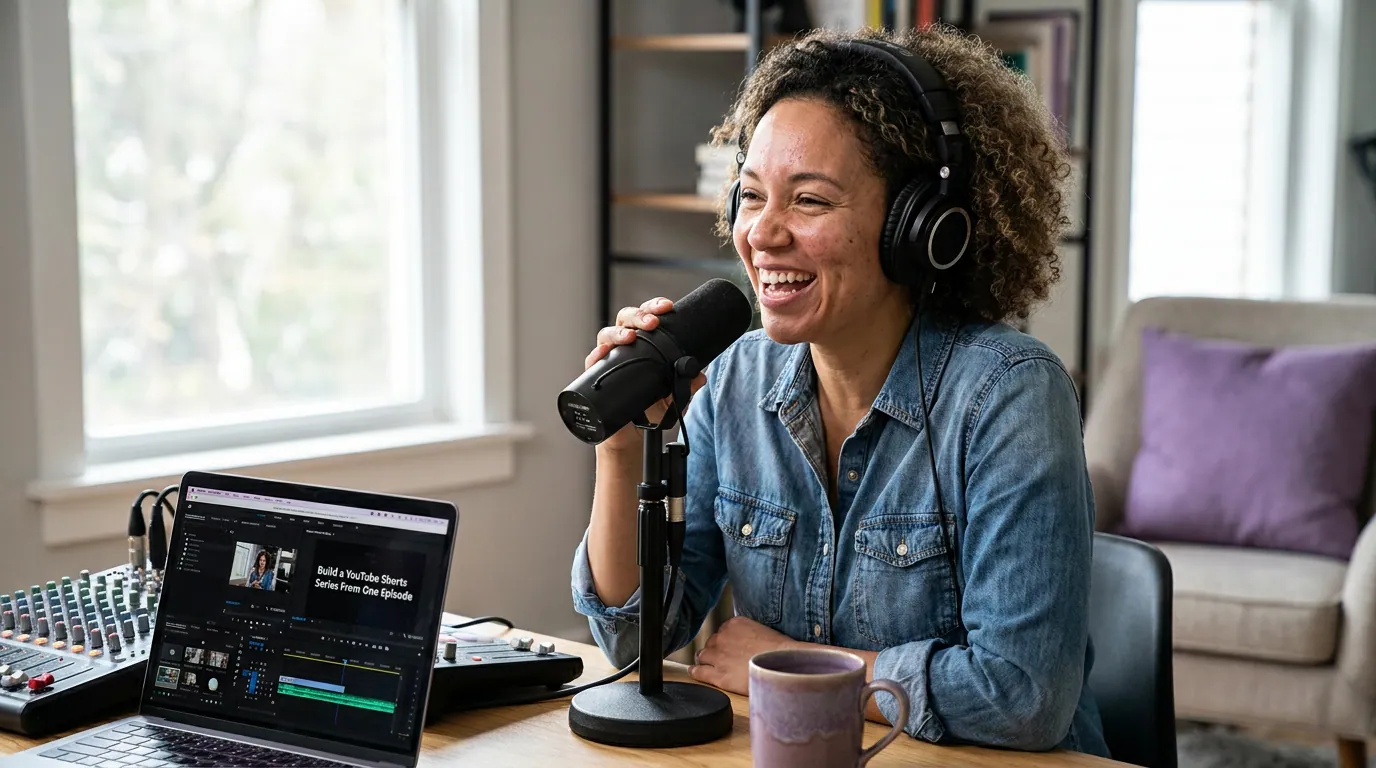
To build a YouTube Shorts series from one episode, pull four to six clips from the same conversation, order them so each one raises a question the next answers, number and title them as a set, and end every Short with a route back to the full video. The shift is from scatter to sequence: the same clips, ordered to be binged and to feed the long episode, instead of dropped at random.
Most "podcast to Shorts" advice stops at "the AI finds your best moments." That gets you clips. It does not get you a series. A series is what turns a one-time viewer of one Short into someone who watches three more and then taps through to the 45-minute episode, which is the only thing that actually grows the show. This walks the difference.
What makes a Shorts series different from a clip dump
A clip dump is five unrelated moments posted whenever. A series is a small set of clips from one episode, ordered and titled so they reference each other and pull the viewer along a path that ends at the full video. The clips can be the same; the architecture is the difference.
Why bother building the architecture? Because clips are how video podcasts grow, and a sequenced set compounds where scattered clips do not. One studio's client data puts clips at 20–40% of new audience with 2–5× reach lifts for video shows (Podcast Studio Glasgow), single-source ranges, directional, not audited guarantees. And 57% of listeners now rely on social media for podcast recommendations, the first time it passed friends and family (InsideRadio). Discovery happens in the feed. A series gives the feed a reason to keep showing the same viewer your stuff, and gives that viewer a reason to keep watching.
YouTube is the right home for it. It now has more than one billion monthly podcast viewers (Variety, Feb 2025), and Shorts sit one tap away from the long video on the same platform, no link-in-bio detour. That adjacency is the whole reason a Shorts series can route to the episode in a way a TikTok series can't.
The arc map: sequence, don't scatter
Here is the framework. Before you cut anything, lay the episode's clippable moments onto an arc map, a deliberate order where each Short sets up the next. You are not picking the five best clips. You are picking five clips that, in order, build a question.
A clean five-Short arc for an interview episode looks like this:
- The hook (Short 1). The single most arresting line in the episode, the claim, the number, the confession. This is the one you push hardest, because it's the front door.
- The stakes (Short 2). Why that claim matters, or what's at risk if you ignore it. Open the question the rest of the series answers.
- The turn (Short 3). The counterintuitive part, the bit that contradicts what people assume. This is usually your second-strongest standalone clip.
- The payoff (Short 4). The concrete how, the example, the receipts. The viewer who watched 1–3 has earned this.
- The cliffhanger (Short 5). The moment that's great but incomplete, it names a thing the full episode explains. This is the one built to route.
You don't need exactly five. Four to six is the workable band for a single episode. Fewer than four and it isn't a series; more than six and you're usually padding with clips that should have been killed. Choosing which moments earn a slot is its own skill, how to pick the best AI-suggested clips is the rubric I use to keep, fix, or kill each candidate before it gets a number.
How to cut the series fast (the workflow)
The arc is the thinking. The cutting is mechanical, and an AI clipper does the heavy lifting so you spend your time on order, not scrubbing.
- Import the episode once. Paste the YouTube URL or upload the file. The tool transcribes the whole thing and surfaces candidate moments, topic shifts, question-and-answer pairs, energy spikes. If you want to know why a given moment gets flagged, how AI clip detection actually works breaks down the signals.
- Tag candidates against the arc, not by quality. As you review, label each keeper as hook / stakes / turn / payoff / cliffhanger. You're casting roles, not ranking. A merely-good clip that fills the "stakes" gap beats a great clip that duplicates your hook.
- Trim each to one self-contained idea. For Shorts, 20–60 seconds is the working range, most strong clips landing near 30–45. End the moment the payoff lands, don't pad to a target. A 20–40-minute episode holds enough 30–90-second moments for a week or more of posts (castmagic, clip-length framing; per-episode counts are an editorial rule of thumb).
- Reframe to 9:16 and caption. Podcasts are shot landscape; Shorts are vertical. Reframe so the active speaker stays centered, and burn in captions, most social video plays on mute. Set the caption style and brand template once for the whole batch so the series looks like a set.
- Number and title as a series (next section).

Number, title, and link so it reads as a series
A series only works if a viewer can tell it's a series. Three moves make that legible, and all three happen at upload.
Number it in the title. Put a visible marker viewers recognize: "Part 1 of 5," "[1/5]," or "Ep. 42, Clip 1." This single token tells the algorithm and the human that more exists, and it's the cheapest retention lever you have. Keep the numbering identical across all five so they group visually on your channel.
Write titles that chain. Each title should hint at the next beat without spoiling it. Short 2's title can answer Short 1's and pose a new question. Avoid five interchangeable titles, that's the tell of a clip dump wearing a costume.
Put them in one Shorts-friendly playlist named for the episode or the theme. A viewer who finishes one Short and wants more lands in the set instead of scrolling away. The playlist is also where binge-watch time accrues, which is the metric that tells YouTube to keep recommending the series.
Route Shorts viewers to the full episode
This is the part generic clip advice never covers, and it's the entire point of doing a series on YouTube specifically. A Short that gets a million views and sends nobody to the show grew your view count, not your podcast. Views are not conversions. Build the route deliberately.
- Pin a comment with the episode link on every Short, written as a payoff, not a plea: "Full breakdown of why this works is at 14:20 in the episode →." The pinned comment is the most reliable manual route Shorts gives you.
- Add the related-video link that connects the Short to the source long video. On YouTube, this is the native bridge from Shorts back to the full upload, the one viewers tap most when a clip leaves them wanting the rest.
- Lean on the cliffhanger Short. Short 5 should name something the episode resolves and stop just short of resolving it. "He explains exactly how he did it in the full conversation" only works if the Short genuinely teed up a question worth answering.
One honest caveat: routing converts a slice of viewers, never most of them. A swipe-feed audience is volatile by design, and a strong series might send single-digit percentages of Shorts viewers to the episode. That's still the difference between a clip program that grows the show and one that only grows a number.
Why sequence beats scatter
The payoff of the arc map is carryover, a viewer who watches one Short being more likely to watch the next because the set is built to chain. Scattered clips share an audience by accident; a series shares one on purpose.
To be clear about that chart: those bars show the relative effect of structure, not numbers I measured. I won't put a fake percentage on something I can't source. The point is directional and it holds up in practice, a numbered, ordered set carries an audience forward in a way five disconnected clips don't.
Common mistakes building a Shorts series
Posting all five at once. A series is a drip, not a dump. Spread the arc across the week so each Short has room to find an audience and so a viewer who finds Short 3 still has Shorts 4 and 5 ahead of them. Lead the week with your hook.
Five clips that all do the same job. If every Short is a "best moment," you have five hooks and no arc. The stakes and payoff clips are less viral on their own, that's exactly why they hold the series together. Cast roles; don't just rank.
No route on any Short. A series with no pinned comment, no related-video link, and no playlist is just a prettier clip dump. The route is the reason to use YouTube for this at all.
Letting the auto-crop center the wrong speaker. On a two-person episode, an auto-reframe can lock onto whoever's silent. Check the active speaker stays in frame on every Short before it ships, one bad crop reads as careless across the whole set.
Treating views as the win. A million-view Short that routes nobody is empty engagement. Watch how many viewers the series actually sends to the episode, and kill arcs that travel but never convert.
FAQ
How many Shorts should I make from one episode? Four to six for a single arc-map series. Below four it doesn't read as a series; above six you're usually padding with clips that should be killed. A 20–40-minute episode holds enough strong 30–90-second moments for that and more, but resist posting every viable clip, the series works because it's curated, not exhaustive.
What order should the Shorts go in? Hook, stakes, turn, payoff, cliffhanger. Lead with the most arresting line, establish why it matters, deliver the counterintuitive turn, pay it off with the concrete how, then end on a clip that points to the full episode. Each Short should open a loop the next one closes.
How do I get Shorts viewers to watch the full podcast? Use all three native YouTube routes: pin a comment linking the episode written as a payoff, add the related-video link from the Short to the source upload, and group the series in one playlist. Build the last Short as a genuine cliffhanger that names something only the full episode resolves. Expect a slice to convert, not the majority.
How long should each Short be? 20 to 60 seconds, with most strong clips landing around 30–45. End the moment the payoff arrives instead of padding to a length. The cut point matters more than the duration, a tight 28-second Short beats a baggy 55-second one.
Should I post the whole series the same day? No. Drip it across the week so each Short gets its own shot at the feed and so a viewer entering mid-series still has more ahead. Open the week with your hook clip and close it with the cliffhanger that routes to the episode.
The same episode can feed more than Shorts. Once you have the arc mapped, the strongest beats also make a shareable quote graphic, the full transcript becomes a blog post that ranks, the throughline becomes a newsletter from one episode, and the list-shaped moments become an Instagram carousel. One conversation, a week of distribution, with the Shorts series doing the discovery.