
Turn a Podcast Episode Into a Blog Post That Ranks

Pull the transcript, then treat it as raw notes, not a draft. A raw transcript reads like speech and Google reads it as thin, so it almost never ranks on its own. Run it through a six-step edit pass: de-um it, restructure into question-shaped H2s, add a sourced data point, fold in two clean quotes, drop a summary box up top, and fact-trim the rambles. That pass is the article.
The mistake nearly everyone makes is pasting the transcript, adding a headline, and hitting publish. The result is a 6,000-word wall of "you know, like, the thing is" that no reader finishes and no search engine rewards. Google's March 2024 core update folded the Helpful Content System into core ranking and launched a scaled-content-abuse policy; Google later reported the work left "45% less low-quality, unoriginal content in search results" (Google blog). A dumped transcript is exactly the pattern that policy targets, large amounts of unoriginal content with little value to users (Google spam policies). The fix is not more words. It is the right edit pass on the words you already have.
How do you turn a podcast episode into a blog post that ranks?
Transcribe the episode, then edit it into a structured article rather than publishing it raw. Cut filler words, reshape the talk into question-style H2 headings people actually search, add one sourced statistic and two clean quotes, place a summary box near the top, and trim tangents. The transcript is your input; the edit pass is the article.
The reason raw transcripts fail is structural, not lazy. Speech wanders, repeats, and front-loads nothing, a host takes ninety seconds to reach the point a reader needs in the first sentence. Search engines and the people skimming on a phone both want the answer first, named subheadings they can jump to, and evidence they can trust. The good news: a single episode is a deep well of raw material, a dozen distinct ideas, the host's sharpest phrasings, real examples, so you are working from abundance. Your job is to impose shape on it.
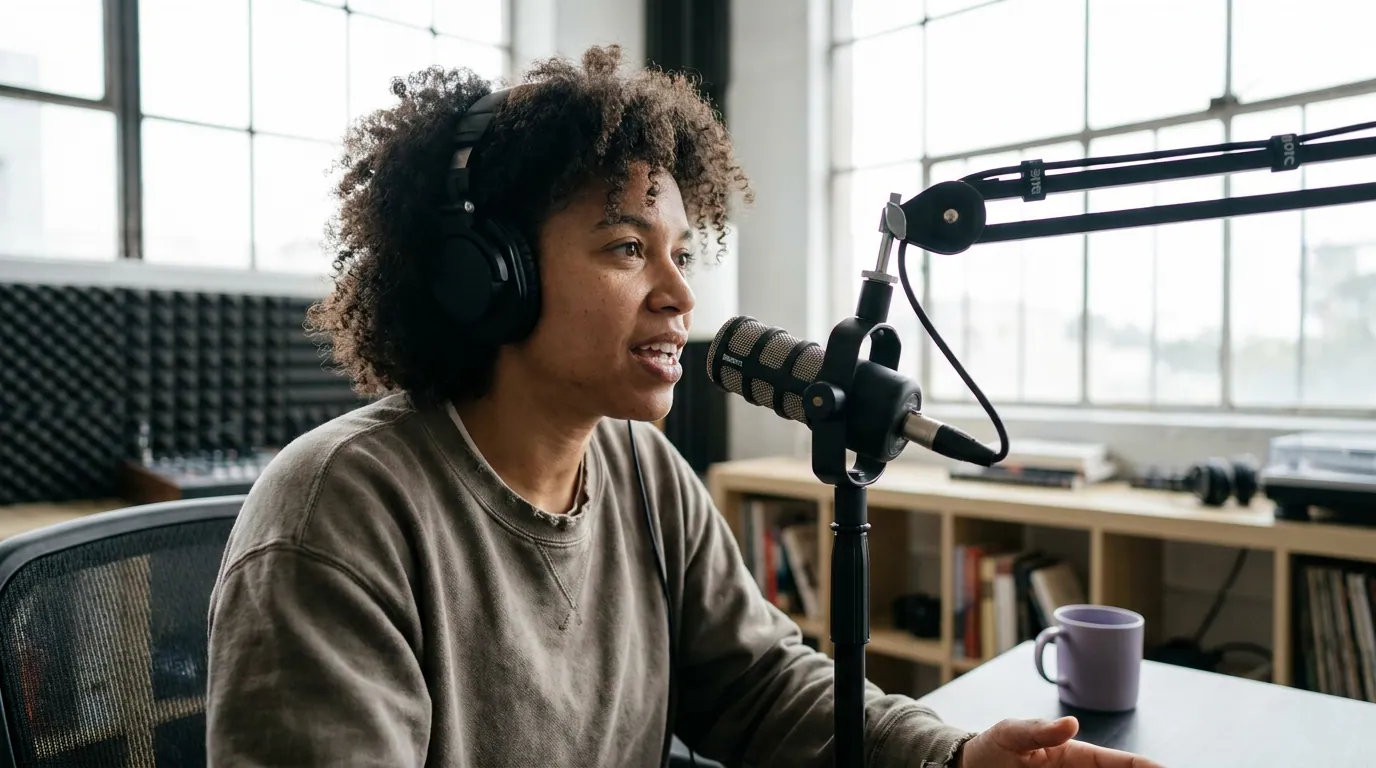
The 6-step edit pass
This is the core method. Each step fixes one specific way a transcript reads like speech and one specific reason Google treats it as thin. Do them in order, structure before evidence before polish, and a 6,000-word transcript usually compresses to a 1,400–1,800-word article that earns its rank.
- De-um. Strip the "um," "like," "you know," false starts, and the third re-statement of the same point. Spoken English is roughly 30–40% repair and filler; written English carries none. This single step removes the most obvious tell that a page is a dumped transcript. Read each paragraph aloud, if it sounds like a person talking rather than writing, keep cutting.
- Restructure into H2 questions. A transcript has no headings; a ranking article is built on them. Pull the three to six real ideas the episode covers and rewrite each as a question a reader would type, "How long should a cold open be?" not "On cold opens." Under each H2, lead with a 40–60-word direct answer, then expand. This is also how you earn AI Overview and answer-box placement, since those lift the liftable paragraph.
- Insert a sourced data point. A conversation rarely cites a number, but a page that ranks usually does. Add one real, named statistic that supports the episode's claim. Beyond credibility, it measurably helps machine readers: the Princeton-led GEO study (KDD 2024) found that adding statistics, quotations, and citations boosted a page's visibility in AI answers by up to about 40%, and validated roughly 37% live on Perplexity (GEO paper, arXiv). Never invent the figure; name the source inline.
- Fold in two clean quotes. The host said something better than you'll paraphrase it, keep it. Lift one or two of the sharpest lines, tidy the grammar without changing the meaning, and present them as block quotes attributed to the speaker. Quotes are original first-party content a transcript-scraper can't replicate, and the GEO study above names quotations as one of the three low-effort additions that lift AI visibility.
- Add a summary box near the top. Before the body, drop a short "what you'll get" box or a two-sentence takeaway that answers the title outright. Skimmers decide in seconds; the box is the answer-first contract. This is the same discipline that makes a clip's first three seconds work, say the payoff before you earn the read.
- Fact-trim the tangents. Episodes wander into side stories that are fun live and dead weight on a page. Cut anything that doesn't serve the search intent of your chosen keyword. A tighter, on-topic 1,500 words beats a sprawling 4,000 every time, length is not the ranking signal; information gain is.
The on-page SEO checklist for spoken-word source material
A transcript-born article needs a different on-page checklist than a written-from-scratch one, because the source has habits a normal SEO list never accounts for. Speech buries the keyword, never states the question, and produces no internal structure. Work this list after the edit pass, in this order.
| Check | Why it matters for transcripts | Done when |
|---|---|---|
| Keyword in the H1, first 100 words, one H2 | Speech rarely says the search term plainly; you must place it | The exact phrase appears naturally three times |
| One question-style H2 per real idea | Transcripts have zero headings; questions match search | Every section header is jumpable and searched |
| A summary box or answer-first opener | Hosts front-load nothing; skimmers and answer boxes need it | The title's question is answered in ≤60 words up top |
| One sourced stat + a named source link | Conversations cite no numbers; pages that rank usually do | A real figure is attributed inline, not invented |
| Descriptive internal links (3–6) | A transcript links to nothing | Sibling articles linked by descriptive anchor |
| Title tag + meta description rewritten | Auto-titling from a transcript produces garbage | Both are human-written and keyword-bearing |
| Trimmed to the intent, tangents cut | Episodes ramble; thin sprawl reads as scaled content | No section that doesn't serve the keyword survives |
Two notes that save you wasted effort. First, do not lean on FAQ or HowTo schema for SERP real estate, Google ended FAQ rich results on August 2023 and deprecated HowTo results (Search Engine Land). Keep a visible FAQ section for readers and answer boxes, but expect no special markup payoff. Second, freshness is a real retrieval signal for AI answers, Ahrefs' analysis of 17 million citations found AI-surfaced URLs average about 25.7% fresher than the pages traditional search returns (Ahrefs), so date the post and refresh it when the episode's topic moves. Treat that as a correlation, not a lever you can pull on demand.
Common mistakes turning a transcript into a blog post
- Publishing the raw transcript. This is the headline error, and it's the exact scaled-content pattern Google's March 2024 update cut at scale (Google spam policies). A transcript is notes. The edit pass is the article. Skipping the pass skips the work that ranks.
- Keeping the episode's running order. Conversations meander; articles argue. Don't preserve the talk's sequence out of fidelity, reorder into the logical structure a reader needs, strongest answer first.
- No keyword placement. Because speech rarely says the search phrase, a transcript-born post often never contains its own target keyword. You have to add it deliberately to the H1, the opening, and at least one H2.
- Zero evidence. A conversation feels authoritative live but cites nothing. Without a named statistic or a real example, the page has no information gain over the audio it came from, and information gain, not word count, is the survival line.
- Treating auto-generated titles as final. Transcript tools produce literal, ugly titles and metas. Rewrite the title tag and meta description by hand; they are the first thing both readers and crawlers judge.
Where the rest of the episode goes
The blog post is one output. The same episode should feed the channels that send people to read it, and 57% of listeners now rely on social media for podcast recommendations, the first time that surpassed friends and family (InsideRadio). Treat the post as the hub and these as spokes pointing back to it:
- Write a newsletter from one podcast episode, the same transcript, a shorter and more personal edit pass.
- Build an Instagram carousel from a podcast episode, turn the H2 answers into swipeable cards.
- Make quote graphics from your episodes, reuse the two quotes you already pulled in step four.
- Make an audiogram from a podcast episode, an audio-only teaser that links to the full read.
The clips do the discovery work. How AI clip detection works covers why a tool surfaces the moments it does, and picking the best AI-suggested clips covers which of those are worth promoting the post. The article ranks; the clips bring the traffic that proves to Google the article deserves to.