
Republish a Podcast Episode on Medium and Substack


Publish the episode as one edited article on a URL you own, then republish it to Medium and Substack with a canonical link pointing back to that original. The canonical tag tells Google which copy is the source, so the same text on three sites reads as syndication, not duplicate content. Then adapt the body for each audience.
The reason this matters is that podcasters do the second half right and skip the first. They paste the same transcript-born article onto Medium, Substack, and their own site with no canonical signal, then wonder why none of them rank and the wrong copy shows up in search. None of that is a "duplicate content penalty", Google's own canonicalization docs say there is no such penalty for honest duplication, but without a canonical, Google picks the canonical version for you, and the hint you set is only a hint, so it can land on a copy you never wanted (Google Search Central). The whole game is telling the search engine where home is, then giving each platform's readers a reason to stay.
How do you republish a podcast episode on Medium and Substack without duplicate-content problems?
Publish the original on a domain you control first, then republish to Medium and Substack with each copy's canonical link set to that original URL. Medium has a built-in "Set canonical link" flow; Substack has none, so treat it as the place you adapt, not duplicate. Change the framing per platform.
"Duplicate content" sounds like a punishment, but the real failure modes are quieter. Google clusters identical or near-identical pages and shows one, if you sent no signal, it guesses, and it often surfaces Medium's high-authority domain over your own site, which means your home page gets none of the link equity or the email signups. Worse, an unedited transcript posted three times is the exact thin, scaled pattern Google's March 2024 update cut at scale (Google spam policies). The canonical fixes the first problem; a real edit pass fixes the second.

Why bother republishing at all?
Because distribution beats one perfect page, and podcast discovery now runs through the channels you republish into. A record 57% of listeners rely on social media for podcast recommendations, the first time that surpassed friends and family (InsideRadio). Medium and Substack are reading networks with their own recommendation engines and existing audiences. A version of your episode living where readers already are sends those readers back to your home page and your show. The episode is one production; three placements is three front doors.
The steps
Do these in order. The sequence matters: the original must exist and be indexable before you syndicate, or there is nothing for the canonical to point at.
- Publish the edited original on a domain you own, first. Not the raw transcript, the edited article. A transcript reads like speech and Google reads it as thin, so run it through a real edit pass before it goes anywhere. (The full method is in turning a podcast episode into a blog post that ranks.) Let it get indexed; check it appears in a
site:search before step three.
- Republish to Medium with the canonical set. Use Medium's import tool, paste your original URL into "Import a story," and Medium automatically sets the canonical link back to your source. If you compose in the editor instead, open story settings and use "Set canonical link" to paste the original URL by hand (Medium Help). This is the single most-skipped step, and it is the one that protects your own site's ranking.
- Adapt for Substack rather than duplicate. Substack has no canonical-link field, so do not paste the same text and hope. Substack is an email-first relationship product: the people reading already subscribed to you. Rewrite the opener as a personal note, cut the SEO scaffolding, and lead with the one idea from the episode you want in their inbox. A different enough version is its own piece, not a duplicate.
- Differentiate the framing on every platform. Same episode, three angles. On your own site, write for search, the question-style headings someone would type. On Medium, write for the topic-curious reader who found you through a tag or a publication. On Substack, write for the subscriber who already trusts you. The transcript is shared raw material; the framing is what makes each copy worth its own read.
- Link each copy back to the show and the original. Every republished version should carry a clear line back to the episode (audio or video) and to your home article. That is how a Medium reader becomes a subscriber and how the syndicated copies pass interest back to the source you own.
- Seed all three with clips. Drop a short captioned clip into each post and across social to drive the read. Clips are the discovery layer that sends people to the long form, that is the whole reason the social-recommendation number above matters.
Where the canonical points when you don't own a website
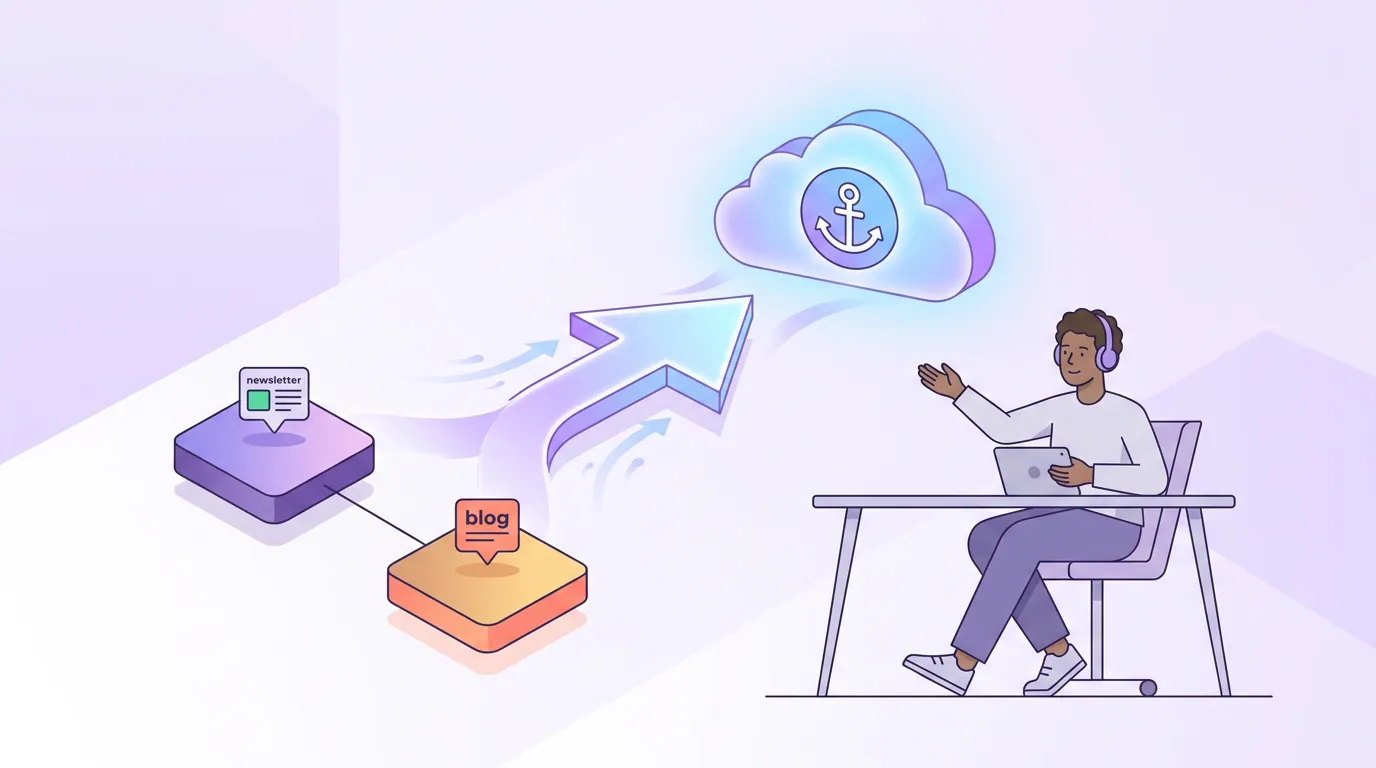
If you have no domain of your own, you have a real decision to make, and the honest answer is "make Substack your home." Set the canonical to wherever you most want ranking and where you control the relationship. With no personal site, that is usually your Substack, it gives you a URL, an email list you own, and a stable home, so publish there first and republish the adapted version to Medium with Medium's canonical pointed at the Substack post. Never set a canonical to a page you don't control, and never point two different originals at each other.
Medium vs. Substack: how the same episode should read differently
The biggest waste is treating the two platforms as the same paste target. They reward opposite instincts. Medium is a discovery network with tags, publications, and a curation engine, readers arrive topic-first and don't know you. Substack is an owned email list, readers subscribed to you and open because it's from you. Adapt the same episode along these lines.
| Element | Medium version | Substack version |
|---|---|---|
| Reader's relationship | Topic-curious, found you via tag | Already subscribed, came for you |
| Opening line | The searchable promise of the topic | A personal note, "I got into this on the show this week" |
| Headings | Question-style, SEO-shaped | Lighter; conversational section breaks are fine |
| Length | Full edited article | Tighter; one idea, well told |
| Canonical | Set to your original URL (built-in) | No canonical field, adapt, don't duplicate |
| Call to action | Follow the show + read the source | Reply, share, forward to a friend |
The shared spine is the transcript and the episode's best ideas. Everything above the spine, the opener, the headings, the close, should change so neither copy reads as a clone of the other.
Common mistakes
- Skipping the canonical on Medium. This is the headline error. Without it, Google may treat Medium's high-authority page as the original and yours as the copy, so your own site gets none of the ranking. Use Medium's import flow or "Set canonical link" every time (Medium Help).
- Pasting an unedited transcript to all three. Three copies of speech-like filler is the thin, scaled pattern Google's March 2024 policy targets (Google spam policies). Edit it into a real article before it leaves your hard drive.
- Treating Substack like a second Medium. Substack readers chose you; an SEO-shaped paste reads cold in an inbox. Rewrite the opener as a note and cut the scaffolding.
- Publishing the copies before the original is indexed. The canonical needs a live, indexable target. Confirm your original shows up in a
site:search before you syndicate. - Canonicalising to a page you don't own. Never point a canonical at someone else's URL or at a page that might disappear. If you have no site, make Substack the home and point Medium at it, not the reverse, and never at a third party.
Tools and the honest version
You need three things: a transcript, an edit pass, and a canonical-capable publishing platform. For the transcript, any tool that transcribes the episode works, QuickReel hands you the transcript and the clips together from one upload, which saves a round trip, but a standalone transcription tool is fine if that's what you have. For the canonical, Medium's built-in import is the cleanest free path; if you publish on your own site, your CMS (WordPress, Ghost, Webflow) sets the canonical natively. Substack is deliberately not in that list, it has no canonical control, which is exactly why the workflow treats it as an adaptation destination, not a syndication one.
FAQ
Is there a duplicate-content penalty for republishing my own podcast article? No. Google's canonicalization documentation states plainly that duplicate content is not grounds for a penalty unless it's deceptive (Google Search Central). The real risk is that, without a canonical signal, Google picks which copy to show, and often picks a high-authority platform like Medium over your own site. The canonical tag tells it which copy is the source so the ranking goes where you want.
Does Substack support canonical links? No. Substack has no canonical-link field, so you can't tell search engines a Substack post is a copy of your original. The practical workaround is to adapt the episode for Substack instead of pasting it verbatim, rewrite the opener and tighten the body so it reads as its own piece. If you own no website, make the Substack post your home and set Medium's canonical to point at it.
How do I set a canonical link on Medium? Use the import tool: paste your original article's URL into "Import a story" and Medium sets the canonical automatically. If you write in Medium's editor instead, open story settings and use "Set canonical link" to paste your original URL by hand (Medium Help). Do this before you publish, not after.
Should the Medium and Substack versions be word-for-word identical? No, and not just for SEO. Medium readers arrive topic-first through tags and don't know you; Substack readers subscribed to you. Change the opener, the headings, and the close so each copy fits its audience. The shared spine is the episode's ideas, the framing around them should differ.
Do I need an FAQ section if FAQ rich results are gone? Keep the visible FAQ; drop the schema expectations. Google ended FAQ rich results on August 2023 and deprecated HowTo results (Search Engine Land). A real FAQ still helps readers and feeds answer boxes, it just no longer earns special SERP markup.

Where the rest of the episode goes
The Medium and Substack posts are two outputs of one episode. The same source feeds the channels that drive readers to all three:
- Write a newsletter from one podcast episode, the deeper version of the Substack adaptation above.
- Build an Instagram carousel from a podcast episode, turn the article's section headings into swipeable cards.
- Make quote graphics from your episodes, pull the host's sharpest lines into shareable images that link back to the post.
The clips do the discovery work that fills all of these. How AI clip detection works explains why a tool surfaces the moments it does, and picking the best AI-suggested clips covers which ones are worth attaching to your Medium and Substack posts.