
How to Ask Good Podcast Interview Questions

To get real answers, decide what you want the question to pull before you ask it. Every good interview question aims at one of four targets: a story, an opinion, a contrast, or a specific. Name the target, phrase for it, and a flat question becomes one that opens a guest up.
Most advice tells you to "ask open-ended questions" and leaves you there. That fixes nothing in the moment, because "open-ended" describes the shape of the answer, not what you were trying to get. The skill is choosing the target first. Once you know whether you want a scene, a take, a comparison, or a concrete detail, the wording almost writes itself, and the same curiosity that produced a dead "did you like it?" produces a paragraph instead. This guide gives you the four-target framework, a method for rewriting your flat questions on the spot, and how to balance a full question set so an episode doesn't sag.
What makes a podcast question actually work?
A question works when its phrasing makes one kind of answer the path of least resistance. Ask for a story and the guest narrates; ask for an opinion and they take a side. The failure mode isn't a "wrong" topic, it's a shape that lets the guest escape in one word. Aim at a target and the answer has somewhere to go.
This reframes the usual open-vs-closed advice. "Closed" questions fail because they aim at nothing: "Did you enjoy it?" requests a yes and gets one. But you don't fix that by mechanically swapping "did" for "what." You fix it by deciding you wanted a story about the hardest part, and asking for that. The target is upstream of the wording. Pick it, and the open phrasing follows on its own.

The four targets: story, opinion, contrast, specific
Here's the framework. Four things a question can pull from a guest, the trigger phrasing that reliably hits each, and the kind of answer it produces. Most flat questions fail because they aim at none of these.
A story question asks the guest to narrate a scene: "Walk me through the morning you decided to quit." You're not after their opinion of the decision, you want the moment, with detail and tension. Story answers are the ones that become clips, because a moment with a beginning and an end is self-contained.
An opinion question asks them to plant a flag: "Where do you land on remote work now?" It works only when the guest has standing to have a view. Aim it at someone who'd rather not commit and you get a hedge; aim it at the right person and you get the line everyone quotes back.
A contrast question asks for a turning point: "What did you believe about this two years ago that you don't now?" Contrast is the most underused target and often the most productive, because the gap between then and now is where the genuine insight sits. Most hosts never ask for it.
A specific question asks for one concrete thing: a number, a name, an exact moment. "How much did the first version cost to build?" It's also your rescue tool. When an answer goes abstract and floaty, a specific question yanks it back to the ground: "What exactly did the email say?"
How to convert a flat question into a good one (in three moves)
Aiming at a target turns rewriting into a procedure instead of a guess. Here's the move sequence: pick the target, swap the opening so it can't be answered in one word, then cut your own opinion out of the sentence. Three steps, and almost every dead question comes back to life.
- Pick the target. Before you touch the wording, decide what you actually want. A scene? A take? A before-and-after? A hard fact? "Did you like the job?" usually means I want a story about the job, so aim at story.
- Swap the opener so one word can't answer it. Verbs like did, do, is, are, were, would invite a yes. Lead with what, how, or a target trigger ("walk me through") and a single word no longer fits.
- Cut your own read out of the sentence. "It must have been brutal, right?" hands the guest your answer and asks them to nod. Delete your verdict and let them supply theirs: "What was that stretch actually like?"
Run those three moves on five common flat questions and you get this.
Notice that two of the five became story questions. That's not an accident, when you're unsure which target to pick, story is the safe default, because a scene almost always contains the opinion, the contrast, and the specifics anyway, and the guest hands them to you without being asked.

How to balance a full question set
A real interview needs more than one target. A set of all story questions wanders; a set of all opinion questions feels like an interrogation; all specifics feels like a quiz. The mix that holds a 45-minute conversation leans on stories, salts in opinion and contrast for the memorable lines, and keeps a few specifics in reserve to pull a drifting answer back to earth.
Treat those ten as doors, not a checklist. The number that matters more than the mix is how few you bring: write eight to ten strong openers for a 45-minute interview, not thirty. Thirty means you read your list instead of listening, and the question that actually earns the episode, the follow-up built on what the guest just said, never gets asked. The framework gets you a strong opener for each topic; the follow-up question is where the episode lives, and you can only catch it by listening closely enough to hear the word they leaned on.
Common mistakes that flatten good questions
Even with the right target, four habits quietly drain the answer. Each has a fix.
- Stacking two questions in one breath. "Why did you start, and what would you change?" The guest answers the last one and forgets the first, or freezes choosing. Ask one. Hold the second and ask it after they finish.
- Front-loading context the guest doesn't need. A forty-second wind-up before the question buries it; by the time you stop, they've lost the thread. Ask the question first. Add context only if their face says they need it.
- Asking a question you already telegraphed the answer to. If your phrasing reveals the answer you're hoping for, you'll get agreement, not their version. Cut your read out, move three of the rewrite.
- Skipping the research, then asking what's already public. "So, what does your company do?" wastes the slot and signals you didn't prepare. Do the homework so you can ask the question only this guest can answer, see how to research a guest in under 90 minutes and the rest of the day-of prep checklist.
- Treating every closed question as a sin. A closed question is the right tool when you need a clean, quotable fact or a hard pivot: "Did you take the deal, yes or no?" forces a crisp line you can clip. The problem is never one closed question; it's an hour built entirely from them. For the full taxonomy of question shapes to avoid, the companion field guide on open vs leading vs yes/no questions has the diagnostics.
One more habit worth naming, because it sits at the edge of question design and guest etiquette: a question that targets a contrast or a specific can stray into territory the guest didn't agree to discuss. Aim sharp, but read the room. A guest who feels cornered gives you the public answer every time.
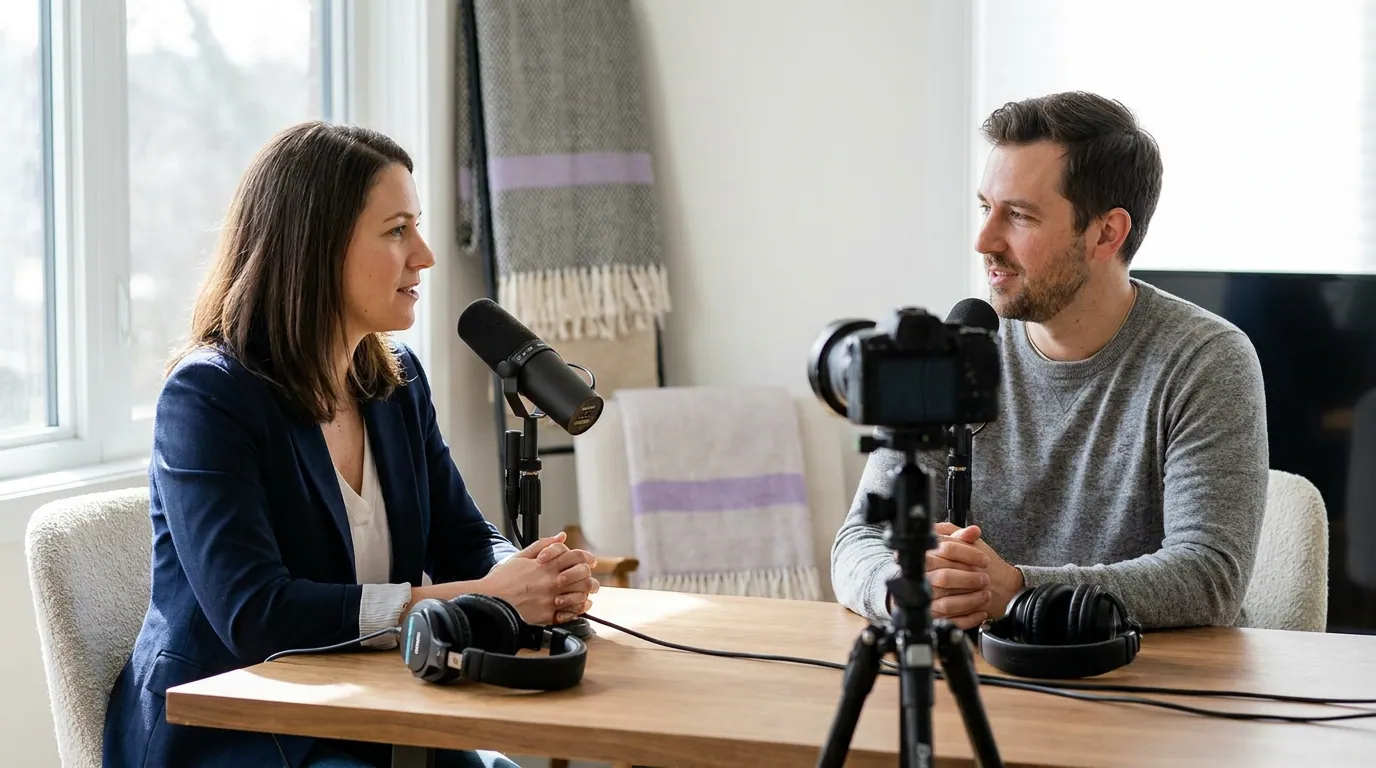
Why the right question is also your distribution
The unguarded, story-shaped answer a good question earns isn't only better radio, it's how the episode finds new people. 57% of listeners now rely on social media for podcast recommendations, the first time that source passed friends and family (InsideRadio). And the share of new US weekly listeners who prefer to watch a podcast has climbed to 53%, up from 30% in April 2022 (Backlinko). A sharp question pulls the moment; the moment becomes the clip; the clip is what does the discovery work the algorithm rewards.
Frequently asked questions
What are the best types of questions to ask a podcast guest? The most productive questions aim at one of four targets: a story (a scene the guest narrates), an opinion (a position they'll defend), a contrast (a before-and-after), or a specific (a concrete number or detail). Decide which you want before you ask, and the open phrasing follows. Story questions are the safest default because a scene usually contains the others too.
How do I turn a yes/no question into a better one? Three moves. First, decide what you actually wanted, a story, opinion, contrast, or specific. Second, swap the opener: lead with what or how instead of did, is, or would, so one word can't answer it. Third, cut your own opinion out of the sentence so the guest supplies theirs. "Did you like the job?" becomes "Walk me through your first month."
How many questions should I prepare for a podcast interview? Eight to ten strong open questions for a 45-minute interview, not thirty. More than that and you read your list instead of listening, which kills the follow-up, the second question, built on what the guest just said, is usually where the real answer shows up. Treat your prepared questions as doors to open, not a checklist to complete.
Should I send the questions to my guest in advance? Send themes and two or three anchor questions, not a full script. Themes let the guest prepare stories without over-rehearsing into flat, recited answers. Keep your follow-ups unsent and unscripted, surprise, inside a topic they're ready for, is what produces the moments worth keeping.
What's the single fastest way to ask better questions? Before each question, silently name the target: story, opinion, contrast, or specific. That one-second habit forces you to ask for something concrete instead of lobbing a vague prompt, and it makes the open phrasing almost automatic. It also tells you when an answer drifted, reach for a specific to pull it back.