
Text Hook vs Spoken Hook: Which to Lead With


Lead with the text hook by default, because most of the feed watches on mute and reads your clip before they hear it. Lead with the spoken hook only when the delivery is the point, a laugh, a gasp, a voice that sells the line. Best is to layer both, with each carrying different information.
That is the whole decision in three sentences, and the rest of this page is the reasoning and the mechanics: when each one wins, why the mute data tilts the default, and the exact way to stack a text hook over a spoken hook without the overlay reading like a subtitle of the audio.
Text hook vs spoken hook: what's the difference
A text hook is the line you put on screen in the opening frame, a caption card or overlay a viewer reads instantly, with the sound off. A spoken hook is the line the speaker actually says first, carried by voice: the tone, the pause, the laugh, the way they land it. Both are trying to do the same job, stop the scroll, but they reach the viewer through different senses, and the feed is heavily biased toward one of them.
That bias is the reason this question has a real answer instead of "it depends." Most social video is consumed silently, so a hook that lives only in the audio is invisible to the majority of the people scrolling past. A hook that lives only on screen, meanwhile, gives up the one thing video has that text can't: a human voice doing something a sentence can't reproduce. The right call depends on which of those advantages your specific moment needs more.
Why the default leans toward text
The default leans toward text because most social video is watched with the sound off. Two publisher-reported reads bracket it: Digiday's 2016 round-up put Facebook silent views at as much as 85% across multiple publishers (Digiday), and a 2019 Verizon Media / Publicis Media study found 83% of consumers watch video sound-off (NextTV). Both are survey/publisher figures, not platform-audited, so treat the exact number as a range, not a law, but the direction is settled: if your hook is spoken-only, the silent majority never hears it.
There is a second pressure on the open: it has to win fast. Clipping practitioners treat the opening three seconds as the moment the scroll decision gets made, "absolutely critical for social media success," as one vendor guide puts it (Castmagic). A muted viewer makes that decision off your text, because that is the only part of the hook reaching them in those three seconds. So unless you have a specific reason to lead with voice, you put the line on screen.
This matters more than a caption preference. For a video show, clips often drive 20–40% of new audience (Podcast Studio Glasgow, a single studio's client data, so directional). Most of that audience meets you sound-off, so the text hook is doing most of the recruiting. For a full breakdown of how the opening seconds spend that attention, see what to put in the first 3 seconds of a clip.
The decision rule: text, voice, or both
Here is the rule. Default to a text hook; lead with voice only when the delivery carries information the words don't; and layer both whenever the moment can support two distinct beats. The diagram below is the version I use when scoring a clip's open.
When the text hook wins
Lead with text when the hook is informational, a number, a claim, a contrarian statement, a question that reads as interesting on the page. "We went from 40 listeners to 4,000 in six weeks" is a text hook: it lands silently, no voice required. The same is true for any clip whose surprise lives in the content of the line rather than how it's said. On muted-first platforms, Reels, TikTok, Shorts, this is the safe default, because the spoken version of that line is reaching a minority of viewers.
Text also wins when the speaker buries the hook. People often say the best part halfway through a sentence, after a windup. You can't easily re-record the voice, but you can put the buried line on screen in second zero and let the audio catch up. The text becomes the promise; the voice becomes the delivery of it.
When the spoken hook wins
Lead with voice when the delivery is the point and the words on their own don't sell it. A genuine laugh, a voice cracking on an emotional line, a beat of stunned silence, a delivery so dry the timing is the joke, none of that survives as a caption. "I can't believe I just said that out loud" reads as nothing on screen; spoken, with the right pause, it's the whole hook. Comedy and emotional clips lean here more than business or educational ones.
A known or distinctive voice is the other case. If your host has a recognizable sound, the first second of audio is itself a hook for returning viewers. Even then, add a text card for the silent majority, but let the voice take the lead beat. The honest caveat: leading with voice is a bet that enough viewers have sound on for that specific clip. On most feeds, that bet loses more often than it wins, so reserve it for moments where the delivery genuinely can't be captioned.
How to layer both without repeating yourself
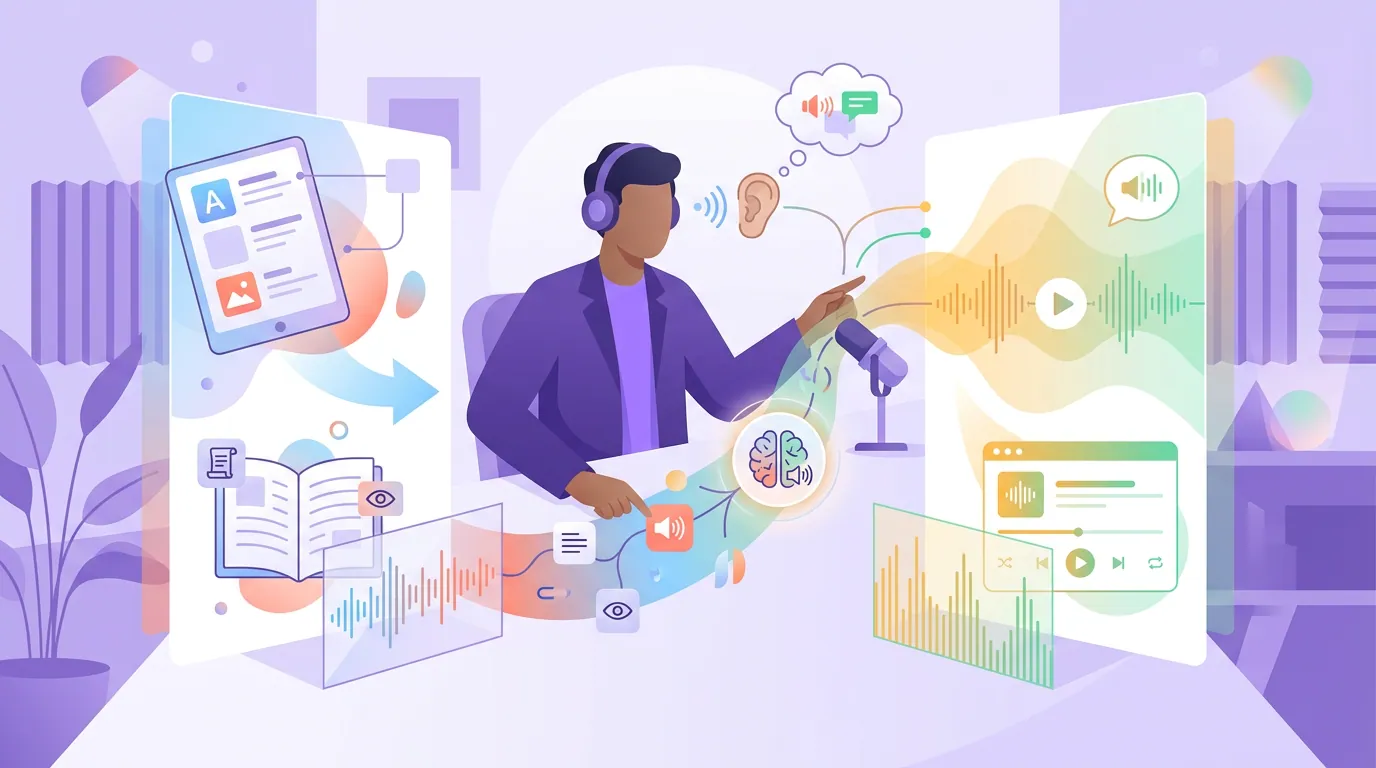
The best opens use both, but the trap is making the text overlay a word-for-word subtitle of the spoken hook. When the screen says exactly what the voice says at the same instant, you've spent two channels to deliver one idea, and a muted viewer gets no more than a sound-on one. Layering works when text and voice carry different beats: the text states the stakes or the setup, and the voice delivers the payoff a half-second later.
A worked example. The raw line is: "Honestly, the week I almost quit the podcast was the week one clip changed everything." Don't caption that verbatim over the same audio. Instead, second-zero text reads "The week I almost quit", the stake, on screen, instantly readable. The voice then lands "...and then one clip changed everything" a beat later as the payoff. A muted viewer reads the stake and stays for the captions that follow; a sound-on viewer gets the stake and the spoken turn. Two beats, two channels, no repetition.
The mechanics matter. Keep the second-zero text card up just long enough to read, roughly a second, then hand off to word-by-word captions that track the speech so the open never freezes. A static card sitting through all three seconds reads as a slideshow and gets scrolled. For the deeper case on why on-screen text carries silent viewers through the whole clip, not just the hook, see how on-screen text holds retention, and for ready-made opening lines that work on the page, 7 hook openers that make people stop scrolling.
Common mistakes
Leading with voice on a muted-first platform. A spoken-only hook on Reels, TikTok, or Shorts reaches the minority who have sound on. If your open dies on mute, it's a text-led clip wearing the wrong open. Watch every clip silent before you publish it.
Captioning the spoken hook word for word. The overlay that exactly mirrors the audio wastes a channel. Make the text say something the voice doesn't, the stake, a number, the setup, and let the voice deliver the rest.
Treating the text card as the whole hook. A text overlay on a slow, mumbled opening just delays the scroll. The line still has to be good and the audio underneath still has to be clean; text decorates a strong hook, it doesn't rescue a weak one. Why a weak open quietly sinks a clip is the recurring pattern in why your podcast clips get no views.
Holding a static card too long. Even the right text hook becomes a slideshow if it sits frozen for three seconds. Read-then-hand-off to live captions by second one.
Trusting the auto-suggested opening line. AI clippers cut at clean pause boundaries, which often means the open lands on the windup, not the hook, and they won't decide for you whether the moment is text-led or voice-led. Audit the open yourself, then use the keep-or-cut rubric in how to pick the best AI-suggested clips, and learn where viewers actually leave in how to read a retention curve on a clip.
FAQ
Should I always add a text hook? Yes, in nearly every case. With roughly 80%+ of social video watched on mute across publisher and survey reads (Digiday; NextTV), a hook that lives only in the audio is invisible to most of the feed. Even on a voice-led clip, add a text card so silent viewers get the hook.
When is a spoken hook better than text? When the delivery carries information the words don't, a laugh, an emotional break, a perfectly timed pause, or a recognizable voice. If you can read the line on the page and it still lands, it's a text hook. If reading it falls flat but hearing it works, lead with voice and caption it for the muted majority.
Won't two hooks at once feel cluttered? Only if they say the same thing. Layer them so the text states the stakes and the voice delivers the payoff a beat later, each channel adds something. If the overlay is a verbatim subtitle of the audio, cut one or rewrite the other.
Does the platform change the answer? The lean toward text holds across Reels, TikTok, and Shorts because all three default to autoplay and many viewers keep sound off. It softens slightly where audiences more often watch with sound on, but text-first is the safer default everywhere on the open.
What if the speaker buries the best line mid-sentence? Put the buried line on screen as the second-zero text hook, then let the audio catch up to it. The text becomes the promise and the voice becomes the delivery, which also re-sequences a clip that the speaker said in the wrong order.