
What to Put in the First 3 Seconds of a Clip

Put your single most interesting line on screen as text in second zero, a face and a clear voice into second one, and the first turn of the story, a question, a stake, or a number, into second two. No logo, no "hey guys," no slow inhale. The viewer decides whether to stay before second three, so each of those three seconds does one specific job, and you can plan them frame by frame.
Most clips waste the opening on throat-clearing the speaker did in the room: the breath, the "so, basically," the restatement of the question. The first three seconds are the only real estate you get before the scroll, and they reward a plan, not a vibe. Below is that plan, second by second.
Why the first three seconds decide the clip
The opening is close to the only thing that matters before a viewer has decided to stay. Practitioners are blunt about it: "the opening three seconds of any clip are absolutely critical for social media success" (castmagic). The widely repeated reason is a Facebook/Meta figure, about 65% of people who get past the first three seconds go on to watch at least ten (attributed to Meta for Business, via EnterpriseTube), so clearing three seconds is the hinge the rest of the watch swings on. Treat it as directional secondary data, not a platform-audited law, but the direction is not in dispute: the keep-or-scroll decision happens fast and early, and after it, retention is mostly downhill.
There is a second reason to obsess over the open: most social video is watched on mute, with a widely cited estimate of 85% of Facebook video views happening with the sound off (Digiday, publisher-reported and directional; the same piece notes other estimates ranging from 50–80% up to 85–90%). So your first three seconds are not really audio, they are the first line of text on screen. A muted viewer reads your hook before they hear a word of it. That single fact is why text gets the very first second in the plan below, and why audio has to support the text rather than carry it.
And the stakes are not marginal. For a video show, clips often drive 20–40% of new audience (Podcast Studio Glasgow, a single studio's client data, so directional). Most of that audience is won or lost in three seconds.
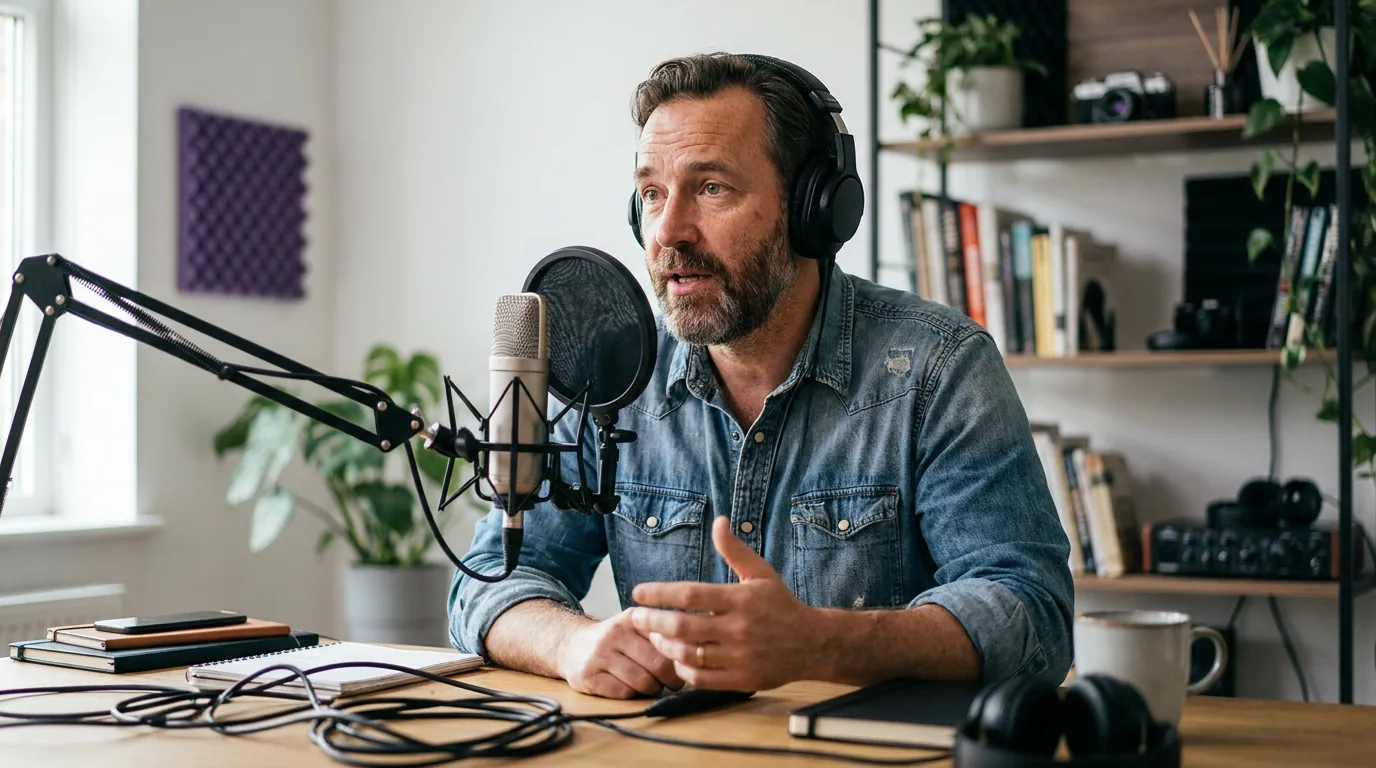
The 0/1/2 rule: one job per second
Here is the framework. Each of the first three seconds carries one visual, one audio, and one text job. Stop thinking of the opening as a blurry "hook" and start treating it as three discrete frames, each with an assignment you can check off.
Second 0, the hook line, before anything else
Second zero belongs to the text. Because most viewers are muted, the first caption card is the hook, and it has to be legible the instant the frame appears, not faded in, not preceded by a title slide. The job of second zero: the single most interesting sentence in the whole clip, already on screen as readable text.
Visually, a face should already be in the frame, mid-expression, mid-motion, looking at the camera or at the other guest. A face beats a static intro card every time; the brain locks onto eyes faster than onto type. On audio, start mid-sentence. The first word a viewer hears should be a word that matters, not the inhale, not "so," not "yeah, I think." Trim the breath. If your clip opens on a pause, you have already lost the second.
The most common second-zero failure is starting on the warm-up. People restate the question before they answer it, and an unedited clip keeps that warm-up. Cut to the answer. The setup can follow as explanation once curiosity exists, for the full re-sequencing move, see how AI picks (and mis-picks) your clip's entry point and the keep-or-cut rubric in how to pick the best AI-suggested clips.
Second 1, confirm a real person
Second one's job is to prove there is a human worth listening to. By now the viewer has read your hook line; second one is where they decide if a real, watchable person is attached to it. Keep the face in frame and let the strongest spoken word land cleanly, loud enough, clear enough, no mush. This is the moment the audio takes over from the text and has to be worth turning the sound on for.
On text, the caption should track the speech word by word, with the keyword highlighted so a muted viewer's eye knows where the meaning is. Do not let a static card sit through second one; if your caption hasn't moved since second zero, the clip looks like a slideshow, and slideshows get scrolled. The visual rule is simple: a person, not a placeholder. A talking head with energy outperforms a beautifully designed title card with none.
Second 2, the first turn
Second two has to introduce a turn, the thing that makes "interesting" become "I need to know how this ends." The strongest turns are a sharp question ("here's why that's completely backwards"), a stake ("this almost cost me the company"), or a number ("we went from 40 listeners to 4,000"). One of those should be delivered on audio and reflected in the on-screen text by second two, or the clip plateaus right where it should be accelerating.
Give the eye a small change to mark the turn: a cut, a slight punch-in zoom, or a half-second of B-roll. Not a transition wipe, not a sound effect, a subtle visual update that signals the clip is going somewhere. The number-one second-two mistake is staying flat: same shot, same framing, same caption card, no escalation. A flat second two reads as "this is the whole thing," and the viewer leaves to find one that isn't.
The before-and-after: same clip, two openings
The 0/1/2 rule is clearest when you watch the same moment with a slow open and a planned one. The diagram below is the standard "raw clip" pattern on top and the fixed open on the bottom.
A worked example. The raw audio runs: "So, basically, a lot of people ask me how I grew the show, and honestly for the first year nothing worked, until I started posting one clip a day and it went from 40 listeners to 4,000." As recorded, second zero is "so, basically," and a muted viewer is gone before "4,000" ever appears.
Apply the rule. Second zero text: "40 listeners to 4,000, here's the one thing that did it." Trim the inhale; start audio on "I started posting one clip a day." Second one keeps the face and lands "one clip a day" cleanly. Second two delivers the turn, the number, "40 to 4,000", with a half-second punch-in. Same words, same length, a completely different first three seconds. The specific opener patterns that work for second zero are collected in 7 hook openers that make people stop scrolling.
Common mistakes in the first three seconds
Branding the open. A logo sting, an animated intro, or "welcome back to the show" in second zero is the fastest way to lose a feed viewer. Your brand belongs at the end, after they've decided to stay. The open is for the hook, not the channel.
A static caption card that never moves. If the same text sits frozen across all three seconds, the clip looks like a slideshow. Captions should track speech word by word from second one, this also fixes the muted-viewer problem. Why a frozen open silently bleeds viewers is part of the bigger pattern in why your podcast clips get no views.
Keeping the inhale. Even a great line dies if it's preceded by half a second of breath. Start on the first word, not the breath before it. Watch your waveform and cut to the first syllable that carries meaning.
A flat second two. No turn, no escalation, no visual change, just more of the same shot. The viewer assumes the clip has peaked and leaves. Every clip needs a reason to keep watching by second two; the 0/1/2 grid forces you to name it.
Trusting the auto-suggested opening. AI clippers cut at clean topic and pause boundaries, which usually means they open on the warm-up, not the payoff, see how AI clip detection actually works. Audit and re-order the open yourself; don't assume the suggested first frame is the right one.
Optimizing the open and ignoring the curve. A strong three-second open with a saggy middle still underperforms. The open buys you attention; the rest has to keep it. Learn to read where viewers actually leave in how to read a retention curve on a clip, and pick moments that hold in how to pick the clip moment that travels.
FAQ
What should literally be the first thing on screen? Your single most interesting line, as readable caption text, with a face already in the frame. Most viewers watch muted, an estimate near 85% (Digiday, directional), so the first caption card is your real hook. No logo, no title slide, no inhale.
How long do I actually have? About three seconds. The opening three seconds are "absolutely critical" (castmagic), and a Facebook/Meta figure puts about 65% of viewers who clear three seconds at watching to ten (via EnterpriseTube, directional). Plan as if the keep-or-scroll decision is made before second four.
Should I add a text hook if the speaker already says it? Yes. On muted feeds the spoken hook is invisible, so the on-screen text in second zero does the work. Make the caption say the hook, then let word-by-word captions track the speech from second one so the open never sits still.
What if the best line comes 10 seconds in? Re-order. Move the payoff to second zero and let the setup follow as explanation. Cut at the speaker's natural pauses so it sounds like a tighter edit, not a splice, the same boundaries an AI clipper uses to cut cleanly.
Does this apply to narrative or suspense clips too? Not fully. Story-driven clips often need the reveal held to the end, so don't front-load the payoff there. The visual and audio jobs still hold, face in frame, clean audio, no dead air, but second two should raise a question rather than answer it.
Is a hook text overlay enough on its own? No. A text overlay on a slow opening just delays the scroll. Fix the line and the audio underneath first, a real person saying something worth hearing, then add the text to carry it for muted viewers. Decoration second, substance first.