
Best Tools to Clip From a YouTube URL (2026)

To clip straight from a YouTube URL, the best tool is Opus Clip for hands-off ranked clips from a pasted link, QuickReel if you want to paste the URL and also edit, bulk-export, and schedule in one place, and Vizard for a team clipping a backlog by transcript. 2Short is the cheapest native-URL option, and Submagic does it well but charges extra for it. The catch most roundups skip: these tools eat a YouTube link three very different ways.
Almost every "AI clipper" claims YouTube-URL support, so the real question isn't whether a tool takes a link, it's how. Some download the video the moment you paste a link. Some only auto-pull videos from a YouTube channel you've connected and verified. Some still make you download the MP4 and re-upload it yourself. That difference decides your speed, and, if you ever clip a video you don't own, your legal exposure. Below is how each tool ingests a link, verified June 2026, plus source-length caps and pricing.
The short answer, by who you are
| You are... | Pick | Why |
|---|---|---|
| A solo creator who wants ranked clips, hands-off | Opus Clip | Native paste-a-URL + virality score; per-input credits |
| A creator who pastes a URL and wants to edit + schedule | QuickReel | URL import on every paid tier; editable timeline + scheduler included |
| A team clipping a YouTube backlog by transcript | Vizard | Native URL import; transcript-first; batch on Business |
| Budget-first, just need clips from a link | 2Short | Free tier + paid from ~$9.90; native YouTube-URL import |
| Caption-obsessed, fewer clips | Submagic | Best captions, but URL clipping is a paid add-on |
On a clean talking-head source, these tools mostly agree on which moments are worth clipping, their shortlists overlap heavily. Most modern tools detect roughly the same 80% of moments, so the winner is whichever one removes the most clicks between a YouTube URL and a posted clip (Choppity clip-maker comparison, 2026). For URL clipping, those clicks hide almost entirely in the import step.

The three ways a tool eats a YouTube link
There are exactly three import paths, and a tool's path matters more than its detection model. Get this right and you've narrowed the field before you compare a single feature.
Paste-and-download is the fastest: you drop any YouTube link into a field, the tool downloads the video server-side, and clipping starts. Channel auto-import is hands-off but narrower, you connect and verify a YouTube account, and the tool only pulls your own new public videos over a certain length. File-only is the old way: no URL field, so you export the MP4 from YouTube Studio (or a downloader) and upload it like any other file. The first two skip the download-and-reupload round trip entirely; the third doesn't.
Which path each tool uses (verified June 2026)
This is the table the category buries. For a YouTube source, the import path is the single biggest time difference between two otherwise-equal tools, so it's the first thing to check.
| Tool | Import path | The catch |
|---|---|---|
| Opus Clip | Paste-and-download + channel auto-import | Auto-import is your own channel only, 3-min+ videos (Opus help, 2026) |
| QuickReel | Paste-and-download | YouTube import on every paid tier (quickreel.io) |
| Vizard | Paste-and-download | Also takes Twitch, Zoom, Drive links; per-upload-minute credits (vizard.ai) |
| 2Short | Paste-and-download | Source needs captions (YouTube auto-caption usually covers it) (2short.ai) |
| Submagic | Paste-and-download, via add-on | "Magic Clips" URL clipping is a +$19/mo add-on (+$12/member annual) (submagic.co) |
Two lines deserve a second read. Opus Clip's auto-import only watches your own connected channel and only pulls new public videos longer than three minutes uploaded after you set it up (Opus help center, 2026), handy if you want clips to appear automatically after each upload, useless for clipping a one-off link from someone else (for that you paste manually). Submagic's URL clipping is a paid add-on: the captions everyone praises are in the base plan, but "Magic Clips", the paste-a-URL-get-clips feature, costs an extra +$19/month (or +$12/member/month billed yearly) on top of any plan (Submagic pricing, 2026). If captions are your whole reason for being there, that's fine; if URL clipping is the job, you're paying twice. Weigh the dedicated options in best auto-captioning tools for video clips before you do.
One thing every roundup hides: the rights line
Auto-import from your own verified channel and pasting a stranger's link are not the same act legally. Pasting a YouTube link you don't own into any tool, clipping it, and re-uploading the clips can be copyright infringement, the rights responsibility is entirely yours, whatever the tool's marketing implies (Opus Clip compliance guidance, 2026). Channel auto-import sidesteps this by construction: it only ever touches videos you uploaded. If you clip third-party content, get written permission first. This is the part the "10 best tools" lists never mention, and it's the part that gets channels struck.

How long a video each free tier accepts (verified June 2026)
Source-video length is where free tiers quietly diverge. A free plan that caps the source at 90 seconds can't clip a podcast at all, it's a caption demo. Here's the longest single source each free tier will ingest from a URL.
Opus Clip's free plan gives 60 input minutes but watermarks exports that delete after three days and locks the editor and virality score (opus.pro), a demo, not a working tier. Vizard's free plan is 60 credits at 720p with three-day storage (vizard.ai). 2Short's free Starter gives roughly 15–30 minutes of analysis a month with no watermark on exports, though sources differ on the exact minute count, verify on their site (2short.ai). Submagic's free plan caps each clip at about 90 seconds and watermarks it (submagic.co), which is enough to judge captions and nothing else. The best free tools to clip podcasts without a watermark compares which free tiers are usable for posting versus just previewing.
The pricing table (verified June 2026)
The sticker price isn't the trap, the billing unit is. Some tools bill per minute of source you feed in; some bill per minute on a plan regardless of clips. When the source is a long YouTube video you feed in regularly, that unit decides the real bill.
| Tool | Entry paid plan | What you get |
|---|---|---|
| 2Short | $9.90/mo Lite (2short.ai) | Native URL import; no watermark; needs source captions |
| QuickReel | $9/mo Starter; $29 Pro (~$17.40 annual) (quickreel.io) | 100 / 250 credits; URL import + editor + scheduler included |
| Submagic | $19/mo Starter ($12/member annual) (submagic.co) | Best captions; URL clipping is a +$19/mo add-on |
| Opus Clip | $15/mo Starter (opus.pro) | 150 input min/mo; editor + virality score Pro-gated ($29/mo) |
| Vizard | ~$16.90/mo Creator (annual) (vizard.ai) | 1 credit = 1 upload min; 600 credits; batch on Business |
The five tools, reviewed for URL clipping
1. Opus Clip, hands-off ranked clips from a pasted link
Opus Clip is the strongest "give me ranked clips and leave me alone" pick. Paste a YouTube URL and its engine returns a shortlist with a 0–100 virality score that's a genuinely useful sorting hint for which clip to post first. It's the category's most-funded tool, a $215M valuation and 10M+ users as of early 2025 (Sacra, 2025), and the detection shows it on clean talking-head sources.
Two catches for URL work. Credits burn on input length, a 60-minute source costs 60 credits whether it makes 5 clips or 50, so a weekly hour-long video needs ~240 credits and pushes you past the $15 Starter (150 min) onto Pro at $29/mo (opus.pro). And the editor is Pro-gated, so on Starter you take the auto-frame as-is. If Opus is your shortlist, run the QuickReel vs Opus Clip cost breakdown at your real monthly source volume first, and skim the best Opus Clip alternatives if the credit math doesn't work.
Best for: solo creators who want ranked clips hands-off and clip selectively enough that Starter's 150 source minutes (or Pro's 300) covers their month.
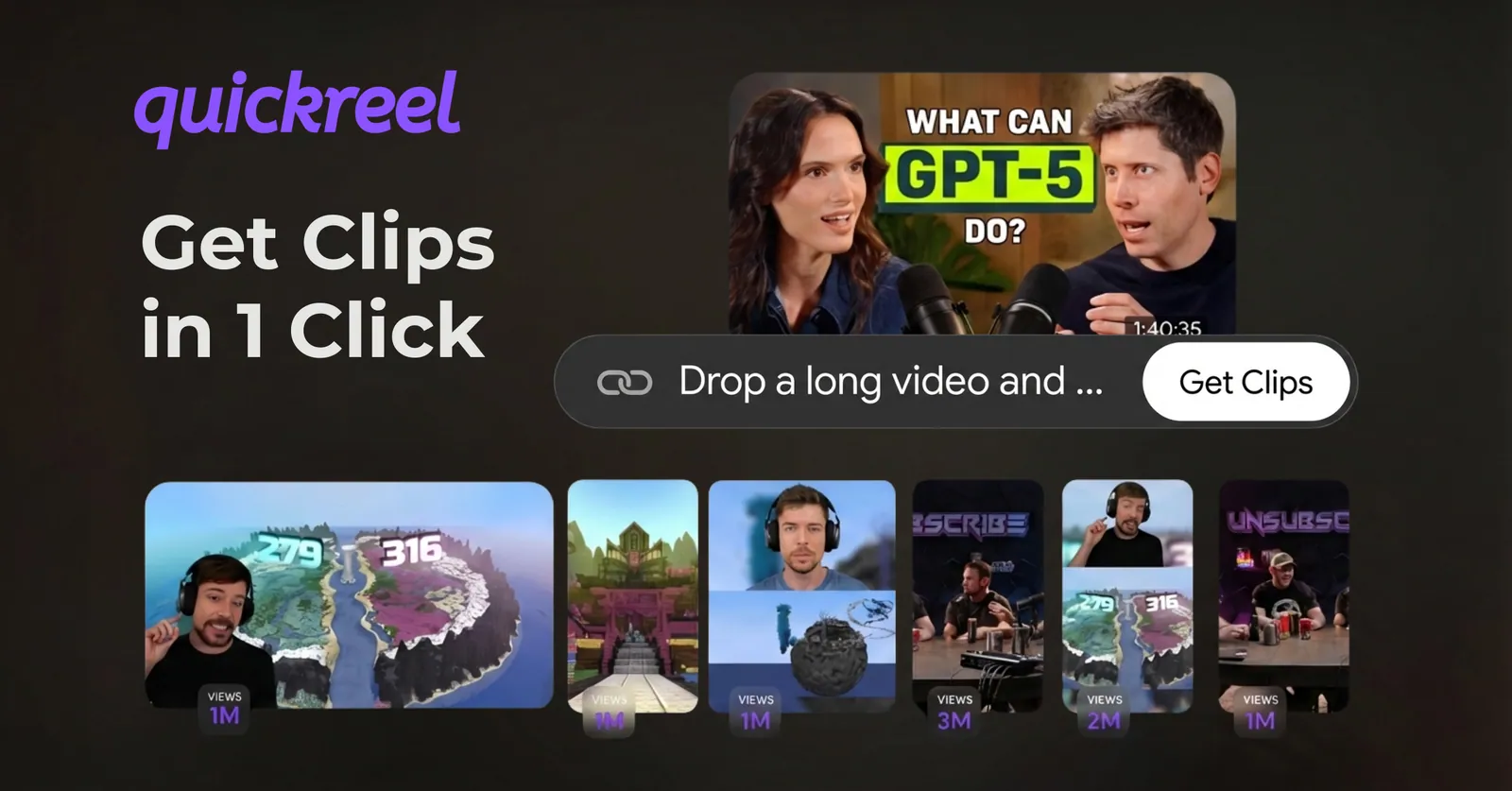
2. QuickReel, paste the URL, then edit, bulk-export, and schedule
Full disclosure: this is us, and I scored it against the same rubric skeptically. QuickReel takes a YouTube link on every paid tier (quickreel.io) and detects the same caliber of moments as the top tier. Its edge for URL work is what happens after import: the editable timeline lets you trim, reframe, and fix captions, and you can bulk-export a batch and schedule it across platforms from one place, rather than exporting one clip at a time into a separate scheduler. Pricing runs $9 Starter (100 credits) → $29 Pro at ~$17.40 billed annually (250 credits) → Pro+ and Ultimate for volume (quickreel.io), with credits billed by plan rather than by raw source length.
Where it's not the answer: if you want a pure ranked shortlist with a confidence number and zero touching, Opus Clip's virality score and hands-off flow are cleaner. QuickReel assumes you'll spend a minute or two per clip in the editor, that's the trade for control. And like every tool here, it still needs a human review pass. Running our own clip-quality benchmarks across these tools, I find roughly a quarter to two-fifths of auto-clips need a trim or a reframe before posting (QuickReel internal benchmark, June 2026), budget for it whichever tool you pick.
3. Vizard, transcript-first URL clipping for teams
Vizard is the pick when a team clips a backlog of long uploads and prefers editing by transcript, highlight the text, get the clip. It takes a link not just from YouTube but from Twitch, Zoom, and Google Drive too (vizard.ai), so it's the most flexible on where the source lives. Credits are 1 per upload minute, and the Creator plan is ~$16.90/mo billed annually for 600 credits (about 10 hours of source) (vizard.ai); batch workflows and team seats are on Business.
The catch is the billing unit. Because credits are charged on the source length you feed in, before a single clip is cut, feeding in untrimmed two-hour streams burns credits fast. Trimming the source before import is the lever that controls the bill.
Best for: teams clipping a backlog who think in transcripts and pull from more than just YouTube.
4. 2Short, the cheapest native-URL option
2Short is the budget-first native-URL pick. Paste a YouTube link and it scans the video's captions to find high-engagement moments, then exports with animated subtitles and no watermark even on lower tiers (2short.ai). Lite is $9.90/mo, Pro $19.90, Premium $49.90 (2short.ai), the lowest entry price here for a tool whose whole job is clipping from a link.
The real constraint is its dependency: 2Short leans on the source video's captions to find moments, so it works best on spoken-word content YouTube has auto-captioned (most podcasts and talks qualify). On a music-heavy or sparsely-captioned source, detection suffers. The free Starter is tight on analysis minutes, so treat it as a trial, not a workflow.
Best for: creators on a budget clipping well-captioned talking-head videos straight from a link.
5. Submagic, best captions, but URL clipping costs extra
Submagic earns its reputation on captions, they're widely rated the cleanest in the category, and the Starter plan is $19/mo, or $12/member/mo billed yearly (submagic.co). It does take a YouTube link and turn it into clips. The honest caveat: that feature, Magic Clips, is a paid add-on at +$19/month (or +$12/member/month billed yearly) on top of any plan (submagic.co). So a Starter plan plus Magic Clips is ~$38/mo at monthly billing before your first bulk batch, reasonable if captions are the whole point, expensive if URL clipping is the job.
Best for: creators whose first priority is caption quality and who clip occasionally enough that the add-on pays off.
How I evaluated these
I scored each tool on four things specific to clipping from a URL, not on a generic feature checklist:
- Import path, does it paste-and-download any link, only auto-import your own channel, or force a file upload? (Verified against each tool's docs and pricing page, June 2026.)
- Source-length cap, the longest single video the free and entry tiers will ingest from a link.
- Billing unit, per source-minute fed in, or per plan, since that decides the real cost at podcast volume.
- What happens after import, auto-only, or can you edit, reframe, and fix captions before export.
I did not score on detection accuracy alone, because on clean spoken-word sources the tools' shortlists overlap heavily, the category's own reviewers put the agreement at roughly 80% of moments (Choppity, 2026). Prices and limits move; re-check each pricing page before you commit. For a wider field of clippers tested on detection and output, see the best AI podcast clip generators, tested.
Frequently asked questions
Can I clip any YouTube video by pasting its URL? Technically most of these tools will download and clip any public link. Legally, you should only clip videos you own or have written permission to use. Pasting a stranger's link, clipping it, and re-uploading the clips can be copyright infringement, and the responsibility is yours, not the tool's (Opus Clip compliance, 2026).
Is pasting a URL faster than uploading the file? Yes, meaningfully. Native paste-and-download fetches the video server-side, so clipping starts in seconds. File-only tools add two steps, downloading the MP4 from YouTube and re-uploading it, which on a 60-minute source is a full upload of the whole file before clipping even begins.
What's the difference between channel auto-import and pasting a link? Auto-import connects your YouTube account and automatically pulls your own new public videos (Opus Clip's, for example, only catches videos over three minutes uploaded after setup, Opus help, 2026). Pasting a link is manual and works on any URL, but the rights responsibility is on you. Auto-import is your-videos-only by design.
Do any of these clip a YouTube URL for free? Yes, Opus Clip, Vizard, QuickReel, and 2Short all have free tiers that accept a link, though most watermark exports or cap the source length. Submagic's free tier caps clips at about 90 seconds, so it's a caption preview rather than a podcast clipper (submagic.co).
Do AI clips from a URL post automatically without editing? They can, but you shouldn't. Every AI clipper here still needs a human pass, in our own benchmarks, roughly a quarter to two-fifths of auto-clips need a trim, a reframe, or a caption fix before posting (QuickReel internal benchmark, June 2026). Virality without a review pass is empty engagement, and views are not subscribers.