
Best Podcast-to-Shorts Tools, Ranked (Audio-First)

The best podcast-to-shorts tool depends on what your source looks like. Record full video with a camera per guest, and a face-tracking clipper like Opus Clip wins. Record audio-only or sit still in one static shot, and those tools have nothing to track, a visual-builder like Headliner, Wavve, or QuickReel makes better shorts.
So this ranking is split by source type, not by a single "winner." Most clipping tools were built for the dynamic-video case, multiple people, movement, a camera that cuts. Run an audio-only episode through them and you get a static talking-head crop or, worse, a tool that refuses the file. The audio-first path is the one nobody tests, so it's the one we tested.
The quick verdict by source type
- Audio-only podcast? Start with a visual-builder. Headliner has a real free tier (5 videos/month) and is the lowest-risk way to make an audiogram-style short. QuickReel is the better pick if you want auto-picked moments, captions, and scheduling in one place.
- Static-camera video podcast? QuickReel or Opus Clip. Both pull moments and add captions; a fixed crop is fine when one person is on screen. QuickReel's $9 Starter is the cheaper entry; Opus has the larger track record.
- Dynamic, multi-camera video podcast? Opus Clip for its speaker tracking and virality score; Vizard as a close, cheaper alternative.
- Avoid: running an audio-only file through a clipper that needs a face to reframe, you'll get a blank crop or a rejected upload.
Comparison table (verified June 2026)
Prices are monthly billing unless noted; annual is cheaper for most. "Audio-first fit" is our read on how the tool handles audio-only or static-camera input, not its overall quality.
| Tool | Entry paid price (monthly) | Audio-first fit |
|---|---|---|
| Headliner | Free tier; paid from ~$10/mo | Strong, built for audiograms |
| Wavve | Free trial; Starter $7.99/mo (70 upload min) | Strong, audiogram specialist |
| QuickReel | $9 Starter (100 credits) | Strong, captions + scheduling |
| Opus Clip | $15 Starter (150 min) | Fair, needs a video frame |
| Vizard | $29 Creator (~$14.50 annual) | Fair, video-feed clipper |
| Descript | $24 Hobbyist (~$16 annual) | Good, full editor, more work |
| Klap | $29 Starter (1 free clip) | Fair, video-feed clipper |
Sources: Opus Clip pricing, Vizard pricing, Descript pricing, Klap pricing, Headliner pricing, Wavve pricing, QuickReel pricing, all verified June 2026. SaaS prices move, re-check before you buy.
Why audio-first breaks most clippers
The dominant clipping tools, Opus Clip, Vizard, Klap, were built around a video feed. Their headline feature is auto-reframing: they detect who is speaking and crop the 16:9 frame to that face for a 9:16 short. On a two-camera interview with movement, that's genuinely useful. On an audio-only episode there is no face to find, and on a static single-shot there is nothing to reframe, the "smart crop" just returns the same fixed rectangle you started with.
Reviewers who test these head-to-head keep coming back to workflow. The comparison house Choppity rates moment-detection quality as wildly uneven across tools, then argues the bigger lever is how many clicks sit between your source and a posted clip. For audio-first creators, a question sits even earlier: can the tool make a watchable short at all when there's no dynamic video to lean on?
That's where visual-builders earn their place. Instead of cropping an existing frame, they build one: a waveform, a background, the episode artwork, a progress bar, and, the part that matters most, burned-in captions. Publishers told Digiday in 2016 that 85% of Facebook video views happened with the sound off (publisher-reported, pre-2017, so treat it as directional rather than current). Even discounted, that's the reason captions decide whether an audio short is legible. A clean audiogram with accurate, animated captions outperforms a static face crop with no text, every time.

The seven, reviewed honestly
1. Headliner, best free audiogram maker for audio-only shows
Headliner is the closest thing to a default for turning audio into a social clip. You drop in audio, it transcribes, you add a waveform and captions, and you export a vertical or square audiogram. The free tier covers five videos a month, which is enough for a weekly show to test the format before paying.
Cons: the free tier caps transcription, so a long episode eats the monthly allowance fast, and third-party write-ups disagree on the exact minute and video limits, so check Headliner's pricing page before you build a workflow around any specific number. It also won't auto-pick your best moments; you choose the timestamps yourself. Best for: audio-only hosts who want a free, low-commitment way to publish audiograms.
2. Wavve, the audiogram specialist
Wavve does one job and does it cleanly: audio plus a designed template equals a branded clip with captions. It detects engaging segments, styles captions, and resizes for each platform. If audiograms are your whole strategy, the dedicated tool tends to give more design control than a general clipper.
Cons: there's a free trial but no real free tier any more, the watermark-free start is the $7.99/mo Starter (70 upload minutes), so you pay almost immediately. Pricing scales by upload minutes, and the jump from Starter to the $19.99/mo Pro (210 minutes) is where volume gets pricey. Best for: creators whose plan is "audiograms, consistently," and who'll pay for design polish.
3. QuickReel, best all-in-one for audio-first and static-camera shows
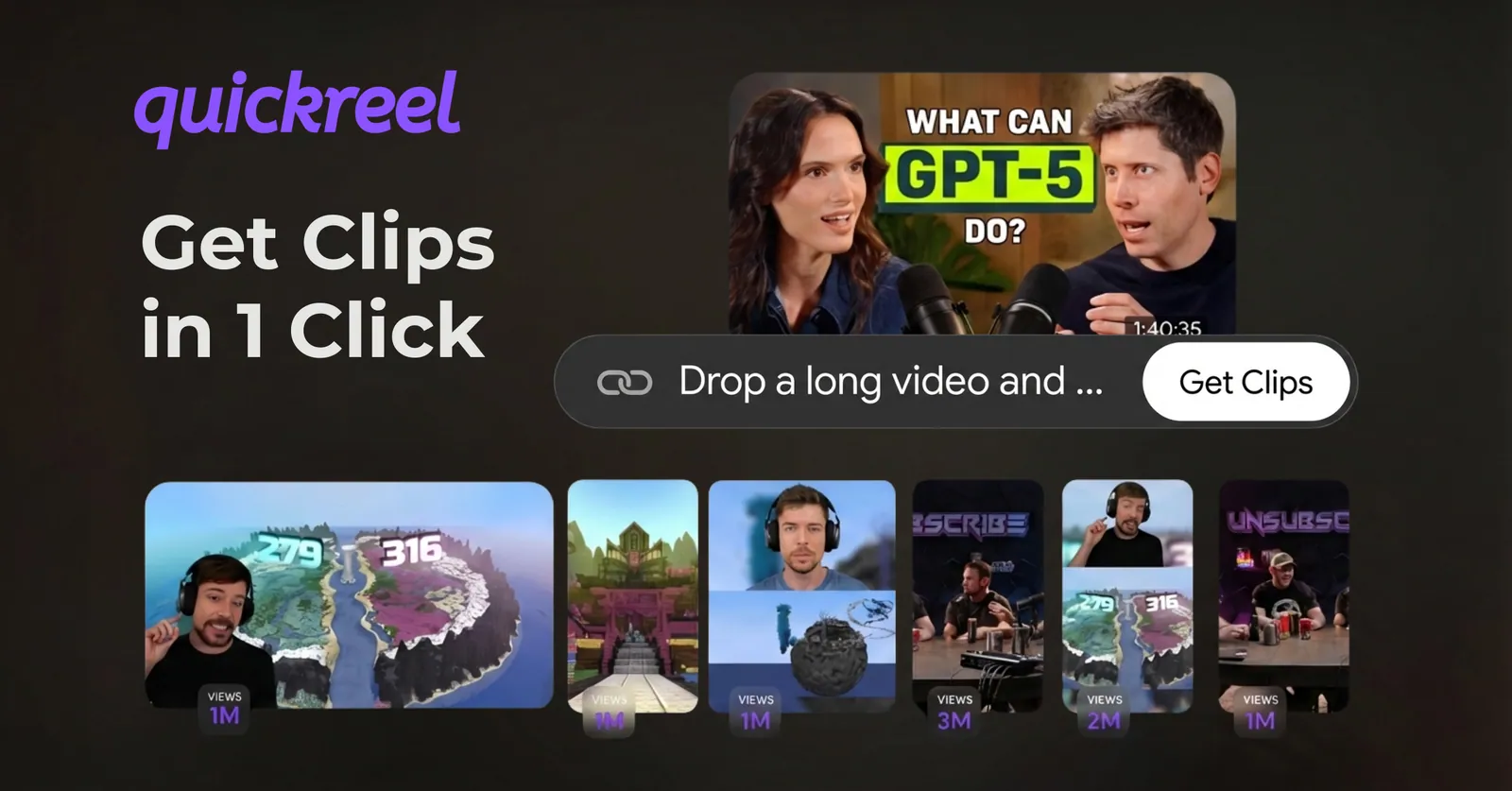
QuickReel sits in the gap most tools leave open: it auto-picks moments and adds captions like a clipper, but it builds a watchable visual for audio-only and static-camera sources instead of demanding a dynamic feed. Paste a YouTube link or upload an episode and it returns captioned vertical clips with 12+ caption styles, support for 20+ languages, and a scheduler that posts to up to 30 destinations, useful if a single episode feeds Shorts, Reels, and TikTok.
Cons: like every AI clipper, the moment-picking is a strong first draft, not a final cut, in our own editing we re-cut or rewrite captions on a meaningful share of the AI's picks before posting, the same honesty that applies to Opus and Vizard. It's also browser-based, so heavy local-file editors may miss a desktop app. Best for: audio-first and static-camera hosts who want picks, captions, and distribution without stitching three tools together.
4. Opus Clip, best for dynamic, multi-camera video podcasts
Opus Clip is the category leader for a reason: speaker-tracking auto-reframe, a virality score that ranks clip candidates, and the deepest track record in AI clipping. On a real video podcast, two or more cameras, movement, cuts, its reframing is the best in this group. The free tier gives 60 processing minutes a month, though exports are watermarked and clips vanish from storage after three days; Starter is $15/mo for 150 minutes, Pro $29/mo for 300.
Cons: the strengths assume a video feed. On audio-only input there's nothing to track, and on a static single-shot the smart-crop adds little over a manual crop. The three-day storage purge on free, and the fact that cancelling deletes projects within three days, both catch people out. Best for: video-first shows with camera movement. For audio-first, it's a fair option, not the right one. See our Opus Clip alternatives and the QuickReel vs Opus Clip breakdown for the head-to-head.
5. Vizard, the cheaper video-feed clipper
Vizard is the value pick among the face-tracking tools. It clips, captions, and reframes, with a credit system where one credit equals one upload minute. Annual billing drops Creator to about $14.50/mo, which undercuts Opus on price for similar core features. The free tier gives 60 credits a month.
Cons: monthly billing nearly doubles to $29 for Creator, so the headline price assumes you commit for a year. Like Opus, it's built for a video feed, strong on dynamic input, unremarkable on audio-only. Best for: video podcasters who want Opus-style clipping at a lower annual price. We test it against the field in our AI podcast clip generators roundup.
6. Descript, best if you want to edit, not just clip
Descript is a full audio-and-video editor with clipping bolted on, not a clipper with editing bolted on. You edit by editing the transcript, delete a word, the audio goes with it, which makes it excellent for tightening rambling segments before you cut them into shorts. For audio-first shows that need real cleanup (filler removal, Studio Sound), it does more than any pure clipper here.
Cons: it's the most hands-on tool in this list, so "fast podcast-to-shorts" is not its strength, you're driving an editor. Pricing starts at $24/mo monthly (Hobbyist, $16 annual) for watermark-free export, and the September 2025 shift to "media minutes" plus metered AI credits makes real costs harder to predict. Best for: hosts who want to edit and clean the audio, not just slice clips. See descript alternatives for clipping if speed matters more than editing depth.
7. Klap, capable, but priced for video volume
Klap turns long videos into vertical clips with captions and a brand kit, and its output quality is competitive with the other face-tracking tools. It's a reasonable clipper if you're already shooting video.
Cons: it's the steepest entry here for what you get, Starter is $29/mo ($23 annual) after a single free trial clip, with Pro at $79/mo, so the free path barely exists. And like the rest of the video-feed group, it has no special handling for audio-only input. Best for: video creators who'll use the higher-volume tiers; a hard sell for audio-first hosts on a budget.
How we evaluated
This is an editorial ranking, not a lab benchmark. The lens was deliberately narrow: the audio-first path, because every general roundup already covers the video-first case.
- Source-type fit (the differentiator). We judged each tool by whether it produces a watchable short from audio-only and static-camera input, not just dynamic video. That single axis reorders the usual list.
- What "good" means at mute. Caption presence and accuracy weighed heavily, because muted viewing is the default on social feeds (Digiday's 2016 publisher data put muted Facebook video at 85%), and an audio short with no on-screen text dies in the feed.
- Verified pricing. Every price was checked against each tool's own pricing page in June 2026 and cited inline. SaaS prices move; re-verify before you buy.
- Honest limits. No tool here is set-and-forget. In our own editing, a meaningful share of every tool's AI picks get re-cut or re-captioned before posting, we applied that standard to QuickReel as plainly as to the rest.
Who tested: this ranking was assembled by QuickReel's short-form team, which ships podcast clips daily. We have a stake in one of these tools and say so, the pricing and feature claims above are verifiable on each vendor's site, and we've named real cons for QuickReel alongside everyone else.
Who should pick what
Match the tool to your recording setup, in one line each:
- Audio-only, testing the format, zero budget: Headliner's free tier.
- Audio-only, audiograms as a core strategy: Wavve for design control, QuickReel for picks + captions + scheduling.
- Static-camera video podcast, want one tool: QuickReel ($9 entry) or Opus Clip.
- Dynamic multi-camera video podcast: Opus Clip, or Vizard for a lower annual price.
- You need to clean and edit the audio first: Descript.
If you're cross-shopping the broader market, our best AI podcast clip generators test, best free podcast clip tools, and best auto-captioning tools cover adjacent angles in more depth.
FAQ
What's the best podcast-to-shorts tool for audio-only podcasts?
For audio-only shows, a visual-builder beats a face-tracking clipper. Headliner's free tier (5 videos/month, per its pricing page) is the lowest-risk start. QuickReel is the better pick if you also want auto-selected moments, captions in 20+ languages, and scheduling in one place rather than across separate tools.
Can Opus Clip make shorts from an audio-only podcast?
Not well. Opus Clip's headline feature is speaker-tracking auto-reframe, which needs a face in the video to crop to. On audio-only input there's nothing to track, so you'd get a static result with no visual advantage over a dedicated audiogram tool. Opus is the right tool for dynamic, multi-camera video, not audio-first shows.
Do I need captions on a podcast short?
Yes. Publishers reported 85% of Facebook video views happening on mute (Digiday, 2016, publisher-reported and pre-2017, so directional), so a clip with no on-screen text is effectively silent to most of the feed. For audio-first shorts especially, accurate burned-in captions are the difference between a watchable clip and a dead one.
Is there a genuinely free way to turn a podcast into shorts?
Yes, with limits. Headliner (5 videos/month), Opus Clip (60 minutes/month, watermarked, 3-day storage), and Vizard (60 credits/month) all have real free tiers as of June 2026. QuickReel's free signup lets you export a handful of captioned clips before you hit the $9 Starter plan. Read the caps before committing, free tiers cover testing, not a full publishing schedule.
Will an AI clipper pick the right moments on its own?
Treat the picks as a strong first draft. Detection quality varies more than vendors admit, Choppity rates it from excellent to poor depending on the tool. In our own editing, a meaningful share of every tool's picks get re-cut or re-captioned. The tool saves you the scrubbing; you still choose, trim, and fix captions before posting.