
Education Podcasts That Actually Teach in Audio

The best education podcasts to learn from are built like a class, not a lecture: one concept per episode, a recap that makes the idea stick, and show notes you can study after. Six pass that test, Stuff You Should Know, Hidden Brain, Freakonomics Radio, Huberman Lab, Radiolab, and Hardcore History. Pick by how you want to learn.
Most "best educational podcasts" lists rank shows by fame and add a sentence of praise. That tells you what's popular, not what actually teaches. Audio is a hard medium to learn in, you can't reread a paragraph, you can't see a diagram, and you're usually doing something else while you listen. So this page judges each show on instructional design: how well it teaches given that it's only sound in your ears. The shows that do it well share three habits, and you can use those same three habits to vet any learning podcast yourself.
What makes a podcast genuinely good for learning?
A podcast teaches well in audio when it does three things: keeps each episode to one concept you can hold in your head, scaffolds that concept with a recap or quiz so it survives the walk home, and structures the catalog so you know whether to listen in order or jump in anywhere. Length and production matter less than those three. A show can sound beautiful and teach you nothing.
Think about the constraint honestly. Reading lets you skim, reread, and pause on a hard sentence. Audio gives you none of that, it moves at the host's pace, fades while you parse a tunnel of traffic, and is gone. Education researchers have a name for the bottleneck: working memory holds only a few items at once, and audio loads them in a single, unstoppable stream. A well-designed learning podcast respects that limit. A badly designed one floods it and calls the result "depth."
There is one honest caveat up front, especially for language learners. Listening alone does not produce skill. You learn from a podcast when you do something with what you heard, write the takeaway, explain it to someone, test it. Passive listening builds familiarity, not competence. Treat every show below as a class with homework, not a soundtrack.

The best education podcasts to learn from, by how you learn
Here is the shortlist before the detail. Each show wins for a different learning job, and each gets a starter episode in the sections below.
| Show | Best for | The structure it teaches |
|---|---|---|
| Stuff You Should Know | Broad curiosity, a new topic twice a week | Standalone, one topic per episode |
| Hidden Brain | Understanding your own behavior | Standalone, one idea + a follow-up segment |
| Freakonomics Radio | Thinking with data and incentives | Mostly standalone, occasional multi-part series |
| Huberman Lab | Actionable science with protocols | Standalone full-length episodes plus short "Essentials" |
| Radiolab | Hard ideas made felt, not just understood | Standalone, narrative and sound-driven |
| Hardcore History | Going genuinely deep on one era | Long serialized series |
Stuff You Should Know, the standalone done right
For broad learning with the lowest commitment, Stuff You Should Know is the default. Josh Clark and Chuck Bryant pick one topic, how a credit score works, why we hiccup, the history of the lobotomy, and explain it twice a week, each episode self-contained. The show has run past 2,100 main episodes since 2008 and ships two new full episodes most weeks, plus shorter "Short Stuff" extras (Stuff You Should Know; Wikipedia).
The instructional design lesson here is the one-concept rule, executed at scale. You never need prior episodes. You can name what you learned in a sentence. And when a topic is too small to fill a full episode, they spin it into a shorter "Short Stuff" episode instead of padding, a quiet discipline most shows lack. Start anywhere; that is the point.
Hidden Brain, one idea, scaffolded
To understand why people, including you, behave the way they do, start with Hidden Brain. Shankar Vedantam built the show around a single behavioral-science idea per episode, negativity bias, information aversion, the psychology of disgust, explored with one researcher and grounded in real studies (Hidden Brain). Episodes run roughly 30 minutes to an hour, the right length for a commute.
This is the recap-and-quiz scaffold done unusually well. Modern episodes pair the core idea with a "Your Questions Answered" segment, where a psychologist returns to respond to listener questions about a previous episode. That callback is, functionally, a spaced repetition: the idea you heard last week resurfaces, gets re-explained, and sticks. The producers are explicit that the goal is to give you something to apply at work and at home, not just to entertain. Start with any recent episode whose title names a behavior you recognize in yourself.
Freakonomics Radio, teaching a way of thinking
Freakonomics Radio teaches a transferable mental model: look at the incentives and the data underneath everyday things. Stephen Dubner has hosted since 2010, and the archive runs past 600 weekly episodes asking questions like why it's safer to fly than drive, or what a suburban tree is actually worth (Freakonomics). The show anchors a whole network, No Stupid Questions, People I (Mostly) Admire, The Economics of Everyday Things, which is itself a teaching structure: pick the depth you want.
What you are learning is not a topic but a method. After a dozen episodes you start asking "what's the incentive here?" about your own life, which is the mark of real education, when the framework outlives the facts. Freakonomics also runs occasional multi-part series on a single theme, so it sits between the standalone and serialized models. Try a standalone first; graduate to a series when one grips you.
Huberman Lab, the show-notes layer as the real classroom
For science you can act on, Huberman Lab is the clearest example of show notes as a genuine learning layer. Dr. Andrew Huberman publishes detailed notes for every episode, timestamps, the specific "Tool" and "Protocol" segments flagged in order, and links to the peer-reviewed papers referenced (Huberman Lab: show notes FAQ). Full episodes run long, often well over 90 minutes, so the show also publishes shorter "Essentials" episodes distilling the protocols from a past full-length episode.
This is the model to copy if you want listeners to actually retain something. The audio gives you the why; the show notes give you the what-to-do and the where-to-verify. A listener can hear a sleep protocol, then open the notes to find the exact steps and the studies behind them. One honest flag for any health show: protocols are not prescriptions, and a popular podcast is a starting point for questions, not a substitute for a clinician. Use the notes to check claims, not to self-diagnose.
Radiolab, making a hard idea felt
Radiolab teaches through feeling, not explanation. Jad Abumrad and Robert Krulwich built the show to make big, slippery topics, time, morality, blame, felt through sound design and story, so the idea lands before you can analyze it (Radiolab). Episodes typically run from the mid-40-minute range up to an hour and lean on layered audio that competitors still imitate.
The instructional payoff is emotional encoding: you remember the episode about a concept because the production made you feel the stakes, and the feeling is the hook the idea hangs on. That is real teaching, not decoration, emotion is one of the strongest aids to memory. The tradeoff to know going in: Radiolab is the least "give me the steps" show on this list. Come for understanding and wonder, not for a checklist. For the takeaway, you'll have to articulate it yourself afterward, which, conveniently, is exactly the homework that makes it stick.
Hardcore History, serialized depth, and its honest cost
When you want to go deep on one era, Dan Carlin's Hardcore History is the standard. Carlin rejects the weekly-episode treadmill entirely: he releases a new installment roughly every few months, each running three to four-plus hours, and frequently builds multi-part series. His World War I series, "Blueprint for Armageddon," spans six episodes and about 23 hours total, with individual parts running from roughly three hours to nearly four and a half (Dan Carlin, Blueprint for Armageddon I).
This is the serialized model in its purest form, and it teaches like an audiobook course. The cost is real and worth naming: there is no quick recap, no twice-a-week cadence, and the back catalog is small precisely because each episode takes months. If your learning style needs frequent, bite-sized wins, this will frustrate you. If you want to actually understand how a war started and reshaped the world, nothing in audio rewards the patience more. Start "Blueprint for Armageddon" and clear a few weekends.
What they have in common (the part you can copy)
Strip away the genres and the six shows share three traits that map exactly to the test at the top. Naming them is the useful part, because these are the traits to look for, or to build, if you make your own content.
- One concept per episode, even inside a long one. Stuff You Should Know does it per topic; Hardcore History does it per installment. Even a four-hour episode holds a single throughline. The shows that flood you with five loosely related ideas are the ones you forget by lunch.
- A scaffold that repeats the core point. Hidden Brain's follow-up segment, Huberman's "Essentials" recap episodes, Radiolab's narrative callbacks, each one re-exposes the idea so it survives. Repetition is not filler when it's structured; it's how memory works.
- A show-notes layer that turns listening into studying. Huberman's timestamped notes and linked papers are the clearest case, but every show on this list publishes notes you can return to. The audio is the lecture; the notes are the textbook. Shows that ship a one-line description treat the episode as disposable.
The episode-length data shows there is no single "right" length for learning, only a right structure. These shows span from under fifteen minutes to over three hours and all teach well, because each matches its length to its job.
Series vs standalone: which structure should you pick?
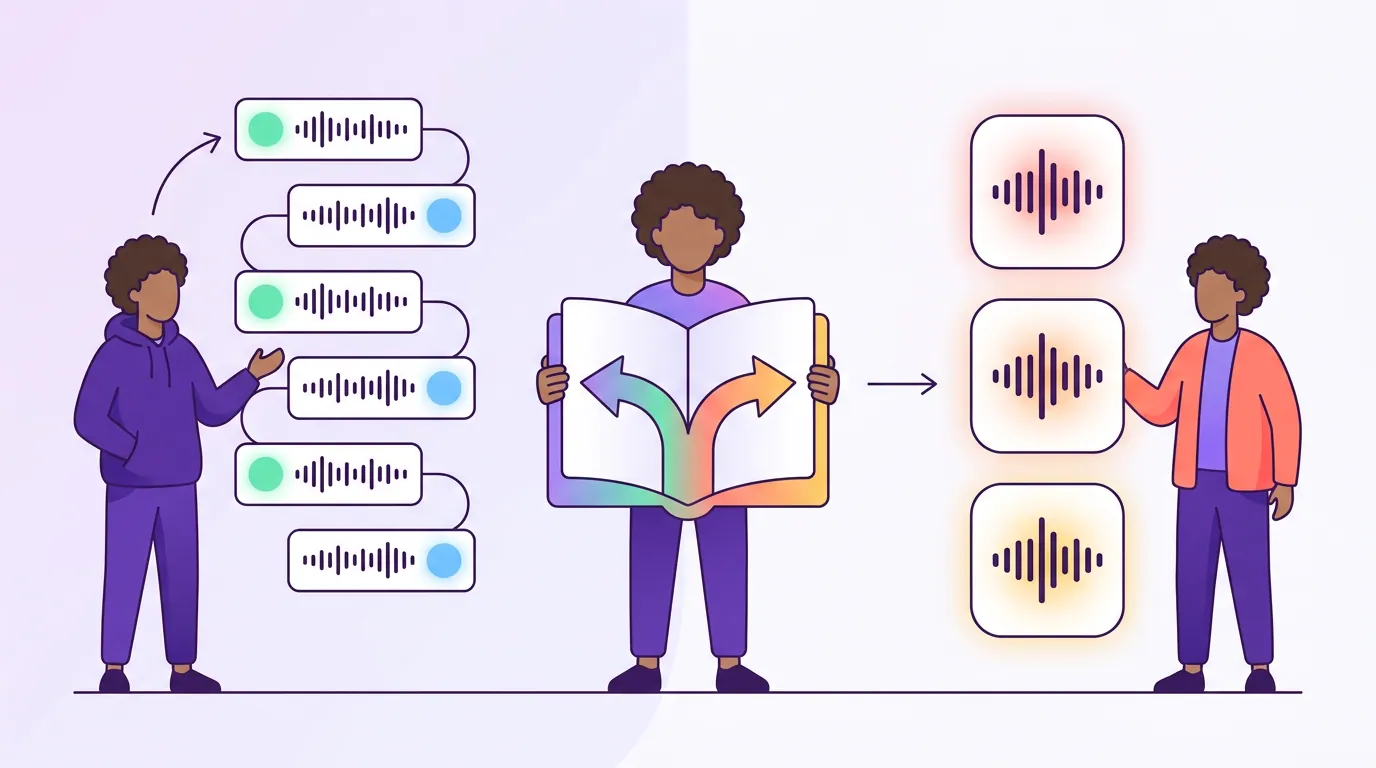
Pick standalone shows when you want breadth and flexibility, and series-based shows when you want one subject all the way down. Standalone episodes, Stuff You Should Know, Hidden Brain, let you drop in anywhere and learn something complete in under an hour. Serialized shows like Hardcore History reward listening in order and ask for hours, but build understanding nothing else matches. Neither is better; they teach different things.
The practical rule: start with standalone shows to find what you care about, then go serialized on the one subject that grabbed you. Breadth first, depth second. A daily news podcast such as The New York Times' The Daily, about 20 minutes, six days a week (Wikipedia: The Daily)), is the extreme standalone case: tiny, frequent, self-contained. Hardcore History is the opposite pole. Most learning lives between them, and you want a few of each in rotation.
For more on how the structural habits of top shows translate across genres, our breakdowns of business podcasts worth studying as a new host and finance podcasts that teach hosts to explain money pull apart the same teaching mechanics in adjacent niches.
How we chose these shows
This is an editorial pick with stated criteria. We required each show to (1) keep a clear single concept per episode, (2) include a recap, callback, or distilled-summary mechanism that helps retention, and (3) publish a show-notes layer you can study after listening, then we checked each show's format, host, and cadence against its own publisher and platform pages. We deliberately left off shows that are entertaining but teach nothing testable, and "educational" feeds that are really one long unstructured ramble.
A note on what we did not do: this is not a popularity ranking, and it is not a scraped directory. The factual details, host, episode counts, release dates, live on entity pages like those on fanpage.wiki. The analysis of why each one teaches well in audio lives here. For how curation habits differ by market, see our look at the production habits behind the top US podcasts and why the UK top ten looks nothing like the US. The same instructional lens applies to entertainment genres too, see what the best true crime hosts do differently and the comedy podcasts new hosts should steal from.
FAQ
What is the single best education podcast for a beginner? Stuff You Should Know. The episodes are self-contained, each covers one topic you can name afterward, and a twice-weekly cadence means you always have something new without a backlog. Start with any title that sparks a "wait, how does that actually work?" and go from there.
Do education podcasts actually help adults learn, or is it passive? They help only if you make them active. Listening builds familiarity; doing something with what you heard builds skill. Write one takeaway per episode, explain it to someone, or test it that week. Without that step, even the best-designed show is background noise.
Can a podcast replace a course? For exposure and motivation, often yes; for skill, rarely on its own. Audio is excellent at sparking interest and building a mental model, but it can't check your work or force you to practice. Use podcasts to find what you want to learn, then add a structured source, a book, a course, or hands-on practice, for the actual skill.
Are longer episodes better for learning? No. Length should match the job, not signal seriousness. A 30-minute Hidden Brain episode with a single idea and a recap can teach more durably than a rambling three-hour one. Long episodes only earn their length when they serialize a deep subject and stay on one throughline, the way Hardcore History does.
How many should I subscribe to at once? Two or three, with different jobs, one short standalone for breadth, one deep show for the subject you care most about. Following ten "educational" feeds guarantees a guilty backlog and shallow listening. Fewer shows, listened to actively, beats a long unfinished queue.