
Comedy Podcasts New Hosts Should Steal From

The comedy podcasts worth studying, SmartLess, Conan O'Brien Needs a Friend, Good Hang with Amy Poehler, Comedy Bang! Bang!, Flagrant, are not funnier than your favorite open mic. They are better engineered. Each one runs on a designed co-host dynamic, a repeatable segment scaffold, and a deliberate balance between scripted setup and live riffing. The jokes are interchangeable. The machine that produces them is the thing to steal.
Most "best comedy podcasts" lists rank shows by downloads and stop there, which tells you nothing you can use. This breaks the top shows down as systems: who plays which role at the mic, what structure they hang the chaos on, and which recurring bit does the heavy lifting. If you are building a funny show, the names are inspiration. The architecture is the lesson.
What do the best comedy podcasts have in common?
The best comedy podcasts share three things: more than one voice in the room, a recurring structure listeners can anticipate, and a host who lets the planned bit get hijacked. Comedy on a feed is not about delivering jokes, it is about manufacturing the unplanned reaction. Almost every show that travels is built to make that reaction happen on purpose.
Start with the demand. Comedy is the #1 US podcast genre by weekly audience, ahead of news, society and culture, true crime, and sports (Edison Research, via Statista). That is the most crowded room in podcasting, which means "be funny" is not a strategy, everyone in the room is trying that. The shows that win design a format that produces funny reliably, episode after episode, instead of waiting for it.

The three-role chemistry engine
Comedy chemistry is not magic; it is casting. The shows that work assign three jobs at the mic, an anchor who keeps the conversation moving, a spark who generates premises and bits, and a wildcard who derails on purpose. A show can survive with two of these roles in one person, but the ones that travel keep all three live in the room. When you hear "great chemistry," you are hearing those roles in balance.
Look at the structure of SmartLess (#5 on the Edison Q1 2026 US top 50, per Podnews/Edison). Jason Bateman is the dry anchor, Sean Hayes the cheerful spark, Will Arnett the chaotic wildcard, and the show's own framing leans on those contrasting personalities (Wikipedia). The roles are stable; the guest changes. That stability is why a new listener knows what they are getting in episode 300 the same way they did in episode 3.
Conan O'Brien Needs a Friend (#15, per Edison) runs the same engine with a workplace twist. Conan is the spark, his assistant Sona Movsesian is the wildcard who can call him out like no one else, and producer Matt Gourley plays the conscientious anchor. Vulture singled out exactly this "core O'Brien-Movsesian-Gourley workplace dynamic" as the source of the show's "habitual comfort" (Wikipedia). Conan said it plainly himself: he needs people to pick on and people to pick on him. That is the three-role engine described from the inside.
The takeaway for a new host is uncomfortable but cheap to act on: if you and your co-host are both anchors, your show is pleasant and forgettable. If you are both wildcards, it is exhausting. Cast the missing role deliberately, even if that means a third chair or a producer who is allowed to talk. For more on this specific failure mode, see our breakdown of how co-host dynamics make or break a show.
The recurring-segment scaffold
A recurring segment is the second engine, and it is the one new hosts most often skip. A scaffold is a repeated structural beat, a cold-open bit, a mid-show game, a fixed closing, that the audience learns to expect and that gives improvisation somewhere to live. Without it, every episode starts from zero. With it, the show has a shape even on a flat day, and the segment itself becomes the thing people quote.
The strongest example is the surprise-guest mechanic on SmartLess: one host books a mystery guest and the other two have to guess who is coming, unprepared, on the record (Wikipedia). That single recurring rule generates the show's funniest minutes before the guest even says anything, because nobody got to write questions in advance. The scaffold manufactures spontaneity on a schedule.
Conan's show stacks several: a pre-interview segment where Conan mocks Sona's work habits and Gourley's flea-market hobbies, an ad read he brands as "Conan O'Brien Pays Off the Mortgage on His Beach House," and a closing chat largely unrelated to the interview (Wikipedia). The interview is the body; the recurring bits are the spine. Comedy Bang! Bang! is even more rigid underneath the chaos: Scott Aukerman interviews a real guest, then after each ad break a comedian arrives in character and the episode goes off the rails, a structure he has run since the show launched as a radio broadcast in 2009 (The Daily Beast, 2017) and was still running past episode 920 by late 2025 (Earwolf). The format is fixed precisely so the improv has rules to break.
If you are designing this for your own show, start with our guide to building recurring podcast segments that survive past episode ten. The principle: pick one segment, run it every single episode until it is a habit, and only then add a second.
The riff-vs-script balance
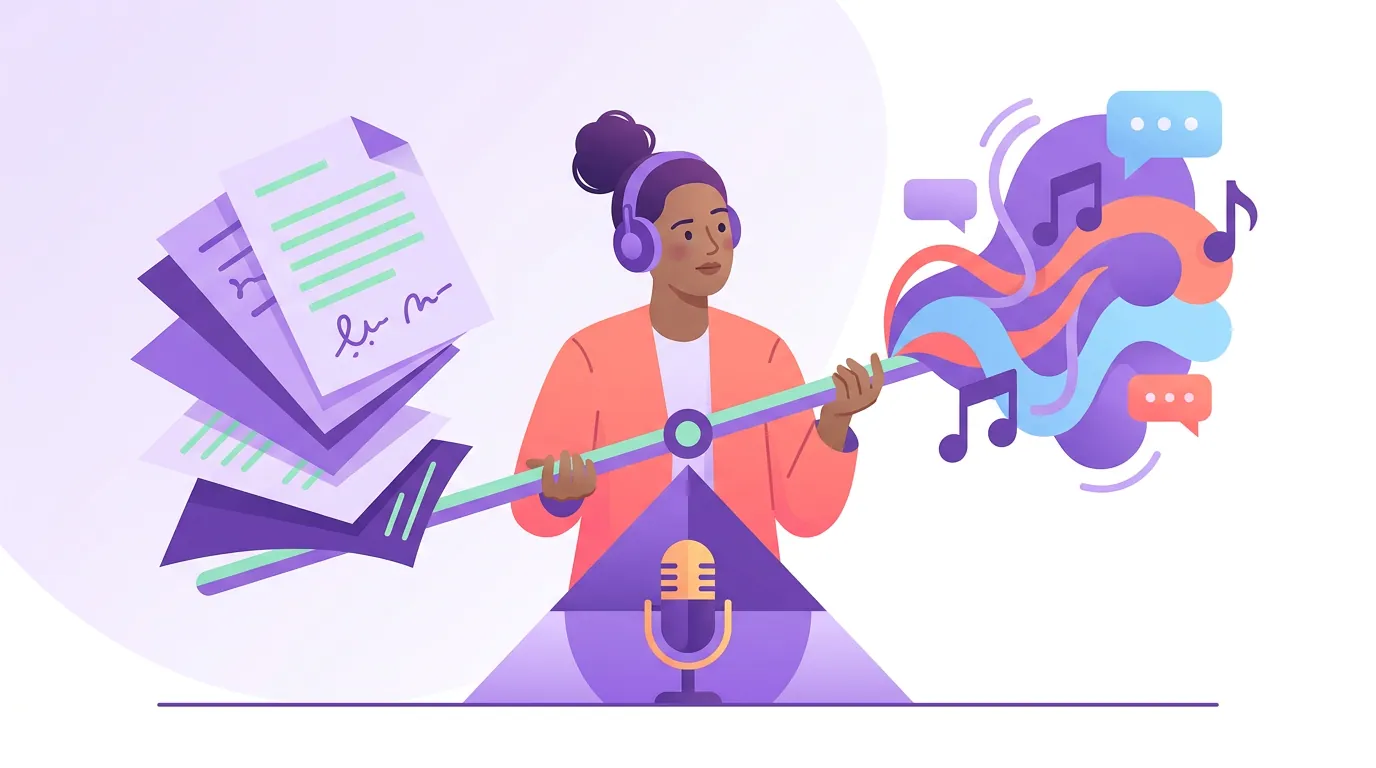
The third engine is how much is written down. The best comedy podcasts are neither fully scripted nor pure free-for-alls, they sit on a deliberate point of a spectrum, with a light scaffold holding loose improvisation. Too scripted and it sounds like sketch comedy read aloud; too loose and it meanders into 90 unbroadcastable minutes. The skill is knowing which beats to lock and which to leave open.
The pattern across the shows that work: structure the entrances and exits, improvise the middle. SmartLess scripts the reveal mechanic and nothing else, the hosts explicitly do not research the guest, so the conversation is off-the-cuff by design (Wikipedia). Good Hang with Amy Poehler (a fast riser at #13 on the Q1 2026 list, up from #38, per Edison) pushes furthest toward the loose end: the show's official description tells you the rule in one line, "This podcast is not about trying to make you better or giving advice. Amy just wants to have a good time" (Good Hang, The Ringer). One weekly guest, "what's been making them laugh" as the through-line, and almost no rules on top of that. What reads as zero structure is really one firm premise with wide freedom inside it.
For a new host with no audience to forgive a dead patch, lean slightly more scripted than your idols. Write the cold open, the segment transitions, and the close. Leave the conversation open. You can loosen the scaffold as your chemistry gets reps in, the famous shows earned their looseness over hundreds of episodes.
The common thread: a clippable recurring bit
Here is the pattern most format guides miss. Across these comedy shows, the recurring segment is almost always the thing that clips, the self-contained, repeatable bit that travels off the feed and pulls new listeners back to it. The scaffold is not just a structure for the episode; it is a structure for distribution.
I read six comedy shows for three things: how many regular voices each keeps at the mic, how many recurring structural beats it runs, and whether it has a recurring bit that reliably clips. Four of the six, SmartLess (#5), Conan O'Brien Needs a Friend (#15), Good Hang (#13), and Call Her Daddy (#4), sit on the Edison Q1 2026 US top 50. Two, Comedy Bang! Bang! and Flagrant, are not on that chart but are studied here as long-running format exemplars (Comedy Bang! Bang! has run the same structure for 16 years; Flagrant is one of the most-clipped panel shows on YouTube). The table below is that cut. Show details are sourced to each show's documented format.
Read the table as a checklist, not a leaderboard. Five of the six keep more than one voice live (Good Hang is the exception, and it compensates with a famous host and a celebrity guest every week, a substitution most new shows cannot make). Every one of them runs a recurring bit that produces a self-contained, postable moment. Flagrant, built by Andrew Schulz around a rotating panel of comedians, has roughly 2 million YouTube subscribers, and its hot-take exchanges clip as cleanly as anything in the genre. The lesson compounds: the segment you build for structure is the same segment that feeds your distribution.
One honest caveat: this is a small, hand-read sample of established shows, not a statistical survey. It tells you what successful comedy formats tend to share, not what guarantees success. Treat it as a design pattern to test, not a law.
How a new comedy show should use this
You cannot borrow Conan's fame, but you can borrow his architecture. Here is the order of operations that the three engines imply:
- Cast the missing role. Decide who is your anchor, spark, and wildcard. If two of you overlap, recruit the third, a co-host, a producer with a mic, a recurring guest.
- Build one recurring segment and run it every episode. A cold-open game, a fixed closing question, a weekly "what's making you laugh" round. One. Make it a habit before adding a second.
- Lock the entrances and exits; improvise the middle. Script the open, the transitions, and the close. Leave the conversation free.
- Design the segment to clip. Give it a name, a fixed shape, and a clean start and end so a 45-second cut makes sense with no context.
- Post the bit, not the episode. Social drives discovery now, 57% of listeners rely on social media for podcast recommendations, edging past the 54% who rely on friends and family, the first time social took the top spot (Coleman Insights & Amplifi Media, "The State of Video Podcasting 2025," n=1,000 US consumers, via InsideRadio).
That last point is where the format work pays off twice. The recurring bit you built to give your episode a spine is also the most clippable thing you make, which is why the comedy shows that grow fastest are usually the ones with the most quotable recurring segment. For the distribution side of this, our companion piece on why the best comedy podcasts travel maps which formats produce which clip types.
For broader patterns, the same casting-and-scaffold logic shows up in serious genres too, see what the best business podcasts do as new hosts study them, what top true crime hosts do differently, and the shared habits behind the top US podcasts.