
The Best Comedy Podcasts and Why They Travel

The best comedy podcasts, SmartLess, This Past Weekend with Theo Von, Bad Friends, Conan O'Brien Needs a Friend, Good Hang with Amy Poehler, all rank inside Edison's US top 50, and they grow for the same reason: their format manufactures a steady supply of clippable moments. The joke is not the asset. The chemistry between people is, because chemistry is what survives being cut into 40 seconds.
You can find a ranked list of funny shows anywhere. This page does the part that helps if you are building one: it sorts the top comedy formats by how they clip, which chemistry setups reliably produce shareable moments, and which look great in a full episode but die the second you try to cut them. Funny is the easy part. Funny that travels is a format choice.
What are the best comedy podcasts right now?
As of Edison's Q4 2025 ranking, the highest-reach US comedy podcasts are The Joe Rogan Experience (#1), Call Her Daddy (#4), SmartLess (#5), This Past Weekend with Theo Von (#8), and Bad Friends (#12), with Conan O'Brien Needs a Friend (#26) and Good Hang with Amy Poehler (#38, its peak) further down (Edison Podcast Metrics via Podnews, Q4 2025). They span solo, duo, and panel formats.
It helps to know why comedy dominates the charts in the first place. Comedy is the #1 podcast genre in the US by audience, ahead of news, society and culture, and true crime (Edison Research / Statista). It is also the format people most want as company, which is exactly why the people matter more than the material.
Why do comedy podcasts travel so well?
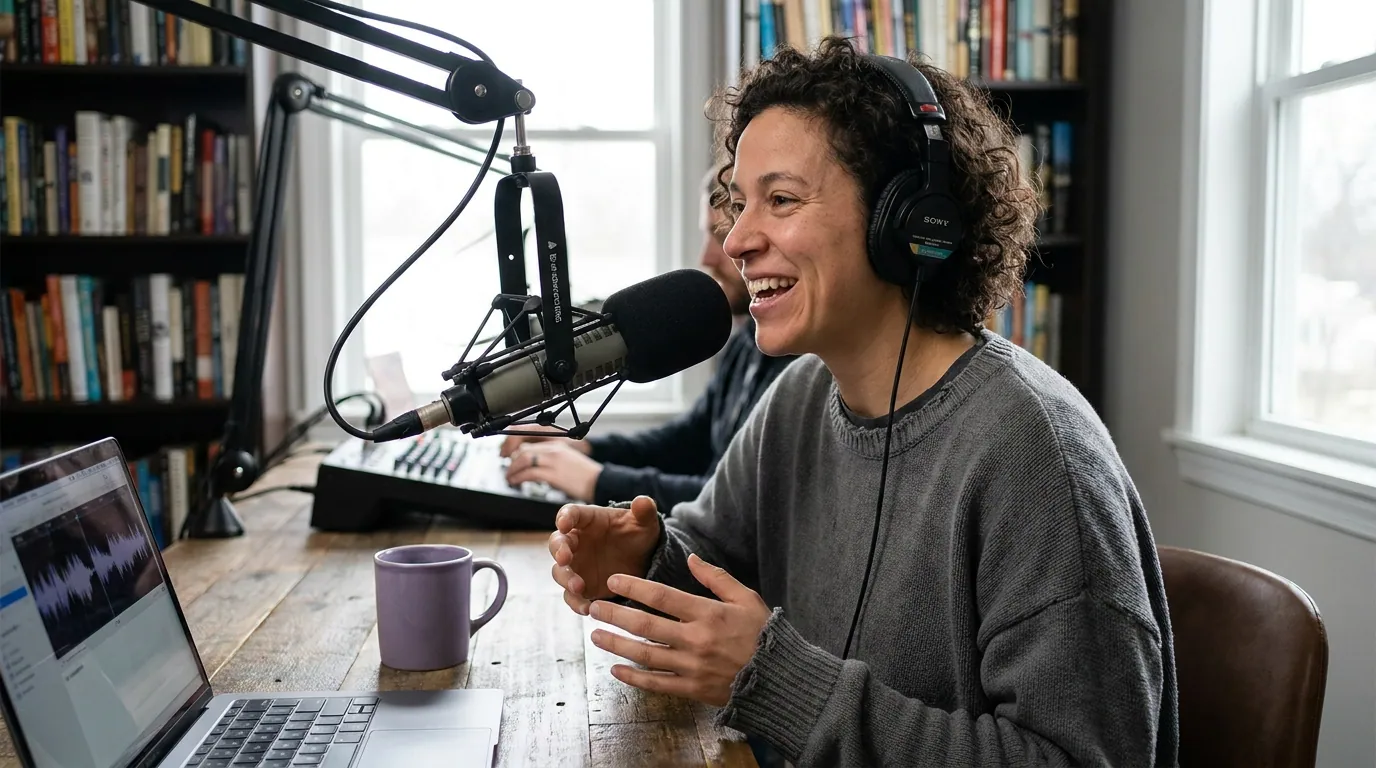
Comedy travels because the unit that carries it, a reaction, a riff, a confession someone laughs through, is already clip-length. A 90-minute episode holds 30 of them. The winning shows do not write better jokes; they run a format that keeps producing standalone moments a stranger can enjoy with zero context.
That matters now more than it did five years ago, because clips are how most people meet a show. 57% of listeners rely on social media for podcast recommendations, just ahead of the 54% who rely on friends and family, the first time social overtook word of mouth (InsideRadio). A funny show that does not clip is a funny show almost nobody finds.
The chemistry-to-clip map: four formats, four kinds of clip
Here is the framework this page exists for. Comedy shows cluster into four chemistry setups, and each one reliably produces a different type of clippable moment. Pick your format and you are, whether you realize it or not, picking what your clips will look like. The directory pages with each show's full run live elsewhere; the format analysis lives here.
Duo: the roast-and-reaction machine
Two co-hosts who know each other well are the most clip-dense format in comedy, because the reaction is built in. When one host says something outrageous, the other's face is the punchline, and that two-shot is a finished clip on its own. Bad Friends (Andrew Santino and Bobby Lee, #12 on Edison's Q4 2025 list) runs almost entirely on this: fast banter and merciless mutual roasting that cuts into self-contained 30-to-60-second pieces with no setup needed. See the Bad Friends entity page for the full run.
The steal for a new host: a duo manufactures reaction shots for free, but only if you film both faces. An audio-only duo throws away its best clip, the listener's reaction. The transferable habit is two cameras (or one wide two-shot), not two microphones.
Panel: the dogpile and the reveal
Three or more hosts produce a different clip: the group dogpile, where everyone piles onto one bit, and the surprise reveal. SmartLess (#5) is the template, Jason Bateman, Sean Hayes, and Will Arnett, with one host bringing a guest the other two have not been told about. That reveal moment, where two hosts react in real time to who just walked in, is a clip you cannot script and cannot fake. (SmartLess entity page.)
The catch panels hide: more voices mean more cross-talk, and cross-talk is hard to caption and hard to follow in a vertical crop. The shows that clip well from a panel pick moments where one person lands the line and the others react, not the chaotic four-way. Clip the spike, not the scrum.
Solo plus guest: the confession and the slow-build story
A single host with a guest produces the longest-fuse clips: a confession, or a story that takes 90 seconds to pay off. This Past Weekend with Theo Von (#8) is built on this, a relaxed one-on-one where the funny arrives through a meandering personal story rather than a punchline. Conan O'Brien Needs a Friend (#26) works similarly, with Conan's decades of timing turning a guest's straight line into a bit. (Theo Von page; Conan O'Brien page.)
This format clips beautifully but demands the most editing judgment, because the payoff is buried. You have to keep enough of the build for the laugh to land without keeping so much that the clip drags. That is the single hardest call in comedy clipping, and where the moment-picking matters most, covered in detail in what the best true crime hosts do differently, which faces the same build-versus-payoff trade in a darker register.
Improv interview: the spontaneous bit
The fourth format is the interview that keeps derailing into improvised bits. Good Hang with Amy Poehler (peaked at #38, per Edison via Podnews) leans on Poehler's improv instinct to turn a normal question into a runaway scene. (Good Hang page.) These clips feel the most "you had to be there", which is both their charm and their risk. They travel when the bit is self-contained and flop when it needs the prior ten minutes.
What actually makes a comedy moment clippable?
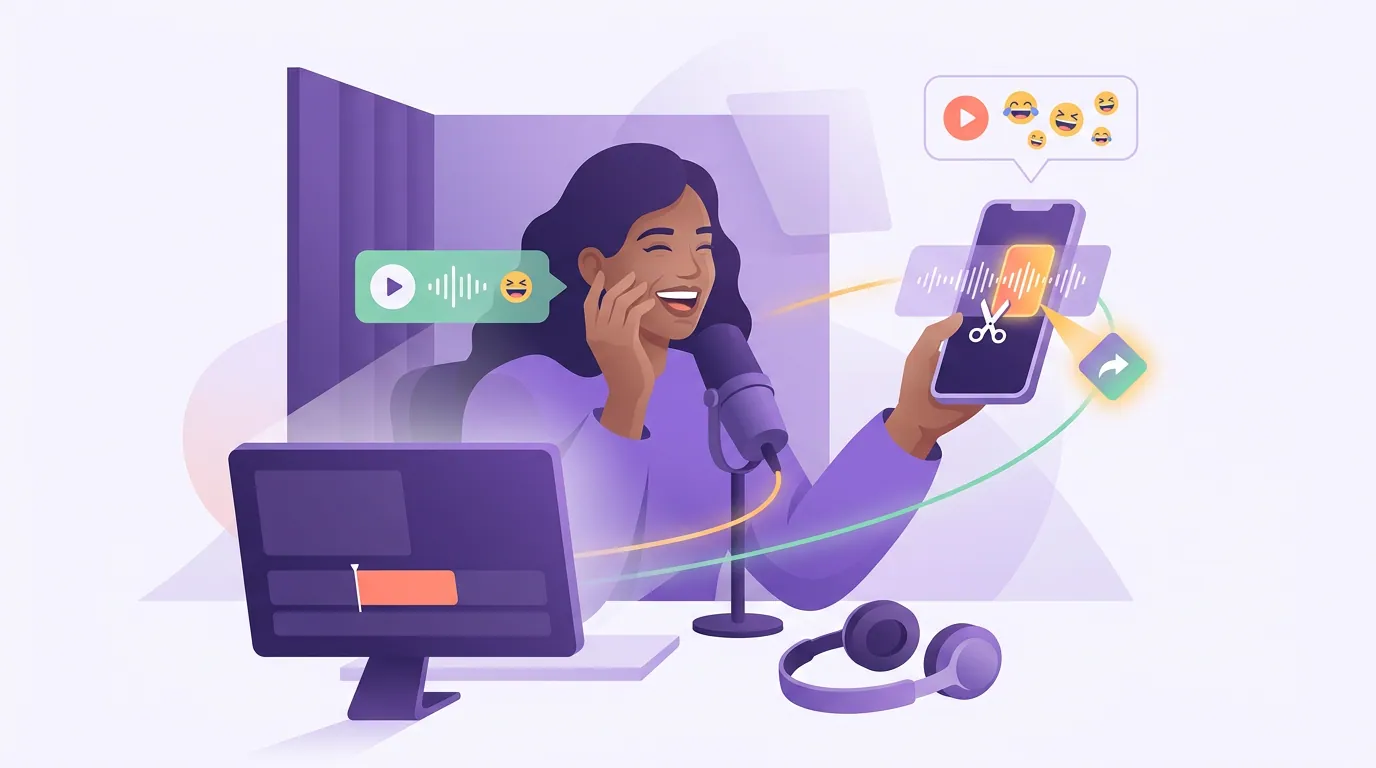
A comedy clip travels when it has a full arc, setup, escalation, payoff, inside roughly 30 to 60 seconds, and needs nothing from outside the clip to make sense. Most comedy that fails to travel fails because the laugh depends on context the viewer never had, or because the setup is so long the viewer scrolls before the payoff. The fix is structural, not funnier writing.
Three rules separate comedy clips that travel from ones that sit at a few hundred views:
- Lead with the second-funniest line, not the setup. Open on something already mid-tension, then let the payoff land. A cold three seconds of "so anyway" loses the scroll.
- Caption it, because most viewers have the sound off. About 75% of mobile video is watched on mute (Verizon Media / Sharethrough, 2017), and timing-based comedy without captions is just two people moving their mouths.
- End on the laugh, then cut. Comedy clips that linger after the payoff bleed retention. The reaction is the ending; trim the dead air after it.
The honest caveat the chart-toppers leave out: clip volume without a real moment is empty motion. A comedy clip that gets a million views but sends nobody to the show is a vanity number, and timing-dependent humor is the genre that flops hardest when you grab the wrong 40 seconds. Pick the moment that stands alone; do not just cut every laugh.
So which format should you build?
If you want your comedy show to clip, the decision rule is simple: match the format to the chemistry you actually have. Two friends who riff naturally should build a duo and film both faces. A host with a deep guest network should run solo-plus-guest and learn to cut the slow build. Pick the format that produces clips from the people in the room, not the one you admire.
Comedy also has the friendliest economics for going all-in, because fans pay for more of it. Pop culture and comedy is one of Patreon's top-earning podcast categories, and podcast creators earned $629M on Patreon in 2024, up 33% year over year (Variety). The clips bring strangers in; the relationship keeps the funny ones paying. That order, clip to find them, format to keep them, is the whole playbook.
For the formats that recur across genres, see the top US podcasts and the habits behind them and why the UK podcast top 10 looks nothing like the US. For a comedy-adjacent business angle, business podcasts worth studying and how Canadian shows handle the cross-border problem are useful next reads.
FAQ
What is the #1 comedy podcast in the US? By Edison's Q4 2025 reach ranking, the highest-reach show widely classed as comedy is The Joe Rogan Experience (#1 overall), followed by Call Her Daddy (#4) and SmartLess (#5) (Edison via Podnews). Edison's public list is not split by genre; it measures reach by survey, counting shows people listened to or watched, so it captures YouTube viewing that download-only charts miss.
Why is comedy the most popular podcast genre? Comedy is the #1 US genre by audience because it works as company, people put it on while doing something else (Edison Research / Statista). It also clips well, and clips now drive more discovery than personal referral does, so funny shows compound on social platforms in a way slower genres do not.
Do comedy podcasts need to be video? Not strictly, but it is a large disadvantage for the formats built on reaction. A duo or panel show throws away its best clip, the listener's face, when it records audio only. Solo storytelling survives audio better, but even there a filmed version gives you vertical clips to post, and clips are the main discovery channel.
How long should a comedy podcast clip be? Aim for roughly 30 to 60 seconds with a complete setup-escalation-payoff arc inside the clip. Shorter than 20 seconds rarely leaves room for a build; longer than 60 risks losing the scroll before the payoff. Lead near the tension, caption it for mute viewers, and cut right after the laugh.
Can a new comedy podcast compete with shows like SmartLess? Not on audience, those rosters are unrepeatable. But the format is fully copyable at your scale: pick the chemistry setup that fits your hosts, film it, and clip every episode into standalone moments. The blocker is consistency, not talent, and automating the clipping is what makes a weekly schedule survivable.