
Best Clip Tools That Also Schedule Posts (2026)

If you want one tool that both makes clips and schedules them out, the honest shortlist is QuickReel, Opus Clip, Vizard, Submagic, Klap, and Munch, they all clip and they all post directly to social. The real question is narrower: which platforms does each one reach natively, and is its scheduler good enough to cancel your Buffer subscription? For most solo creators the answer is yes; for anyone running several accounts on the same platform, usually no.
The trap with "all-in-one" tools is that the scheduler is often the part that was bolted on last. A clipper that exports a clean, captioned vertical and then posts to only two of the five platforms you care about hasn't saved you a step, it's added one. So this comparison scores the bundle, not the clipping. The clipping engines mostly land in the same place: run one episode through all six and they surface a heavily overlapping set of moments, as our tested roundup of AI podcast clip generators found. The tiebreaker is which tool removes the most clicks between a video link and a finished, posted clip.
What "a clip tool with scheduling" should actually do
Three things, in order. First, turn a long video into captioned vertical clips you'd actually post. Second, connect to the specific platforms you publish on, not "social media" in the abstract, but YouTube Shorts, TikTok, Instagram Reels, Facebook, LinkedIn, and X by name. Third, let you queue or auto-schedule those clips on a calendar without exporting, re-uploading, and re-captioning in a second app.
The middle one is where tools quietly differ, and it's the whole point of this page. A scheduler that posts to three platforms is a different product from one that posts to seven, even if both call themselves "all-in-one." Below is the connector matrix, built from each vendor's own published docs as of June 2026.
The comparison table: clip, schedule, price
Here is the bundle at a glance, the cheapest plan that actually turns scheduling on, and how many platforms each one connects to at that tier. Prices verified on each vendor's pricing page in June 2026; SaaS prices move, so re-check before you buy.
| Tool | Cheapest plan with scheduling | Native platforms |
|---|---|---|
| QuickReel | Starter $9/mo (1 connection); Pro $17.40/mo (6) | YT Shorts, TikTok, IG Reels, FB, LinkedIn, X |
| Opus Clip | Pro $29/mo | YT Shorts, TikTok, IG Reels, FB, LinkedIn, X |
| Vizard | Creator ~$14.50/mo annual (6 accounts) | YT Shorts, TikTok, IG, FB, LinkedIn, X |
| Submagic | Paid tier (publishing live since Mar 2026) | YT Shorts, TikTok, IG Reels/Stories (FB, LinkedIn, X "coming soon") |
| Klap | Basic ~$14/mo annual | YT, TikTok, IG Reels, LinkedIn |
| Munch | Pro $49/mo (Munch Studio from ~$38/mo) | YT Shorts, TikTok, IG, FB, LinkedIn, X |
Two things jump out. Scheduling is gated to a mid or upper tier almost everywhere, and the price of that specific tier varies more than the headline "starting at" number suggests. QuickReel is the only one here where a built-in scheduler appears on the entry plan (quickreel.io/pricing); on Opus Clip it only turns on at the $29 Pro plan (opus.pro/pricing).
Can the built-in scheduler replace a separate tool?
Sometimes. The rule is the number of accounts you run per platform. A clip tool's scheduler is built to push your own clips to your own one account per network, that covers the vast majority of creators and small shows, and for them a built-in scheduler genuinely replaces Buffer or Hootsuite. Where it breaks is the moment you need two TikTok accounts, an approval step before anything goes live, or a unified inbox for comments. That's a social management product, not a clipping product, and no clipper here pretends otherwise.
Submagic is the cleanest example of both sides of this rule: since March 2026 it publishes directly to TikTok, Instagram and YouTube Shorts straight from the editor, which removes the separate-scheduler step for a solo creator on those three networks, but it connects only one account per platform, and Facebook, LinkedIn and X are still listed "coming soon" rather than live (Submagic scheduler). So it both replaces a dedicated scheduler (for one creator, on the platforms it covers) and falls short of one (multi-account, plus the gaps). Keep that test in mind for every tool below.

The six tools, with the honest cons
1. QuickReel, scheduler on the entry plan, broad platform reach
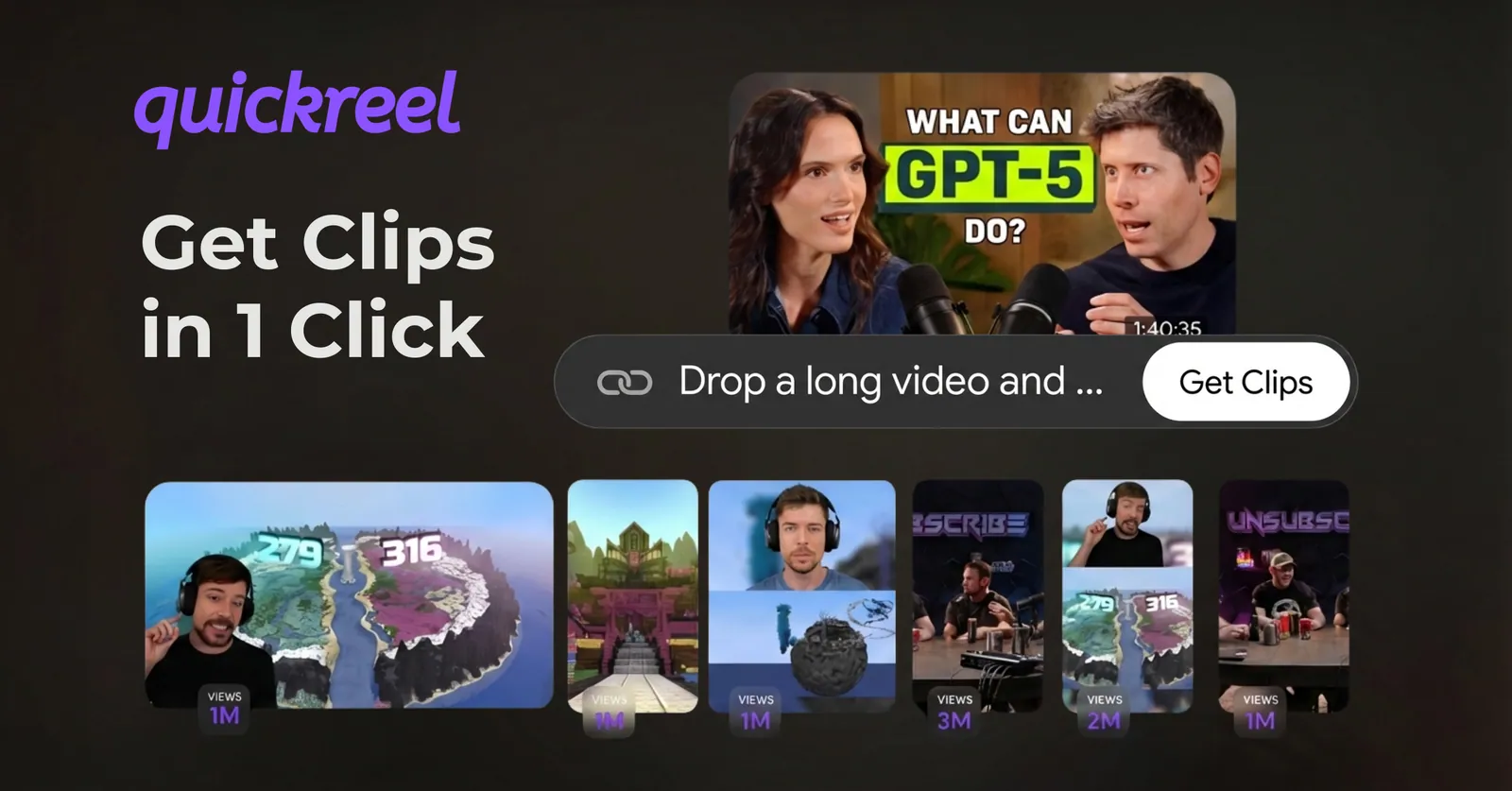
QuickReel clips a long video into captioned verticals and connects to social platforms on every paid tier, scaling from 1 connection on the $9 Starter plan to 30 on Ultimate, with Pro at $17.40/mo (renews $29) covering 6 platforms (quickreel.io/pricing). It posts to the full major set, YouTube Shorts, TikTok, Instagram Reels, Facebook, LinkedIn, X, plus 20+ languages and 12+ caption styles. The free tier (about one episode's worth of credits) exists so you can test the clip quality before paying.
The cons, stated plainly. The free plan watermarks exports, so you'll evaluate, not ship, on it. And like every tool here, the AI's clip picks still need a human pass, in our own clip-quality testing, expect to re-trim or reject a meaningful share of suggested moments before they're worth posting. QuickReel is an accelerant, not a replacement editor; if the input audio is rough, no clipper fixes that for you.
2. Opus Clip, strongest brand, scheduler is Pro-only
Opus Clip is the category's biggest name, backed by a $215M valuation in March 2025 and 10M+ users, 170M+ clips generated (Sacra). Its scheduler is real and broad, posting to YouTube and Shorts, TikTok, Instagram Reels, Facebook, LinkedIn and X, with analytics built into the calendar (opus.pro/calendar).
The cons. Scheduling is locked behind the $29/mo Pro plan, the Free and $15 Starter tiers don't include it (opus.pro/pricing). If your reason for an all-in-one tool is to consolidate spend, Opus's scheduling sits at the top of that math, not the bottom. The clipping itself is excellent and the virality scoring is well-regarded; the friction is purely that the bundle's cheapest entry into scheduling is the priciest on this list among the mainstream picks. For a closer look, see our QuickReel vs Opus Clip comparison, the wider list of Opus Clip alternatives for 2026, and the honest Opus Clip alternative for heavy clippers.
3. Vizard, aggressive pricing, full auto-scheduling
Vizard turns long video into clips and has grown into a genuine clip-plus-publish workflow. Its auto-scheduler posts to all six major networks, TikTok, YouTube, Instagram, Facebook, LinkedIn and X, and lets you set a minimum viral score, cap clips-per-day (up to 10), and drag posts around a calendar (Vizard help center). Scheduling is included from the Creator plan (around $14.50/mo on annual billing, $29 monthly), which manages 6 social accounts; Business (about $19.50/mo annual, $39 monthly) handles 20 (vizard.ai/pricing).
The cons. The free plan caps you at one connected account, and on it only TikTok is available as a publishing target, the other networks need a paid tier. Reviewers consistently note Vizard's AI clip picks lean generic, so the human-review tax is real here too. But for price-per-platform on auto-scheduling, it's hard to beat.
4. Submagic, best solo-creator consolidation, one account per platform
Submagic started as a captions tool and added native publishing in March 2026: schedule and post directly to TikTok, Instagram (Reels and Stories) and YouTube Shorts, with AI-generated platform-specific titles and hashtags, all from inside the editor (Submagic scheduler). For a solo creator who lives on those three platforms, that combination, strong captions plus direct publishing, does replace a separate scheduler.
The cons. Two real ones. It connects only one account per platform, which rules out multi-client agency work. And its scheduler is the narrowest live set on this list right now: as of June 2026, Facebook, LinkedIn and X are all marked "coming soon," not shipped (Submagic scheduler). So if any of those three is part of your distribution, you'll still be exporting and posting them by hand today. Submagic is the consolidation pick for one creator who publishes to YouTube Shorts, TikTok and Instagram, verify the others have shipped before you count on them.
5. Klap, solid clipper, narrower connector set
Klap converts YouTube videos into ready-to-post Shorts, Reels and TikToks in 50+ languages, with virality scores and direct publishing to TikTok, YouTube, Instagram and LinkedIn (klap.app/pricing). On annual billing its pricing page currently shows roughly $14 Basic, $39 Pro and $94 Pro+ per month (monthly billing is about double); older third-party listings quote higher numbers, so price off the live page.
The cons. Klap's connector set is the narrowest here, no native Facebook and no X, per its own docs, so if either is part of your distribution, you'll still need a second tool, which defeats the bundle. Hands-on reviewers also note that most creators end up downloading and posting manually anyway for finer control. The clipping is good; the scheduling is the weak half of the pair.
6. Munch, repurposing-plus-strategy, priced for businesses
Munch (now "Munch Studio") repurposes long video into clips and schedules them to Instagram, Facebook, TikTok, YouTube Shorts, LinkedIn and X, with auto-scheduling, analytics and a content-strategy layer aimed at business owners (getmunch.com). The repurposing tool runs Pro $49, Elite $116 and Ultimate $220 per month (Ultimate drops to roughly $183/mo on annual billing); the separate Munch Studio social product starts around $38/mo (SaaSworthy).
The cons. It's the most expensive entry into scheduling on this list, and pricing is partly gated behind signup, which makes upfront comparison harder. The platform reach is full and the strategy features are genuine, but for a single show that just wants clips-plus-calendar, you're paying for a marketing suite you may not use.
How we evaluated
We scored only on the clip-plus-publish bundle, not on clip quality in isolation (covered in our tested roundup of AI podcast clip generators). Three criteria: native platform connectors (drawn from each vendor's help and pricing docs, June 2026), the cheapest plan that actually includes scheduling, and the multi-account limit that decides whether the built-in scheduler can stand alone. Every price and connector was checked against the vendor's own pages, linked inline, rather than third-party listicles, because those go stale fastest. Where a number varied across sources (Opus Clip's Starter price, Klap's monthly-vs-annual rates), we used the vendor page and flagged the variance.
One caveat we won't bury: clip detection is largely commoditized. All six tools find roughly the same moments, and all six need a human to review and re-trim them before posting, in our own clip-quality benchmarks (an internal QuickReel observation, not a published study), that human pass touches somewhere between a fifth and two-fifths of the AI's picks across tools. The scheduler is the genuine differentiator now, not the AI.
Who should pick what
- Solo creator, one account per platform, watching spend: QuickReel (scheduler on the $9 entry plan) or Submagic (best caption-plus-publish consolidation, if you only need YouTube Shorts, TikTok and Instagram for now).
- You want the most-proven clipper and don't mind the price: Opus Clip, just budget for the $29 Pro plan, since that's where scheduling lives.
- Cheapest full auto-scheduling across all six platforms: Vizard's Creator plan.
- Facebook and X both matter, plus a strategy layer, and budget isn't the constraint: Munch.
- You only post to YouTube, TikTok, Instagram and LinkedIn: Klap is fine, but check the connector gaps first.
If you'd rather not commit a card to find out whether the clips and the calendar fit your workflow, start with the one that lets you test both for free.
FAQ
Which clip tool has the best built-in scheduler? For breadth, QuickReel, Opus Clip, Vizard and Munch all post natively to the six major platforms, YouTube Shorts, TikTok, Instagram, Facebook, LinkedIn and X. The "best" depends on price and account needs: QuickReel and Vizard are the cheapest routes to full scheduling; Munch reaches everything but costs the most.
Can a clip tool's scheduler replace Buffer or Hootsuite? For a solo creator or single brand, yes, built-in schedulers handle one account per platform, which covers most people. They can't replace a dedicated tool if you run multiple accounts on the same network, need approval workflows, or want a unified comment inbox. That's a social-management job, not a clipping one.
Does Opus Clip include scheduling on the free plan? No. Opus Clip's scheduler turns on at the $29/mo Pro plan; the Free and $15 Starter tiers don't include social scheduling (opus.pro/pricing). QuickReel is the exception here, its scheduler appears on the $9 Starter plan.
Which tools can post to Facebook and X? Per their own docs (June 2026), QuickReel, Opus Clip, Vizard and Munch post natively to both Facebook and X. Klap skips both. Submagic's live scheduler covers only YouTube Shorts, TikTok and Instagram today, Facebook, LinkedIn and X are all marked "coming soon." Check the connector matrix above before assuming "all-in-one" means every platform.
Do I still need to edit clips the tool generates? Yes. Every AI clipper, including all six here, needs a human to review and re-trim a sizable share of the suggested clips, fixing cut points, hooks, and the occasional moment the AI misreads. (In our own testing that share ran from about a fifth to two-fifths of picks, tool depending.) Treat these tools as an accelerant, and pair them with good auto-captioning and a quick quality pass. For free options to test the workflow first, see our best free podcast clip tools.