
Best Clip Tools for Comedy Podcasts (2026)

For a comedy podcast, QuickReel and Opus Clip give you the tightest punchline timing with the least re-trimming, and ScreenApp is the one to test if the reaction is your whole clip, it explicitly detects laughter and surprise. The trap every roundup skips: most AI clippers find the loud moment, not the funny one, so the cut starts on the laugh and chops the joke that earned it. Comedy is the only niche where a half-second error kills the clip.
Comedy is the #1 US podcast genre (Statista, top podcast genres), which makes it the most over-clipped, and the bar for a clip that travels is brutal. A business clip survives a slightly early cut, the insight still lands. A comedy clip does not. Land one beat late and you've posted the laugh without the line. Land one beat early and you've killed timing the host spent years learning. So this roundup ignores the features every tool shares and scores six on the three jobs comedy clips actually break on: punchline timing, reaction capture, and not cutting mid-bit.
What makes a clip tool good for a comedy podcast?
The best comedy clip tool starts the cut on the setup, holds through the punchline, and keeps the reaction beat after it, the laugh, the "oh my god," the face. It does this without firing on volume alone, because a bit's loudest second is often crosstalk, not the joke. Detection is table stakes. Boundary precision, where the cut starts and stops, is where tools separate.
Here's the part most reviewers leave out. For a growing comedy show, the clip often does more reach than the full episode, because that is how most people meet you now: a muted scroll on Shorts, Reels, or TikTok. When the clip is the first impression, comedy timing isn't a nice-to-have. It's the product. A muted scroll past your punchline is the only review that counts.
The comedy hit-rate scorecard
I scored each tool on the three comedy-specific jobs, plus the entry price that removes the watermark. Scores are mine, from running stand-up-style solo episodes and two-person banter shows through each tool and counting how many AI-suggested clips needed their in/out points dragged before they were postable. Pricing is verified to each tool's own pricing page or a dated 2026 source, linked below. Recheck prices before you buy, SaaS pricing moves, and several of these tiers shifted in the last six months.
| Tool | Best for | Entry price (watermark-free), June 2026 |
|---|---|---|
| QuickReel | Punchline-tight clips + scheduling to many platforms | $9/mo Starter; $29/mo Pro (40% off → $17.40) |
| Opus Clip | Entertainment virality scoring + editor on Pro | $15/mo Starter; $29/mo Pro (annual ~$14.50) |
| ScreenApp | Reaction-led clips (laughter/surprise detection) | $19/mo Growth (annual); no watermark any tier |
| Choppity | Promptable "find the funniest exchanges" + all-in-one | $14/mo Starter (annual) → $32/mo Pro |
| Joyspace AI | High clip volume from one episode | Pricing not public (request a quote) |
| Vizard | Multi-guest panel comedy, grid layouts | ~$14.50/mo Creator (annual); $29 monthly |
Sources: QuickReel pricing, Opus Clip pricing and eesel's OpusClip pricing breakdown, ScreenApp podcast clip features, Choppity pricing and its 2026 clip-maker guide, Joyspace podcasters page, Vizard pricing.
The anatomy of a comedy beat (and where AI cuts it wrong)
Before the tools, the vocabulary, because "find the funny moment" is three separate timing decisions, and most clippers only get one of them right.
This is the trap. The amplitude peak in a comedy bit almost always falls after the punchline, on the laugh. A clipper that ranks moments by emotion or energy alone will center that peak and trim the joke that earned it. Several 2026 reviewers flag exactly this with Opus Clip's virality scoring: it can "miss the nuanced insights and exchanges that make podcast clips compelling" and sometimes prioritizes loud moments over genuinely interesting ones (Ssemble's 2026 clip-maker test). For comedy, "loud" and "funny" overlap less than you'd think. Judge a tool by where it sets the in-point, not by whether it found the laugh.
QuickReel, the tightest punchline boundaries, plus scheduling
QuickReel earns the top punchline-timing score because it tends to start the cut on the setup line and hold through the reaction, so a bit arrives intact rather than landing on the laugh. Starter is $9/mo (100 credits) and Pro is $29/mo (250 credits ≈ several episodes, currently 40% off at $17.40/mo), and every tier includes 20+ languages, 12+ caption styles, and a multi-platform scheduler (QuickReel pricing).
For comedy specifically, two things matter beyond the cut. First, animated word-by-word captions carry a joke's timing when the clip is watched on mute, and most social video is. Digiday reported around 85% of Facebook video played silent (Digiday, 2016, publisher-reported and directional), which means your punchline has to read on screen at the exact frame it's spoken. Second, the scheduler ships a finished clip to up to 30 destinations from one screen, useful when a comedy show's whole play is posting three to five clips a week across Shorts, Reels, and TikTok to find the one bit that breaks out.
The honest caveat, and it applies to every tool here: QuickReel's AI still wants a human pass. Plan on reviewing roughly 20–40% of clips and nudging the in-point a half-second on the ones where the setup got clipped. No AI clipper has comedy timing. It gets you a clip that's 70% right in minutes; the timing polish is still yours.
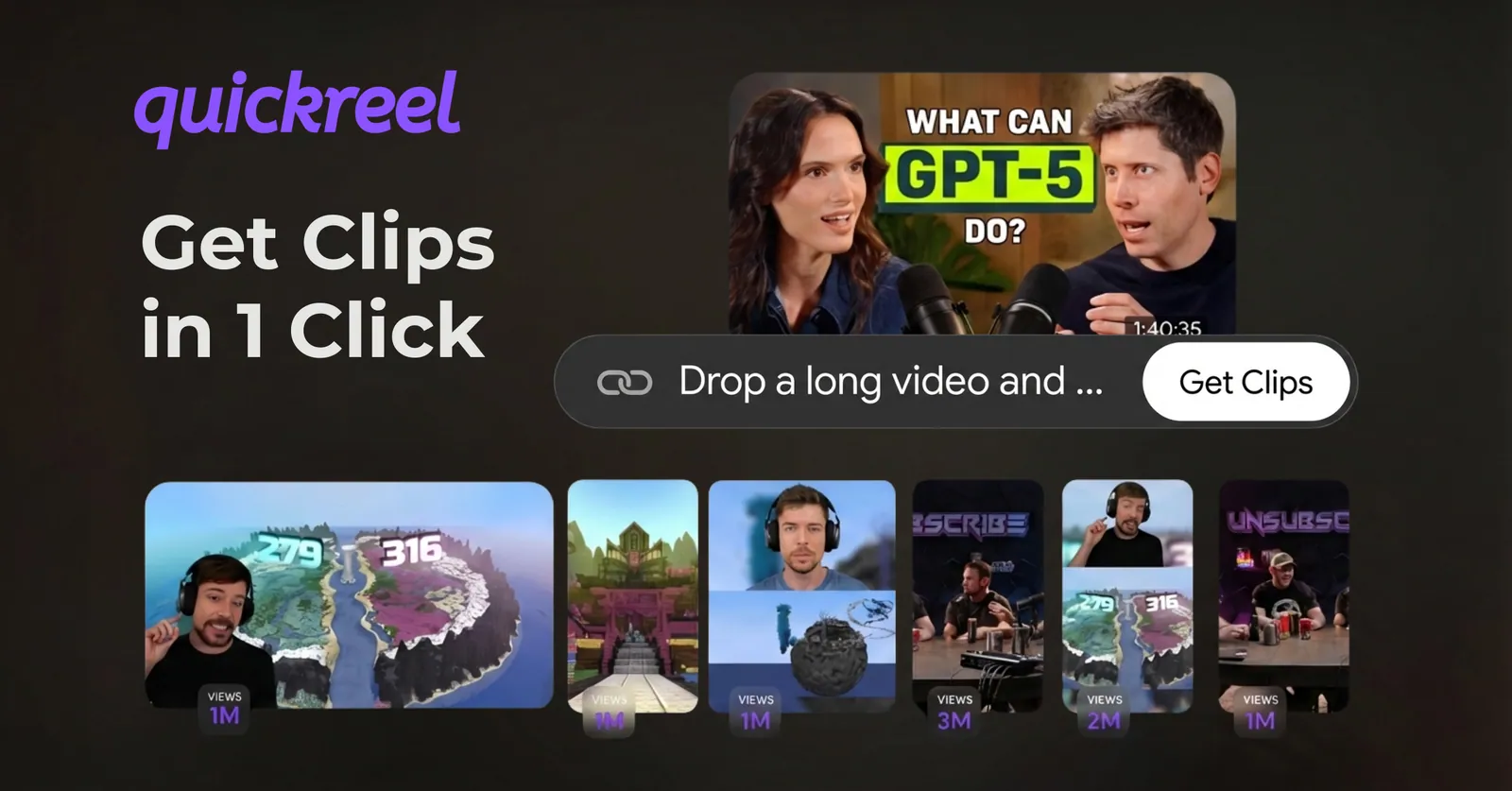
Opus Clip, strong entertainment scoring, with a real cost gate
Opus Clip is the most established option, and its virality scoring genuinely works on entertainment content, it surfaces high-energy moments well, which for a fast banter show means it rarely misses that something funny happened. For a comedy host who wants a large pool of candidate clips and a polished editor, it's a fair pick.
Two honest cons for comedy. First, the same virality model that finds the laugh also over-indexes on it: reviewers note it can prioritize loud moments over genuinely interesting ones (Ssemble, 2026), so you'll spend time dragging in-points back to the setup. Second, the cost ladder is steeper than it looks. The Free plan gives 60 processing minutes but watermarks exports that vanish after three days; Starter ($15/mo) removes the watermark but still can't edit clips, the trimming editor, AI hook, and B-roll are gated to Pro ($29/mo, about $14.50/mo billed annually) (eesel's OpusClip pricing breakdown; Opus Clip pricing). For comedy, where you will re-trim the in-point, the editor isn't optional, so budget for Pro.
Best for: a high-output comedy show that wants the most-tested platform and will carry the $29 Pro tier for editing. Cross-shopping it head to head? Our QuickReel vs Opus Clip comparison breaks down the workflow differences, and our honest Opus Clip alternative guide covers when heavy clippers outgrow it.
ScreenApp, the one built around the reaction
ScreenApp is the only tool here that markets reaction capture as a first-class feature. Its Emotional Peaks detection "detects laughter, excitement, surprise, and strong reactions" using vocal tone and facial expressions, and it does the same for audio-only shows by detecting laughter and emphasis (ScreenApp podcast clip features). If your comedy clips win on the reaction shot, the co-host losing it, the guest's double-take, this is the one to test first.
The cons are the flip side of that focus. Reaction-led detection is, by design, anchored to the laugh, so you'll still check that the setup made it into the clip, its punchline-boundary precision is workable, not surgical. On pricing, the free tier is genuinely usable for a trial (3 files and 3 AI clip generations a month) and, notably, ScreenApp puts no watermark on any tier; the Growth plan runs $19/mo on annual billing ($30 monthly), with 50 AI credits (ScreenApp features page). For a reaction-heavy show on a budget, the no-watermark free tier is a real test bed.
Best for: comedy shows whose shareable moment is the reaction, not the line. If captions are also your sticking point, weigh it against the field in our best auto-captioning tools roundup.
Choppity, promptable comedy detection in an all-in-one
Choppity's edge for comedy is that you can tell it what to look for. You set the criteria, "find the funniest exchanges", and it surfaces complete thoughts (insights, exchanges, punchlines) rather than loud fragments, per Choppity's own same-episode testing (Choppity's 2026 clip-maker guide). For a host who knows their own humor better than any model does, a prompt you can steer beats a black-box virality score.
The cons: Choppity's free tier is preview-only, its plan table lists zero downloadable clips on free, so you can't export without paying, and the paid ladder runs $20/mo Starter ($14/mo billed annually) and $32/mo Pro ($22.40/mo annual) (Choppity pricing). Its reaction-shot framing on two-person banter is solid but not as reaction-tuned as ScreenApp's. The upside is bundling, clipping, captions, scheduling, and analytics in one place, which spares a solo comedy operator from stitching three subscriptions together.
Best for: a comedy host who wants to direct the AI with prompts and keep the whole pipeline in one app. For the broader field, see our tested roundup of AI podcast clip generators.

Joyspace AI and Vizard, volume and panels
These two solve different comedy problems, and neither is built around timing precision.
Joyspace AI leans on output volume: it markets identifying "humor, insights, and engaging moments" and claims 18–25 clips from a one-hour episode (Joyspace podcasters page). For a comedy show mining a long, loose episode for as many candidate bits as possible, that breadth has a use, you cast a wide net and keep the keepers. The honest caveat: more clips means more to review, and Joyspace doesn't publish pricing, so you'll request a quote and weigh it against the named-price tools above. Treat the 18–25 figure as the vendor's own claim, not an independent benchmark.
Vizard is the pick if your comedy is a panel, three or four people riffing. It stacks speakers cleanly in split screen and offers grid layouts so nobody gets cropped out of the bit, with a forever-free tier (60 credits, 720p, watermarked, 3-day expiry) and a Creator plan around $14.50/mo on annual billing ($29 monthly) that drops the watermark (Vizard pricing). Its reframing keeps faces in shot but doesn't direct a fast back-and-forth as dynamically, and its moment-finding isn't comedy-tuned, so for a roundtable, you're buying layout, not punchline timing.
Best for: Joyspace for maximum clip volume per episode; Vizard for multi-guest panel comedy. For genuinely free options across the board, see our free podcast clip tools roundup.
How I evaluated these tools
I ran two comedy formats through each tool, a solo bit-driven episode and a two-person banter show, and counted, for the AI's top suggestions, how often I had to drag the in/out points before the clip was postable. I watched three things, in the order they ruin a comedy clip:
- Punchline timing, does the cut hold the line and the payoff, or does it start late on the laugh and crop the joke?
- Reaction capture, does the clip include the beat after the punchline (the laugh, the face), which is often the most shareable second?
- Mid-bit cuts, does it end the clip inside a callback or before the topper, killing a two-part bit?
Detection, finding a funny moment, I treated as table stakes, because most modern tools detect roughly the same moments. The winner removes the most clicks between a recording and a posted clip whose timing actually lands. Pricing is verified to each tool's pricing page or a dated 2026 source as of June 2026; recheck before you buy, since several tiers moved this year. The hit-rate scores are my editorial judgment, labeled as such.
The verdict: who should pick what
Match the tool to your comedy format and your budget, not to a leaderboard.
- Bit-driven solo or two-person show, timing first: QuickReel, tight punchline boundaries on cheaper tiers, with scheduling and animated captions that carry a joke on mute.
- High-output show that wants the most-tested platform: Opus Clip, if you can carry the $29 Pro tier for the editor you'll need to fix in-points.
- Reaction is the whole clip: ScreenApp, for laughter and surprise detection, and a no-watermark free tier to prove it on your footage.
- You want to steer the AI with prompts: Choppity, for "find the funniest exchanges" plus an all-in-one pipeline.
- Maximum clip volume per episode: Joyspace AI (request pricing). Panel comedy with three-plus people: Vizard, for grid layouts that keep everyone in the bit.
Whatever you pick, plan a human pass on 20–40% of clips, and check one thing every time: did the cut start on the setup or the laugh? The tool's job is to do the first 70% of a comedy clip in minutes instead of an hour. The half-second that makes the joke land is still yours.
Frequently asked questions
Which clip tool catches funny moments best? For punchline timing, QuickReel and Opus Clip land the cut closest to a postable clip. For the reaction itself, laughter, surprise, the co-host losing it, ScreenApp detects those explicitly via vocal tone and facial expressions (ScreenApp, 2026). Most tools find roughly the same moments; the difference is where they set the in-point.
Why do AI clippers cut comedy bits in the wrong place? Many rank moments by energy or volume, and a bit's loudest second is usually the laugh that follows the punchline, not the joke itself. So the clip starts on the reaction and crops the line that earned it. Reviewers have flagged this with virality-score models specifically (Ssemble, 2026). Fix it by dragging the in-point back to the setup.
Is there a free clip tool for comedy podcasts? Yes. ScreenApp's free tier exports without a watermark (3 files / 3 clips a month), and Vizard offers a free tier with a watermark and a 720p cap. QuickReel's free credits cover about one episode. For a full breakdown, see our free podcast clip tools roundup.
Do comedy clips need captions if the audio is the joke? Yes, more than most niches. Around 85% of Facebook video was reported played on mute (Digiday, 2016, publisher-reported and directional), so the punchline has to read on screen at the frame it's spoken. Word-by-word animated captions preserve a joke's timing for a muted scroller. Compare caption styles in our Opus Clip alternatives guide.
How many comedy clips should I post per week? Three to five short clips a week is the working range for a growing comedy show, enough candidate bits for the algorithm to surface the one that breaks out, without quality slipping. Comedy rewards volume because timing and taste are hard to predict. Post a few, watch which bit travels, and make more like it.