
Best Clips AI and Vidyo Alternatives (2026)

If you came here from Clips AI or Vidyo.ai, the two reasons you're searching are different, so the right replacement is different. Clips AI is an open-source Python library, not a finished app, you build the workflow yourself. Vidyo.ai rebranded to quso.ai and shifted toward an all-in-one social suite. Match the fix to the reason below.
This is not a generic "top 10 clip tools" page. It's a switcher map. I've used these products to ship clips, and below I name the specific gap that pushed you out of each one, then the alternative that closes that exact gap. Every price was checked against the vendor's own page in June 2026; SaaS prices move, so re-verify before you pay.
What actually changed with Clips AI and Vidyo
Clips AI never was a polished consumer app. It's a Python library on GitHub (MIT-licensed, ~512 stars, 68 commits) that finds clips from a transcript and reframes 16:9 to 9:16 using WhisperX and Pyannote (GitHub/ClipsAI, June 2026). It works, but you install dependencies, supply a Hugging Face token, and write the glue code. There's no GUI, no caption styling, no scheduler. For a developer that's a feature; for a creator it's a wall.
Vidyo.ai still exists, but under a new name. The product is now quso.ai ("formerly vidyo.ai"), repositioned from a pure clipper into a broader social tool with AI avatars, a writer, scheduling, and analytics (quso.ai/pricing, June 2026). If you liked the old, narrow clipper and the surface now feels heavier, that's the change you felt.

The verdict, up front
Left Clips AI because maintaining a pipeline isn't your job? Pick a hosted app that does the same transcript-driven clipping with captions and posting already attached, QuickReel, OpusClip, or quso all qualify. Left Vidyo.ai/quso because it sprawled, or because the watermark and 720p free cap wore on you? Pick a focused clipper with a usable free tier. For most podcasters my default is QuickReel, on workflow span and price, with OpusClip the strong second if virality scoring is the one feature you can't lose. Pick by your migration reason, not by a star rating.
The switcher map
This is the page's whole point. Find your reason for leaving on the left; the tool on the right is the one that closes that specific gap.

The alternatives, with honest pros and cons
QuickReel, best span for a podcaster leaving either tool
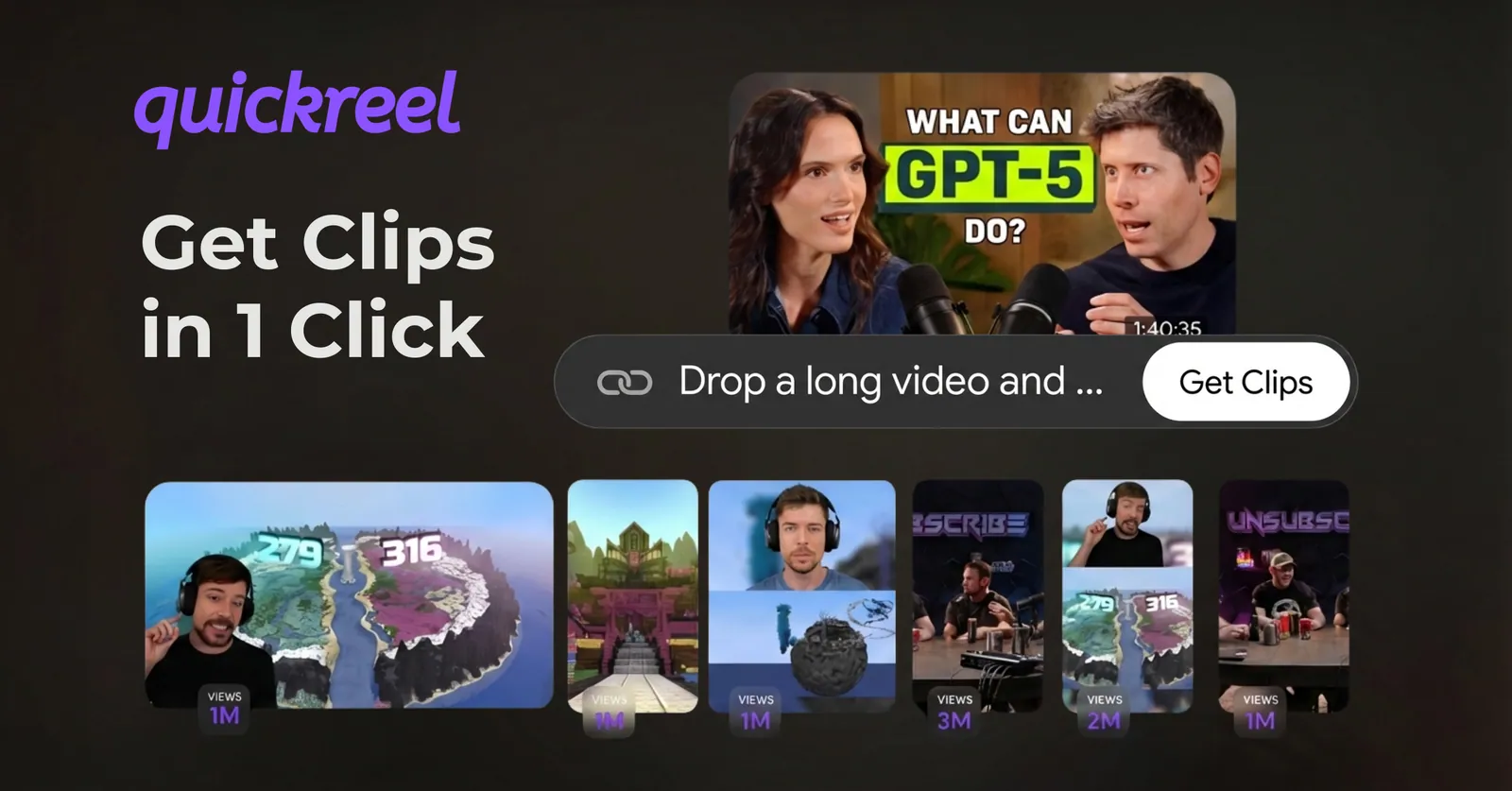
QuickReel is a hosted clipper that takes a YouTube URL or upload, finds moments, applies one of 12+ caption styles, reframes vertical, and schedules out. Paid plans run $9 Starter → $17.40 Pro (reg. $29) → $29.40 Pro+ → $89 Ultimate, with 20+ languages and scheduling to up to 30 connected platforms on the top tier (quickreel.io/pricing, June 2026). Sign-up is free; the credit allowance is the demo.
Why it fits the switcher: it closes both Clips AI gaps (no code, captions included) and the quso gaps (focused on clips, broader scheduling). The API on paid plans is the bridge for the developer who liked Clips AI's control but is done maintaining WhisperX.
Cons, stated plainly: like every AI clipper, it still needs human review, budget ~20–40% of your time checking caption accuracy and crop (the reviewer norm across this category). There is no standalone always-free tier the way OpusClip publishes one; you sign up free and use your starting credits.
OpusClip, best if virality scoring is the feature you'll miss
OpusClip is the category's most-funded player ($215M valuation after a SoftBank Vision Fund 2 round, 10M+ users by early 2025, per Sacra, Mar 2025). Its draw is the ClipAnything/virality score that ranks moments by predicted engagement. Pricing: a permanent free plan (60 processing minutes/month, watermarked), Starter $15/mo (watermark removed, 150 min, 720p), and Pro $29/mo (300 min, 1080p, all aspect ratios, social scheduler) (opus.pro/pricing and its plans & credits docs, June 2026).
Why it fits: if you left Clips AI for a polished app, OpusClip is the most app-like. If you left quso because you only want clips, OpusClip stays in that lane.
Cons: credits burn on input length, not output, feeding a 30-minute podcast costs 30 credits whether OpusClip returns 5 clips or 50, since one credit equals one minute of source video. The cancellation behavior is the bigger trap: cancel and your projects drop out of reach within about three days, even with credits left (OpusClip plans & credits docs, June 2026). Export everything before you cancel.
quso.ai (formerly Vidyo.ai), keep it only if you want the wider suite
If the rebrand is the only thing that spooked you, the engine you liked is still here. quso runs Free ($0, 75 credits, 720p, watermark), Lite $29, Essential $39, Growth $49 monthly, with yearly billing dropping those to roughly $15/$20/$25 (quso.ai/pricing, June 2026). Essential adds filler and silence removal; Growth adds unlimited scheduling and analytics.
Why it fits: staying is the lowest-friction option, and the AI avatars/writer are genuinely more than a clipper does. Cons: the free tier's watermark and 720p cap are the reason many people search "vidyo ai alternative" in the first place, and the breadth is exactly what feels heavy if you only want clips. Don't pay for avatars you won't use.
2Short, best cheap, focused clipper
2Short is a lean YouTube-first clipper around $9.90/mo for its first paid tier (makeshorts pricing roundup, verify live, SaaS prices move). It does the core job, find, caption, reframe, without the wider suite. If you left quso because it sprawled and you want the closest thing to a single-purpose clipper, this is it. Con: thinner on multi-platform scheduling and brand templates than QuickReel or quso.
FunClip, best free open-source replacement for Clips AI
If you liked that Clips AI was free and self-hosted but want something more actively built, FunClip (ModelScope) is the closest open-source successor: speech recognition plus LLM-based clipping, integrating Qwen and GPT-series models, with default prompts since v2.0.0 (GitHub/modelscope/FunClip). Cons: same shape as Clips AI, it's an engine, not an app. You still own the setup, the captions, and the posting. For most non-developers, the time cost outweighs the zero dollar price; a $9–$30/mo hosted tool is cheaper than your weekend.
Side-by-side: the numbers that decide it
| Tool | First watermark-free tier | Best for the switcher who… |
|---|---|---|
| QuickReel | $9/mo Starter | …wants captions + scheduling without code |
| OpusClip | $15/mo Starter | …relies on virality scoring |
| quso.ai | $29/mo Lite (or ~$15 yearly) | …wants the wider all-in-one suite |
| 2Short | ~$9.90/mo | …wants a cheap, single-purpose clipper |
| FunClip | $0 (self-host) | …is a developer keeping control |
Pricing from each vendor's page, June 2026. Quso's lower yearly rate requires annual commitment. Re-check before paying.

How I evaluated these
I weighted four things, in order: does it remove clicks between a URL and a posted clip; caption quality and styling; price at the first usable tier; and whether the free tier is honest (watermark, resolution, retention). Most modern clippers detect roughly the same 80% of good moments, so detection alone rarely decides it, the winner removes the most steps. I checked each price and free-tier limit against the vendor's own pricing page in June 2026 and flagged anything I couldn't confirm.
The reality check that applies to every tool here: an AI clipper is an accelerant, not a replacement editor. Plan to review captions, crop, and the in/out points on every clip before it posts. Virality without a strategy is empty engagement, views are not subscribers.
FAQ
Is Clips AI shut down?
No. Clips AI is still available as an open-source Python library on GitHub and via pip install clipsai (GitHub/ClipsAI, June 2026). It was never a consumer app with a polished interface. If you expected a website where you upload and get clips, you wanted a hosted tool like QuickReel or OpusClip instead, that's the gap, not a shutdown.
What happened to Vidyo.ai?
Vidyo.ai rebranded to quso.ai and broadened from a clipper into an all-in-one social suite with AI avatars, a writer, scheduling, and analytics (quso.ai/pricing, June 2026). Your account and the underlying clipping engine carried over. If the new scope feels heavy and you only want clips, a focused tool like OpusClip or 2Short is a cleaner fit.
Is there a free alternative to Clips AI?
Yes, two kinds. For a free hosted app, OpusClip publishes a permanent free plan (60 minutes/month, watermarked) and QuickReel lets you sign up and clip free with starting credits. For a free open-source engine like Clips AI itself, FunClip is the closest actively built option, but you self-host it. See our free podcast clip tools roundup for the full list and the honest catches.
Which alternative captions clips best?
For caption styling out of the box, a hosted tool beats the open-source libraries, which ship transcripts but no styling. QuickReel offers 12+ caption styles and 20+ languages; OpusClip and quso also auto-caption with style presets. Whatever you choose, fix the auto-transcript, names and jargon are where AI captions miss. Our auto-captioning tools comparison goes deeper.
Should a developer just keep using Clips AI?
Only if the pipeline is your product, not a chore. If you want code-level control, are comfortable maintaining WhisperX and ffmpeg, and your team already ships Python, keeping Clips AI (or moving to FunClip) is reasonable and free. If you're spending weekends on dependency errors instead of clips, a hosted tool with an API, like QuickReel, usually costs less than your time.
Where to go next
Still deciding on the broader field? Start with our tested roundup of the best AI podcast clip generators, then narrow with the best Opus Clip alternatives if virality scoring is your anchor feature. For a head-to-head on the two most app-like options, see QuickReel vs Opus Clip, and if you clip heavily every week, the honest Opus Clip alternative for heavy clippers breaks down the credit math.