
The Easiest Podcast Clip Tool for First-Timers

If you have never cut a clip in your life, pick the tool that puts the fewest clicks between a video link and a finished post. By that single test, QuickReel and Vizard tie at the top: paste a link, wait, download. Submagic and Klap are close. Opus Clip is excellent but front-loads a watermark; 2Short is simple but its free tier previews clips rather than publishing them.
Most beginner roundups rank on features you won't touch for months, B-roll engines, dubbing in 29 languages, API access. None of that matters on your first day. What matters is whether you can get one watchable, postable clip out the door without reading a manual, and whether the clip looks decent before you change a single setting. So that is what we ranked on: onboarding friction. Three measures, scored below.
This is a buyer's guide, not a leaderboard of brand loyalty. I build and benchmark clips for a living, and I'll tell you where QuickReel costs you and where a rival is genuinely the better first stop.
How we scored "easiest" (the onboarding-friction method)
Every tool here uses the same core AI: you give it a long video, it finds the moments worth posting, reframes them vertical, and burns in captions. Run one episode through several of them, as I have, and the detection engines surface mostly the same standout moments. The difference for a beginner is not what the AI finds, it's how many clicks, decisions, and bits of jargon sit between you and a clip you can actually upload.
We scored each tool on three things, all from a first-time-user's seat:
- Clicks to first exported clip. Counted from a fresh signup to a downloaded or scheduled clip. Fewer is better.
- Defaults that look good untouched. Can you post the AI's output without changing the caption style, crop, or layout? Or do the defaults look unfinished?
- No-jargon UI. Does the interface explain itself, or does it assume you already know what "B-roll," "virality score," or "reframe" means?
Pricing and free-tier limits are verified against each tool's live pricing page as of June 2026; SaaS prices move, so re-check before you pay. Where a number comes from a third party, it's named inline.
The beginner-friendliness scorecard
Here is the short version. The full mini-reviews follow, each with a real downside.
| Tool | Best for the beginner who… | First-clip friction (lower = easier) |
|---|---|---|
| QuickReel | Wants to paste a link and post the same day | Low, ~4 clicks; defaults post-ready; plain UI |
| Vizard | Likes a clean editor and wants to tweak captions | Low, ~4 clicks, but free exports are watermarked |
| Submagic | Cares most about caption look out of the box | Low-medium, ~5 clicks; free trial watermarks |
| Klap | Wants polished templates and will pay to start | Medium, ~5 clicks; one free trial video only |
| Opus Clip | Wants the most-proven engine, watermark aside | Medium, ~6 clicks; free tier watermarks |
| 2Short | Only wants to test on existing YouTube videos | Test-only, free tier previews, export is paid |
A note on the keyword everyone searches: the "easiest podcast clip tool" is the one whose defaults you'd actually post without editing. That's a higher bar than "has a free plan," and it's where these tools separate.
The tools, reviewed for a first-timer
QuickReel, fewest clicks, post-ready defaults
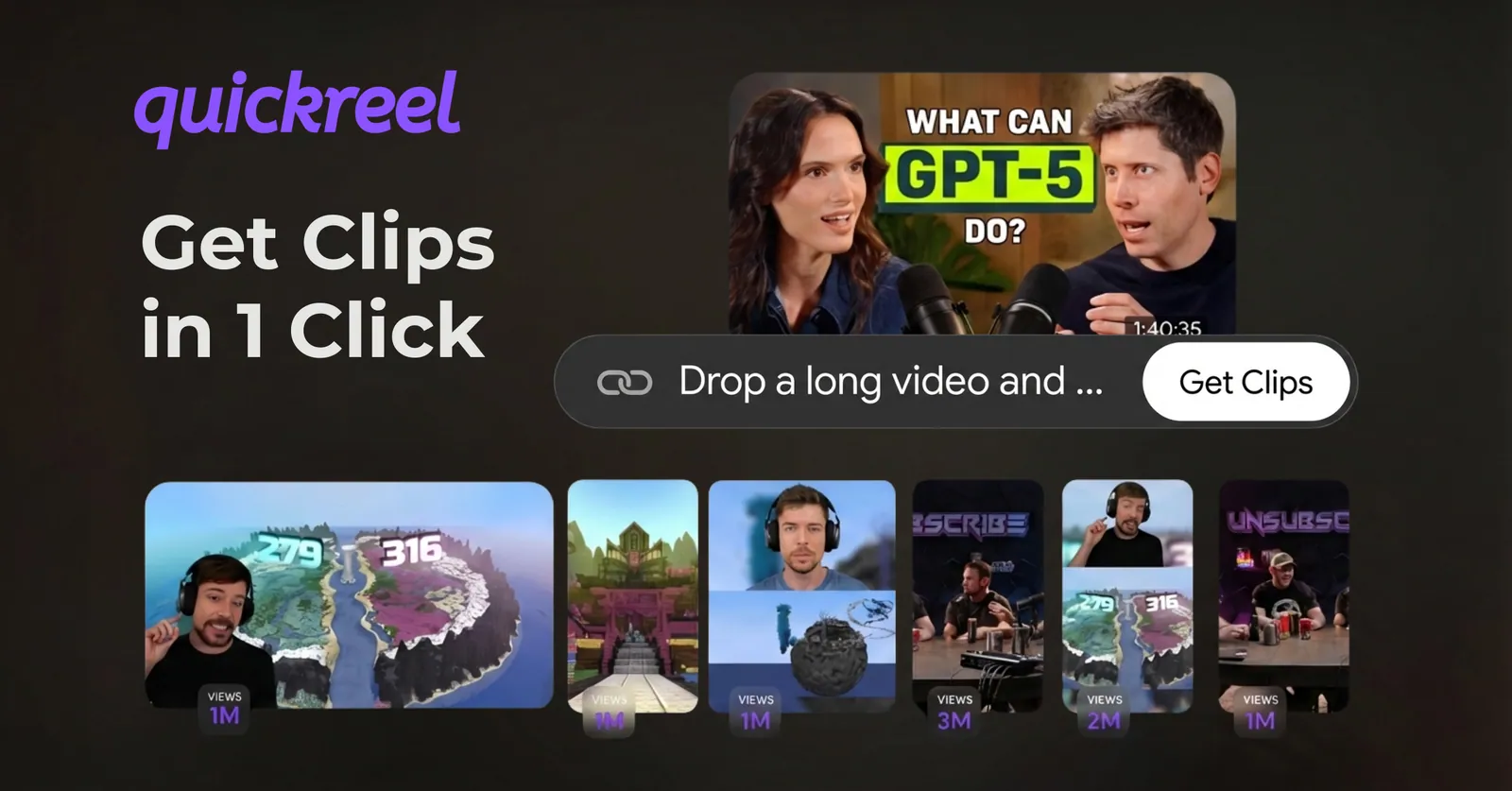
QuickReel is built around the one move a beginner needs: paste a YouTube link or upload an episode, and it returns captioned, vertical clips you can download or schedule. A 20-minute video runs about 20 credits and yields six to eight clips, per QuickReel's own credit explainer. Sign-up needs no credit card, and the interface stays in plain language, "clips," "captions," "schedule," not a wall of pro-editor terms.
The reason it sits at the top of the friction ranking is the defaults. The auto-generated caption styles and the vertical crop are close enough to post untouched on day one, which is the whole point when you can't yet judge a good crop from a bad one. There are 20+ languages and 12+ caption styles if you want them, plus scheduling to multiple platforms, but you can ignore all of it and still ship.
The honest downside: QuickReel is a clip-and-publish tool, not a full audio editor. If you want to reshape the underlying episode, fix ums, rearrange segments, master the audio, you'll still want something like Descript alongside it. And like every AI clipper here, it will occasionally start a clip half a sentence early; budget two minutes to nudge the in-point. Pricing starts at a $9/month Starter (100 credits), with Pro at $17.40/month and a $89 Ultimate at the top, per quickreel.io/pricing (June 2026).
Vizard, the cleanest editor, but the free tier watermarks
Vizard ties QuickReel on raw click count and arguably beats it on editor polish. The clip workspace is tidy and self-explanatory, captions are easy to restyle, and reviewers consistently flag it as one of the more beginner-pleasant editors in the category. For a first-timer who wants to fiddle with caption color and timing without feeling lost, it's a strong pick.
The honest downside: the free plan stamps a Vizard watermark on every export, caps you at 720p, and deletes projects after three days, per Vizard's own help center. So you can learn the tool for free, but you can't really publish for free. To post clean clips you're on Creator at about $14.50/month (billed annually) or $29 month-to-month, per vizard.ai/pricing. For a beginner, "free to learn, paid to publish" is a fine deal, just know which one you're getting.
Submagic, best caption look straight out of the box
If your one worry is "will my captions look amateur," Submagic answers it. Its captions and animated styles are the polished, TikTok-native kind that look finished without any tuning, and the editor is fully browser-based with a famously simple interface, Submagic advertises a 4.9/5 rating across 2,000-plus reviews on Google, Trustpilot and G2 combined, per its pricing page. For a beginner who's posting to Reels and Shorts and cares most about the caption aesthetic, that out-of-the-box quality is the selling point.
The honest downside: the free tier is three videos a month and watermarks the output (with a 200MB, ~90-second cap), so it's a try-before-you-buy, not a free workflow. The Starter plan is $19/month month-to-month or $12/month billed yearly, and caps you at 15 videos with a two-minute-per-video limit, per submagic.co/pricing. That two-minute ceiling matters: a full 60-minute episode has to be clipped into short pieces, so for long podcasts you'll lean on the AI's picks rather than feeding it the whole thing.
Klap, polished templates, but you pay to start
Klap produces clean, template-driven clips from a tidy, approachable workflow, and the output looks professional out of the box. For a beginner who responds better to picking a template than to fiddling with settings, that template-first approach lowers the learning curve.
The honest downside for a beginner is the on-ramp. Klap's free access is a single trial video, after which the entry plan is Starter at $14/month billed yearly (10 uploads and 100 clips a month, 45-minute source limit), per klap.app/pricing. Month-to-month runs higher. The friction isn't the price so much as the wall: you get exactly one free clip to judge the tool before you have to commit a year up front for the cheapest rate. If you already know you'll publish weekly, that's fine; if you're still deciding whether clipping is for you, one trial video is a thin basis to commit on.
Opus Clip, the most-proven engine, with a watermark gate
Opus Clip is the category's heavyweight: a $215M valuation (SoftBank Vision Fund 2, March 2025) and 10M+ users who've made 170M+ clips, per Sacra. Its "virality score", a 0-100 rating on each clip, genuinely helps a beginner decide which clips to post first, and the detection is as good as anything here.
The honest downside for a first-timer: the free plan watermarks every export, clips expire after three days, and the editor and virality features are gated above free, per Opus's plans page. So the free tier is a demo you can't publish from. There's no trial of the paid tiers either, to test the real product you pay Starter at $15/month (still no editor) or Pro at $29/month. Opus is the tool I'd recommend once you're committed; it's not the gentlest place to take your very first step, because your first clips will wear a watermark.
For the full head-to-head, see our QuickReel vs Opus Clip comparison and the wider list of Opus Clip alternatives.
2Short, simplest to test, but the free tier won't publish for you
2Short does one thing plainly: paste a YouTube URL, and it pulls shorts from it. The interface is clean, ad-free, and genuinely beginner-approachable, and it's purpose-built for repurposing existing YouTube videos.
The honest downside: the free Starter tier is built for evaluation, not publishing. It gives you 30 minutes of AI analysis a month so you can preview the AI's picks, but practical export of fresh clips is gated, to download net-new clips for posting you move to the Lite plan at $9.90/month, per 2short.ai/pricing. It also only repurposes existing video; it won't help if your podcast isn't already on YouTube. As a free way to see whether AI clip-selection works on your content, it's useful. As a free way to publish week after week, it isn't.

How we evaluated this
I edit and benchmark short-form clips for QuickReel, so I came to this with bias and I'm naming it. To keep the ranking fair, I held the criteria to things a complete beginner can verify on day one: how many clicks to a finished clip, whether the defaults are postable, and whether the words on screen need a glossary. I did not rank on advanced features (dubbing, B-roll, API), because a first-time podcaster will not touch them for months, and ranking on them is how most "easiest tool" lists quietly stop being about ease.
Pricing and free-tier limits were checked against each tool's live pricing or help page in June 2026 and are cited inline. They change often; verify the current number before you pay.
One caveat worth stating plainly, because the marketing for every tool here buries it: no AI clipper ships fully hands-off. Across the clips I cut and benchmark at QuickReel, roughly a third still need a small human fix before posting, a trimmed in-point, a corrected caption word, a swap for a stronger moment (QuickReel internal review, not a published study). The AI finds strong moments and gets the caption mostly right, but it will clip half a sentence, mistime a line, or pick a flat clip now and then. The "easiest" tool isn't the one that removes the review, none do, it's the one that makes the review a two-minute glance instead of a learn-the-software project.
Who should pick what
For a true first-timer who wants to post the same day, QuickReel is the lowest-friction start: no card, plain UI, and defaults you can post without editing.
If you want a cleaner editor and don't mind paying once you're past testing, Vizard is the nicest workspace. If captions are your whole anxiety, Submagic looks best untouched. Klap is for the beginner who already knows they'll publish weekly and will commit to an annual plan (from $14/month) for polished templates.
Opus Clip is the tool to graduate to once you're committed, the engine and the virality score are excellent, but its watermark gate makes it a rough place to take step one. And 2Short is the right free test, the wrong free publisher.
Whichever you choose, the workflow is the same five steps. Pick the one that makes step four optional, and post three clips this week instead of perfecting one. For deeper feature comparisons, see our tested AI podcast clip generators roundup, the free clip tools breakdown if budget is the deciding factor, and the auto-captioning tools guide if caption quality is your priority.