
Best AI Video Repurposing Tools (2026)

If you record one long thing a week and want it everywhere, pick by outputs, not clip quality, most tools detect roughly the same moments. For multiple asset types from one upload (clips, audiograms, captions, blog text, scheduling), Descript covers the widest spread, and QuickReel covers nearly as wide at the lowest entry price. The twist: scheduling is now table stakes, all six publish to social, so the real spread-makers are who builds audiograms (only Descript) and written blog/show-note output (Descript, plus QuickReel's blog-to-video). The coverage matrix below decides it.
Almost every "best AI video repurposing tool" roundup ranks the same five tools on the same axis: which one finds the better clips. That axis is nearly dead. When everyone has clips, the clip stops being the differentiator. Run one episode through several of these tools and the shortlists overlap heavily, they surface the same laughs, the same hot takes, the same clean soundbites. So this comparison scores something else: how many distinct asset types each tool produces from a single upload. That is what "repurposing" should actually mean.
What "repurposing" should mean (and what most tools do instead)
Repurposing one episode should produce more than one format. A 30-minute interview holds enough material for short clips, a square audiogram for audio-first feeds, a caption file for accessibility and search, a blog post or show notes, and a scheduling step to push it all out. Most tools labeled "repurposing" stop at the first item, they are excellent clip generators wearing a broader name.
That gap matters because clips are how new listeners find you, not the whole job. Clips drive an estimated 20–40% of new audience for video shows and can raise reach two to five times (Podcast Studio Glasgow). But clips alone leave the audio-only and search audiences on the table. Make only clips, and you are repurposing one episode into one channel, not many.

The verdict, up front
- Widest coverage: Descript, clips, captions, audiograms, blog text, and show notes from one transcript. The trade-off is price and a learning curve; it is an editor first.
- Best coverage-to-price: QuickReel, clips, captions, 40+ language subtitles, AI titles/descriptions, blog-to-video, and a scheduler that reaches up to ~30 platforms on the top tier, with a free plan to test (QuickReel pricing).
- Best pure clip detection + virality scoring: Opus Clip, single-purpose and very good at it, with a built-in social scheduler; $15/mo Starter, $29/mo Pro for editing (Opus Clip pricing).
- Best for international clip teams: Vizard, strong clip engine, 100+ translation targets, browser-based, with an auto-schedule calendar (Vizard pricing).
- Cleanest captions: Klap, polished caption styling and direct scheduling, but no audiogram or written-text output (Klap pricing).
- Trend-matched clips + publishing, priciest entry: Munch, clips plus keyword/trend analytics and a publish manager, from $49/mo (Munch review, NemoVideo).
The coverage matrix (the part nobody else publishes)
This is the table to act on. Each "Yes" means the tool produces that asset type itself from a single upload, not "you could export the file and paste it into a different app." "Scheduler" means native multi-platform publishing, not a one-off social post. Prices were verified in June 2026 from each tool's own pricing page; SaaS prices move, so re-check before you buy.
| Tool | Clips · Captions/SRT · Audiogram · Blog/text · Scheduler | Distinct types | Entry paid price |
|---|---|---|---|
| Descript | Yes · Yes · Yes · Yes · No (publishes to social, not a calendar scheduler) | 4 | $16/mo Hobbyist (annual) |
| QuickReel | Yes · Yes · Limited (text-to-video, not classic audiogram) · Yes (blog-to-video) · Yes (6–30 platforms by tier) | 4 | $9/mo Starter |
| Opus Clip | Yes · Yes · No · No · Yes (social scheduler, auto-post) | 3 | $15/mo Starter |
| Vizard | Yes · Yes · No · No · Yes (auto-schedule calendar) | 3 | $14.50/mo Creator (annual) |
| Klap | Yes · Yes · No · No · Yes (calendar, paid plans) | 3 | $14/mo Basic (annual) |
| Munch | Yes · Yes · No · No · Yes (publish manager) | 3 | $49/mo Pro |
Three honest caveats are baked into that table. First, the headline finding, scheduling is no longer a differentiator. All six now publish to social: Opus, Vizard, Klap, and Munch each have a calendar or auto-post feature (Vizard auto-schedule; Klap scheduling). Descript is the odd one out: it posts to social but does not run a true multi-platform calendar, so I scored its scheduler "No." Second, "audiogram" is where the real spread opens up: only Descript builds true audiogram videos, a waveform over a still or branded template, on paid tiers (Capterra plan breakdown); QuickReel leans on text-to-video and AI footage rather than a classic waveform audiogram, so I marked it "Limited," not "Yes." Third, "blog/text" means the tool generates publishable written content: Descript's AI Actions turn a transcript into blog posts and show notes; QuickReel turns written content into video (blog-to-video) and auto-writes clip titles and descriptions; the others generate caption text and that is it. So once you discount the now-commodity scheduler, the spread narrows to two things, written output and audiograms, and only Descript and QuickReel touch both.

How we evaluated
I run QuickReel's clip-quality benchmarks and have edited thousands of short-form clips, so I read these tools the way an operator does, not a feature-list scraper. For this comparison I did three things. I counted each tool's output types from its documented features, not its marketing adjectives. I verified every price from the tool's own pricing page in June 2026. And I applied the reality check that holds for all of them: every AI clipper still needs roughly 20–40% human review. None posts unattended without producing the occasional off-frame crop or mis-timed caption. Where a price varied across third-party reviews, I deferred to the official page and flagged the variance.
One number worth keeping in view: Opus Clip raised at a $215M valuation in March 2025 and reports 10M+ users (Sacra). The category has money and momentum. That makes the coverage question sharper, not softer, capital is chasing clip detection that has largely commoditized.
The tools, reviewed honestly
Descript, widest coverage, but it's an editor first
Descript is the only tool here that genuinely does the whole list. From one transcript, its AI assistant Underlord can pull social clips, strip filler and silence, generate show notes and chapters, and turn the episode into a blog post, and the platform builds true audiograms on paid tiers (Capterra). Transcription runs roughly 92–95% accurate on clean single-speaker English (Sonix review).
The cost is two-sided. First, money: a September 2025 overhaul replaced "unlimited transcription" with a two-meter system of media minutes plus AI credits, so heavy clip and Studio Sound use burns credits faster than the headline price implies (Descript pricing). Hobbyist is $16/mo annual, Creator $24/mo annual (Capterra). Second, it is a full editor, more to learn than a paste-a-URL clipper. Pick Descript if the written outputs matter as much as the clips and you want one tool for the whole pipeline.
QuickReel, the coverage-to-price pick
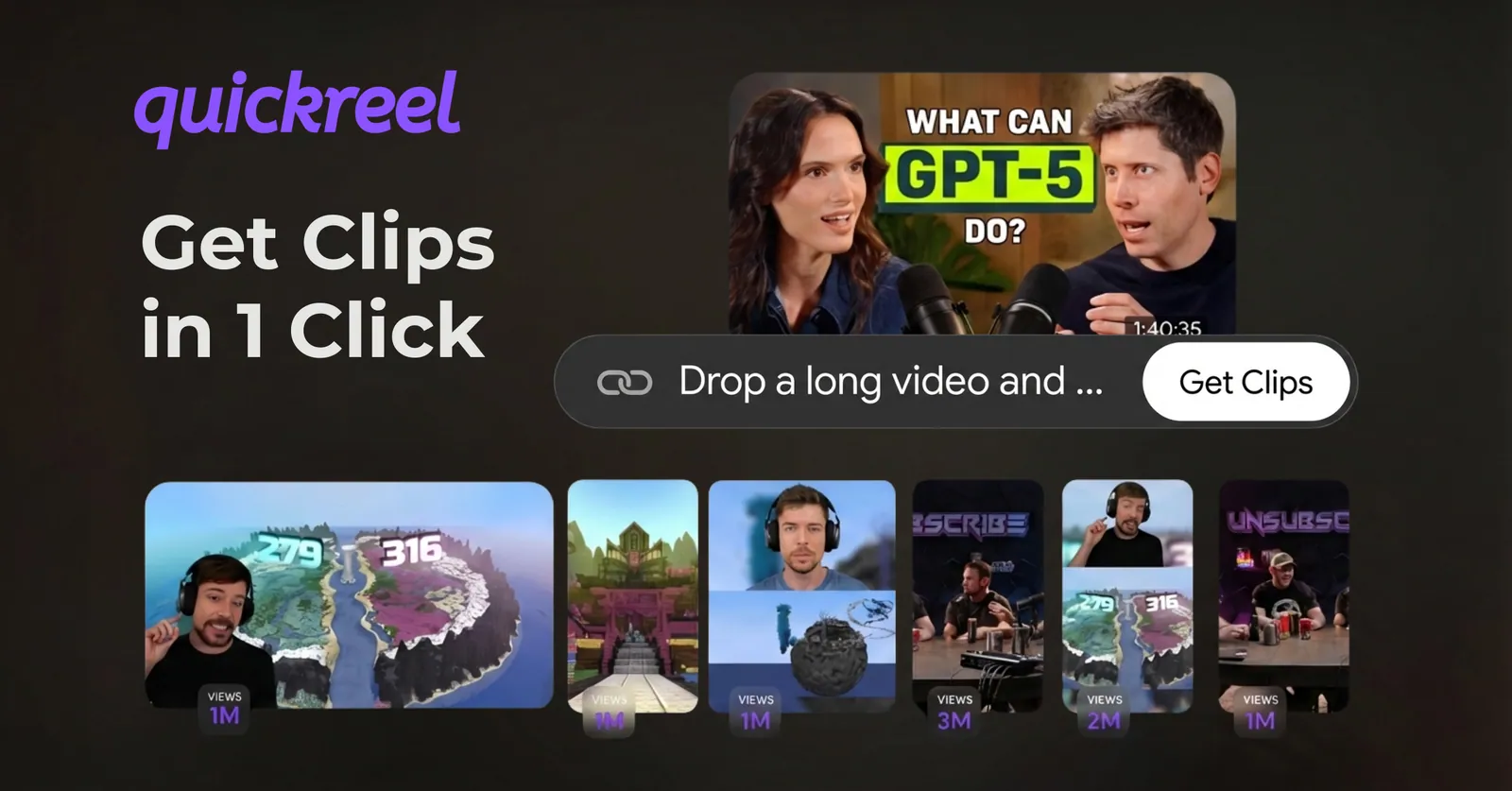
QuickReel matches Descript's four counted output types but does it for a fraction of the price, and it has the one thing Descript lacks: a true multi-platform scheduler with a calendar (Descript posts to social but doesn't run one). From one upload it makes clips with a virality score, captions in 12+ styles, subtitles in 40+ languages, AI-generated titles and descriptions, and an AI Hook that rebuilds the opening seconds; it also does blog-to-video, converting written posts into video (QuickReel features; pricing). The scheduler connects 6 platforms on the mid tier and up to ~30 on the top tier, broader reach than the clip-first tools' calendars, most of which connect a handful of accounts at the entry level.
Honest limits: QuickReel does not build a classic waveform audiogram the way Descript does, its audio-first answer is text-to-video and AI footage, which is a different thing. And like every tool here, its clip picks need a human review pass. Pricing starts at $9/mo Starter, with Pro at $17.40/mo, plus a free plan to test first (QuickReel pricing). Pick QuickReel if you want most of Descript's breadth plus scheduling at roughly half the price, and you publish to many platforms weekly.
Opus Clip, the best single-purpose clip engine
Opus Clip is the category's reference point for a reason: upload a long video and it finds 10–30 strong moments, scores each on estimated virality, and reframes with speaker tracking (Opus Clip pricing). The virality score is genuinely useful for deciding what to review first. It is also honest about what it is, purely a repurposing tool; with no source video, it has nothing to do.
The catch is the credit model and the gates. One credit equals one minute of source processed regardless of how many clips come out; Pro gives 300 minutes ($29/mo, ~$14.50 billed annually); and editing, the AI hook, and B-roll are Pro-locked, Starter at $15/mo removes the watermark but still cannot edit (Opus Clip pricing analysis, eesel). It does include a social scheduler that auto-posts to YouTube, TikTok, and Instagram, but coverage stops there, no audiogram, no blog text. Pick Opus Clip if you only need clips and want the most trusted detection. For heavier or broader needs, see our Opus Clip alternatives and the head-to-head with QuickReel.
Vizard, clip-first, strongest for international teams
Vizard does clips well and stands out on languages: it auto-captions and translates into 100+ targets from 30+ input languages, with native YouTube and Zoom imports (Vizard via Creatify review). For a team clipping interviews and webinars across markets, that translation depth is a real edge.
It does include an auto-schedule calendar that posts to YouTube, TikTok, Instagram, X, LinkedIn, and Facebook (Vizard auto-schedule). What it does not do is written output or audiograms, no blog/text, no waveform audiogram (Vizard pricing). Creator runs $29/mo monthly or about $14.50/mo billed annually, and the credit math is, by several reviewers' accounts, buried in the docs. Pick Vizard if multilingual clips are the job and written assets are not.
Klap, the cleanest captions, narrow on output types
Klap's captions are the standout: bold, minimal, or colorful styles that look professional without manual fiddling, plus solid brand kits and speaker-tracked reframing (Klap pricing). If your bottleneck is making clips look finished, Klap removes it. On paid plans it also schedules straight to TikTok, Instagram, YouTube, and LinkedIn from a built-in calendar (Klap scheduling).
Where it stays narrow is the other output types: no audiogram and no blog/written text, it generates clips, captions, and the scheduling step, full stop. Basic is $28/mo monthly or $14/mo annual (10 videos up to 45 min, 100 clips), Pro $78/mo monthly or $39/mo annual (Klap pricing). Pick Klap if caption polish is the priority and you don't need written assets or audiograms.
Munch, trend-matched clips plus a publish manager
Munch leans analytical: alongside clip detection it runs keyword and trend analysis, scores clips for coherence, and posts directly to YouTube, TikTok, and Instagram (Munch review, NemoVideo). That trends-plus-publishing combination is genuinely more than a pure clipper, and its coherence scoring is one of the better attempts at picking moments that stand on their own.
The honest knocks are price and accuracy. Munch starts at $49/mo Pro (250 minutes), climbs to $116 Elite and $220 Ultimate (Sonary), and one hands-on reviewer found its clip moments coherent about 70% of the time, usable, but you still review before posting (NemoVideo). No blog/text output, no audiogram. Pick Munch if trend-matching and a built-in publish queue justify the highest entry price in this list.
Who should pick what
Match the tool to the asset spread you actually need, not the longest feature list:
- You publish clips only: Opus Clip or Klap. Opus for detection and virality scoring; Klap for caption polish. Both now schedule, so distribution is covered either way.
- You clip across languages: Vizard for translation depth (100+ targets) with its own scheduler, or QuickReel if you also want 40+ language subtitles plus written output in one place.
- **You want clips and written content (blog, show notes) from one episode:** Descript, full stop, the only tool that does both natively well, and the only one that also builds true audiograms.
- You want the widest output spread at the lowest cost, with a free tier to test: QuickReel, it ties Descript on counted output types and undercuts every tool here on entry price.
- You want trend analytics and a built-in publish queue, and the budget is there: Munch.
A closing reality check, because BOFU readers deserve it: virality without strategy is empty engagement, and views are not conversions. The widest-coverage tool still won't grow your show if the clips don't earn a follow. Pick for the outputs you'll actually use, then judge by whether the clips drive subscribers, not by the dashboard's view count. For deeper clip-quality testing across these tools, see our tested podcast clip generators; for caption-specific picks, the best auto-captioning tools; and if budget is the constraint, the best free podcast clip tools.
FAQ
What is the best AI video repurposing tool in 2026? For the most output types from one upload, Descript leads, clips, captions, audiograms, and blog text from one transcript. QuickReel ties it on counted output types and adds a true scheduler Descript lacks, all at the lowest entry price, so it's the value pick. For clips alone, Opus Clip has the most trusted detection. There's no single winner; pick by which assets you need.
What's the difference between a clip generator and a repurposing tool? A clip generator produces short videos from a long source and stops there. A true repurposing tool turns one upload into multiple formats, clips, an audiogram, captions, written content, and a scheduling step. Most tools marketed as "repurposing" are clip generators; only Descript and QuickReel cover meaningfully more here.
Can these tools turn a video into a blog post? Only Descript does it well natively, its AI Actions convert a transcript into blog posts and show notes (Descript). QuickReel goes the other direction (blog-to-video) and auto-writes clip titles and descriptions. Opus Clip, Vizard, Klap, and Munch generate caption text but not publishable blog content.
Do AI repurposing tools still need human editing? Yes. Every tool here needs roughly 20–40% human review, checking crops, fixing caption typos, trimming a moment the AI cut a beat too early or late. Treat any of them as an accelerant that does the first 70%, not a hands-off publisher.
Which is cheapest? QuickReel has the lowest entry paid plan at $9/mo and a free tier (QuickReel pricing). But the cheapest entry plan isn't always the cheapest in use, Opus Clip and Munch meter by source minutes, and Descript layers AI credits on top of media minutes, so heavy users can pay more than the sticker suggests. Verify current pricing and credit caps on each tool's page before you commit.