
Spotify for Podcasters: What You Give Up for Free

Spotify for Podcasters (the platform formerly called Anchor) is a genuinely free host with unlimited storage and unlimited downloads, the only major one with no caps. The trade-off is that it is built to make Spotify better, not to make you portable. Your richest data, your subscription revenue, and your premium features all lean toward Spotify's ecosystem. For most new shows it is a fine place to start, as long as you start with eyes open.
That is the whole review in three sentences. The rest of this page is the audit behind it: a dimension-by-dimension look at what free actually costs you, where the platform is excellent, where it goes flat, and the one risk most "Anchor review" posts skip entirely.
A quick naming note, because it confuses everyone. Anchor launched in 2015, Spotify bought it in 2019, and it has been renamed twice since, first to Spotify for Podcasters, now consolidated under Spotify for Creators (creators.spotify.com). It is one product with three names. I'll use the current name and "Anchor" where it helps you find it.
Is Spotify for Podcasters good?
For a new or hobby show, yes, it is good and the price is right. You get unlimited hosting at zero cost, one-click distribution to every major directory, and the best in-app analytics of any host for the listeners who are on Spotify. It becomes a worse fit as you grow a cross-platform audience, want detailed data everywhere, or plan to monetize early, because the strengths are concentrated inside Spotify's walls.
The honest framing is not "good or bad." It is "good at the things Spotify is incentivized to be good at." Spotify gives away hosting because hosting feeds its app with content and keeps listeners inside the product. That alignment works in your favor at the start, and against you the moment your goals point outward.
The free tier, audited dimension by dimension
Here is the side-by-side, then the detail on each row. Every claim is sourced in the section that follows.
| Dimension | What you get | The catch |
|---|---|---|
| Cost & storage | Free, unlimited storage and downloads | None on cost; this is the genuine win |
| Distribution | Auto-feed to Apple, YouTube Music, Amazon, more | Submitting to Apple is less smooth than rival hosts |
| Analytics | Rich demographics + retention on Spotify | Off-Spotify, you get raw download counts only |
| Monetization | 50/50 ad split + subscriptions + video revenue | Eligibility gates; subscriptions and video are Spotify-listener-only |
| Portability | RSS exports; 301 redirect to a new host | Premium features and video don't travel with you |
| Account safety | Long-running, Spotify-backed | Inactive legacy accounts faced deletion in 2026 |
Cost and storage: the real, unambiguous win
This is where Spotify for Podcasters earns its popularity, full stop. It is the only major host offering unlimited storage and unlimited downloads with no tier upgrades as you grow, per Resonate Recordings' 2026 review. Paid hosts that meter downloads or uploads run roughly $15–$50/month for a show at that scale, Libsyn sits around $15–$20 on upload-based pricing, and a download-metered host like Captivate jumps to $49/month once you pass 30,000 downloads. Modest money, but recurring, and on Spotify it's zero.
For a beginner, that removes the single most common reason new podcasters quit before finding their footing: a recurring bill for a show that hasn't proven itself yet. If you are testing whether you'll even stick with podcasting, and nearly half of all podcasts never make it past their first three episodes Amplifi Media, paying $0 to find out is the rational move. No con here. The cost is the cost in the other dimensions.
Distribution: broad, with one rough edge
Spotify for Podcasters generates a standard RSS feed and pushes it to Apple Podcasts, Amazon Music, YouTube Music, and the other major directories (Resonate Recordings). Distribution is platform-neutral in the sense that your show reaches listeners wherever they are.
The rough edge: getting onto Apple Podcasts is more hands-on here than with hosts that have a tighter Apple integration. Buzzsprout's own comparison notes Spotify "allows easy distribution to Spotify, but other major directories like Apple Podcasts are much more difficult" (Buzzsprout, 2026), a fair point to weigh, and an expected one from a competing host. In practice it's a one-time submission hassle, not an ongoing tax.
Analytics: excellent inside Spotify, blind outside it
This is the most important trade-off to understand, so here it is plainly. Inside Spotify, the analytics are among the best any host offers, listener demographics, retention curves, episode-by-episode performance, follower growth, and how people found your show. Buzzsprout, a direct competitor, concedes you "can't beat stats from Spotify for Creators" for that data (Buzzsprout, 2026).
The blind spot is everything else. For listeners on Apple Podcasts, Overcast, or Pocket Casts, the analytics fall back to basic download counts (Resonate Recordings). You see how many times an episode was downloaded, and little more. If your audience splits across apps, and most growing shows' audiences do, you are flying with rich instruments over half the route and a fuel gauge over the rest.
Why this matters for a new show: your first big growth lever is short clips on social, and clips drive 20–40% of new audience for video shows (Podcast Studio Glasgow). Those new listeners often land on Apple or YouTube, not Spotify, exactly where your data goes flat. You can grow well here; you just can't see all of it.
Monetization: real money, real gates
Spotify's creator monetization is more serious than it was, and worth understanding before you build a plan on it. There are three paths: the Spotify Partner Program (an ad-revenue share, a 50/50 split), subscriptions for premium episodes, and Premium video revenue when Spotify Premium users watch your video episodes (Whop, 2026; Spotify for Creators).
The gates are the catch, and they have two parts. First, eligibility. Spotify cut Partner Program thresholds sharply in January 2026 to 1,000 engaged audience members over the prior 30 days, 2,000 consumed hours, and a 3-episode minimum, down from 2,000 listeners / 10,000 hours / 12 episodes (Spotify newsroom, Jan 7 2026; TechCrunch, 2026). The program runs only in eligible markets, the US, UK, Canada, Australia, and the Nordics among them, so check the current terms for your country before you count on it.
Second, the part to get right: not all of this revenue is Spotify-listener-only, and most "Anchor review" posts get this backwards. Per Spotify's own program terms, the 50% ad-revenue share applies to ads Spotify monetizes in your episodes both on and off Spotify, including plays on other apps. What is walled off is the rest: subscription content is purchasable only by people who subscribe through Spotify, listeners on Apple Podcasts or Pocket Casts cannot buy your premium tier at all (Resonate Recordings), and Premium video payouts are limited to Spotify Premium viewers. So the ecosystem concentration narrows your subscription and video money to one slice of your audience, even though ad revenue follows your show across platforms. (As of January 2026 you don't even need to host on Spotify to join the Partner Program, Acast, Libsyn, Audioboom and others integrate via Spotify's Distribution API, per the Spotify newsroom.)
Keep the broader reality in view: across all hosts, most independent podcasters earn little, small shows under 1,000 listeners typically pull $0–$50 a month, and meaningful revenue tends to arrive only after a couple of years of consistent publishing (OBSBOT, 2025; Command Your Brand, 2025). Monetization is a real feature here, but it is not a near-term plan for most new shows on any platform.
Portability: you can leave, but not with everything
Good news first, because most reviews get this wrong out of fear: you are not trapped. You can move to another host. The path is standard, export your episode files, sign up elsewhere, import your RSS feed URL, and the new host generates a 301 redirect from the old feed so your subscribers stay subscribed (Resonate Recordings). Your back catalog and your audience follow you. That is the part lock-in scaremongering ignores.
The real lock-in is subtler. Everything you built that is Spotify-native does not travel: video episodes, subscriber-only premium content, and the rich analytics history all live inside Spotify's ecosystem. Move hosts and you keep your audio feed and subscribers; you leave behind the premium experience and the data trail. The deeper you invest in Spotify-only features, the higher your switching cost, not because the RSS won't move, but because the value you created on top of it won't.
Account safety: a 2026 wake-up call
One event from this year belongs in any honest review. In March 2026, Spotify emailed holders of inactive legacy Anchor / Spotify for Podcasters accounts a firm deadline of April 17, 2026 to migrate to a standard Spotify login, or have all stored audio, video, and images permanently deleted with no recovery path (ppc.land).
Read it for what it is. This was housekeeping tied to merging Anchor's old logins into Spotify for Creators, not a sign that active shows are at risk. But it is a useful reminder of the deal: when your show lives on a platform you don't control, the platform's consolidation decisions become your problem. Keep local backups of your master files regardless of host. That rule is free and it never expires.
How I evaluated this
This review judges Spotify for Podcasters on the criteria that matter to a new or growing independent show: cost, distribution reach, analytics depth (on and off Spotify), monetization access, portability, and account safety. The basis is the platform's own documentation, Spotify for Creators, the Partner Program terms, and the January 2026 newsroom announcement, plus independent reviews: primarily Resonate Recordings for feature and migration detail and Buzzsprout's competitor comparison, which I weighed knowing Buzzsprout is a rival host. Monetization thresholds and eligible markets change; every figure here was current at publication, confirm the live terms before you build a plan around any of them.
Who should use it, and who shouldn't
Use Spotify for Podcasters if you are starting out, want zero hosting cost while you find your footing, expect a Spotify-heavy audience, or run a hobby show where unlimited free hosting outweighs cross-platform data. For most first-time podcasters, it is the sensible default. Pair it with a decent mic, see the best podcast mics by budget tier or the best podcast mic under $100, and you can launch for almost nothing.
Look elsewhere if you need detailed analytics across every app from day one, you're building a cross-platform monetization plan, or you want a host whose incentives point at your portability rather than at one player's ecosystem. A metered paid host gives you uniform stats everywhere; that's what you're paying for.
Two things worth separating from the hosting decision entirely. Recording quality with remote guests is a different problem, start with Riverside vs Zencastr vs SquadCast compared, since no host fixes a bad recording. And if you're recording at all on a budget, free podcast recording software that's actually usable and podcast editing software for total beginners cover the steps before hosting. Mac users can shortlist with the best podcast recording software for Mac.
Where clips fit, and my own bias
Full disclosure: I work on QuickReel, so here's the honest line. QuickReel is not a host and not an Anchor alternative, it doesn't store or distribute your episodes, and it won't replace Spotify for Podcasters for that job. The two sit at different points in the workflow.
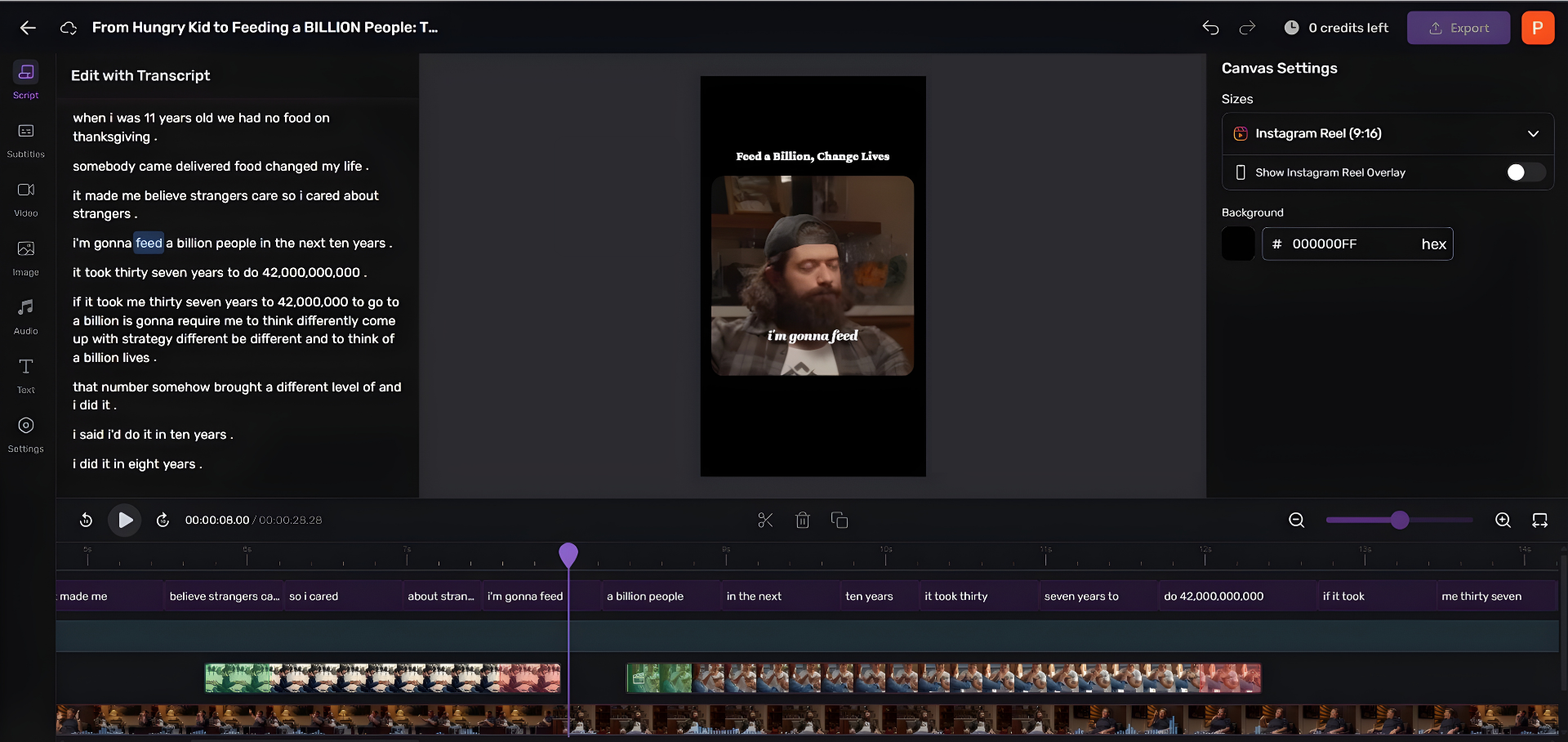
What it does is the step that fixes Spotify's biggest blind spot. Your analytics go flat off Spotify, but that's also where your next listeners are, on YouTube, TikTok, Instagram, and Apple, where short clips do the discovery work. YouTube alone passed one billion monthly podcast viewers (Variety, Jan 2025). Host on Spotify if the free, uncapped storage suits you, then turn each episode into captioned vertical clips and post them where new audiences actually find shows.
FAQ
Is Spotify for Podcasters really free? Yes, genuinely. There's one plan and it's free, with unlimited storage and unlimited downloads and no tier upgrades as you grow (Resonate Recordings, 2026). The cost shows up elsewhere, thinner off-Spotify analytics, monetization gated to Spotify listeners, and Spotify-native features that don't move if you leave, not in a bill.
Can I move my podcast off Spotify for Podcasters later? Yes. Export your episode files, import your RSS feed to a new host, and set a 301 redirect so subscribers stay subscribed (Resonate Recordings). Your audio catalog and audience follow you. What doesn't travel: video episodes, Spotify subscriber content, and your analytics history.
Does Spotify for Podcasters distribute to Apple Podcasts? Yes, it generates an RSS feed that reaches Apple, Amazon Music, YouTube Music, and other major directories. The one rough edge competitors point to is that getting onto Apple is a bit more hands-on here than with hosts built around tighter Apple integration (Buzzsprout, 2026).
How much can I make with Spotify monetization? It depends on eligibility and audience. There's a 50/50 ad-revenue share, subscriptions, and Premium video revenue, but you must clear Partner Program thresholds, cut in January 2026 to 1,000 engaged audience members, 2,000 consumed hours, and 3 episodes (Spotify newsroom). Ad revenue follows your show on and off Spotify; subscription and Premium video money is Spotify-listener-only. Across all hosts, most podcasters earn little, fewer than a third monetize at all.
Are my old Anchor account and episodes safe? Active shows are fine. In 2026 Spotify deleted only inactive legacy accounts that weren't migrated to a Spotify login by an April 17 deadline (ppc.land). The lesson for everyone, on any host: keep your own local backups of your master audio and video files.