
AI Clipping Cost vs a Freelance Editor's Bill

On pure cost, AI clipping wins above roughly two clips a month, and the gap is not close. A freelancer charges $50–$100 for one solid captioned podcast clip (gigradar 2026 rates; pixflow guide). An AI subscription charges that, or less, for a whole month and dozens of clips. So a single human clip can cost more than thirty days of software.
This page is deliberately not the AI-versus-human quality debate. It's the bill. I run clip-quality benchmarks for a living, and below I put real per-clip freelance rates, a real monthly retainer, and verified AI subscription prices into the same units, cost per finished clip, then mark the exact volume where each one wins. Freelance still wins something. It just isn't price. Every figure here was checked against its source on 27 June 2026; rates move, so re-verify before you commit a budget.
Is AI clipping cheaper than a freelance editor?
Yes, at almost any real volume. A freelance editor charges $50–$100 per solid short-form podcast clip, and that rate is flat, ten clips cost ten times one. An AI clip subscription is flat the other way: $9–$29 a month covers dozens of clips, so its cost per clip falls as you make more. The two lines cross at about two clips a month, and after that AI is cheaper on every model.
The reason is structural, not a discount. Freelance is a per-unit price; software is a fixed price. The moment you make more than one or two clips, a fixed monthly fee spread across many outputs beats a per-unit fee charged on each. That is the whole comparison in one sentence, the rest of this page is the receipts and the one honest exception.
What does a freelance editor actually charge per clip?
For short-form podcast clips, expect $20–$100 per clip at the budget-to-standard tier, with solid captioned work clustering around $50–$75 (gigradar 2026). Creative, branded, motion-graphics-heavy edits run $100–$500 per clip (pixflow). The headline truth: the rate is per finished clip, so it does not fall with volume.
Three pricing shapes are common in 2026, and you'll be quoted one of them:
- Per clip. $20–$100 for a standard captioned short; $100–$500 for high-production work (pixflow).
- Per episode. $150–$400 to take one podcast episode and cut its social clips as a package (gigradar).
- Monthly retainer. Roughly $1,800/mo for 40 short clips (about $45/clip), scaling to $5,000/mo for 16 episodes plus 32 social clips at the podcast-network end (gigradar). Retainers buy a lower per-clip rate in exchange for a volume commitment.
One honest caveat on these numbers: they are largely US and Western benchmarks. Offshore and entry-tier editors charge meaningfully less, a beginner billing $20–$35/hr or taking $100–$400 per short project can undercut the per-clip figures above (krock 2026 rates). The tradeoff there is judgment and turnaround, not the math, which is exactly the line this comparison is drawing.
What does AI clipping cost per clip?
An AI subscription is a fixed monthly fee, so cost per clip is just the fee divided by clips you post. On QuickReel's verified ladder, Starter $9/mo for 100 credits, Pro $29 list at a standing $17.40 promo for 250 credits, Ultimate $259 list at an $89 promo for 1,000 credits, where one credit equals one minute of source video (a 20-minute upload spends 20 credits and yields 6–8 clips) (quickreel.io/pricing, checked 27 Jun 2026), the per-clip number collapses as volume rises.
| Finished clips/month | Plan | AI cost per clip |
|---|---|---|
| 5 | Pro ($17.40) | ~$3.48 |
| 15 | Pro ($17.40) | ~$1.16 |
| 30 | Pro ($17.40) | ~$0.58 |
| 60 | Pro ($17.40) | ~$0.29 |
Compare those cents to a freelancer's $50 floor and the contest is over on the sticker. But the sticker is not the whole AI cost, and pretending otherwise is the dishonest version of this article. Every AI clipper, QuickReel included, still needs a human review pass: trim a loose entry, tighten an end, drop a misfired pick. In my own clip-quality benchmarks, that touches roughly 20–40% of auto-picks across tools. That review time is a real cost the pricing page never prints. The full per-tool sticker breakdown lives in AI clip tool pricing compared side by side, and the method for folding your own time in is in how to calculate your true cost per clip.

Where is the volume threshold?
It's about two clips a month, and it's lopsided. Below two clips, the absolute dollar gap is small, one freelance clip at $50 versus a $17.40 plan is a $33 difference, and if that one clip needs to be flawless, paying the human is defensible. Above two clips, freelance cost climbs in a straight line while the subscription holds flat, so the gap widens into the hundreds and then thousands.
Here's the part that surprises people. Even after you charge yourself for the AI review pass, freelance still doesn't win on cost. Take a busy host who values their time at $50/hr and spends 5 minutes finishing each AI clip. At 16 clips a month, the all-in DIY-with-AI cost is about $84 (a $17.40 plan plus roughly $67 of review time). The freelancer for those same 16 clips is $800. For the freelancer to break even on cost alone at that volume, you would have to value your own time at about $587/hr, a rate almost no podcast operator hits. The threshold question answers itself: on price, AI wins at any volume you'd realistically run.
When is a freelancer worth the higher cost?
When you're buying judgment, not throughput. A freelancer earns the premium on the handful of clips where a human cut beats a machine pick: a launch trailer, a sizzle reel for a sponsor, a tricky multi-guest moment that needs real narrative shaping, or a brand piece with custom motion graphics. For those, $100–$500 a clip buys taste and intent that no detector reproduces (pixflow).
The trap is paying freelance rates for volume. If you need 12 captioned clips a week to feed the algorithm, hiring that out at $50 each is $600 a week for work an AI does in minutes, and most of those clips are standard talking-head cuts where the human and the machine produce nearly the same result. Moment-detection has largely converged: in my benchmarks the major tools surface mostly the same obvious picks from one upload, so paying a premium to find them rarely pays back. Spend the freelance budget on the few clips that need a human, and let software handle the steady stream of standard ones. See how the field's detection and edit quality actually compare in the best AI podcast clip generators, tested.
The honest scorecard
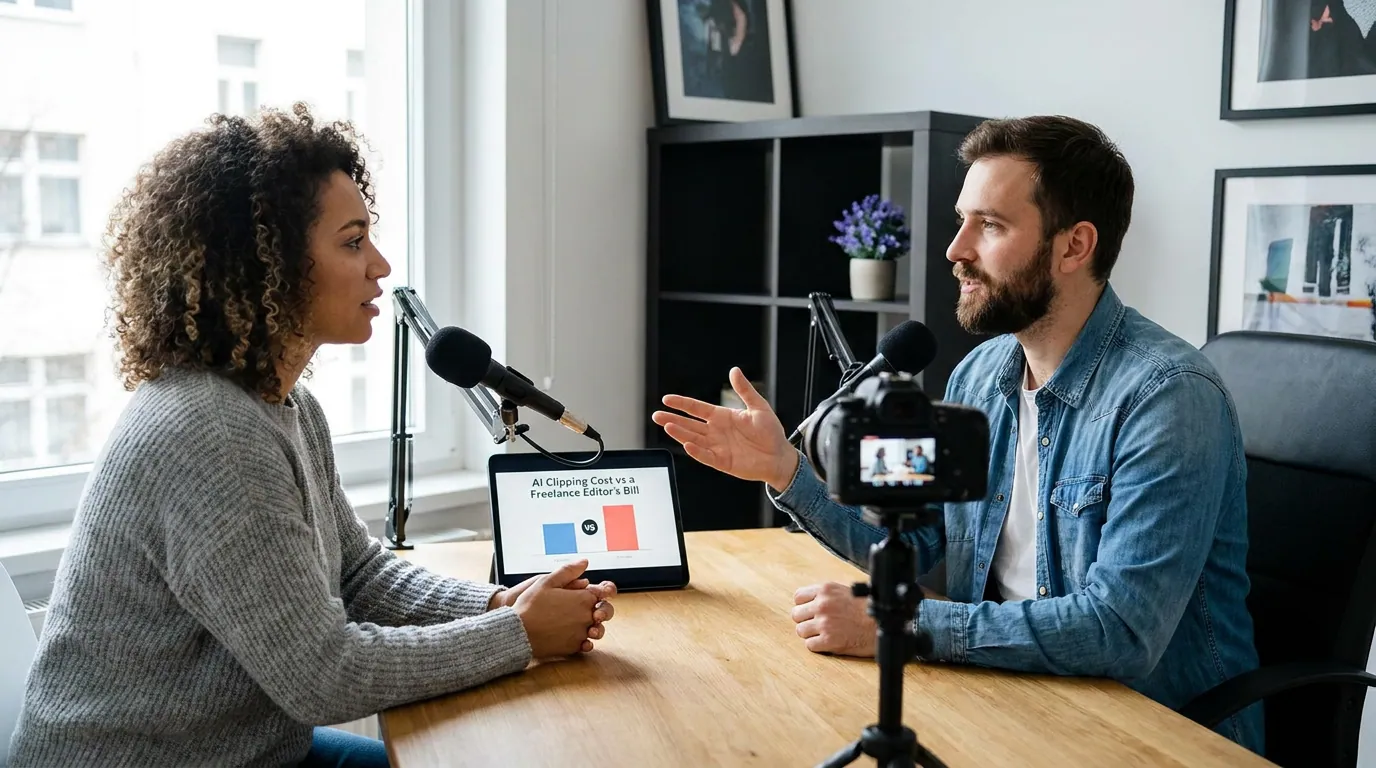
Put plainly: AI clipping is the cost winner at any volume you'd actually run, and a freelancer is the quality winner on the specific clips that need a human hand. They are not really competing for the same job. The smart spend uses both, software for the weekly volume, a human for the few high-stakes pieces.
| What you're optimizing for | Cheaper route | Why |
|---|---|---|
| Weekly clip volume (5+ a month) | AI subscription | Flat fee spread across many clips; cents per clip |
| One bespoke, high-stakes clip | Freelancer (or DIY) | Human judgment is worth the per-clip premium here |
| Predictable monthly output, hands-off | Retainer vs subscription | Retainer ~$45/clip; subscription a few dollars, AI still cheaper, retainer buys off your time |
If you want the episode-level version of this math, minutes burned, clips produced, all-in cost traced through every meter including a freelancer, see the real cost to clip one podcast episode. For the pricing units that make tools bill the same episode differently, read how clip tool credits actually work.
FAQ
Is it ever cheaper to hire a freelancer than to use an AI clip tool? Only at the very low end. If you make one clip a month and it must be flawless, a $50 freelance clip is a small absolute premium over a subscription. From two clips a month upward, the freelancer's per-unit rate compounds while the subscription stays flat, so AI wins on cost, and the gap reaches the hundreds quickly.
How much do freelance editors charge for podcast clips in 2026? Standard captioned short-form podcast clips run $20–$100 each, clustering around $50–$75 for solid work, and $100–$500 for high-production edits (gigradar; pixflow). Per-episode packages are $150–$400, and retainers run from about $1,800/mo for 40 clips up to $5,000/mo for 16 episodes plus 32 clips.
Does AI clipping have hidden costs the subscription price doesn't show? Yes, your review time. Every AI clipper needs a human pass on roughly 20–40% of its picks to trim entries, tighten ends, or drop misfires. Even so, that time is cheap relative to a freelance rate: at $50/hr and 5 minutes per clip, all-in DIY-with-AI still beats a freelancer until you value your time near $587/hr.
Can I use both an AI tool and a freelancer? That's usually the right answer. Run your weekly volume of standard clips through software at cents apiece, and pay a freelancer for the few high-stakes pieces, a trailer, a sponsor reel, a branded edit, where human judgment is worth $100–$500. You stop overpaying for volume and keep the quality where it counts. Compare tools in the best Opus Clip alternatives in 2026.