
Video Podcast vs Audio-First: Which Should You Pick?


There is no single right answer to video versus audio-first, the choice depends on your goal, your budget, and the kind of guests you record. If you are chasing discovery and growth in 2026, lean video, because that is where new listeners look. If you record remote guests on a shoestring, or your value is in deep audio, audio-first plus a light YouTube presence often beats a half-built studio.
Most articles tell you to "go video" and stop there. That advice is right for some shows and wrong for others, and it skips the path most established audio shows actually need: a hybrid route that puts you on YouTube without forcing you into a full video production. Below is a framework that asks three questions, routes you to one of three real options, and gives the audio-first crowd a specific way onto YouTube that doesn't require a camera in everyone's face.
Should your podcast be on YouTube at all?
For almost every show, yes, but "be on YouTube" and "produce a full video podcast" are two different decisions. YouTube is where podcast discovery now happens, so having something there is close to mandatory. Whether that something is a polished two-camera video or an audio track with a static cover image is the real question, and that depends on your goals and resources.
The case for being present is hard to argue with. 42% of US weekly podcast listeners use YouTube most often, ahead of Spotify and Apple (Cumulus Media / Signal Hill Insights via Backlinko, Oct 2025). YouTube said it passed 1 billion monthly podcast viewers worldwide, announced in February 2025 (Variety). And 53% of new US weekly listeners now say they prefer to watch a podcast, up from 30% in April 2022 (Backlinko).
So the honest framing is not "audio is dead." Plenty of beloved shows are audio-first and growing. The framing is: if you ignore YouTube entirely, you are absent from the largest discovery surface in podcasting. The decision is how much production you put behind your YouTube presence, not whether to have one.
The three-question decision framework
Answer three questions and you land on one of three paths. The questions are deliberately about you, not about a trend: what you are trying to get out of the show, what you can actually sustain, and how your guests show up. A blanket "go video" answer ignores all three, which is why so many shows build a video setup, hate it, and quit.
Question 1, What is the goal? If you want raw discovery and a growing subscriber count, video wins, because the watch-preference shift and YouTube's reach favor it. If your goal is depth, a tight loyal audience, or a show that monetizes through a small high-value base rather than mass reach, audio-first holds up fine, you just need a basic YouTube presence so newcomers can find you.
Question 2, What is the budget? Budget means time and editing help as much as money. Video adds a camera, lighting, a tidy background, longer edits, and thumbnail design to every episode. If you cannot sustain that on top of recording, a half-built video show is worse than a clean audio one. Burnout is the real risk: publishing consistency is the single biggest predictor of a podcast surviving, and about 47% of podcasts stop at three episodes or fewer (Amplifi Media analysis). Pick the production level you can hold for a year.
Question 3, What is your guest situation? In-person guests make video natural and worth it. Remote guests over a call make full video harder to get right, mismatched lighting, webcam quality, and dead-eye framing all show. Solo shows can do either, but video raises the on-camera demand on you alone. If most of your guests are remote, the hybrid path usually beats forcing video.
The hybrid path: get on YouTube without a studio
This is the route most audio-first shows actually need, and almost no one spells it out. You can have a real YouTube presence without filming yourself: upload your episode audio as a video, lead distribution with vertical clips, and add a simple webcam only when it earns its place. You get the discovery surface without rebuilding your show around a camera.
Here is the specific hybrid setup, in order of effort:
- Upload the full episode to YouTube as audio-over-static. Pair your audio with a clean cover frame or a slow-moving waveform, add chapters, and write a real description. This puts your full episode where the largest share of US weekly podcast listeners already are, with zero new filming.
- Lead with vertical clips and Shorts. Clips are the discovery engine, they drive 20–40% of new audience for video shows and can raise reach 2–5x (Podcast Studio Glasgow). Even audio-first shows can clip a captioned audiogram or a simple talking-head moment. A Shorts strategy built for podcast channels is the cheapest way to test demand before you commit to full video.
- Add a single webcam when ready. Once the audio upload and clips show traction, a single decent webcam per host turns the hybrid into a light video show, no studio, no multi-cam. This is the step where you confirm video is worth it with your audience's data, not a trend article's.
The hybrid path also de-risks the whole decision. You build the YouTube presence, the clip pipeline, and the funnel first, then layer in video production only if the numbers say to. The clips-to-channel funnel for YouTube podcasts maps how those clips feed your channel, and turning Shorts viewers into long-episode watchers covers the conversion step most hosts skip.
What each path actually costs
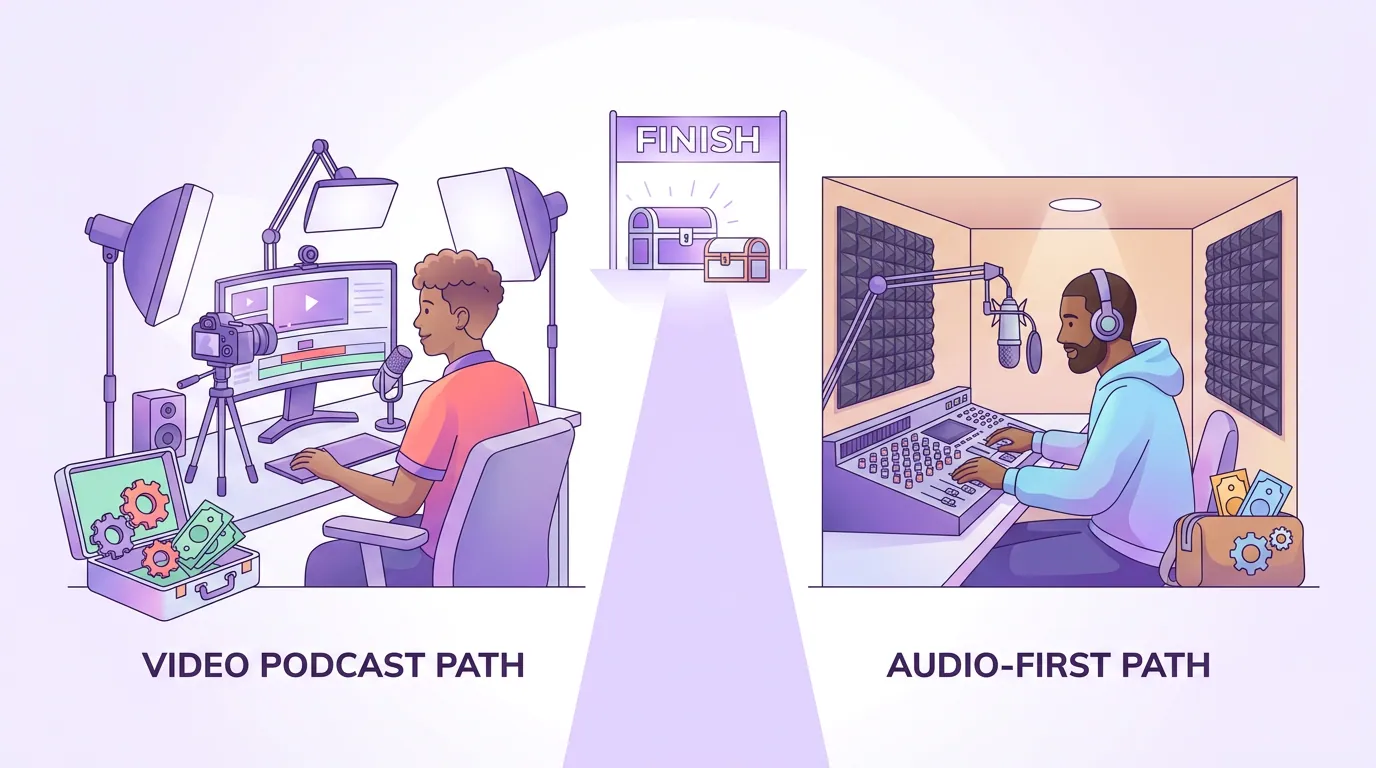
The three paths differ most in effort, not in whether they "work." Here's the honest trade-off, so you can match the path to what you can sustain.
| Path | Best for | The honest catch |
|---|---|---|
| Audio-first + YT audio upload | Depth shows, remote/solo, tight budget | You're absent from video search; clips are your only visual discovery |
| Hybrid (audio + clips + webcam) | Most shows that want reach without a studio | Requires a clip habit; webcam quality varies by host |
| Full video-first | Growth-focused, in-person guests, real budget | Highest per-episode workload; abandonment risk if unsustainable |
Common mistakes when choosing
Four patterns trip up most hosts at this fork. Each has a fix.
- Building a full video setup before testing demand. Buying lights and a multi-cam rig before a single clip proves your audience wants video. Fix: run the hybrid path first; let clip performance tell you whether to invest.
- Treating "audio-first" as "not on YouTube." Skipping YouTube entirely because you don't film. Fix: upload audio-over-static and clip from it, presence costs almost nothing.
- Forcing video on a remote-guest show. Recording mismatched webcams that make the show look worse than audio would. Fix: use clean audio plus captioned clips until you have in-person episodes worth filming.
- Confusing views with growth. A clip that "did numbers" and a clip that grew your show are different events. Virality without a funnel is empty engagement, views are not conversions. Fix: track subscribes and episode plays, not just impressions.
Tools that fit each path
You don't need different tools for audio versus video; you need a clip pipeline and a way to publish to YouTube either way. For the audio upload, your host or a simple editor that exports an audio-over-static video is enough. For clips, an AI clipper (QuickReel, Opus Clip, and others) turns either an audio episode or a video one into captioned shorts. Be honest about the ceiling: AI gives you candidates, not finished posts. Plan to manually review and pick the best handful each batch, Podcast Studio Glasgow recommends hand-selecting your top 5–10 clips (Podcast Studio Glasgow), to catch a clip that ends mid-sentence or starts weak. Budget for that review on any path.
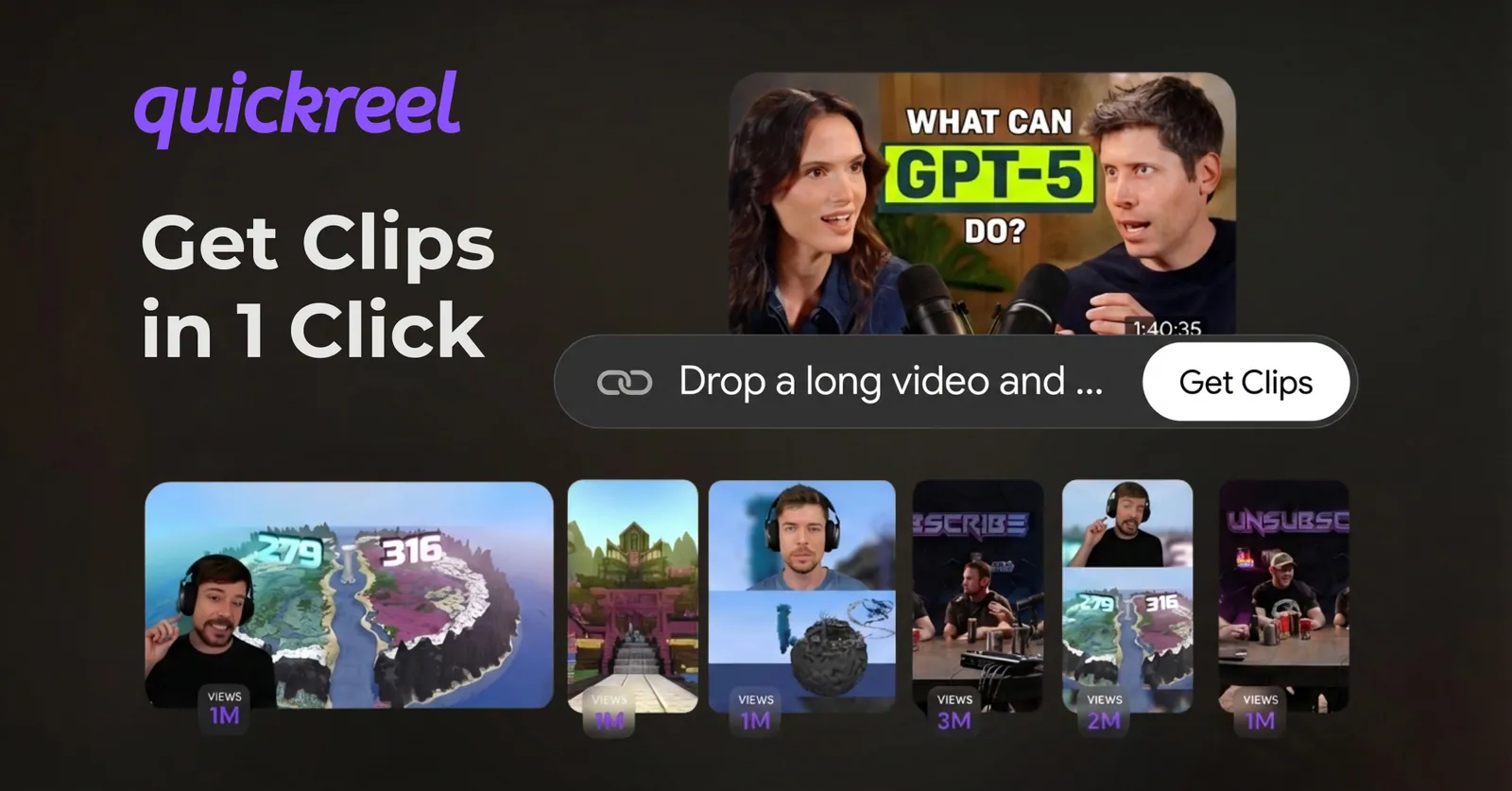
Where QuickReel fits the hybrid route specifically: paste a YouTube link or upload an episode and it returns captioned vertical clips plus multi-platform scheduling, so an audio-first show can build a YouTube clip habit without a video studio. Most clippers detect roughly the same moments, so pick the one that removes the most clicks between your episode and a posted clip. Once the clips are bringing people in, an email list built from zero and a welcome sequence for new subscribers keep the audience you attract, and the path to your first 1,000 YouTube subscribers maps what comes next.
FAQ
Is a video podcast better than audio-only in 2026? Better for discovery, not better in every way. 42% of US weekly podcast listeners use YouTube most often (Cumulus Media / Signal Hill Insights via Backlinko, Oct 2025), so video reaches more new people. But audio-first shows with loyal audiences still grow and monetize well. "Better" depends on whether your goal is reach or depth, and whether you can sustain video production.
Can an audio-first podcast still grow on YouTube? Yes. Upload your episode as audio-over-static so the full show lives where listeners search, and lead discovery with captioned clips and Shorts. Clips drive 20–40% of new audience for video shows (Podcast Studio Glasgow). You get YouTube reach without filming a full video podcast.
Do I need a studio to start a video podcast? No. A single decent webcam per host, soft natural light, and a tidy background is enough to start. The gap between that and a multi-cam studio matters less than consistency. Add equipment only after clips prove your audience wants video, not before.
Should I switch my established audio show to video? Don't switch, extend. Keep the audio show your audience already loves, add the YouTube audio upload and a clip habit, and introduce a webcam only if those clips bring real traffic. A hard switch risks your existing routine, which is the thing keeping the show alive.
What if most of my guests are remote? Lean hybrid. Remote video often looks worse than clean audio because of mismatched webcams and lighting. Run audio-first with captioned clips, and reserve full video for in-person episodes where the framing actually adds something. Forcing video on remote calls usually lowers quality without raising reach.