
How to Start a Science Podcast Without Dumbing It Down


To start a science podcast without dumbing it down, keep the concept simple and the claim precise. Use plain-language analogies to explain how something works, but never soften what a study actually found, say the sample size, the effect size, and whether it's peer-reviewed. Clarity is word choice; accuracy is what you assert. You can have both.
Dumbing down is not the same as simplifying. Simplifying means finding a true, plain way to say a hard thing, that is the whole craft. Dumbing down means dropping the caveats that make the claim true: stripping the "in mice," the "small sample," the "correlation, not cause." The first builds an audience that learns; the second builds one that gets things wrong with confidence. This guide gives you a repeatable method for the first kind: a framework for building analogies that don't lie, a checklist for reading a study correctly on air, and a prep list that gets working scientists to say yes to your show.
Science sits in the top US podcast-genre neighbourhood, close to Society & Culture and News in the listening data (Statista, top US podcast genres). That means a real, curious audience exists, and it also means a higher credibility bar than most niches: get the science wrong and the comments will let you know, loudly and correctly.
What makes a science podcast accurate but still listenable?
Three habits, mostly. You explain mechanisms with analogies, but state findings with numbers, the how can be a metaphor, the what cannot. You read the study, not the press release, most science misinformation starts with a university PR headline, not the paper. And you say the uncertainty out loud, "this was 40 people, so treat it as a hint, not a verdict" is more interesting, not less, than false certainty.
The trap new science shows fall into is thinking accuracy and accessibility trade off against each other, that you must either be rigorous and dull or clear and sloppy. They don't trade off. The dull comes from reciting jargon you haven't translated; the sloppy comes from translating so hard you delete the truth. A good episode does the translation work and keeps the truth, and that combination is rare enough that doing it consistently is your whole moat.
The rest of this guide is the operating system: how to build an analogy that simplifies without lying, how to represent a study correctly on air, and how to prep so working researchers want to come on.
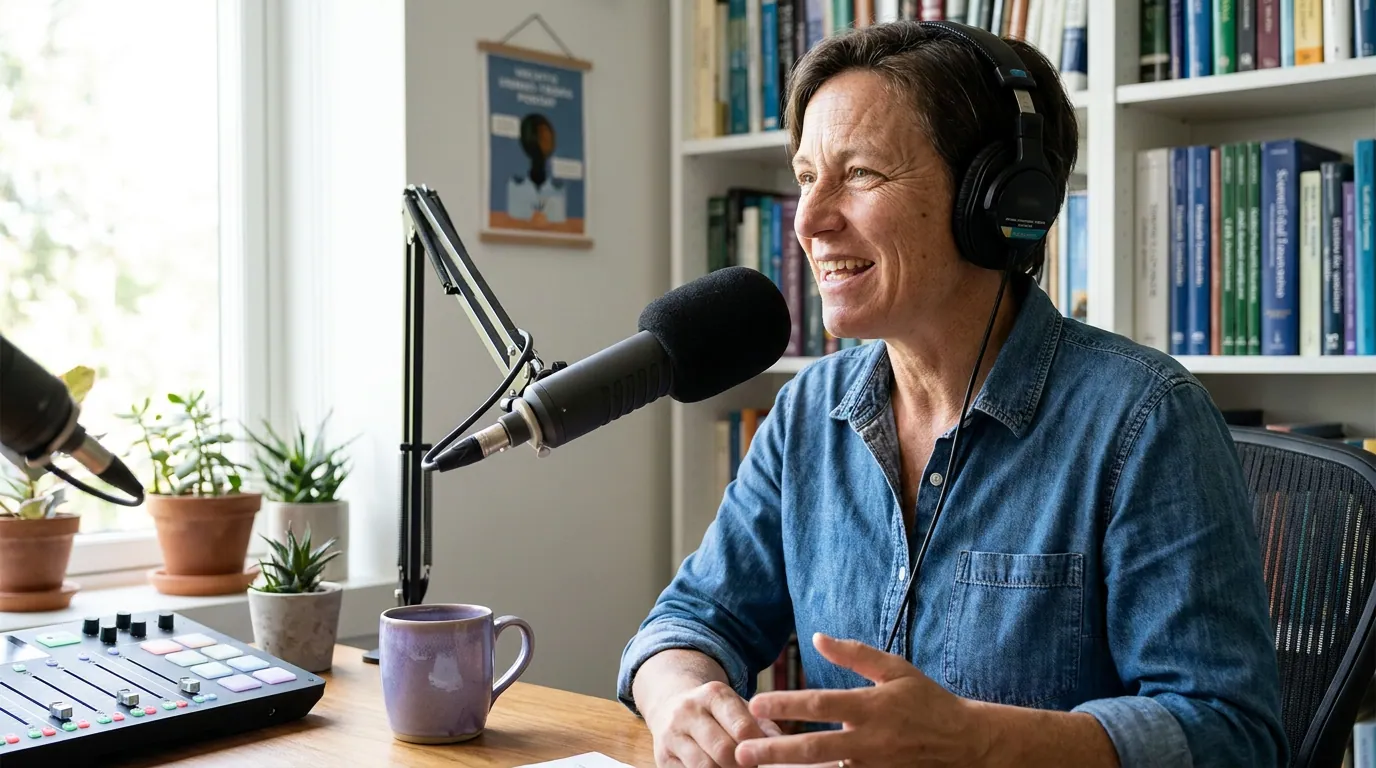
The analogy-building framework
An analogy is the most powerful tool in science communication and the easiest to get wrong, because a sloppy analogy doesn't just confuse, it installs a false model the listener will reason from later. Build every analogy with four moves, in order, and it will simplify without lying.
Here is the framework on a real concept. Take a vaccine. Anchor: "Think of it like a wanted poster handed to your immune system." Map: "The poster is the antigen; the immune cells are the police memorizing the face." Name the limit: "But unlike a poster, your body keeps memory cells alive for years, and a real pathogen can change its face, that's why some vaccines need boosters." Check: if a listener reasons from this, do they conclude that vaccines train recognition and that variants and waning immunity are real? Yes. The analogy holds.
Now the same concept dumbed down: "A vaccine is basically a tiny dose of the disease that makes you immune forever." It's catchy and it's wrong, many vaccines contain no live pathogen, and almost none confer permanent immunity. A listener reasoning from that analogy reaches a false conclusion, which is the exact failure step four catches. The fix costs you one sentence, not your whole bit.
How to read and represent a study correctly on air
Before you describe a study to listeners, answer five questions out loud in your own notes. This is where science podcasts earn or lose trust, because the gap between what a study found and what the headline says is usually enormous, and the host is the only person standing in that gap.
Walk the five in order, and say the answers on air in plain language:
- Peer-reviewed or preprint? A preprint hasn't been checked by other scientists yet. You can cover it, preprints are real news, but say so: "this is a preprint, so it's a first draft that hasn't been reviewed yet." Never present a preprint with the certainty of settled science.
- What's the sample, and who's in it? "Forty people" and "40,000 people" are different worlds, and "in mice" is a different world from "in humans." State it plainly: a finding in 12 mice is a hint worth one careful sentence, not a headline. Audiences forgive small studies; they don't forgive you hiding that they were small.
- Effect size, not just statistical significance. "Significant" means "probably not random," not "big." A statistically significant result can be tiny, a drug that lowers risk from 2.0% to 1.9% is real and almost useless. Always answer "how much," not just "yes or no." This single habit will put your show ahead of most science news coverage.
- Correlation or causation? Observational studies find that things happen together; they rarely prove one caused the other. If the study didn't randomize, say "this found a link, not a cause", and resist the verb "causes" unless the design earns it.
- Who funded it, and has it replicated? Funding doesn't automatically taint a result, but it's context the listener deserves. And a single unreplicated study is the beginning of a question, not the end of one. "One study found X; it hasn't been replicated yet" is a more honest, and more interesting, sentence than "science says X."
The pattern that holds all five together: describe the finding, then immediately give its size and its limits in the same breath. "A small, 40-person trial found a modest improvement, promising, but early." That sentence is accurate, plain, and listenable. It is the whole method in one line.

The researcher-interview prep checklist that earns scientist guests
Working scientists are cautious about podcasts, and for good reason, many shows misquote them, edit out the caveats, and turn careful findings into clickbait. The way you earn a yes, and a second yes, is by showing them you won't do that. The prep is the pitch.
- Read the actual paper, not the abstract. Reference a specific figure or limitation in your outreach. "I read your 2025 paper and I'm curious about the wide confidence interval in Figure 3" earns more yeses than any flattery, because it signals you'll represent the work correctly.
- Send your angle and your scope, not a question list to memorize. Tell them what the episode is about and what you'll not claim, "I won't overstate this as a cure; I want to explain the mechanism clearly." Scientists relax when they know you won't put words in their mouth.
- Pre-agree on the caveats. Ask, before recording, "what's the one thing people always get wrong about this work?" Then make sure that caveat survives into the final cut. This is the single biggest trust-builder with academic guests.
- Offer a fact-check pass on claims, not on opinions. You don't owe a guest editorial control, but offering to confirm any specific numbers or claims you'll state in narration is reasonable and reassuring. It's a journalism norm, not a weakness.
- Respect their time and their hedging. Researchers hedge because reality is uncertain, not because they're being evasive. Don't push a scientist to give a cleaner soundbite than the evidence supports, the hedge is the accurate answer, and a good host makes the hedge sound compelling instead of cutting it.
- Make the audio easy on their end. Send a one-line setup tip (earbuds with a mic beat laptop speakers; quiet room; record on a remote tool that captures local audio) so the conversation sounds good without asking them to buy gear.
Do these six and word spreads in research circles that you're a host who gets it right. That reputation is how a science show books guests its download numbers don't yet deserve.
Science podcast ideas that aren't already saturated
The crowded lane is "two hosts react to science news." The open lanes are narrower and stickier:
- One field, gone deep. Not "science," but "marine biology" or "the history of one disease." A defined scope is easier to make accurate and easier for the right listener to find.
- The method, not just the result. A show about how we know things, study design, replication, what makes evidence strong, has almost no competition and real educational value.
- Scientist-to-public translation. Interview one researcher per episode and spend it turning their work into plain English, live, using the analogy framework. The guest does the rigor; you do the translation.
- Local or applied science. The science of your city's water supply, your region's wildlife, the tech in everyday objects. Specific beats general for both accuracy and discovery.
A show called "everything science" will be shallow by necessity; a show about one corner of it can be deep and correct. The same discipline that powers a research-led true crime podcast built on documents applies here, the niche that sounds smaller usually survives, because the strongest sorting line between active and dead shows is episode count, with publishing cadence following close behind, and a tight scope is far easier to keep publishing week after week.
On gear, a science show needs no special rig, a clear, quiet voice does more for comprehension than any effect. A single budget mic from our by-tier guide or a solid pick under $100 is plenty to start; put your effort into the reading and the explaining. If you're still choosing a niche, our guides to starting a business podcast that wins clients and a comedy podcast with friends lay out the very different research and tone each one asks of you.
Common mistakes that quietly wreck a science show
- Trusting the press release. University and journal PR routinely overstates findings. Read the paper, or at minimum the abstract and methods, before you describe the result. The headline is marketing; the paper is the science.
- Saying "studies show" with no study. It's the laziest phrase in science media and it trains listeners to distrust you the moment one claim turns out wrong. Name the study, the year, and the sample, or don't make the claim.
- Deleting the uncertainty to sound confident. "Scientists have proven" is almost always wrong, science rarely proves, it accumulates evidence. "The current best evidence suggests" is more accurate and, with the right delivery, more compelling.
- Letting a guest overclaim unchallenged. Even experts overstate their own field sometimes. A gentle "how confident are we in that, and what would change your mind?" keeps the episode honest and makes for a better moment than nodding along.
- Treating correlation as causation. The most common science-media error there is. If the study didn't randomize, don't use "causes." Say "linked to," and explain the difference once, your audience will thank you.
The same rigor that keeps your science correct is what makes the show worth following. Careful, clear science shows are the ones listeners trust, share, and recommend to the friend who "wants to understand this but hates being talked down to." That person is your audience. Build for them.
Frequently asked questions
How do you explain complex science without dumbing it down?
Keep the concept simple and the claim precise. Use a plain-language analogy to explain how something works, then state the finding with its real numbers and limits: sample size, effect size, and whether it's peer-reviewed. Simplifying means finding a true, plain way to say a hard thing; dumbing down means deleting the caveats that make it true. Do the first.
Do you need a science degree to start a science podcast?
No. Many strong science shows are hosted by skilled translators who interview the experts rather than being the expert. What you do need is the discipline to read the actual study, represent it accurately (sample, effect size, peer-review status), and say the uncertainty out loud. Curiosity plus rigor beats credentials plus carelessness.
How do you get scientists to come on your podcast?
Show them you'll represent their work correctly. Read the actual paper and reference a specific figure in your outreach, send your angle and what you won't overclaim, pre-agree on the key caveats, and offer to fact-check the numbers you'll state. Scientists say yes to hosts who won't turn careful findings into clickbait, the prep is the pitch.
How do you talk about a study on a podcast accurately?
Describe the finding, then give its size and limits in the same breath: "A small, 40-person trial found a modest improvement, promising, but early." Always answer "how big is the effect," not just "is it significant," flag preprints as unreviewed, and say "linked to" rather than "causes" unless the study randomized. Name the study, year, and sample every time.
What's a good science podcast idea that isn't oversaturated?
Go narrow. One field gone deep (marine biology, materials science, the history of one disease) beats a general "science news" show on both accuracy and discoverability. A show about how we know things, study design and evidence quality, has almost no competition. So does local or applied science. A defined scope is easier to keep correct and easier for the right listener to find.
Read the paper, build analogies that survive the check step, and say the uncertainty out loud. A science podcast that is rigorous about findings and clear about concepts is both the one you can defend in the comments and the one listeners actually learn from, and in a top-tier genre (Statista), that combination is exactly how you stand out from the shows that pick one and drop the other.