
How to Start a Real Estate Podcast for Your Market


To start a real estate podcast that actually generates business, build it around your market, not around generic advice: record short, dated, hyper-local episodes ("What's happening in [neighborhood] this month") that rank when someone searches your city, and book the lenders, inspectors, and contractors you already work with as guests so the show becomes a referral engine. The format is simple. The leverage is local.
A national show about "buying your first home" competes with a million pieces of content and converts almost no one in your zip code. A show about your market, the school-district premiums, the inventory shifts, the one street where prices moved, is something no big-budget competitor can make, and it reaches exactly the people who might list with you. That is the whole strategy: a local-lead-engine, not an audience-size contest.
Below is the model: how to design market-update episodes that rank locally, a guest ladder that turns interviews into referral relationships, the gear you actually need, and the license and advertising-disclosure rules an agent has to follow before publishing a word.
What kind of real estate podcast actually gets you clients?
A hyper-local one. The version that generates business is a short, recurring market update for a single metro or set of neighborhoods, hosted by the agent or investor who works there, supported by guests from the local transaction chain. It out-converts a polished national show because it reaches the few hundred people in your area who are actually about to move, not a national audience that will never call you.
There are three real estate formats, and they are not equal for lead generation:
- The local market show, "[City] Real Estate Monthly." Dated updates on inventory, prices, new listings, and neighborhood-level shifts. This is the lead engine, because it ranks for local searches and signals expertise to the exact people deciding whether to list.
- The education show, "Buying your first home," "How to stage a house." Useful, but it competes nationally with enormous content libraries and rarely converts a listener into a client in your market.
- The investor show, deals, cap rates, financing, market analysis. Great for building authority with investors and partners; narrower audience, higher deal value per listener.
You can blend them, but pick a lead format and make the others occasional. The local market show is the one that turns a podcast into a pipeline, so the rest of this guide builds around it.
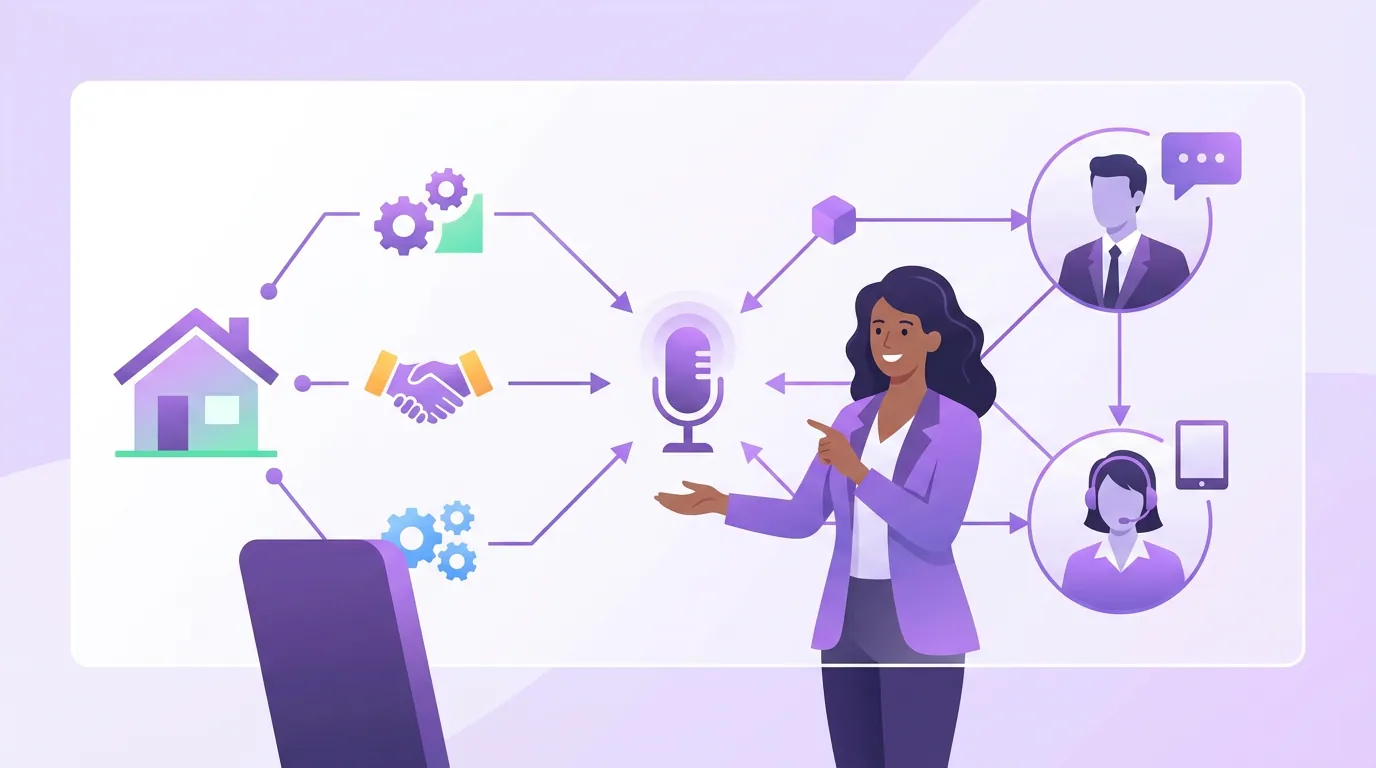
The local-lead-engine model
Here is the loop the whole show runs on. A market-update episode produces three assets at once: a ranking page for local search, a stack of social clips that drive discovery, and a reason to call a local professional who then refers you back. Each turn of the loop widens your reach and your referral network. Most agents record an episode and stop at "I published it", the leverage is in working the full loop every time.
How to record a market-update episode that ranks in your city
Make it dated, specific, and named after the place. Search engines and the local people who use them both reward an episode titled "Austin Housing Market, June 2026: Inventory, Prices, and the East Side Shift" over a vague "Real Estate Update." The title carries the city and the month, the show notes carry the numbers, and the spoken episode carries the analysis only a local can give.
Work this structure every month:
- Title with the place and the date. "[Neighborhood or metro] Real Estate, [Month Year]." This is your local-search hook, it matches how people actually search ("Tampa housing market July") and gives each episode a unique, rankable page.
- Open with the one number that moved. Median price, days on market, active inventory, or new listings versus last month. Pull it from your MLS or a public source like a local board report, and say where it came from. One concrete, sourced number in the first 30 seconds is what separates a market show from an opinion show.
- Go to the street level. This is where you win. "Inventory is up citywide, but in [school district] anything under $500K still goes in a weekend." National shows physically cannot say this. Your local knowledge is the moat.
- Add a buyer or seller takeaway. End each segment with what it means for someone in that situation right now. This is the bridge from "interesting" to "I should call this agent."
- Write show notes with the data and a transcript. Put the numbers, the neighborhoods, and a full transcript in the notes. A transcript gives search engines text to index for every local term you mentioned, which is most of how a local episode gets found.
- Clip the three sharpest moments. The single most surprising stat, the strongest neighborhood call, and the clearest buyer/seller takeaway. Captioned vertical clips are how a local show reaches people who would never browse a podcast app, and social is now where discovery happens.
Clips matter more than most agents realize. Fifty-seven percent of listeners now rely on social media for podcast recommendations, the first time it passed friends and family (InsideRadio). For a local agent, a clip that surfaces in your city's feed reaches a warmer prospect than almost any other channel you have.
The referral-network guest strategy
Your guests are not just content, they are nodes in a referral network. Every professional in the local transaction chain who comes on your show now has a reason to send business your way, because you gave them visibility first. This is the difference between a real estate podcast that builds an audience and one that builds a pipeline.
Rank potential guests by how often their clients overlap with yours and how high the deal value runs. Lenders and inspectors touch nearly every transaction, so they sit at the top; a satisfied buyer or seller is lower-frequency but high-trust as a testimonial.
Two working rules make this pay off:
- Send every guest their clips. When a lender or inspector comes on, hand them three captioned clips of their best moments to post to their own audience. They look good, they reach their network, and they remember who made that happen. This single habit turns a one-off interview into an ongoing relationship.
- Be specific about reciprocity, and stay compliant. A referral relationship is legitimate; a paid referral is not. Under the federal Real Estate Settlement Procedures Act (RESPA), agents cannot pay or receive a fee or kickback for referring settlement-service business such as a mortgage. Co-marketing on a podcast is fine when each party pays its fair share of actual costs and nothing is exchanged for the referral itself. Keep it to visibility and goodwill, not payments. (RESPA, 12 U.S.C. § 2607, confirm specifics with your broker's compliance counsel.)
The same network logic is why a business podcast that wins clients and a fitness podcast hosted by a coach work, the show is a relationship-builder first and a media product second. A real estate show just has an unusually clear, transaction-tied network to build.
The license and advertising-disclosure rules agents must follow
A podcast is advertising, and real estate advertising is regulated. The moment you mention your services, a listing, or your name and brokerage, several rules apply, and getting them wrong risks your license, not just an awkward correction. None of this is hard; it just has to be deliberate.
The non-negotiables, plainly:
- Identify your brokerage. Most state real estate commissions require that any advertising, and a podcast where you solicit business is advertising, identify the brokerage you work under, not just your personal name. Some states require your license number. Check your state commission's advertising rules and run your standard disclosure past your broker.
- Don't promise returns. If you talk numbers, appreciation, rental yield, "this neighborhood is up 12%", present them as past, sourced data, not a forecast, and say plainly that past performance is not a guarantee. Promising investment outcomes is where agents drift into securities and consumer-protection trouble.
- Stay in your lane on legal and tax. You can explain how a process generally works; you cannot give legal or tax advice unless you hold that license. When a question goes there, say "talk to a real estate attorney or a CPA", on the record, in the episode.
- Use "Realtor®" correctly. The term is a trademark of the National Association of Realtors and only applies to members. If you are not a member, you are a real estate agent or broker, not a Realtor.
- Disclose material relationships. If a guest or sponsor pays you, or you have a financial relationship with a lender you co-market with, disclose it, both for RESPA and for the FTC's endorsement rules, which require clear disclosure of paid or material connections.
This is not legal advice, and rules differ by state. Treat the map above as a starting checklist and get your broker's compliance sign-off on a standard disclosure you read in every episode. The good news: a clear, honest disclosure actually builds trust with the local audience you are trying to convert.
Gear: what a real estate show actually needs
Very little. Your competitive edge is local data and relationships, not audio engineering. A single clear, quiet voice recording does more for retention than any plugin. By one cost breakdown, equipment runs roughly $100–350 for a starter setup and $1,500–5,000 for a pro studio (Ausha); a local market show belongs at the bottom of that range until it is producing leads.
Start with one good dynamic mic, headphones, and a quiet room. Our budget mic guide by tier and a solid pick under $100 cover everything a one-host market show needs. If you bring guests on video, add a simple webcam later, but record audio cleanly first. Spend your money on a good microphone and your time on the MLS data; that ratio is the whole game.
One reality check before you launch: consistency, not gear, is what keeps a show alive. Nearly half of all podcasts never make it past their first three episodes Amplifi Media, and a monthly market update is sustainable precisely because the data refreshes itself, there is always a new number to report. Pick a cadence you can hold through a slow listing season, not one that feels impressive in month one.
Common mistakes that sink a real estate podcast
- Going national instead of local. Generic home-buying advice competes with everyone and converts no one in your zip code. The local-market angle is the entire reason a small show beats a big one here. Name the neighborhood.
- Treating it as a brochure. An episode that is one long ad for your listings gets skipped. Lead with genuinely useful market data; the conversion comes from being the obvious local expert, not from a hard sell.
- Skipping the clips. Recording an episode and never cutting clips wastes the discovery channel that now drives the majority of podcast recommendations (InsideRadio). Three clips per episode is the floor.
- Ignoring disclosure rules until something goes wrong. A missing brokerage identification or a promised return can cost you your license. Build the disclosure into your episode template from episode one.
- Quitting before the loop turns. Local SEO and a referral network compound slowly. Many agents quit in the danger zone before either pays off; the monthly cadence exists to carry you through it.
A real estate show is closer in discipline to a client-winning business podcast than to a comedy show recorded with friends, the format is conversational, but the sourcing and compliance bar is professional. And like a true crime show that lives or dies on documents, your credibility rests on getting the numbers right and saying where they came from.
Frequently asked questions
Can a real estate agent have a podcast?
Yes, and it is one of the better marketing channels for an agent because it builds local authority and a referral network at once. The main constraints are advertising and disclosure rules: identify your brokerage as your state requires, don't promise investment returns, stay out of legal and tax advice, and disclose any paid or material relationships. Confirm your standard disclosure with your broker before publishing.
What should a real estate podcast be about?
Your local market. The format that generates clients is a recurring, dated market update for a specific metro or set of neighborhoods, inventory, prices, days on market, and street-level analysis only a local can give. Blend in guests from your transaction chain (lenders, inspectors, contractors) and occasional education or investor episodes, but make the local market show your core.
How do real estate podcasts get clients?
Through a loop: hyper-local episodes rank for local searches and signal expertise, social clips reach prospects where discovery now happens, and guests from your transaction chain become referral sources. Fifty-seven percent of listeners rely on social media for podcast recommendations (InsideRadio), so clipping each episode is what connects the show to actual leads.
What disclosures does a real estate agent need on a podcast?
At minimum: identify your brokerage (and license number where your state requires it) when you solicit business, state who you represent when discussing a specific listing, frame any prices or returns as past data rather than guarantees, refer legal and tax questions to licensed professionals, and disclose paid or material relationships per RESPA and the FTC. Rules vary by state, get your broker's sign-off.
How much does it cost to start a real estate podcast?
You can start at the budget tier of roughly $100–350 for a mic, headphones, and recording software (Ausha). A local market show needs nothing fancier to begin. Spend on a single good dynamic microphone and a quiet room, and put your real investment into the MLS data and guest relationships that make the show convert.
Build the show around your market, work the lead loop every episode, and put the disclosures in your template from day one. A monthly local update is sustainable, it ranks where your clients search, and it turns every lender and inspector you interview into a referral relationship, which is how a small, specific show out-earns a polished national one.