
How to Start a Music Podcast Without Licensing Fines


To start a music podcast without licensing fines, build the show around audio you actually have the rights to play, not chart songs you bought. Buying a track lets you listen to it; it does not let you broadcast it (RSS.com). Use licensed libraries, public-domain audio, or formats built on talk and short fair-use snippets, and clear two separate copyrights before any full song goes in an episode.
This guide is not legal advice, if you plan to feature copyrighted songs in full, talk to a music attorney first. But most music-podcast legal trouble comes from one wrong assumption ("I can play any song I own"), and you can design that risk out before you record. Below is the clearance map: the two copyrights you have to think about, why the licenses you probably already pay for don't cover a podcast, the audio-versus-video gap that catches video shows, and the formats that let you make a great music show without clearing a single full track.
Music shows live next door to podcasting's biggest categories, Comedy, News, and Society & Culture top US genres by listening time, and music-and-arts shows draw from the same culture-hungry audience (Statista). The appetite is there. The shows that survive are the ones that figured out the rights before episode one, not after a takedown notice.
Can you legally play songs on a podcast?
Not without permission. Playing a copyrighted song on a podcast, even a few seconds, even in the background, generally requires clearing rights directly from the people who own it (Art and Media Law). Buying the MP3, owning the vinyl, or paying for Spotify gives you the right to listen, not to republish the recording inside your own show to an audience.
The reason this surprises people is that listening and publishing feel the same, it's the same song coming out of the same speakers. Legally they are different acts. When you stream a song privately, the platform has already paid the rights holders for that play. When you embed that song in an episode and distribute it, you become the publisher, and the publisher needs a license (RSS.com). There is no "I paid for it once" exemption, and there is no special carve-out for educational or commentary shows just because they teach about the music (Art and Media Law).
The two-copyright map (the thing nobody explains)
Here is the part that trips up every beginner: one song is not one copyright. It is two, and they are usually owned by different people. The composition is the written work, the melody, chords, and lyrics, typically owned by the songwriter and their publisher. The master is the specific recording of that composition, typically owned by the record label or the artist who paid for the session (Art and Media Law). To use a recording in your podcast, you generally need permission from both.
This split is why "I'll just ask the artist" often isn't enough. An independent artist might own their master but have signed the composition to a publisher, or vice versa. Get a yes from one and you still don't have clearance. The practical takeaway: assume two permissions, in writing, before a full copyrighted track touches your timeline.
What each license actually covers
There are four license types that come up in music podcasting, and they do different jobs. The mistake is assuming the one you already have covers everything, it almost never does.
Two of these deserve a flag. First, the performance license from a PRO like ASCAP or BMI is the one many creators assume is the magic key, it isn't. PROs license public performance (radio play, a venue, a stream), not the right to reproduce a recording inside an audio-visual work; those are mechanical and sync rights, which the writers or publishers license separately (ASCAP). Second, there is no compulsory license for dropping an existing recording into a podcast. Covering a song you re-perform has a statutory mechanical path; using someone else's recording does not, that requires direct negotiation with the label and publisher (Art and Media Law).
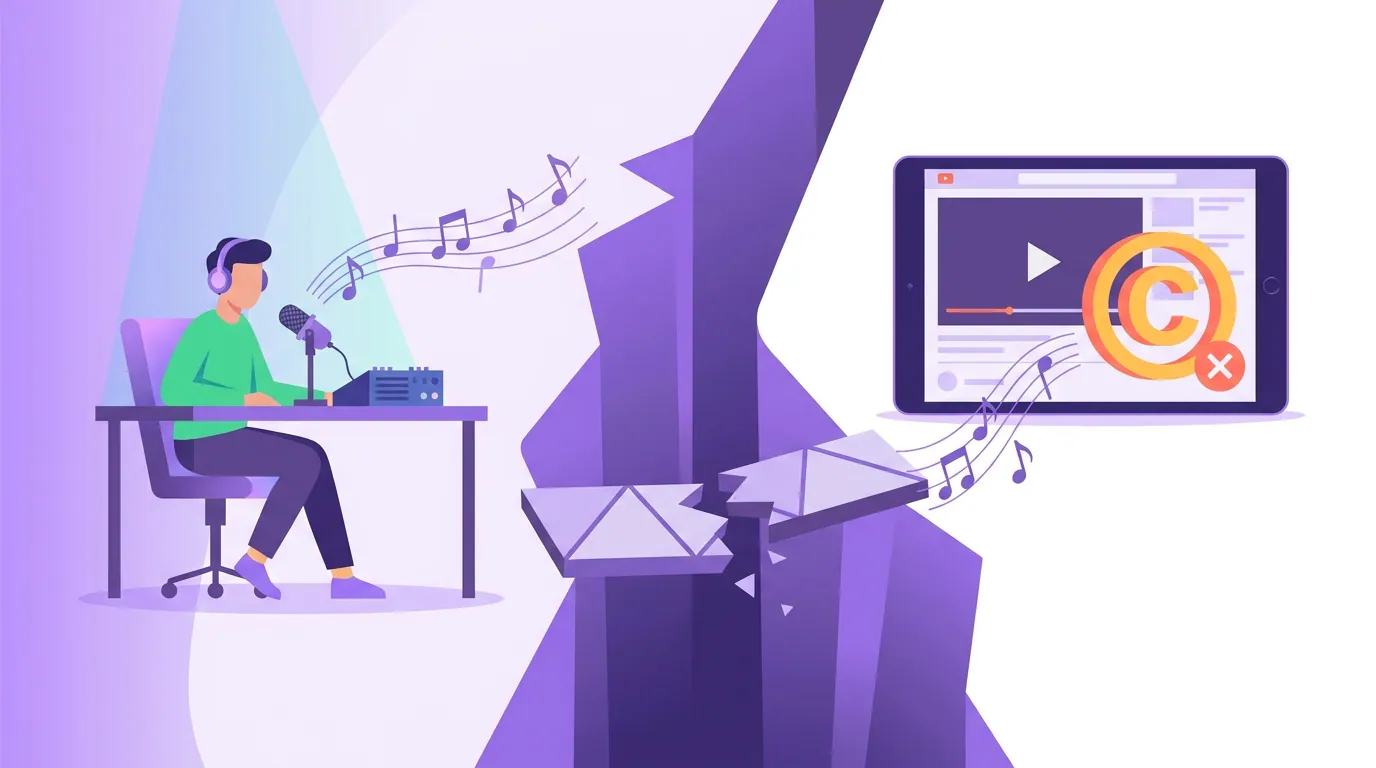
The audio-vs-video gap that catches video shows
This is the 2026-specific trap. A music podcast rarely lives in one place anymore, it's an RSS audio feed, a YouTube video, a Spotify Video version, and a pile of social clips. Each of those has different rules, and a license that covers the first does not automatically cover the rest.
Audio-only episodes distributed by RSS need mechanical reproduction rights; most "royalty-free" subscription licenses cover that use. But the moment your podcast becomes video, on YouTube, Spotify Video, or a vertical clip on TikTok, it is legally an audiovisual work, and audiovisual works need a sync license that audio-only clearances do not include (Art and Media Law). The structural problem: one episode can need mechanical rights for the feed, sync rights for the video version, and separate sync clearance for the clips, and most podcasters operate under a single license that only covers the first. On video platforms, automated systems make this concrete fast. YouTube's Content ID and the audio-fingerprinting systems on Spotify and Apple can flag unlicensed music, triggering muted sections, demonetization, takedowns, or DMCA notices to your host (RSS.com).
If you go video, and most growing shows should, confirm your music source clears sync, not just audio. The good news is that the major creator-music libraries do. A single Epidemic Sound subscription, for example, covers use across YouTube, Reels, TikTok, Facebook, and podcast platforms under one license (Epidemic Sound). That breadth is exactly what saves a multi-platform music show.
Music podcast formats that work without full tracks
You do not need to play whole songs to make a great music show. Most of the best ones barely do. Pick a format that matches the rights you can realistically get, and the licensing problem mostly disappears.
In practice, four lanes carry almost every music podcast that never sends a licensing budget into orbit:
- Interview and review shows. Talk about artists, albums, and scenes, host musicians, break down songwriting, review releases. Discussing music is not reproducing a recording, so the clearance problem largely vanishes. This is the format most music-podcast ideas should start in.
- Short snippets with commentary. Brief, transformative excerpts under genuine criticism or analysis may qualify as fair use. Treat this as a legal defense, not a license, it is fact-specific, there is no safe "X seconds" rule, and a court decides it after the fact (Art and Media Law). Keep clips short, always add real commentary, and never use a snippet as decoration.
- Royalty-free / library music. Subscriptions like Epidemic Sound and Artlist pre-clear intros, beds, and stingers, Epidemic Sound's Creator plan starts around $9.99/month billed annually and covers podcast and social use (Epidemic Sound). Smaller catalogs than the charts, but zero clearance headaches.
- Public-domain audio. Free to use, with one sharp caveat below.
The public-domain timing trap (a 2026 example)
Public domain is real and powerful, but the trap is the two-copyright split again. A composition and its recording enter the public domain on different clocks, so a song can be free while the famous recording of it is still locked up. The crisp 2026 example: on January 1, 2026, the composition of "Georgia on My Mind" (published 1930) entered the US public domain, but the 1930 sound recording gets an extra five years and won't be free until January 1, 2031 (Duke University Center for the Study of the Public Domain).
So if you want public-domain music, verify both layers. A safe path is a sound recording from 1925 or earlier (those entered the US public domain on January 1, 2026) paired with a composition old enough to be clear (Duke CSPD), or, simpler, perform your own version of a public-domain composition, which gives you a master you own outright. "Old song" is not the same as "free recording," and that distinction is exactly where confident beginners get burned.
Common mistakes that get music podcasts fined
- Assuming "I bought it" is a license. The single most common error. Owning a copy lets you listen; it never grants the mechanical, master, or sync rights a podcast needs (RSS.com). Treat every full track as something you must clear or replace.
- Relying on a PRO license to cover the podcast. ASCAP/BMI performance licenses don't grant the right to reproduce a recording in your show (ASCAP). If a tactic depends only on a performance license, it doesn't clear your episode.
- Forgetting sync when you go video. Your royalty-free audio license may not cover the YouTube or Spotify Video version, and the fingerprinting systems will notice (Art and Media Law). Confirm sync coverage before you publish video or clips.
- Treating "fair use" as a green light. Fair use is a defense argued after a claim, not permission you grant yourself. Short, transformative, commentary-driven use is defensible; a song played as background is not (Art and Media Law).
- Clearing one copyright, not both. A yes from the artist on the master doesn't cover the publisher's composition. Get both, in writing, or the clearance is incomplete.
The discipline here is the same one that protects a document-led true crime podcast: build on assets you can defend in writing, and the format takes care of itself. A music show is closer in research load to that than to a comedy podcast recorded with friends, where the rights surface is mostly your own jokes. If you're weighing niches, our guides to starting a business podcast that wins clients and a fitness podcast as a coach lay out the very different legal and research loads each one carries.
On gear, a music podcast needs no exotic rig, a clean, quiet voice does more for retention than any plugin. A solid pick from our mics-by-budget-tier guide, or a reliable option under $100, is enough to start; spend your real effort on clearing the audio, not on hardware.
Frequently asked questions
Can I play any song on my podcast if I bought it?
No. Buying a song, physically or digitally, gives you the right to listen, not to broadcast it inside your own show (RSS.com). Republishing a recording to an audience is a separate act that needs its own clearance: typically a mechanical license for the composition and a master license for the recording, both from the rights holders.
Does an ASCAP or BMI license let me use songs in a podcast?
Not by itself. ASCAP and BMI license public performance rights, not the reproduction rights a podcast needs. Recording a song into an audio or audio-visual work requires mechanical and synchronization rights, which the writers and publishers license separately (ASCAP). A PRO license is one piece, never the whole clearance.
Do I need a sync license for a music podcast?
If your show is audio-only on an RSS feed, you generally need mechanical rights, not sync. The moment it becomes video, YouTube, Spotify Video, or social clips, it's an audiovisual work and needs a sync license too (Art and Media Law). Many creator-music subscriptions cover both audio and video use under one license.
Is royalty-free music safe for a music podcast?
Yes, that's what it's built for. Libraries like Epidemic Sound and Artlist pre-clear their catalogs for podcast and social use, with plans starting around $9.99/month billed annually (Epidemic Sound). The trade-off is a smaller catalog than the charts, and some free tracks still require crediting the artist in your show notes (RSS.com).
Can I use old or public-domain songs for free?
Sometimes, but check both copyrights. A composition and its recording enter the public domain on different clocks, so a 1930 song's composition can be free in 2026 while the original 1930 recording stays protected until 2031 (Duke CSPD). The safe move is to verify both layers, use a recording from 1925 or earlier, or record your own version of a public-domain composition.
Pick a format that matches the rights you can get, clear both copyrights before any full track goes in, and confirm sync coverage the day you add video. A music podcast built on cleared audio is the one that's still publishing a year in, while the "I bought it, so I can play it" shows are answering DMCA notices (RSS.com).